Public relations and journalism have had a difficult relationship for over a century, characterised by mutual dependence and - often - mutual distrust. The two professions have vied with each other for primacy: journalists could open or close the gates, but PR had the stories, the contacts and often the budgets for extravagant campaigns. The arrival of the internet, and especially of social media, has changed much of that. These new technologies have turned the audience into players - who play an important part in making the reputation, and the brand, of everyone from heads of state to new car models vulnerable to viral tweets and social media attacks. Companies, parties and governments are seeking more protection - especially since individuals within these organisations can themselves damage, even destroy, their brand or reputation with an ill-chosen remark or an appearance of arrogance. The pressures, and the possibilities, of the digital age have given public figures and institutions both a necessity to protect themselves, and channels to promote themselves free of news media gatekeepers.
Political and corporate communications professionals have become more essential, and more influential within the top echelons of business, politics and other institutions. Companies and governments can now - must now - become media themselves, putting out a message 24/7, establishing channels of their own, creating content to attract audiences and reaching out to their networks to involve them in their strategies Journalism is being brought into these new, more influential and fast growing communications strategies. And, as newspapers struggle to stay alive, journalists must adapt to a world where old barriers are being smashed and new relationships built - this time with public relations in the driving seat. The world being created is at once more protected and more transparent; the communicators are at once more influential and more fragile. This unique study illuminates a new media age.
eBook - ePub
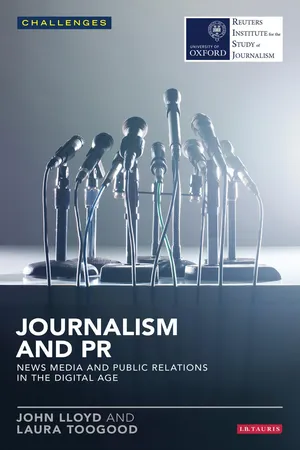
Journalism and PR
News Media and Public Relations in the Digital Age
- 160 pages
- English
- ePUB (mobile friendly)
- Available on iOS & Android
eBook - ePub
About this book
Information
Table of contents
- RISJ Challenges
- Title Page
- Copyright Page
- Contents
- Executive Summary
- Acknowledgements
- Notes on the Text
- Introduction
- 1. Public Relations: A Brief Selective History
- 2. Corporate PR
- 3. Political Communications
- 4. How it’s Done: the Internet as a Mechanism for a Changed Relationship between PR and Journalism
- 5. PR Elsewhere
- 6. Conclusions and Recommendations
- Appendix: List of Interviewees (Who Agreed to be Named)
- Notes
- References
- Series Page
Trusted by 375,005 students
Access to over 1.5 million titles for a fair monthly price.
Study more efficiently using our study tools.
Frequently asked questions
Yes, you can cancel anytime from the Subscription tab in your account settings on the Perlego website. Your subscription will stay active until the end of your current billing period. Learn how to cancel your subscription
No, books cannot be downloaded as external files, such as PDFs, for use outside of Perlego. However, you can download books within the Perlego app for offline reading on mobile or tablet. Learn how to download books offline
Perlego offers two plans: Essential and Complete
- Essential is ideal for learners and professionals who enjoy exploring a wide range of subjects. Access the Essential Library with 800,000+ trusted titles and best-sellers across business, personal growth, and the humanities. Includes unlimited reading time and Standard Read Aloud voice.
- Complete: Perfect for advanced learners and researchers needing full, unrestricted access. Unlock 1.5M+ books across hundreds of subjects, including academic and specialized titles. The Complete Plan also includes advanced features like Premium Read Aloud and Research Assistant.
We are an online textbook subscription service, where you can get access to an entire online library for less than the price of a single book per month. With over 1.5 million books across 990+ topics, we’ve got you covered! Learn about our mission
Look out for the read-aloud symbol on your next book to see if you can listen to it. The read-aloud tool reads text aloud for you, highlighting the text as it is being read. You can pause it, speed it up and slow it down. Learn more about Read Aloud
Yes! You can use the Perlego app on both iOS and Android devices to read anytime, anywhere — even offline. Perfect for commutes or when you’re on the go.
Please note we cannot support devices running on iOS 13 and Android 7 or earlier. Learn more about using the app
Please note we cannot support devices running on iOS 13 and Android 7 or earlier. Learn more about using the app
Yes, you can access Journalism and PR by John Lloyd,Laura Toogood in PDF and/or ePUB format, as well as other popular books in Law & Journalism. We have over 1.5 million books available in our catalogue for you to explore.