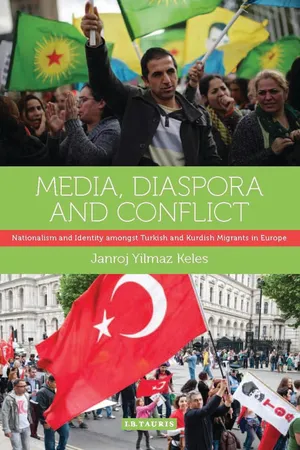
For migrant communities residing outside of their home countries, various transnational media have played a key role in maintaining, reviving and transforming ethnic and religious identities. A vital element is how media outlets report and represent ethno-national conflict in the home country. Janroj Yilmaz Keles here examines how this plays out among Kurdish and Turkish communities in Europe. He offers an analysis of how Turkish and Kurdish migrants in Europe react to the myriad mediated narratives. A vital element is how media outlets report and represent the ethno-national conflict between the Turkish state and the Kurdish PKK.Janroj Yilmaz Keles here offers an examination of how Turkish and Kurdish migrants in Europe react to the myriad narratives that arise. Taking as his starting point an analysis of the nature of nationalisms in the modern age, Keles shows how language is often a central element in the struggle for hegemony within a state. The media has become a site for the clash of representations in both Turkish and Kurdish languages, especially for those based in the diaspora in Europe.
These 'virtual communities', connected by television and the internet, in turn influence and are influenced by the way the conflict between the Turkish state and subaltern Kurds is played out, both in the media and on the ground.By looking at first, second and third generations of Turkish and Kurdish populations in Europe, Keles highlights the dynamics of migration, settlement and integration that often depend on the policies of each settlement country. Since these settlement states often see the proliferation of such media as an impediment to integration, Media, Diaspora and Conflict offers timely analysis concerning the nature of diasporas and the construction of identity.
eBook - ePub
Media, Diaspora and Conflict
Nationalism and Identity amongst Turkish and Kurdish Migrants in Europe
- 280 pages
- English
- ePUB (mobile friendly)
- Available on iOS & Android
eBook - ePub
Media, Diaspora and Conflict
Nationalism and Identity amongst Turkish and Kurdish Migrants in Europe
About this book
Information
CHAPTER 1
“NATIONALISM HAS GONE MOBILE”
Theoretical framework
Introduction
How can we make sense of the mobilisation of Turkish and Kurdish migrants around homeland politics? What is the role of Turkish and Kurdish media in politically, culturally and ethnically reconstructing the migrants’ identities in different nation states? I explore the politicisation, differentiation, deterritorialisation and ethnicisation of Turkish and Kurdish migrant identities in Europe in this book. I begin by discussing theories of nationalism, with particular reference to Benedict Anderson’s work on “imagined community” (1991) and Michael Billig’s work on “banal nationalism” (1995). Both theories are helpful as they focus on the role of media dissemination for constructing and maintaining nationalism. The primary focus of the book is on the way these two ideas both complement and counteract each other in the construction of Turkish and Kurdish migrants’ identities in Europe.
As has been demonstrated by several scholars (Karim 1998, Aksoy et al. 2000, Rigoni 2002, Georgiou 2005, Kosnick 2007) in the field of transnationalised media and migration, many nation states try to project imagined communities through print language as well as via satellite television. The aim of Turkish state broadcasting corporation TRT also makes clear that they intend to build a Turkish imagined community in different settlement countries (TRT 2006a) (see Chapter 3). Secondly, the media – including the digital media – play an important role in constructing transnational networks and communication amongst migrants. This cross-national media consumption is closely related to the complex multiple identities of migrants who are in the process of negotiating their sense of belonging, community and diasporic consciousness; these people use transnational media as cultural resources (Gillespie 2002). In particular diasporic identities “are constantly producing and reproducing themselves anew, through transformation and difference” (Hall 1990: 235). Transnational media contributes to the formation and experience of diasporic communities (Sreberny 2000) and connects them with multiple political and geographical places across national borders. A sense of displacement and narratives of return, sense of belonging and recalling memories are related mainly through transnational media. As such, transnational media also creates a strong loyalty to the homeland among diasporic communities. This is particularly visible in conflicted (diasporic) communities’ media practices.
One of the striking elements of transnational media products is their repeated deployment of national symbols and nationalist language, which can be usefully examined using Billig’s notion of “banal nationalism”. Through this media culture, migrants create their cultural and political attachments across national borders. The media play an important role in shaping migrants’ ways of thinking and cultural resources. The media deployment of banal nationalism also shapes their feelings of belonging to their “homeland”, in particular where they are politically, economically and culturally excluded by settlement countries.
The third section explains how I have drawn on insights from Gramsci about the nature of power and hegemony, and how this manifests itself through the media and in the relations between these communities. The fourth section discusses the relationship between nationalism and transnational communication, identities and politics. I argue that membership of an imagined community cannot be limited to a sovereign nation state territory. Instead I suggest that communication technologies help to disseminate print in national languages and symbols, contributing to a new form of deterritorialised nationalism in the age of globalisation. This is supported by Anderson’s (2005) recent acknowledgement that “Nationalism has gone mobile”.
Theoretical debates about nations and nationalism
The concepts of “nation” and “nationalism” have initiated a series of theoretical debates amongst scholars; these can be summarised in two distinct approaches to nationalism. The first approach is based on culture and tradition. Within this view, the nation is an inclusive, taken-for-granted and natural community as well as “something sacred, eternal, organic, carrying a deeper justification than the works of men” (Kohn 1951). This view of nationalism was conceptualised by German romantic writers such as Herder, Fichte, Schlegel and Schleiermacher and influenced most of the primordialists including key writers like Smith (2001) and Hutchinson (2006). The second approach to nationalism, which is used in this book, foregrounds the role of the bureaucracy, the intelligentsia and communication technology in constructing the political entity of a nation-state. This approach is a “by and large rational rather than emotional” approach to the nation (Horace 1978). The modernists consider the nation a political and ideological phenomenon, rather than a natural expression of human feelings of belonging (Gellner 1983, Anderson 1991, Billig 1995, Hobsbawm 1996, McCrone 1998). Rather than taking feelings of national identity or allegiance for granted, modernist approaches explore how these are produced. Modernist approaches show how particular actors, such as bureaucracies (Gellner 1983) or intellectuals (Hobsbawm 1992) made an effort to create a homogenised culture and anchor it in the idea of a shared national identity. Industrial society, enlightenment and rationalisation were important factors that contributed to the construction of the nation state. Within the modernist approach, Anderson’s and Billig’s, which emphasises the role of media in nationalism, is particularly useful for developing the arguments in this book.
Anderson’s framework of “imagined communities”
Many scholars in the field of transnationalised media and migration have highlighted the role of sending states in attempting to build imagined communities through print media and satellite television (Karim 1998, Aksoy et al. 2000, Rigoni 2002, Georgiou 2005, Kosnick 2007). Migrants’ media culture is an important aspect, contributing to the politicisation of their ethnic identities.
Anderson agrees with other modernist theorists like Gellner that nationalism is not a given but is socially constructed: “[N]ationalism is not the awakening of nations to self-consciousness: it invents nations where they do not exist but it does need some pre-existing differentiating marks to work on” (Gellner 1983: 169). However, he refines this argument, pointing out that this does not mean that the nation is a “fabrication”. Instead he suggests that nationalism is a way of “imagining” the nation: “In fact, all communities larger than primordial villages of face-to-face contact (and perhaps even these) are imagined” (Anderson 1991: 6). Anderson argues that the key invention that facilitated large groups of people to imagine themselves as a nation was the newspaper.
Anderson argues that print-capitalism spread literacy beyond the religious elites, in the languages spoken by the people, rather than in Latin. Anderson sees this as “revolutionary vernacularising” (Anderson 1991: 39) because print languages “created unified fields of exchanges and communication”, and “standardized national languages” above the spoken vernaculars.
As a result of linguistic standardisation, people “became capable of comprehending one another via print and paper” and “gradually … hundreds of thousands, millions …” started to imagine themselves as part of a community (Anderson 1991: 44). Secondly, print capitalism “gave a new fixity to language, which, in the long run, helped to build that image of antiquity so central to the subjective idea of the nation” (Anderson 1991: 44). Thirdly, “print-capitalism created languages of power of a kind different from older administrative vernaculars. Certain dialects [language] inevitably were ‘closer’ to each print language and dominated their final forms” (Anderson 1991: 44). Such dialects were “correspondingly elevated to a new politico-cultural eminence” (Anderson 1991: 45) and made language a tool to dominate and subsume the others that “were unsuccessful (or only relatively successful) in insisting on their own print-form” (Anderson 1991: 45). The nations that were successful in creating their own print languages actively discouraged the attempts of other nations to develop publications in their own languages (Anderson 1991: 45). In the meantime, other languages spoken in the territories claimed as belonging to the nation were targeted and banned from public use. This was intended to create unified fields of communication which were crucial to the imagining and establishing of nation states (Anderson 1991: 44). When discussing the later development of radio and television, he determines that these are even more influential than print media, owing to their easy access and large reach.
Beyond this, he outlines the four key elements of his view of the nation: firstly, nations are imagined: “because members … will never know most of their fellow members … yet in the minds of each lives the image of their communion” (Anderson 1991: 6). Secondly, the nation is limited “because even the largest of them … has finite, if elastic, boundaries, beyond which lie other nations”. Consequently, in the minds of nationalists, there must be others who do not belong to their nation and are, therefore, outsiders. Thirdly, the nation is sovereign “because the concept was born in an age in which Enlightenment and Revolution were destroying the legitimacy of the divinely ordained, hierarchical dynastic realm … nations dream of being free … The gauge and emblem of this freedom is the sovereign state”. Finally, the nation is a community “because … the nation is always conceived as a deep, horizontal comradeship … Ultimately it is this fraternity that makes it possible, over the past two centuries, for so many millions of people, not so much to kill, as willingly to die for such limited imaginings” (Anderson 1991: 7).
Refining Anderson’s framework
While Anderson’s framework has been highly influential, it was originally published in 1983 and other authors have built on it by criticising some of its elements. I will now review some of the main points of these critiques, as they are relevant to my argument, further developing the concept of imagined communities rather than invalidating it.
Third world nationalism: model or original
Anderson argues that one important way in which the model of nationalism spread was through colonialism. The colonial powers, in exporting their languages, education and capitalist system into the colonised world, also brought nationalist ideas, literacy and modernity. This gave the colonies access to “the models of nationalism, nation-ness, and nation state produced elsewhere in the course of the nineteenth century” (Anderson 1991: 107). Chatterjee criticises Anderson’s perspecitve as oversimplifying the export of Western nationalism to post-colonial societies (Chatterjee 1999), arguing that Anderson’s framework universalises the development of European experiences and reduces the anti-colonial and post-colonial nationalist movements to a copy of the European nationalism model. This ignores the role of nationalism as a tool against the colonial powers (cf. also Harootunian 1999, Sommer 1999, Itzigsohn et al. 2006). Anderson’s framework, Chatterjee further argues, is Eurocentric, encompassing all experiences as a “product of the political history of Europe” (Chatterjee 1993) while the societies of the colonised world are cast as “perpetual consumers of modernity” (Chatterjee 1986).
While arguing that the nation is historically constructed and imagined by the intelligentsia and by popular mass nationalist movements as a homogenised society and culture in a single political entity, he emphasises the different historical circumstances between colonial powers and the colonised world (Chatterjee 1999). Anderson acknowledged these criticisms in the 1991 edition of his book, revising as “hasty and superficial” his earlier view “that the immediate genealogy should be traced to the imaginings of the colonial state” (Anderson 1991: 163).
Chaterjee’s postcolonial critique points to the importance of considering the different circumstances of Turkish nationalism, which has been considered by some authors (McDowall 2004, Fernandes 2010) as a colonial enterprise, and Kurdish nationalism, which has been developed in resistance to national oppression.
Nationalism and multilingualism
While Anderson views the creation of a standardised language as a key element for development of national consciousness, in particular in the postcolonial nationalisms, a majority of people are multilingual. This calls into question the assumption that “a common language is a functional prerequisite for ‘communities’, whether imagined as sacred or national. This [assumption] is, in effect, to treat (linguistic) homogeneity as a human norm and not as a contingent principle of the nationalist world view” (Segal et al. 1992, for a similar criticism cf. Hollinger 1999). This criticism of Anderson’s framework is particularly apt in the context of Kurdish nationalism: Kurds have four different dialects Sorani, Kurmanji, Zazaki1 and Gorani. In addition, these dialects are not fully standardised and use different scripts: Latin, Cyrillic and Arabic. Despite this difficulty of developing a standardised print language, Kurds who speak different dialects and live in different nation states have developed a unified national consciousness. This was largely in response to the repression and racism that they experienced. In this sense, Chatterjee’s argument that collective resistance to dominant powers can fuel nationalism is an important qualifier to the central role Anderson’s framework assigns to a common standardised print language (1993).
I do not completely reject Anderson’s concept that the media connected people from different geographical spaces through feeling part of a nation because of their shared experiences. However I qualify his argument by suggesting the shared experiences do not need to be told in a single standardised print language. Kurdish newspapers and satellite TV channels report similar news on the Kurds in their dialect. This shared news content created imagined shared experiences and an awareness of Kurds in other parts of Kurdistan. The recent rapid development of satellite and internet media creating a Kurdish imagined community underlines the topical relevance of Anderson’s emphasis on the role of media in creating nationalism. However, the case of the Kurds puts a question mark over the centrality of a single common language; indeed, Anderson acknowledges that “[i]n a world in which the national state is the overwhelming norm, all of this means that nations can now be imagined without linguistic communality” (Anderson 1991: 135). Indeed, in Turkey, the state’s policy of prohibiting the use of Kurdish in public (see Chapter 2) has meant that Kurds are forced to use the Turkish language. Yet, even though they may share some mediated experiences with Turks, the Kurds have re-interpreted the notion of belonging to the nation in an oppositional Kurdish nationalist way.
Contestations of the imagined community
One of the key elements of Anderson’s view of the nation is that it constitutes a community “conceived as a deep, horizontal comradeship” (Anderson 1991: 7). But this comradeship is always conceived as problematic by excluded and subordinated social groups, so that the nation is in “permanent crisis” (Chernilo 2006). In order to address this crisis, some nation states impose values, politics and cultural references to maintain or create a coherent, internally homogeneous community. Most particularly in the case of “ethno-centric nation-building projects, which tend to marginalize or exclude the minorities” (Yiftachel 1999b) the nation state uses coercive and consensual ways to maintain their imagined community. This process could be seen as a hegemonic struggle between dominant and subordinated groups.
These “horizontal ties” (McNeill 2001) are actively cultivated by states, for example through sports activities (King-White 2008). Nonetheless, national discourses are contested and the question of who is a member and who can claim rights evolves over time, through conflicts among included or not fully included citizens (Itzigsohn and vom Hau 2006: 194–5, also see Lomnitz 2001). The weak citizens’ linguistic and ethnic differences are seen as a potential danger to the imagined community. This leads to hegemonic struggles over the internal and external boundaries of ethno-national political projects, putting subaltern and dominant political projectsin “contestation and negotiation”, so that subordinated groups’ alternative visions of the nation reshape national imageries (Itzigsohn and vom Hau 2006: 194–5, cf. Lomnitz 2001).
Postmodern critics
While modernists have approached the nation as linear, internally homogeneous, stable, bounded and inclusive, economic and cultural globalisation has challenged “the era of the pure national” (Rantanen 2002). The mobility of millions of people, the rapid development of communication and transport technologies have impacted on nations and nationalism. With the process of globalisation, and the deterritorialising impulse of socio-cultural, economic and human mobility, the concept of the nation state has been challenged by an increasing cosmopolitanism (Papastergiadis 2000, Rantanen 2002). Instead of focusing on the construction of nations, postmodernist approaches highlight the hybridity of identities and cultures’ interaction (Papastergiadis 2000, Chambers 2009), mobilities of people (Chambers 2009), practices of cross-cultural engagement (Lamont 2000) and recognising multiple identities (Held 2002, Appadurai 2003). Others suggest that globalisation and nationalism should be seen as “co-original and in co-evolution rather than two opposing forces” (Chernilo 2006).
While globalisation, and especially migration and transnational communication are important phenomena, this does not detract from the importance of nations. Rather, this book is concerned with how nationalism is being reconstructed through transnational media in the lives of migrants. Even in today’s globalising world, nations remain the main democratically legitimated source of political authority in everyday life, both domestically and in international relations.
Billig’s framework of banal nationalism
Billig’s influential work examines the everyday forms through which nationhood is reproduced, disseminated and negotiated in routine written and visual texts. He analyses in particular national symbols, signs and speeches of politicians that are disseminated through the media. The media play a crucial role in designing the style in which the nation is imagined. The media are an authorised national reminder creating national consciousness and belonging in everyday life. They “operate directly, through their messages, stereotypes and deictics” (Billig 1995: 124).
While extending Anderson’s concept of the imagined community, Billig explains how the imagined community and people’s attachment to the nation are sustained. Contrary to the view that nationalism takes place during periods of “extraordinary emotional mood, striking at extraordinary times” or is a phenomenon of “blood and soil”, “dangerously irrational, surplus and alien” (1995: 55) he shows how banal and unworthy of comment it is:
The ideological habits, by which our nations are reproduced as nations, are unnamed and therefore unnoticed. The national flag hanging outside a public building in the United States attracts no special attention. It belongs to no special, sociological genus. Having no name, it cannot be ident...
Table of contents
- Front Cover
- Title Page
- Copyright Page
- Dedication
- Contents
- List of Illustrations
- Acknowledgements
- Abbreviations
- Introduction
- 1. “Nationalism has Gone Mobile”
- 2. Constructing an Imagined Turkish National Identity: The origin of Turkey’s “Kurdish Question”
- 3. Mediating the Turkish and Kurdish Ethno-National Conflict
- 4. Media Consumption, Identity Formation and Conflict of Terms
- 5. Political Transnationalism: Öcalan’s Capture
- 6. Three-way Mediated Banal Nationalism in Transnational Spaces
- Conclusion
- Notes
- Bibliography
- Back cover
Trusted by 375,005 students
Access to over 1.5 million titles for a fair monthly price.
Study more efficiently using our study tools.
Frequently asked questions
Yes, you can cancel anytime from the Subscription tab in your account settings on the Perlego website. Your subscription will stay active until the end of your current billing period. Learn how to cancel your subscription
No, books cannot be downloaded as external files, such as PDFs, for use outside of Perlego. However, you can download books within the Perlego app for offline reading on mobile or tablet. Learn how to download books offline
Perlego offers two plans: Essential and Complete
- Essential is ideal for learners and professionals who enjoy exploring a wide range of subjects. Access the Essential Library with 800,000+ trusted titles and best-sellers across business, personal growth, and the humanities. Includes unlimited reading time and Standard Read Aloud voice.
- Complete: Perfect for advanced learners and researchers needing full, unrestricted access. Unlock 1.5M+ books across hundreds of subjects, including academic and specialized titles. The Complete Plan also includes advanced features like Premium Read Aloud and Research Assistant.
We are an online textbook subscription service, where you can get access to an entire online library for less than the price of a single book per month. With over 1.5 million books across 990+ topics, we’ve got you covered! Learn about our mission
Look out for the read-aloud symbol on your next book to see if you can listen to it. The read-aloud tool reads text aloud for you, highlighting the text as it is being read. You can pause it, speed it up and slow it down. Learn more about Read Aloud
Yes! You can use the Perlego app on both iOS and Android devices to read anytime, anywhere — even offline. Perfect for commutes or when you’re on the go.
Please note we cannot support devices running on iOS 13 and Android 7 or earlier. Learn more about using the app
Please note we cannot support devices running on iOS 13 and Android 7 or earlier. Learn more about using the app
Yes, you can access Media, Diaspora and Conflict by Janroj Yilmaz Keles in PDF and/or ePUB format, as well as other popular books in Politics & International Relations & Communication Studies. We have over 1.5 million books available in our catalogue for you to explore.