eBook - ePub
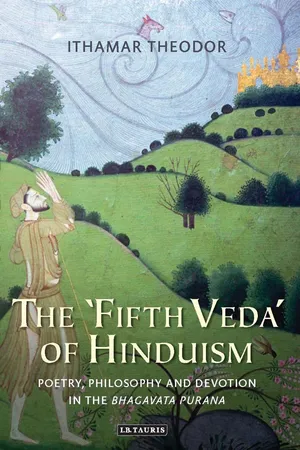
The 'Fifth Veda' of Hinduism
Poetry, Philosophy and Devotion in the Bhagavata Purana
- 240 pages
- English
- ePUB (mobile friendly)
- Available on iOS & Android
eBook - ePub
About this book
The Bhagavata Purana is one of the most important, central and popular scriptures of Hinduism. A medieval Sanskrit text, its influence as a religious book has been comparable only to that of the great Hindu epics, the Ramayana and the Mahabharata. Ithamar Theodor here offers the first analysis for twenty years of the Bhagavata Purana (often called the Fifth Veda ) and its different layers of meaning. He addresses its lyrical meditations on the activities of Krishna (avatar of Lord Vishnu), the central place it affords to the doctrine of bhakti (religious devotion) and its treatment of older Vedic traditions of knowledge. At the same time he places this subtle, poetical book within the context of the wider Hindu scriptures and the other Puranas, including the similar but less grand and significant Vishnu Purana. The author argues that the Bhagavata Purana is a unique work which represents the meeting place of two great orthodox Hindu traditions, the Vedic-Upanishadic and the Aesthetic. As such, it is one of India s greatest theological treatises. This book illuminates its character and continuing significance."
Information
CHAPTER 1
ASSOCIATING THE BHĀGAVATA PURĀṆA WITH RASA THEORY
Personhood in the Hindu Context
The following section is engaged with personhood. It first looks into various notions of personhood, then suggests another notion of aesthetic personhood that will be discussed in this work, and finally offers an articulation of the BhP's notion of personhood. This section opens the door for a syncretic or harmonious understanding of the four notions of Hindu personhood discussed.
Attempting to articulate notions of personhood within Hinduism, one faces a translation problem, as the term ‘person’ is a somewhat Western imposition on Indian culture. The uncertain status of the notion of person in India is conditioned by the fact that it is foreign to the Sanskrit tradition and has no adequate rendering in any of the Sanskritic languages. When dealing with either the human being or the deity, Indian philosophy always worked with other concepts, which rarely imported the holistic signification of person.1 As the term person has no adequate rendering in any of the Sanskritic languages, various terms such as ātman, puruṣa, jīva, īśvara, bhagavān, avatāra and mūrti are used to denote both human and divine persons within various contexts.
The term ‘person’ has a long history, dating back to the Greco-Roman period, where it was used to denote the stage masks of the actors.2 It came to signify a dramatic hero, and hence became applicable by the Stoics to every human being, as all are endowed by God to play on the world stage. Roman law defined the citizens as persons, and as opposed to slaves they had legal rights and duties. Boethius3 coined a basic definition of the person, emphasizing rationality as a major quality characterizing personhood, and the Christian tradition adopted the term to designate the Trinity. As it viewed all men as brothers, it considered all to be persons, whether free citizens, slaves or foreigners. In the medieval period the term person was considered to belong to the realm of responsible action and to refer to an intellectual and morally free subject. Consequently, Aquinas refined Boethius' definition finally to declare that ‘person’ means an integral and unitary self-subsistent subject characterized by intellectual consciousness, moral freedom and all properties ensuing from these defining traits. Prominent among these properties were privacy, ownership of natural rights, moral responsibility, being a source of value in one's own right and the capacity to initiate interpersonal relationships. The definition was such that it could with due precision apply analogically to the divine as well as to human persons.4 This usage remained for hundreds of years, but was later restricted to mean ‘human individuals’, whereas its application to the divine was taken as merely anthropomorphic. The translators of Sanskrit works in the late nineteenth century translated the terms nirguṇa and saguṇa brahman as impersonal and personal Brahman. Other terminology used by them was to refer to nirguṇa brahman as the Absolute, and to saguṇa brahman or īśvara as God. Underlying this obscure usage of terms was the assumption that the Hindu personal notions were not absolute.
Against this background it becomes understandable that the question of personhood in Indian thought has become far too complex and obscure to be dealt with beyond the constraints of modern humanism. Yet the materials for an Indian recognition of the person are present in some theology and anthropology of the Indian tradition.5 Having briefly touched upon the complexity of the usage of this term in the Indian context, we may now turn to articulate three such notions intrinsic to the Hindu orthodox tradition. These are the worldly self of Mīmāṁsā, the solitary self of Sāṅkhya, and the transcendental self of Vedānta.
In articulating ‘the Worldly Self of Mīmāṁsā’, the broader social context may be considered. In general, the Vedic society was world-affirming and sacrifices occupied a central place in its daily affairs. The individual enjoyed full dignity in so far as he was a yajamāna.6 Not only did the sacrifice define the human person as a sacrificer, but it consolidated the four-class social division as well. The Brahmins were the priests enacting the sacrifice, and the members of the other three varṇas or social categories each had their role to play in the sacrificial activity. The Mīmāṁsā was humanistic and active and the early Mīmāṁsā did not consider the Supreme Person or mokṣa to be very important subject matters.7 As a realistic school, the Mīmāṁsā's main interest was mainly practical rather than speculative, as it enquired into the nature and means of Dharma.8 The fundamental philosophical basis is Jaimini's Mīmāṁsā Sūtras9 and the major commentators are Śabara,10Kumārila Bhaṭṭa and Prabhākara.11 Jaimini admits the reality of the Vedic deities to whom the sacrifices were offered. As far as the Supreme Person, he neither argues for his existence nor denies him, but mainly ignores him.
The Mīmāṁsā perceived human life as a life of action and thus life was expressed through action. However, action was not just any action but that under the Vedic injunctions. The Veda itself was taken to be apauruṣeya, that is not composed by any person, not even by a Supreme Person, who was taken to be superfluous in the presence of the eternal Veda. The Mīmāṁsā is pluralistic, and as far as its Vedic textual affiliation, it deals with the first two categories of Vedic texts, namely the Saṁhitās and the Brāhmaṇas.12 The Mīmāṁsā is the ‘most orthodox of all the orthodox systems’,13 and accepted by all other schools as authoritative with regards to the individual's relations to society, forefathers, teachers and gods. The framework underlying proper human action as well as his relations with society and the world was dharma, and thus the Mīmāṁsā Sūtra of Jaiminī commences as follows: ‘Next, therefore, comes the enquiry into dharma. Dharma is that which is indicated by means of the Veda as conducive to the highest good.’14 In the Mīmāṁsā system, there is a connection between the act and its result or fruit. As such, an act performed at present will yield a future result, while in the meantime it takes the form of apūrva,15 which may be taken as an imperceptible antecedent of the fruit or an after-state of the act itself. Liberation for Mīmāṁsā refers mainly to life in heaven, although later thinkers did take dharma to be leading to mokṣa. Prabhākara defined liberation as ‘the absolute cessation of the body caused by the disappearance of all dharma and adharma’, and for Kumārila Bhaṭṭa it is the state of the self free from pain.16
The Mīmāṁsā accepts the existence of the soul, distinct from the mind, body and senses. The soul is the essence of human personality and there is a plurality of souls; it is the agent in each action and experience, and the resting place of apurva. Being eternal, it allows the reaping of a deed's fruits in a future life. Still, Mīmāṁsā doesn't aim to deconstruct the human person, and the physical body is no object of contempt, as it is an important instrument in pursuing dharma. Moreover, it approves of human volition as a positive force, motivating one to pravṛtti, or action according to dharma. The Mīmāṁsā thus represents a holistic human approach, and with its realistic grandstanding and its humanistic and activist ethics, it places the human being at the centre of the universe, while being deeply committed to human welfare.17 The centrality of human welfare serves as an impetus for the human being to control the world in order to fulfil his desires, and the instrument for achieving this is the Vedic sacrifice, which, in a sense, becomes the external manifestation of desire. Yet sacrifice is a necessary manifestation and so action has to be performed. Only then are the gods pleased, is proper enjoyment obtained for them and do natural forces and the world yield to human wishes.18 Later commentators differ in their relation to the fulfilment of desires. Whereas Kumārila holds that one should adhere to dharma as that would lead to happiness and exterminate sorrow, Prabhākara maintains that dharma should be followed for its own sake, without regarding possible gains or consequences. In summary, the notion of personhood in Mīmāṁsā is humanistic, realistic, active and defined by adherence to dharma. Self-fulfilment is defined in terms of sacrifice, and it can be measured in terms of worldly success – in this life as well as in the next.
In articulating the ‘Solitary Self of Sāṅkhya’, the metaphysics of the Sāṅkhya system may be considered. Sāṅkhya is notable for its theory of evolution and its reduction of all that exists to the two fundamental categories of puruṣa19 and prakṛti.20Prakṛti is composed of three constituents called guṇas, and is in a potential and neutral state which is activated and actualized by the puruṣa. The evolution of the unconscious prakṛti can take place only through the presence of the conscious puruṣa. As such, the presence of the puruṣa excites the activity of prakṛti (thus upsetting the equilibrium of the guṇas in prakṛti) and passively starts the evolutionary process. The union of the puruṣa and the prakṛti is compared to a lame man of good vision mounted on the shoulders of a blind man of sure foot.21 The prakṛti first evolves into the mahat22 and from it evolves buddhi.23 The ahaṅkāra24 is the principle of individuation, and from its sattva guṇa25 arise the manas,26 the five organs of perception27 and the five organs of action.28 From the ahaṅkāra's tamo guṇa29 arise the five fine or subtle elements30 known as tannmātras, and from these arise the five gross elements31 known as the mahābhūtas. The rajo guṇa32 acts as an energizer to support this evolution, and thus creation represents the unfolding of the phenomenal world from the original prakṛti, whereas dissolution is the world's absorption back into prakṛti.
The individual is not the body, either gross33 or subtle,34 rather the eternal conscious self, the pure spirit who is the puruṣa. The subtle and gross body is the instrument of consciousness but is unconscious in itself. The subtle body is composed of buddhi, ahaṅkāra and manas, and these three combined comprise the inner organ35 that accounts for the various types of subjective and psychic experiences.36 At the time of death the gross body alone is relinquished whereas the subtle-psychological body accompanies the puruṣa to the next body, and only at the stage of final aloofness is the subtle body entirely given up. As there are many such conscious selves, both in the state of bondage as well as in the liberated state, and as there is a fundamental distinction between the conscious puruṣa and unconscious prakṛti, Sāṅkhya is both pluralistic and dualistic. As opposed to the puruṣa, which may be designated as the ‘essential self’, the term ‘empirical self’ may be applied to the human being. In that human condition, the puruṣa identifies with its gross and subtle bodies and is deluded to perceive itself to be thinking, feeling and acting, when actually it is only the guṇas who are activating the human being. In general, the term guṇa has three meanings, namely ‘quality’, ‘rope’ and ‘not primary’. The guṇas, however, are substances and not mere qualities. This is because in Sāṅkhya philosophy there is no separate existence of qualities. It holds that each and every unit of quality is but a unit of substance.37 The guṇas are thus subtle entities, which characterize every phenomenon, gross or subtle, comprise prakṛti and bind the puruṣa. In the stage of bondage, the puruṣa agitates prakṛti and thus the guṇas are set in motion, whereas in the stage of salvation the puruṣa achieves kaivalya, which is a state of aloofness and distinction from prakṛti. The state of embodiment is only apparent as the experience of repeated births is a mere false impression created by matter obscuring the puruṣa's purity.
Non-theistic Sāṅkhya resembles Jainism but is more radical in its conception of the individual spirit. The latter, called puruṣa (human person) or jña (knower), is never really but only apparently embodied. ...
Table of contents
- Front Cover
- Title Page
- Copyright
- List of Tables
- Preface
- Abbreviations
- Acknowledgements
- Introduction
- 1. Associating the Bhāgavata Purāṇa with Rasa Theory
- 2. The Aesthetic Doctrine of the Bhāgavata Purāṇa
- 3. Notions of Personal Divinity in the Bhāgavata Purāṇa
- 4. A Textual Encounter
- Glossary
- Notes
- Bibliography
Trusted by 375,005 students
Access to over 1.5 million titles for a fair monthly price.
Study more efficiently using our study tools.
Frequently asked questions
Yes, you can cancel anytime from the Subscription tab in your account settings on the Perlego website. Your subscription will stay active until the end of your current billing period. Learn how to cancel your subscription
No, books cannot be downloaded as external files, such as PDFs, for use outside of Perlego. However, you can download books within the Perlego app for offline reading on mobile or tablet. Learn how to download books offline
Perlego offers two plans: Essential and Complete
- Essential is ideal for learners and professionals who enjoy exploring a wide range of subjects. Access the Essential Library with 800,000+ trusted titles and best-sellers across business, personal growth, and the humanities. Includes unlimited reading time and Standard Read Aloud voice.
- Complete: Perfect for advanced learners and researchers needing full, unrestricted access. Unlock 1.5M+ books across hundreds of subjects, including academic and specialized titles. The Complete Plan also includes advanced features like Premium Read Aloud and Research Assistant.
We are an online textbook subscription service, where you can get access to an entire online library for less than the price of a single book per month. With over 1.5 million books across 990+ topics, we’ve got you covered! Learn about our mission
Look out for the read-aloud symbol on your next book to see if you can listen to it. The read-aloud tool reads text aloud for you, highlighting the text as it is being read. You can pause it, speed it up and slow it down. Learn more about Read Aloud
Yes! You can use the Perlego app on both iOS and Android devices to read anytime, anywhere — even offline. Perfect for commutes or when you’re on the go.
Please note we cannot support devices running on iOS 13 and Android 7 or earlier. Learn more about using the app
Please note we cannot support devices running on iOS 13 and Android 7 or earlier. Learn more about using the app
Yes, you can access The 'Fifth Veda' of Hinduism by Ithamar Theodor in PDF and/or ePUB format, as well as other popular books in History & Asian History. We have over 1.5 million books available in our catalogue for you to explore.