I.B.Tauris in association with the Iran Heritage Foundation
From the Sasanian to the Safavid Empire, and from Qajar Iran to the current Islamic Republic, the history of Iran is one which has been coloured by a rich tradition of myths and narratives and shaped by its wealth of philosophers, cultural theorists and political thinkers. Perceptions of Iran dissects the construction of Iranian identity, to reveal how nationalism has been continually re-formulated and how Iran's self-perception has been moulded by its literary past.
Here, Ali M. Ansari gathers together a varied and wide-ranging account of the long history of Iranian encounters with the Western world, whether via the observations of Herodotus, or the knowledge – via the Old Testament – of Cyrus liberating the Jews from Babylon, or into the modern era when nineteenth and twentieth century interactions reflect the unequal power
relationship between Iran and the West. Perceptions of Iran also explores the salient elements in the country's narrative which helped to form Iran's identity, such as Ferdowsi's creation of the Shahnameh – the national epic – the exquisite architecture of Safavid Isfahan or the unfulfilled promise of the Constitutional Movement in the early twentieth century. It offers analysis of the Qajar Shahs' use of a mythical and dynastic past, as they drew on the narratives of Jamshid's glory and Khusraw's splendour in order to legitimise their rule. At the same time, it examines the ways in which foreign travellers
and diplomats understood and conceived of the royal courts of Safavid Persia.
As it covers 2,500 years of political and intellectual history, Perceptions of Iran ties together the diverse threads of Iranian experience that have underpinned the country's social and cultural movements, spanning Mirza Agha Khan Kermani's writing on Persian history and liberal nationalism, through to the strident anti- Western discourses of Seyyed Jamal al-Afghani, Jalal Al-e Ahmad and Ayatollah Khomeini. The book is therefore vital for researchers of Iranian history and
those interested in the use of myth in the construction of national identity more widely.
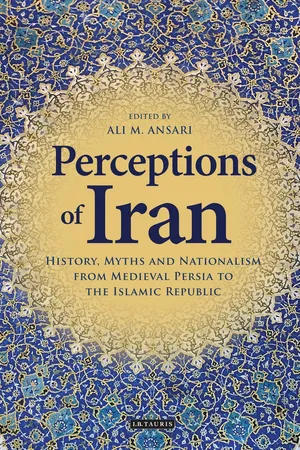
eBook - ePub
Perceptions of Iran
History, Myths and Nationalism from Medieval Persia to the Islamic Republic
- 256 pages
- English
- ePUB (mobile friendly)
- Available on iOS & Android
eBook - ePub
Perceptions of Iran
History, Myths and Nationalism from Medieval Persia to the Islamic Republic
About this book
Information
1
Myth, history and narrative displacement in Iranian historiography
Ali M. Ansari
In a series of lectures outlining his Philosophy of History, Hegel argued:
The Persians are the first Historical People; Persia was the first empire that passed away. While China and India remain stationary, and perpetuate a natural vegetative existence even to the present time, this land has been subject to those developments and revolutions which alone manifest a historical condition […] But here in Persia first arises that light which shines itself, and illuminates what is around; for Zoroaster’s ‘Light’ belongs to the World of Consciousness.1
Indeed, for Hegel: ‘With the Persian empire we first enter onto continuous history.’ Hegel’s conception of ‘history’ as the unfolding of the cunning of reason, and the progress of humanity from darkness to light, slavery to freedom, has justifiably been criticised for its heavily deterministic view of historical development, and not least for his assertion that the apotheosis of political and social development, begun by the Persians, transitioned to the Greek and Romans, reaches fruition in the Germanic peoples under, fortuitously enough, Prussian leadership. Yet if his views have been sidelined, or perhaps more accurately, appropriated and reinterpreted by Marx, this should not detract from the profound influence Hegel and his ideas have had, directly or otherwise, on our understanding of history and more importantly, for our purposes, the place of Iran (or Persia) within this conception. Hegel did not invent the idea of history as progress – this he inherited from the Enlightenment – but he did repackage it as a process that, while beginning in ‘Persia’, did, through time, relocate to the West. ‘Persia’ is therefore at once the source and origin of a singularly Western narrative of history, but one that has been left behind. Indeed: ‘The principle of development begins with the history of Persia. This therefore constitutes strictly the beginning of World-History.’2
The conception of Persia as having served the function of originator and catalyst for a narrative of progress that culminated in the West was one that informed what may be termed the ‘cosmopolitan’ histories of the Enlightenment3 and arguably reached its apogee in the ideological perversion that was the Aryan myth.4 But more potent than this myth of origin was the idea that history had passed the Persians by, such that in the contemporary period they effectively had no history. This aspect of Hegel’s conception has had a far more consequential effect on our understanding of Iran and its history than the recognition that it served as both the catalyst and the essential ‘other’ to the idea of the West. In this sense Hegel’s philosophical conception of history framed and arguably determined what would later be defined, in the Saidian sense, as a thoroughly ‘Orientalist’ understanding of history in which the Orient was not only stripped of an indigenous ‘authentic’ history, but, by extension, of an indigenous ‘authentic’ identity. Indeed, by the end of the nineteenth century, Hegel’s philosophical process took on a more immediately political hue as it was reinterpreted and pressed into colonial service. The absence of history, progress and discernible identity all served to legitimate the growing European global presence, as the heirs of a development that had been initiated in the East returned to confer the bounties of this process on an aged and stagnant Orient.5 The belief, for example, that Iranians had forgotten their history until the Europeans graciously rediscovered it for them is one that has gained currency among contemporary historians of the East, and Iran in particular.6
But here one must pause to consider what sort of history. Hegel’s conception reflected his interest in the broader philosophy of history and the idea of progress. It did not immediately translate to notions of history as identity, nor, by Hegel’s own classifications, to history in its ‘original’ or ‘reflective’ forms.7 Indeed, the tendency to extend this view to other forms of historical writing is quite clearly unsustainable, and while some might limit Persian historical writing to those which would fit the category of ‘original’ history (contemporary chronicles and records), it is quite apparent from the record that historical writing of the reflective variety also existed.8 One needs only to peruse the extensive historical writings of Ata Malik Juvaini (1226–83), Rashid al Din (1247–1318) or Mirkhwand (1433–98) to witness a subtle, often critical and highly reflective historian at work.9 These were by no means simple chronicles of their time – although they may have been used as such by modern historians in search of facts – but, on the contrary, sought to explain, justify and above all educate their public (in particular their political public, princes and rulers) through historical analogy.10 This was narrative history with political and moral purpose. This was history conveyed through the medium of myth, such that factual accuracy was often – though by no means always – sacrificed to the needs of poetic licence.11 The means of transmission – mythopoeic narrative – regularly outweighed the factual rigour of the message itself, and the purpose and function of history was not so much to convey history ‘as it was’,12 but to divine a moral purpose and guide to both life and political action. These were, in their political renditions, the mirrors for princes that would later be appropriated and adapted in Western political thought, most obviously in the writings of Machiavelli, but also reflected in a number of political biographies written in the Enlightenment.13
That is not to suggest that issues of identity were necessarily far from the surface. In his preface to his History, Mirkhwand takes the opportunity to outline the various characteristics required of a good historian, among which he includes ‘integrity and good faith’. These qualities, he argues, explain why the work of historians tend to long outlive their authors; he then proceeds to list the great historians of the past, dividing them among the Arabic and Persian traditions. By this he means the language in which they wrote, and Tabari, for example, is listed among the prominent Arabic writers. Tabari’s fame rests as a chronicler (annalist) of early Islam and the Abbasid Caliphate in particular, but his monumental history entitled the History of Prophets and Kings, while heavily leaning towards the religious tradition and a specifically Islamic narrative of descent, still managed to integrate a narrative of kings that was largely (though not exclusively) derived from the Persian tradition. This binary narrative is suggestive of a much more complex historical inheritance that sought to combine a specifically religious with a secular narrative, and what is striking about the inclusion of the Persian narrative – even if it is criticised – is that it is included at all. In some cases, the Persian narrative of descent (from Kaiomars rather than Adam) is included as a foil to prove the authenticity of the religious history. More often than not, it is included as an alternative if not equal tradition, while subsequent historians took the opportunity either to embellish and expand on the Persian narratives, and, more interestingly, increasingly regarded them as a source of experience and political wisdom.14 This tendency was undoubtedly encouraged by the rapid accrual of Persian bureaucrats to the Abbasid court in Baghdad.
This political nostalgia was further reinforced by a need to explain and record transformation and loss. Indeed, in stark contrast to the British Whig historians of the future, Persian historians of the Iranian world were in no small measure motivated by a desire to explain the loss of their civilisation, and to protect and perhaps nurture its heritage for the future. Arguably the two most productive periods of pre-modern historical writing occur in the aftermath of the Arab/ Islamic and Mongol conquests. Among the pre-eminent historians of the Persian tradition, Mirkhwand lists Rashid al Din and Juvaini as well as Hamdallah Mostofi, all of whom wrote in the traumatic aftermath of the Mongol conquest of the thirteenth century. But the individual who tops Mirkhwand’s list, the first among the historians of Persia, is Ferdowsi, the author of the poetic epic, the Shahnameh, compiled, written and produced in the centuries following the Arab/ Islamic conquest.15 The Shahnameh or ‘Book of Kings’, far from being a chronicle of kings, is a window into a vanished world, and indeed at times a clearly much-lamented civilisation. This lengthy exposition of the ascent of Iranian civilisation combines both ‘mythological’ and ‘historical’ sections, though the former regularly spills over into the latter and the boundaries are never clear. This distinction was neither apparent nor necessarily important to those later pre-modern historians who plundered the Shahnameh for information, even if it was not always used uncritically. Indeed, these pre-modern historians of Iran arguably approached their material with more subtlety and did not ruthlessly bifurcate narratives into ‘history’ and ‘myth’, retaining the former and discarding the latter as the modern discipline might do. These tales might not be factually accurate, but their longevity testified to their integrity and to a deeper truth that had social and moral value, and was thus worth recording and disseminating for future generations. The view that the idea of Iran and Iranian civilisation became a literary motif that was protected and transmitted within the literary imagination of the Persianate world is a modern distinction that disguises the reality that the idea of Iran remained part of a broader historical and bureaucratic tradition: if not explicit, then implicit, but nonetheless extant.
As we approached the modern age in the context of European history and the growing encounters between Europe and Iran, the legacy and influence of this bureaucratic-literary tradition became ever more apparent. In describing the Safavid Empire at the end of the seventeenth century, Sir John Chardin recounts in his Travels:
Persia is the greatest empire in the world, if you consider it according to the geographical description given by the Persians; because they represent it to the full extent of its ancient boundaries, which are the four great seas; the Black Sea, the Red Sea, the Caspian Sea, and the Gulph of Persica [sic].16
These boundaries reflect the historical tradition as depicted within the Shahnameh, and effectively describes an understanding of the middle Persian (Sasanian) concept of Iranshahr – later ‘modernised’ by Mirkhwand into Iranzamin (the land of Iran). Just so that there can be no doubt as to the nomenclature, Chardin continues: ‘The Persians, in naming their country, make use of one word, which they indifferently pronounce Iroun, and Iran.’17 A century later, Sir John Malcolm was equally emphatic when, in the opening page of his monumental two-volume History of Persia, he too drew attention to the indigenous use of ‘Iran’ not only as a geographic description but also as a political statement with historic depth.18 It was this depth that he sought systematically to study and render into English in his History, and he approached his sources with a sympathetic if critical eye. It was immediately apparent that the one thing Iranians were not short of was an appreciation of their historical worth, even if this appreciation was not grounded in a rigorous sifting of myth from history. Indeed, Malcolm, not beset by the conceit that would later afflict practitioners of the emerging discipline of history, noted that all peoples, including the Greeks, had a tendency to be selective in their recording of history and that this was not unique to the distant past.19 In both his History and the various anecdotes recounted in his memoirs (Sketches of Persia), Malcolm makes clear that Iranians not only enjoyed a profound historical consciousness but, if anything, are gripped by it. In one poignant vignette, Malcolm notes that while preparing for his presentation at court, his Iranian hosts abruptly revealed a painting of the Sherley brothers complete in Elizabethan dress, in the expectation that Malcolm and his entourage would equip themselves in identical fashion. Their disappointment at realising that this would not be happening elicited the astonishment at the English lack of respect for tradition.20 In this sense, Iranians suffered from an excess of history which inhibited their progress; not so much, to return to Hegel, that history had passed them by, but that history had imprisoned them. Nietzsche perhaps best described it best wh...
Table of contents
- Cover
- Title Page
- Copyright
- Contents
- List of illustrations
- List of contributors
- Introduction
- 1. Myth, history and narrative displacement in Iranian historiography
- 2. History, national identity and myths in Iranian contemporary political thought: Mirza Fathali Akhundzadeh (1812–78), Mirza Aqa Khan Kermani (1853–96) and Hassan Taqizadeh (1878–1970)
- 3. Ancient Iran in the imagination of the medieval West
- 4. History and chronology in early modern Iran:the Safavid Empire in comparative perspective
- 5. Historiography in late antique Iran
- 6. Reverse Orientalism: Iranian reactions to the West
- 7. Herodotus’ Cyrus and political freedom
- 8. Iran and the Aryan myth
- 9. History and its meaning in the Islamic Republic of Iran: The case of the Mongol invasion(s) and rule
- 10. Safavid Persia through Italian eyes: From reign of freedom to land of oppression
- 11. History and Iranian drama: The case of Bahram Beyzaie
- Bibliographies and further reading
Trusted by 375,005 students
Access to over 1.5 million titles for a fair monthly price.
Study more efficiently using our study tools.
Frequently asked questions
Yes, you can cancel anytime from the Subscription tab in your account settings on the Perlego website. Your subscription will stay active until the end of your current billing period. Learn how to cancel your subscription
No, books cannot be downloaded as external files, such as PDFs, for use outside of Perlego. However, you can download books within the Perlego app for offline reading on mobile or tablet. Learn how to download books offline
Perlego offers two plans: Essential and Complete
- Essential is ideal for learners and professionals who enjoy exploring a wide range of subjects. Access the Essential Library with 800,000+ trusted titles and best-sellers across business, personal growth, and the humanities. Includes unlimited reading time and Standard Read Aloud voice.
- Complete: Perfect for advanced learners and researchers needing full, unrestricted access. Unlock 1.5M+ books across hundreds of subjects, including academic and specialized titles. The Complete Plan also includes advanced features like Premium Read Aloud and Research Assistant.
We are an online textbook subscription service, where you can get access to an entire online library for less than the price of a single book per month. With over 1.5 million books across 990+ topics, we’ve got you covered! Learn about our mission
Look out for the read-aloud symbol on your next book to see if you can listen to it. The read-aloud tool reads text aloud for you, highlighting the text as it is being read. You can pause it, speed it up and slow it down. Learn more about Read Aloud
Yes! You can use the Perlego app on both iOS and Android devices to read anytime, anywhere — even offline. Perfect for commutes or when you’re on the go.
Please note we cannot support devices running on iOS 13 and Android 7 or earlier. Learn more about using the app
Please note we cannot support devices running on iOS 13 and Android 7 or earlier. Learn more about using the app
Yes, you can access Perceptions of Iran by Ali M. Ansari in PDF and/or ePUB format, as well as other popular books in History & Middle Eastern History. We have over 1.5 million books available in our catalogue for you to explore.