eBook - ePub
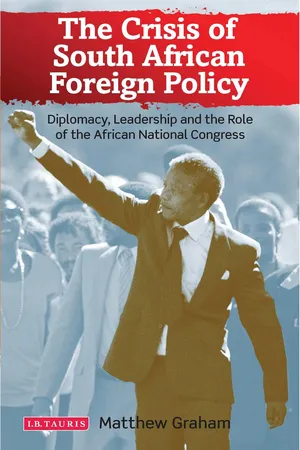
The Crisis of South African Foreign Policy
Diplomacy, Leadership and the Role of the African National Congress
- 304 pages
- English
- ePUB (mobile friendly)
- Available on iOS & Android
eBook - ePub
The Crisis of South African Foreign Policy
Diplomacy, Leadership and the Role of the African National Congress
About this book
The emergence of a 'new' democratic South Africa under Nelson Mandela was regarded as a high watermark for international ideals of human rights and democracy. Much was expected of the ANC in power, particularly that it would be able to translate its ideals into a coherent foreign policy for the African continent. Yet its foreign policy since 1994 has been mired in accusations of incoherence, contradiction and failure. Here, based on extensive archival research and interviews, Matthew Graham offers new ways of interpreting South Africa's foreign policy by investigating the continuities and discontinuities of the ANC's international relations - from exile to political power. Charting the political intrigues during the country's transition from apartheid, and the subsequent influences on Presidents Mandela and Mbeki, The Crisis of South African Foreign Policy makes a vital contribution to our understanding of why post-apartheid South Africa has failed to lead Africa on the world stage.
Information
CHAPTER 1
INTRODUCTION
Since 1994, the policies of the democratic government of South Africa, led by the African National Congress (ANC) have been under intense scrutiny. After decades of racial domination by a white minority, the emergence of Africa's newest democracy was regarded as a high-water mark for international ideals of human rights and democratic governance. Equipped with a visionary, human rights inspired foreign policy, the ‘new’ South Africa was cast by domestic and international observers alike as a rising force for global change. There was a widespread belief, if not expectation, that the newly elected ANC-led government would be able to translate these new-found ideals into an effective and meaningful foreign policy for South Africa. Yet, by the time Thabo Mbeki, South Africa's president from 1999 to 2008, stepped aside, both the country's and the ANC's international reputations had been severely damaged. President Nelson Mandela's assertion in 1993, that human rights ‘will be the light that guides our foreign affairs’ appeared to have been long forgotten.1 Commentators from either side of the political spectrum had lined up to bemoan the failures and inconsistencies of the ANC government's international record. While there have been numerous high-profile successes for the fledgling democracy's foreign policy, these are often obscured by an underlying sentiment of missed opportunity and damaging contradictions. For many critics, the question is ‘how and why did it go wrong’ for South Africa?
A mistaken assumption is that the ‘new’ South Africa began with a clean slate in 1994, and the problems of ANC foreign policy emanate solely from this period. This is incorrect for many reasons, particularly because such an approach expressly excludes what preceded it. The historical legacies of apartheid South Africa and the ANC as a national liberation movement have continued to cast a shadow over the modern political arena. Undoubtedly, the ANC's own policy choices and decisions have significantly contributed to the perception of failure, but little or no consideration is given to how the past has shaped the present. Such an occurrence is perhaps understandable, because the 1994 elections marked an era of hope, optimism and, above all else, a focus on South Africa's post-apartheid future. However, this tendency has obscured the fact that the ANC is indelibly shaped by the experiences of its past. The history of the ANC has largely been separated into three distinct periods; the ANC in exile (1960–90), South Africa's transition from apartheid to democracy (1990–4) and the ANC in government (1994–the present), which has created artificial divisions in the movement's trajectory. The result is that important continuities and discontinuities within the ANC as a political movement and in its foreign policy perspectives and activities are frequently overlooked. Rather than focusing narrowly on the democratic era, this book takes a ‘long view’ and expands the analysis and assessment of the ANC out into South Africa's transition period, and the key events and experiences in the movement's exiled liberation struggle. Therefore this work of history evaluates the so-called ‘crises’ in post-apartheid South Africa's foreign policy against the context of the past, up until Thabo Mbeki resigned from the presidency in 2008; it will not focus on the presidencies of either Kgalema Motlanthe or Jacob Zuma.
From its inception in 1912, the ANC has had an international dimension to its activities in its struggle against formal segregation in South Africa. Fully aware that the intransigent white minority were unlikely to change, the ANC – in what was a farsighted approach for the time – quickly appreciated the importance of international opinion and pressure in assisting their cause. Although the ANC's early attempts at petitioning the British government were unsuccessful, these initial international activities began a long and important series of interactions with external actors. The movement's focus on the international community as an agent of change became more urgent after 1948 when the new National Party (NP) government set about extending and furthering institutionalized racial segregation through the system of apartheid. In April 1960, following the protest and subsequent massacre at Sharpeville, the ANC, alongside all other African opposition groups, were banned by the NP government. The inability of the ANC to operate legally in South Africa forced the movement into indefinite exile, scattering it across the world. The ANC was forced to turn to the international community for help, and its links with the Soviet Union and the newly independent governments of Southern Africa became crucial after 1960. Indeed, without such support the ANC's very survival would have been in doubt. External assistance sustained and shaped the movement throughout its 30-year exile, and significantly influenced its perceptions of the world.
The decision by South African President, F. W. de Klerk to unban the ANC in February 1990, was to set in motion South Africa's transition from apartheid to democracy. Over this four-year period, the negotiation process saw many important decisions made that would transform the country and pave the way for democratic rule. However, in terms of assessing post-apartheid South Africa's foreign policy, the transition period has been widely neglected. This was a pivotal moment in South African history, with a number of converging interests and pressures influencing and impacting the democratic government's initial room for manoeuvre. The demise of global communism, the role of the Western-dominated international community, the efforts by the apartheid-era civil service to direct the negotiation process and the emerging splits within the ANC, would all be crucial. Moreover, it is important to stress that the unbanning of the ANC did not mark a sudden sea change in its ideological perspectives; important continuities in its global outlook remained, particularly amongst the grassroots supporters. By examining the events and decisions of the transition, this book provides a clearer interpretation and new explanations of some of the ANC's policies in government from 1994, until the end of Mbeki's presidency in 2008.
Furthermore, in order to fully understand the evolution in the ANC's foreign policy, it is impossible to separate it from the nature, ideology and structure of the movement as a whole. Indeed, the character of the ANC, both as an exiled movement and a governing political party, has had a significant effect on the shape and direction of its foreign policy. During its exile, the ANC leadership repeatedly demanded that the movement maintain a monolithic unity in order to survive in its fight against the apartheid state, a practice that has since continued until the present.2 However, the attempts to display an external unity of purpose and direction have begun to crumble, revealing the conflicted internal nature of the ANC. In reality, the ANC is a mass nationalist movement, one that harbours a range of ideological doctrines, encompassing anything from socialism to neo-liberalism, and everything in between. Yet the ANC is also an elite-dominated organization, with decision-making confined to a relatively small number of people, an enduring legacy from its exile struggle. This centralization of power, which continued through the transition and has become increasingly apparent in government too, means that decisions go largely uncontested, with little opportunity for internal debate or dissent within the ANC.
However, precisely because the nature of the movement and what it actually represents is not entirely clear given the divergence of opinions within its ranks, it is very difficult for the leaders to speak for ‘the’ ANC. The consequence is that behind the ANC's façade of unity there are underlying tensions not only amongst the movement's supporters but also its leadership. Many of these tensions have found expression in the ANC's foreign policy between 1960 and the present. Consequently, this book will address the ideological incoherence and structural composition of the movement, and analyse how this has shaped the direction and implementation of a democratic South Africa's oscillating foreign policy under ANC stewardship, through until the end of Mbeki's administration. The book allows for these tensions and contradictions to be explored in greater depth, illustrating how the conflicted and contradictory nature of the ANC has had an important bearing on the evolution and implementation of its foreign policy, particularly in government. It is therefore impossible to separate the historic activities of the ANC as an exiled liberation movement, from the ANC as the ruling political party of South Africa. Indeed, the important hold that the past has upon the ANC, particularly after 1994, is a theme that will be emphasized throughout the book.
In order to establish the continuities and discontinuities in the foreign policy of the ANC, and the impact that this had upon the democratic South Africa, the book is split into three main sections. The first section assesses the ANC's exile, 1960–90, examining some of the key events and decisions and the ways in which the movement formulated and implemented its nascent foreign policy against the context of a challenging international environment, and highlighting the important role of external actors throughout the period. The second investigates South Africa's transition to democracy, 1990–4, uncovering the myriad of twists and turns during the process, demonstrating the historic continuities within the ANC, and pointing towards the influences of various groups on the final outcomes that shaped the democratic government. By building upon the platform of the ANC's exile experiences, and the widely overlooked pressures and influences during the pivotal period of negotiations during the transition, the final section focuses on post-apartheid South Africa under the leadership of Presidents Nelson Mandela and Thabo Mbeki. It examines the constraints of the past on the democratic South Africa and the efforts by the ANC government to implement its foreign policy ideals, and investigates the accusations of incoherencies and contradictions. By establishing historic continuities, emphasizing the pivotal moment of the transition and disaggregating ‘the’ ANC, the book offers new ways of interpreting the ‘crises’ in post-apartheid South African foreign policy.
CHAPTER 2
THE ANC IN EXILE, 1960–76
Following three decades of exile from South Africa, the African National Congress (ANC) had become one of the world's most significant and respected national liberation movements. By 1990, the ANC had successfully mobilized global support and achieved international legitimacy in its bid to isolate the South African regime. Yet, the fact that it took the movement 30 years to force the apartheid government to the negotiating table, illustrates the immense difficulties it faced in exile. One observer analysing the ANC's record in exile in 1985, claimed perhaps cruelly, that it was ‘the world's least effective liberation movement’.1 The fortunes of the ANC certainly fluctuated, from being effectively moribund in the 1960s, to a widely fêted international movement by the end of the 1980s. Such a dramatic transformation was in no way inevitable, and was achieved in part by the tireless efforts of the ANC's leaders to engage and garner support from a wide spectrum of international actors, and the generosity that was reciprocated to them in return, most notably by the Soviet Bloc, Western-based campaigning organizations and independent African states. Without sustained support, for example, in areas such as military training, education, financial donations and the provision of refuge, the ANC would not have been able to survive in exile, let alone wage such a comprehensive international campaign against apartheid. The importance of external support to the ANC was emphasized by the South African Communist Party (SACP) leader Joe Slovo, who claimed in 1986 that ‘in this day and age there is no struggle which can be separated from the international context, but in the case of South Africa the international factor plays a unique role; because the evil of apartheid, like no other issue, cuts across the world ideological divide’.2 Although internal opposition definitely played its part in bringing about the end of apartheid, a significant factor in its demise was the concerted efforts of the ANC (plus the activities of internal organizations such as the United Democratic Front (UDF), and the global Anti-Apartheid Movement) to internationalize the South African struggle from 1960.3
The ANC's 30 years of exile began in March 1960, after a protest organized by the rival Pan-Africanist Congress (PAC) culminated in the Sharpeville massacre, which left 69 people dead. The incident sparked a week of demonstrations and protests across South Africa, after which the National Party (NP) government declared a state of emergency, banning the ANC and the PAC.4 Plans to form an external section of the ANC had been discussed in December 1959, ‘to carry abroad the message of its vision and solicit support for the movement’, but in the aftermath of Sharpeville this had to be accelerated.5 In the course of these early discussions the ANC leadership had nominated its Deputy President Oliver Tambo to leave South Africa and head an External Mission to co-ordinate the ANC's international efforts. Tambo secretly left the country in April 1960, first making his way to the British Protectorate of Bechuanaland (now Botswana), and then on to Tanganyika (now Tanzania).6 He quickly set about the task of raising awareness and gaining support for the ANC by touring friendly states and creating links with international backers that enabled Tambo ‘to establish ANC missions in Egypt, Ghana, Morocco and in London’.7 However, despite the South African government's banning of the ANC, there was no immediate exodus of its members; many remained in South Africa to carry out clandestine activities. Only after the arrest of the ANC's leaders at Rivonia in July 1963, and their subsequent imprisonment, did the organization finally abandon its formal structures within South Africa.8 Until 1963, the ANC had managed to maintain an illegal presence in the country, albeit one that was severely limited by sustained repression and harassment by the state. Although the bulk of the leadership had remained, its ability to direct the struggle effectively was greatly diminished. The internal military and political structures of the ANC were thoroughly destroyed after the Rivonia Trial, and with its leaders in prison or in exile, control of the organization shifted to the External Mission.9
This and the following chapter will examine the ANC's foreign policy in practice, but as will be illustrated, it was by no means consistent nor coherent. The very nature of being an exiled political movement meant that for practical purposes the ANC had to be relatively flexible in its approach to external actors, as world events unfolded over which it had little or no influence. Although the ANC espoused socialist ideals throughout its exile (that in turn were not always consistently expressed), the movement appealed to both Western and communist nations for help; quite clearly a different message was required for these very different audiences. For the purposes of political expediency, a fluid approach to foreign policy was thus required. Additionally, as will be seen here and in Chapter Three, the ANC did not produce many clear statements of what its foreign policy actually was. The two clearest examples were the Freedom Charter, written in 1955, before its exile, and the Report of the Commission on Foreign Policy tabled at the 1985 Kabwe Conference.10 While these two documents provide some insight into the ANC's priorities, they are rather limited in scope, with a lack of information about its foreign policy ideals. It is therefore important to take into account the many limitations the ANC faced in developing an explicit and consistent foreign policy in exile.
The burgeoning literature concerning the ANC's exile experiences is vast, spanning a diverse range of themes and approaches.11 This study focuses on the most important events in the chronological evolution of the ANC's foreign relations in exile, concentrating primarily on southern Africa. These include: the impact of the 1969 Lusaka Manifesto; the formation of alliances with like-minded Soviet-sponsored liberation movements; the decolonization of Portuguese Africa and the 1985 Kabwe Conference.
The 1960s
The first decade of exile was a traumatic and turbulent experience for the ANC. The movement found itself ill-prepared for its banning and subsequent life in exile.12 Major problems challenged the very existence of the ANC during the 1960s. Primarily, the ANC was left entirely dependent on the goodwill and benevolence of newly independent states such as Tanzania and Zambia for refuge, as well as the Soviet Union and the Eastern Bloc for financial and military support. It must be noted that without the largesse of the Communist Bloc throughout the entirety of the exile period, the ANC would have faced enormous difficulties in waging its struggle against the apartheid state. Moreover, a growing concern for the movement was the co-ordination of its international efforts, as the ANC leadership was dispersed across Africa and Europe, almost completely cut off from its domestic support base.13 Additional crises faced the ANC including: unanticipated competition for African support and patronage from its rival movement the PAC;14 a mutiny amongst members of its armed wing Umkhonto we Sizwe (known as MK)15 after the defeat of its guerrilla fighters during the Wankie and Sipolilo campaigns of 1967–816 and expulsion from Tanzania in 1969 by the president, Julius Nyerere.17 Despite these substantial difficulties, the 1960s was not as bleak for the ANC as it may first appear. The achievement of simply surviving as a (largely) unified movement in the first decade of exile was in itself a major accomplishment. Furthermore, although the ANC became dependent on external aid, it was relatively successful in attracting international support for its cause; it began the process of forging alliances with Southern African liberation movements such as the Zimbabwe African People's Union (ZAPU) and it was involved in the process leading to South Africa leaving the Commonwealth in 1961.
The ANC had envisaged that its exile from South Africa would be only temporary, but the leadership had realized the pr...
Table of contents
- Front Cover
- Title Page
- Copyright Page
- Dedication
- Contents
- Acronyms
- Acknowledgements
- 1. Introduction
- 2. The ANC in Exile, 1960–76
- 3. From Exile to Liberation
- 4. ANC Foreign Policy during South Africa’s Transition: The Search for Direction, 1990–4
- 5. The Sub Council on Foreign Affairs of the Transitional Executive Council
- 6. Idealism versus Realism? The Contested Nature of South African Foreign Policy, 1994–6
- 7. The Changing Nature of South African Foreign Policy
- 8. A New President, a New Direction? Thabo Mbeki’s Renaissance
- 9. Conclusions
- Notes
- Bibliography
- Back Cover
Trusted by 375,005 students
Access to over 1.5 million titles for a fair monthly price.
Study more efficiently using our study tools.
Frequently asked questions
Yes, you can cancel anytime from the Subscription tab in your account settings on the Perlego website. Your subscription will stay active until the end of your current billing period. Learn how to cancel your subscription
No, books cannot be downloaded as external files, such as PDFs, for use outside of Perlego. However, you can download books within the Perlego app for offline reading on mobile or tablet. Learn how to download books offline
Perlego offers two plans: Essential and Complete
- Essential is ideal for learners and professionals who enjoy exploring a wide range of subjects. Access the Essential Library with 800,000+ trusted titles and best-sellers across business, personal growth, and the humanities. Includes unlimited reading time and Standard Read Aloud voice.
- Complete: Perfect for advanced learners and researchers needing full, unrestricted access. Unlock 1.5M+ books across hundreds of subjects, including academic and specialized titles. The Complete Plan also includes advanced features like Premium Read Aloud and Research Assistant.
We are an online textbook subscription service, where you can get access to an entire online library for less than the price of a single book per month. With over 1.5 million books across 990+ topics, we’ve got you covered! Learn about our mission
Look out for the read-aloud symbol on your next book to see if you can listen to it. The read-aloud tool reads text aloud for you, highlighting the text as it is being read. You can pause it, speed it up and slow it down. Learn more about Read Aloud
Yes! You can use the Perlego app on both iOS and Android devices to read anytime, anywhere — even offline. Perfect for commutes or when you’re on the go.
Please note we cannot support devices running on iOS 13 and Android 7 or earlier. Learn more about using the app
Please note we cannot support devices running on iOS 13 and Android 7 or earlier. Learn more about using the app
Yes, you can access The Crisis of South African Foreign Policy by Matthew Graham in PDF and/or ePUB format, as well as other popular books in Politics & International Relations & African History. We have over 1.5 million books available in our catalogue for you to explore.