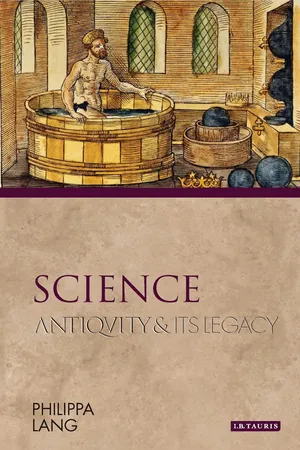
Ancient science is a subject that commands extensive general interest. This is the first non-technical survey of the interface between ancient and modern science. It is aimed at crossover student sales in classics, the history of ideas and the history and philosophy of science. Modern science and its technology are the children of the seventeenth-century. But the bold investigative experimentation and scientific systems of thought that this era spawned were in turn thoroughly influenced by Greek and Roman authors and ideas. Xenophanes' ideas about fossils informed the science of geology. Copernicus and his novel notion that the earth revolved around the sun, and not vice versa, were arguably influenced by the Samian philosopher and mathematician, Aristarchus. And the anatomists of Alexandria still - even today - have valuable insights to bring to current ethical discussions of vivisection and animal welfare. Shedding fresh light on topics such as Euclid's geometry, Aristotelian physics and the proto-Darwinism of pre-Socratic thinkers like Empedocles, Philippa Lang addresses the fascinating differences and similarities between ancient and modern conceptions of 'science'.She discusses the origins of the cosmos; natural laws in mathematics and physics; conceptions and philosophies of biology and disease; ideas about mechanistic science and technology as they have been used to control the societies of human beings; and the important nexus between science, morality and ethics.
Greek and Roman parallels illuminate and clarify the meaning of science itself.
- 240 pages
- English
- ePUB (mobile friendly)
- Available on iOS & Android
eBook - ePub
About this book
Trusted by 375,005 students
Access to over 1.5 million titles for a fair monthly price.
Study more efficiently using our study tools.
Information
CHAPTER I
STRANGE WORLDS
The Pre-Socratics
The city of Miletus lies on the eastern coast of what is now Turkey, in the geographical region traditionally known to the West as Asia Minor. In the sixth century BC, however, Miletus was a flourishing Greek colony in Lydia. It had extensive trading networks and channels of communication with the Mediterranean world of Greek city-states on the mainland of Europe and islands of the Aegean, as well as with other Greek foundations along the eastern Asia Minor coast, in the Black Sea region to the north, and as far south as Naucratis in Egypt. These networks were further embedded within the societies and cultures of the region, including the countries and empires of Egypt, Lydia, Persia, Babylonia and India.
Miletus was thus ideally situated to be a nexus of cultural interaction and interchange. Perhaps this is why three of its citizens are still famous as the earliest of the ‘Pre-Socratic’ thinkers of Greco-Roman antiquity.1 This collection of diverse individuals, beginning with the Milesians Thales (lived c.624–546 BC), Anaximenes (active around 545 BC) and Anaximander (c.610–546 BC), over the course of one or two generations constituted an intellectual revolution within the Greek world, a century or so before the inquiries of Socrates of Athens (469–399 BC) marked a subsequent divergence and evolution in what came to be called philosophy.
‘Pre-Socratics’ is, obviously, a later term of convenience, not a contemporary category. We are also handicapped in reconstructing or understanding their ideas by the fact that Pre-Socratic writings exist only in quotations or paraphrases (‘fragments’) of them by other, later authors, a group that has been itself winnowed by the selective and destructive passage of time. Thales, traditionally the first Pre-Socratic and therefore now occasionally identified as the first ‘scientist’ or ‘philosopher’ in Greco-Roman history, may not have produced any written argument at all. Aristotle, discussing Thales' ideas in the fourth century BC, seems to be somewhat uncertain of what these might actually have been. This suggests a reliance on oral tradition. Moreover Aristotle interprets not only Thales but all Pre-Socratics in terms of his own philosophical terminology, reflecting the development of concepts and arguments in the years since. The result is that we gain our own knowledge of their arguments through this anachronistic lens. And Aristotle is one of the earliest extant interpreters of the Pre-Socratics. Many of our sources for Pre-Socratic thought are much later than him and some were themselves relying on intermediate texts and reports.
The Pre-Socratics had sharply different ideas from each other, but they also had some things in common. They each articulated, in their own way, a radical departure from older kinds of ideas about the origins and nature of the world and its inhabitants, from gods to humans. They reformulated the very idea of what gods could be and how such beings might relate (or not) to events, processes and objects in the world around them. They made explicit and problematised questions of what constituted knowledge, persuasive argument or proof. They claimed confidently to offer a privileged and superior understanding of important elements – moral, physical, epistemological, civic – of the world. Crucially, they often offered reasons and arguments for believing in each of their particular visions. In so doing they reframed both religious and non-religious discourse to a significant degree.
Argument of this type became a very influential trend in Greek and subsequently Greco-Roman society. This was particularly so among the more elite and educated members of that society – those with the leisure to debate, the ability to read and intellectual fashions to keep up with – but had implications for culture much more widely. Philosophy, as it became known, developed as a broad genre of argument, investigation and analysis. It influenced emerging literary genres like ethnographic history and included an evolving specialisation into subject matter that we would now consider ‘scientific’. The impact of this kind of thought is particularly notable among professional healers as the form of medicine known as ‘Hippocratic’.
What began as interlocutory speculation and criticism amongst the Pre-Socratics and their audiences became a dominant mode of Greco-Roman culture, both oral and written, and survived into the Christian and Byzantine eras. It affected Christian theology, political thought, literature and other arts and medicine. In spite of a considerable loss of texts throughout classical antiquity and the subsequent Dark Ages, some treatises were preserved in the Arabic intellectual tradition and rediscovered by the West in medieval times. These included the astronomer Ptolemy's Almagest and several works by the physician Galen. The intellectual upheavals in science and philosophy of the Renaissance, during the fourteenth to seventeenth centuries, were identified by their participants as descended from the natural philosophy of Greece and Rome. The names and works of Ptolemy, Galen, the mathematician Archimedes and the philosopher Aristotle became authorities and exemplars within this resurgence of themes from pre- and early-Christian literature and ideas. In general, the ancient practice of investigative and critical thought, concerning a rational world of consistent and understandable ‘nature’, became an ideal which drove the development of science and natural history, especially in the so-called ‘Enlightenment’ of the seventeenth and eighteenth centuries. Pushed as far back as specific individuals and ideas can be identified, it is a story that leads to the Pre-Socratics and to sixth-century BC Miletus.
As a reading of antiquity, such a story of scientific discovery is highly selective and decontextualised. As a story of scientific progress and rediscovery, it is doubtful: Greco-Roman inquiries into scientific subjects would rarely if ever – outside mathematics – meet modern criteria for what constitutes science. In the rest of this book, we shall examine how we understand and define such ‘ancient science’ through our own familiarity with its successful modern analogue. But the differences are also important in thinking, both about what the sciences are or ‘science’ is, and how society and culture affect forms of investigation and argument.
Pre-Socratics and their next generation successors, the so-called sophists, tended to think big, about such topics as the origin of the cosmos or its fundamental nature; the nature of reality; the definitions of truth; whether gods existed and what they might be. Such thinkers were often at variance with traditional ritual, material or poetic representations of the gods; they also sought to define morality and prescribe political structure.
Their ideas as to all these differed, often radically, from each other. Many offered an explanation of the cosmos in terms of materials: a move taken to its extreme by the atomists, whose discrete, irreducible matter competed with the conception of an infinitely divisible substrate as put forward by Anaxagoras and later Aristotle. For Parmenides, on the other hand, reality was something else entirely. Matter, like movement, was an illusion. His view was taken up by Zeno and Melissus, and became a major influence on Plato's thought.
But on a broader scale, there is a common theme to Pre-Socratic ideas. All describe a hidden, fundamental set of explanatory principles or items, accessible primarily by thought and not directly perceptible by the senses or everyday experience of the world.2 This reality is very different to the macroscopic experience it creates: we do not perceive the world as a set of interacting solid particles in emptiness (the atomists) or a table as something that is also bread and stone (Anaxagoras). We do not think of the world and everything in it as a mass of air in various stages of rarefaction (Anaximenes); we do not think of a woman being reducible to the number two, or of retributive justice as the number four (the Pythagoreans); we allow, unlike Parmenides, that change, motion and different things exist. In its strangeness, the Pre-Socratic universe is similar to that of modern science. Contemporary theories of particle physics and the quantum world offer a reality that is, if anything, even more at variance with our everyday experience and common-sense understanding than were ancient ideas. The differences lie in the methods of investigation and the evidentiary criteria of persuasion.
In the rest of this chapter we shall examine early Greek speculation and argument about the nature and origin of the cosmos. Some elements of this have notable points of comparison with aspects of modern cosmological theory and debate, particularly in the kind of questions and problems encountered in trying to think about the beginning of existence, but less so in how such issues are resolved.
The Pigeons and the Physicists
At the beginning of the 1960s, scientists at Princeton were looking for evidence of the cosmic radiation that theory predicted would have been produced in the ‘big bang’. If the hot big bang model was correct, the universe – time, space, matter and energy – came into being 15 billion years ago, as something extremely hot and incredibly dense. There was no 20 billion years ago.
At the time the alternative cosmological model was the ‘steady-state’ hypothesis, according to which the universe was essentially the same – having the same properties – over time as well as space. Matter did not come into being at one moment, but more of it arrived very slowly in a process of ‘continuous creation’ as the universe expanded (as observations of stellar phenomena had showed it was doing), thus maintaining the overall universe at the same density. The amount of matter required was on such a small scale that it would be very difficult to observe and therefore very difficult to disprove. But since steady-state theory predicted that the universe's properties had not changed over time, the hypothesis could be tested by searching for evidence that the past and contemporary universe differed in key aspects. Any evidence of this would falsify steady-state theory.
The aim of the Princeton scientists – Dilke, Peebles, Wilkinson – was to look for such evidence in the particular form predicted by the big bang model, according to which the early universe was too hot for atoms to exist. Protons, electrons and photons were scattered equally throughout, so that the emission and absorption of energy balanced each other in perfect equilibrium: a state of affairs known as ‘black-body radiation’. At something over 300,000 years after the big bang, the universe had cooled down sufficiently to form neutrally charged atoms, which could not absorb all the thermal energy as perfectly as before. Instead, high-energy photons began to travel on their own through space, rendering the universe transparent instead of opaque. As the universe expanded over the subsequent 15 billion years these photons lost energy and red-shifted. Because this was energy generated in the big bang from the entire early universe (not from only one part), it should appear uniform across all of space. Finding such a uniform spread of energy, a relic of the very early universe, would indicate that the universe had been very different in the past from its current state, falsifying the steady-state hypothesis and providing strong support for the truth of the 'big bang'.
As it happened, this relic radiation was discovered by two other scientists looking for something quite different. Arno Penzias and Robert Wilson were using microwave-detecting equipment designed to find sources of interference with the earth's satellite communications. The signals they were looking for were very faint, so they needed to eliminate all other sources of radiation – such as their receiver's heat, which they cooled with liquid helium to just above absolute zero. But they could not get rid of an unexpected, persistent and invariant radiation at a wavelength of 7.35 cm, which was uniform in every direction of the sky over 24 hours a day.
They checked their equipment. There were pigeons living in the telescope antenna. Surely this unusual problem explained their unexpected readings? But removing the birds and their droppings had no effect upon the persistent long-wavelength radiation. It was not an instrumental problem.
Penzias and Wilson had found the heat energy left over from the big bang and now only a few degrees above absolute zero: cosmic microwave background radiation (CMB). In spite of gaps and imperfections, the big bang model is now standard cosmology.
In the Beginning
The big bang theory models the expansion of space–time from a tiny kernel of very high density and temperature. It is not precisely about the origin of the universe, although hypotheses concerning this also exist, but does describe how the universe in which current physical laws apply came into being. In the first few fractions of a second of this expansion existence was only on the quantum scale and then, as matter and energy separated, a matter of particles. Eventually, about a second after the expansion began, subatomic particles combined into nuclei. Classical physics describes the situation from about 0.1 of a second after the expansion began – ‘the big bang’ itself. Particle accelerators attempt to recreate the conditions just prior to that.
Whatever the initial state or singularity was, or how it came about, cosmic background radiation and other evidence confirms that the universe began, if not literally from ‘nothing’, then from something completely different, and that there has been a finite amount of time between that beginning point and the present. In antiquity, a similar debate emerged within philosophy between the same basic alternatives, but was never similarly resolved into general agreement.
There are other points of comparison as well. The issue of whether time existed before the cosmos was discussed at least as early as the fourth century BC, in Plato's cosmological dialogue the Timaeus (written perhaps c.360 BC). Several schools of thought developed the notion of a cosmos or world that came to an end but began again: an idea that is to some extent paralleled by possible outcomes to our own universe. There are less significant similarities: the imagery of a small homogenous seed or kernel that expands into the large and differentiated cosmos is present in both ancient and modern writing. The chief difference in this case is that in antiquity, the image is sometimes literal. I shall return to these similarities in more detail later in this chapter.
As to the question of whether the cosmos has always existed, and in much the same state as it is now, or whether it had a beginning, this was formulated clearly by Plato (427–347 BC).
Concerning it [the world], then, we must start with the question which is laid down as the question one should ask at the beginning of any topic, whether it always was, having no beginning point of coming into existence, or whether it has come into being, beginning from some beginning point. [In fact] it has come into being. (Timaeus, 28)
The Greek noun genesis means, literally, ‘state of having-come-into-being’, and this meaning is non-committal as to whether it refers to a process of creation by an external agent or was self-caused without plan, consciousness or agency. Early Greek society contained stories about origins of gods, men and the world. There was no fixed religious doctrine on any of these points, but the famous and very influential poem Theogony, composed by Hesiod in about the beginning of the seventh century BC, is still extant. In the Theogony or ‘Birth of the Gods’, the original deity is Chaos, from which all the other gods and forces derive in an expanding genealogy, starting with Earth. The meaning of chaos is space or void, as in the gaps between things, but it also implies a material fluidity or flux.
The Pre-Socratics were clearly influenced by this kind of narrative. Their cosmogonies tend to begin with some primary element such as water, air or fire. This basic material undergoes various changes and differentiations in order to produce the cosmos, consisting of the world at the centre, the sun and other wandering stars (planets) and the fixed stars. Further evolution of landscape and life then occurs upon the earth. Anaximander of Miletus' version of this stuff from which everything else came was ‘the unlimited’, or ‘that without boundaries’: something that was potentially anything but, actually, no particular thing – a more precisely defined version of Hesiod's chaotic potential. In the fourth century BC the divine craftsman of Plato's Timaeus is said to have crafted the world's basic material elements (cubes, icosahedrons, octahedrons and tetrahedrons, all made out of certain kinds of triangles and constituting respectively earth, water, air and fire) out of the chaotic motions of what Plato calls ‘the receptacle’. This last is a kind of metaphysical substrate of matter which a divine craftsman can organise into the elemental materials of the physical universe; and it too shares a conceptual similarity with Hesiod's chaos.3
The original, basic meaning of the Greek word kosmos, Latinised as cosmos, is ‘order, what is regular’. It could and did refer to many kinds of things which had been converted from something formless into something with structure. In the latter sense it could even mean 'hairstyle'. But at some early stage in Greek thought it became the standard terminology for the entirety of the world, including the celestial realm. The Greeks thought of the world or universe as something intrinsically ordered and hence explicable. In origin stories such as the Theogony or the more material accounts of the first Pre-Socratics, this ordered state of being – the universe as we know it – has a beginning, but it is not a beginning out of nothing. A previous state, of indefinite or infinite length, incomprehensible to explication and reason because it entirely lacked structure, is the apparently necessary precursor to genesis.
There is a similarity here with the big bang model: the explicable form of the universe, as described by classical cosmology, has an origin point. But it did not emerge from nothing. Instead it was the result of a different kind of physics, the physics of a singularity, that is of matter-energy beh...
Table of contents
- Front Cover
- Title Page
- Contents
- Acknowledgements
- Foreword
- Chapter I: Strange Worlds
- Chapter II: Strange Creatures
- Chapter III: Natural Laws and how to Discover Them
- Chapter IV: Illness and Disease
- Chapter V: Controlling The World
- Chapter VI: Then and Now
- Some Suggestions for Further Reading
- Notes
- eCopyright
- Back cover
Frequently asked questions
Yes, you can cancel anytime from the Subscription tab in your account settings on the Perlego website. Your subscription will stay active until the end of your current billing period. Learn how to cancel your subscription
No, books cannot be downloaded as external files, such as PDFs, for use outside of Perlego. However, you can download books within the Perlego app for offline reading on mobile or tablet. Learn how to download books offline
Perlego offers two plans: Essential and Complete
- Essential is ideal for learners and professionals who enjoy exploring a wide range of subjects. Access the Essential Library with 800,000+ trusted titles and best-sellers across business, personal growth, and the humanities. Includes unlimited reading time and Standard Read Aloud voice.
- Complete: Perfect for advanced learners and researchers needing full, unrestricted access. Unlock 1.5M+ books across hundreds of subjects, including academic and specialized titles. The Complete Plan also includes advanced features like Premium Read Aloud and Research Assistant.
We are an online textbook subscription service, where you can get access to an entire online library for less than the price of a single book per month. With over 1.5 million books across 990+ topics, we’ve got you covered! Learn about our mission
Look out for the read-aloud symbol on your next book to see if you can listen to it. The read-aloud tool reads text aloud for you, highlighting the text as it is being read. You can pause it, speed it up and slow it down. Learn more about Read Aloud
Yes! You can use the Perlego app on both iOS and Android devices to read anytime, anywhere — even offline. Perfect for commutes or when you’re on the go.
Please note we cannot support devices running on iOS 13 and Android 7 or earlier. Learn more about using the app
Please note we cannot support devices running on iOS 13 and Android 7 or earlier. Learn more about using the app
Yes, you can access Science by Philippa Lang in PDF and/or ePUB format, as well as other popular books in History & Ancient History. We have over 1.5 million books available in our catalogue for you to explore.