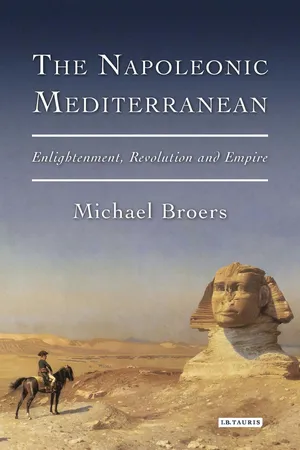
The Mediterranean was one of Napoleon's greatest spheres of influence. With territory in Spain, Italy and, of course, France, Napoleon's regime dominated the Great Sea for much of the early nineteenth century. The 'Napoleonic Mediterranean' was composed of almost the entirety of the western, European lands bordering its northern shores, however tenuously many of those shores were held. The disastrous attempt to conquer Egypt in 1798-99, and the rapid loss of Malta to the British, sealed its eastward and southern limits. None of Napoleon's Mediterranean possessions were easily held; they were volatile societies which showed determined resistance to the new state forged by the French Revolution. In this book, acclaimed historian and biographer of Napoleon, Michael Broers looks at the similarities and differences between Napoleon's Mediterranean imperial possessions. He considers the process of political, military and legal administration as well as the challenges faced by Napoleon's Prefects in overcoming hostility in the local population.
With chapters covering a range of imperial territories, this book is a unique and valuable addition to the historical literature on Napoleonic Europe and the process and practice of imperialism.
- 368 pages
- English
- ePUB (mobile friendly)
- Available on iOS & Android
eBook - ePub
About this book
Trusted by 375,005 students
Access to over 1.5 million titles for a fair monthly price.
Study more efficiently using our study tools.
Information
PART I
THE HISTORICAL GEOGRAPHY OF THE NAPOLEONIC MEDITERRANEAN
1
THE PAROCHIAL REVOLUTION 1799 AND THE COUNTER-REVOLUTION IN ITALY
A tidal wave of anti-French, anti-revolutionary revolts swept the Italian peninsula in the spring and summer of 1799. From Calabria and Puglia in the south to the Alpine valleys, and from the latifundi of the lowland swamps of the pianura padana to the desolate pasture lands of the Apennines, the French occupiers and their ideological sympathisers, the ‘Italian Jacobins’, found themselves assailed with an often hideous ferocity by the coalition of the social forces unimaginable only a few years before. The first of many paradoxes of the revolts of 1799 was the coming together of so many previously antagonistic forces against the French; lord and peasant, bourgeois and noble, central and local administrations, all found a place in a social configuration that was as varied as its geographical settings, in opposition to the new forces unleashed by the French Revolution. The extent and intensity of the anti-French risings of 1799 made a powerful impact on contemporaries, and they deserve to be set beside those other beacons of ‘the counter-revolution in action’, the Vendée, the Tyrol and the Spanish War of Independence, not only for their scale but for what they represent ideologically. The diversity and apparent contradictions of the popular risings of 1799 are underlain by an emphatic rejection of the ideology of the French Revolution and the philosophy of the Enlightenment, by a wide spectrum of Italian society.
The second Italian campaign of 1800 quickly reversed the political and military circumstances brought about in 1799, at least in northern and central Italy, making it all too tempting to relegate the popular risings to the status of an ephemeral eruption of archaic social forces, allowed a brief moment in the Mediterranean sun by a transient set of military coincidences. Viewed in this way, the counter-revolutions of 1799 can be set easily to one side and attention focused on the experience of state-building and political experimentation which took place under the French in Italy in the period 1800–14. Such an approach quite logically leads to the history of Italy in this period – I'epoca francese – being written with the Italian Jacobins and the dynamic aspects of French rule at its centre. Indeed, a long tradition of historiography has evolved along precisely these lines both inside and outside Italy.1 Fixed within the limits of the Revolutionary Napoleonic period and approached, for the most part, through the political and administrative institutions created by the giacobini italiani, the Italian experience of French rule appears as a largely positive one. It puts at its centre the emergence of protonational institutions in the Kingdom of Italy and the initiation of a coherent debate on the nature and desirability of unification;2 thus interpreted, l'epoca frúncese becomes both the triumph of eighteenth-century enlightened reform and the fountain-head of the Risorgimento. It becomes a ‘usable’, indeed an essential, component in the evolution of Italian nationalism.
Notwithstanding the formidable corpus of scholarship this historiographical approach has produced, it is a mistaken, narrow and deeply flawed interpretation of the character of the period. From the wider and longer perspective of ‘the long nineteenth century’ – which in Italy stretches as far forward as 1922, if not beyond – it is the revolts of 1799 that assume a seminal importance rather than the Jacobin triennio which preceded them, or even the 14 years of Franco-Jacobin rule that followed. To push back into ‘the long nineteenth century’, the most striking feature of the last quarter of the eighteenth century in Italy is the resounding, often violent rejection of enlightened reform in many parts of the peninsula. Its ideological rejection is probably clearest in the opposition of the Lombard notabilii to Joseph II's projects for administrative centralisation in 1784–9,3 while its popular, more archaic elements are exemplified by the Viva Maria risings of the 1790s in Tuscany. To bring the period forward beyond 1814 is to undermine still further the centrality of Vitalia giacobina and replace it by counter-revolution. The struggle for unification was an uphill one, of this there can be no doubt, and the truth that more Italians died fighting against the Risorgimento than for it should be treated as food for thought, rather than as a stale, unpalatable fact. The experiences of the post-unification state were equally painful, and the search for its true legitimation still continues. Thus, the constitution and the power of counter-revolution are foreshadowed in the events of the last year of the eighteenth century and forewarn in turn the struggles of the nineteenth.
At the most functional level of history, the revolts of 1799 are easily swept aside. When compared, on this level, with the Vendée or the Spanish War of Independence, their life is counted in months rather than in years. When set beside the achievements of the Italian Jacobins, the superficial, if factual result, in the short term, was that pro-French rule was re-established for half a generation; while in the longer term, however imposing the forces of counter-revolution may have been, Italy was eventually unified. At no time, however, did the inspiration and control of either Vitalia giacobina or the Risorgimento amount to anything other than the preserve of a small, if well-organised and determined minority. The French Revolution in Italy was indubitably the work of a sect, corresponding in its composition and ideology to that sketched out by Cochin.4 It is arguable that his concept of ‘une révolution sectaire’ is far more accurate in an Italian context than in a French one.
Here, then, lies the case for dethroning the giacobini italiani from the central position they have sometimes been given in the history of Italy in the age of the French Revolution. However, the argument for substituting them by the counter-revolutionary risings of 1799 cannot rest solely on their place in a succession of similar revolts dotted throughout the period c.1780–1922. This case must turn on their juxtaposition to the most coherent drive for reform and change the Italian peninsula had seen so far, the ideology of the French Revolution. The very nature of the challenge confronting the rebels of 1799 makes it more significant, and potentially more formative, than the preceding revolts of the ancien régime. This stems less from the introduction of new xenophobic elements afforded by the presence of French troops, than from the overt opposition the rebels manifested to the native Italian regimes of the triennio. The manner and motives for the rejection of so formidable a set of political principles is, in itself, a momentous historical event.
* * * * *
It is not by chance or pedantic affectation that the revolts of 1799 have been referred to consistently throughout this chapter in the plural, for their diversity is their very essence, just as their multiplicity denotes their lasting significance. To portray the revolts of 1799 as the unification of the Italian masses around a protonational, reactionary cause – as was the wont of neo-fascist historians5 – would be as mistaken as to insist on the economic aspects as their sole driving force. The risings of 1799 were, above all else, the defensive expressions of localism and of the deeply ingrained, indeed of the natural, elements of Hesperian society, against a series of alien, external intrusions.
This is not at all to say that the revolts did not embrace internal divisions within communities, for within them powerful local rivalries were to be found. Indeed, it is undeniable that the events of 1799 nurtured and fostered these rivalries, raising them to new levels of ferocity and vindictiveness; to deny this would be folly. Rather, what is important to remember as regards these local civil wars is that a new, critical factor had entered into them. This new element was the external intervention of the revolutionary state, personified by the native giacobini and bolstered by French arms. A significant minority of the propertied classes sided with this external force, but by so doing, for whatever local or personal reasons, it consciously took sides against the essence of localism, of corporatism, and with the new, unitary concept of the state propounded by the Revolution. The ideological clarity of the native, patriot governments, with their determined though far from slavish commitment to the models of revolutionary France, made adherence to them a very different form of collaboration compared to supporting either the Austro-Russian armies or the indigenous dynasties, which carried no such ideological baggage with them. All those Italian states where groups of enlightened, Josephine reformers had directed governments towards policies of centralisation had witnessed systematic reactions by the mid 1790s. The policies of Gianni and Peter-Leopold were reversed with some thoroughness by Ferdinand III in the period 1790–9,6 while the ideological volte-face of the Neapolitan Bourbons was even more spectacular in the decade following the outbreak of the French Revolution.7 In both these states the reform parties and their officials and supporters in the provinces found themselves cast suddenly into opposition and adversity. The intensity of popular opposition to their economic and ecclesiastical reforms had long been clear to them, but now they also faced abandonment by the central authorities who had long been their patrons and, more to the point, their protectors.
Isolated, exposed and finally, their descendants would claim, forsaken, the riformatori settecenteschi turned to the French invaders for practical protection and ideological empathy,8 a process replicated ten years later in Spain.9 In this, something of a dual paradox, a mirror image of reversed loyalties took place over much of Hesperia in the course of the 1790s. The new policy of reaction – or its intensification in the ‘unenlightened’ regimes of the Holy Sea and the House of Savoy – found its logical response in the provinces. The traditionalist clergy, the peasantry, sections of the aristocracy, but above all provinces and communities with traditions of autonomy – in short, those elements in society hitherto harassed by the central power for their recalcitrance – returned to an allegiance to the crown based on traditional forms of loyalty. Conversely, the reformers embraced the Revolution. This was the process that, by 1799, led to reformist bishops such as Serrao in Calabria10 or the cultivated Dominicans of Molfetta11 becoming partisans of the Revolution, and former bandit chiefs with prices on their heads becoming loyal, trusted royalist commanders.12
The logic of these shifts of loyalties was given its chronological development by the sudden volte-face in government policy in the 1790s, but the nature of the divisions themselves had longer, more profound and very tangled histories. From the mesh of local hatreds and rivalries, two very different views of the nature of the state, religion and of society itself were in the process of emerging. At the centre of this struggle lay local particularism. It was at once the area of conflict and the issue at stake, a tangled overlap of espace and mentalité.
Those who rose against the new republican regimes of the triennio did so within a context that took only its own, immediate horizons for its political world. Historians who stress the common features of this myriad of local revolts over their almost atomistic individuality shed great light on the nature of ancien régime cultural patterns13 but in so doing they risk occluding its most elemental characteristic, the defence of local particularism. There can be little doubt that vendetta, that most localised and personalised of considerations, usually dominated their actions.14 Once vendetta was transformed into a political weapon by the revolutionary conflagration, it became deeply affected by ideological divisions, even if its aims, protagonists and essential character did not change.
Perhaps the most important general point to be made about il giacobinismo is that those factions who sided with the French and the native republican governments were almost everywhere the weaker in their local contexts. The nature of their relative weakness is explicit: the future giacobini were almost invariably that part of the local elite most estranged from the popular classes. In parts of the Mezzogiorno this could mean the feudal baron or even the regular clergy, noted for their rapaciousness as landlords as much as for their advanced ideas, just as easily as the rural capitalist galant'uomini. Everywhere it meant those neo-Jansenist clerics and reforming officials who had been the spearhead of the enlightened ministries of the 1780s, and those elements of the propertied classes, noble and non-noble, who had profited from the physiocratic economic policies of the reformers. In all of this, it is important to stress that the true wells of revolutionary republicanism were in the small provincial towns. Fear of disorder and popular violence was not peculiar to the republicans but it was decidedly more marked within their ranks than among the partisans of the older order.15 The Republic, then, became the preserve of the most isolated and unpopular section of the propertied classes. This not only reinforces the popular nature of the counter-revolution and the elitist character of the Revolution in Italy, it also helps resolve the seeming inconsistencies within il giacobinismo itself. This is the case whether the republicans were bourgeois notables locked in combat with a feudal baronage, as in parts of Calabria and the Basilicata16 or, in some cases, the exact reverse.17 This apparent incongruity becomes more explicable with the realisation that whoever was weaker tended to turn to the French and the new republican regimes for support, and above all for protection. Seen from this perspective, the pervasive and very important preoccupation of the Italian elites with law and order in the nineteenth century18 began with the fears of one particularly isolated and detested section of the ancien régime elite.
With the reality or, more typically, with the prospect of determined support from the new, seemingly unstoppable forces of revolution, the local tables could be turned; the price to be paid was acceptance of, and submission to, the new revolutionary state. Perhaps the fact that the pro-republican factions in the provinces were prepared to admit ‘outsiders’ and their new ideology is as important as their original motives for doing so; indeed, it is fundamental for an understanding of counter-revolution. It is at this point that the local quarrels were transformed from apolitical family feuds and class conflicts into confrontations between a political culture based on the Revolution and one based on particularism.
The centrality of particularism is reinforced still further by the geographical pattern of the counter-revolutionary revolts. At the risk of apparent contradiction, it is possible to discern such...
Table of contents
- Front Cover
- Title Page
- Copyright
- Contents
- Preface
- Introduction Delineating an Imperial Region
- Part I. The Historical Geography of the Napoleonic Mediterranean
- Part II. The Law of the French
- Part III. Pride and Prejudice
- Notes
- Further Reading
Frequently asked questions
Yes, you can cancel anytime from the Subscription tab in your account settings on the Perlego website. Your subscription will stay active until the end of your current billing period. Learn how to cancel your subscription
No, books cannot be downloaded as external files, such as PDFs, for use outside of Perlego. However, you can download books within the Perlego app for offline reading on mobile or tablet. Learn how to download books offline
Perlego offers two plans: Essential and Complete
- Essential is ideal for learners and professionals who enjoy exploring a wide range of subjects. Access the Essential Library with 800,000+ trusted titles and best-sellers across business, personal growth, and the humanities. Includes unlimited reading time and Standard Read Aloud voice.
- Complete: Perfect for advanced learners and researchers needing full, unrestricted access. Unlock 1.5M+ books across hundreds of subjects, including academic and specialized titles. The Complete Plan also includes advanced features like Premium Read Aloud and Research Assistant.
We are an online textbook subscription service, where you can get access to an entire online library for less than the price of a single book per month. With over 1.5 million books across 990+ topics, we’ve got you covered! Learn about our mission
Look out for the read-aloud symbol on your next book to see if you can listen to it. The read-aloud tool reads text aloud for you, highlighting the text as it is being read. You can pause it, speed it up and slow it down. Learn more about Read Aloud
Yes! You can use the Perlego app on both iOS and Android devices to read anytime, anywhere — even offline. Perfect for commutes or when you’re on the go.
Please note we cannot support devices running on iOS 13 and Android 7 or earlier. Learn more about using the app
Please note we cannot support devices running on iOS 13 and Android 7 or earlier. Learn more about using the app
Yes, you can access The Napoleonic Mediterranean by Michael Broers in PDF and/or ePUB format, as well as other popular books in History & Historical Geography. We have over 1.5 million books available in our catalogue for you to explore.