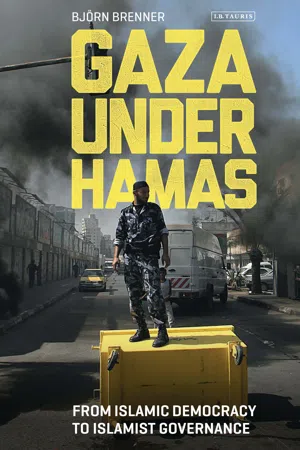
Hamas is designated a terrorist organization by Israel, the EU, the USA and the UN. It has made itself notorious for its violent radicalism and uncompromising rejection of the Jewish state. So after its victory in the 2006 elections the world was watching. How would Hamas govern? Could an Islamist group without any experience of power - and with an unwavering ideology - manage to deal with day-to-day realities on the ground? Bjorn Brenner investigates what happened after the elections and puts the spotlight on the people over whom Hamas rules, rather than on its ideas. Lodging with Palestinian families and experiencing their daily encounters with Hamas, he offers an intimate perspective of the group as seen through local eyes. The book is based on hard-to-secure interviews with a wide range of key political and security figures in the Hamas administration, as well as with military commanders and members of the feared Qassam Brigades. Brenner has also sought out those that Hamas identifies as local trouble makers: the extreme Salafi-Jihadis and members of the now more quiescent mainstream Fatah party led by Mahmoud Abbas.
The book provides a new interpretation of one of the most powerful forces in the Israel-Palestine arena, arguing that the Gazan Islamists carry a potential to be much more flexible and pragmatic than anticipated - if they would think they stand to gain from it. Gaza under Hamas investigates the key challenges to Hamas's authority and reveals why and in what ways ideology comes second to power consolidation.
- 272 pages
- English
- ePUB (mobile friendly)
- Available on iOS & Android
eBook - ePub
About this book
Information
1 ISLAMISTS IN POWER BY DEMOCRATIC MEANS: HAMAS IN PALESTINE
The 2006 elections to the Palestinian Legislative Council (PLC) saw the first democratic ascent to power by Islamists in the Arab world. In a landslide victory, the Islamic resistance movement in Palestine, Hamas, was catapulted from its former position of extra-parliamentary activism into the vortex of political power, assuming the role of government. Given the hitherto mixed outcomes of Islamists experimenting with democracy in other parts of the world, for instance in Africa and Asia, the question now was how governance by the first Arab Islamists to gain power by democratic means would turn out. Beyond Hamas’s own Islamist ideology and its electoral promises to govern democratically, what would Hamas’s governance come to mean in practice?
The eventual decision by Hamas to participate in the parliamentary process had followed several years of robust internal debate.1 Prior to the first Palestinian legislative elections in 1996, that debate had intensified; though, the movement had remained divided at the time, unable to go ahead with what many within the Hamas leadership were already arguing was a necessary shift in the movement’s role in Palestinian politics. However, almost 10 years later, the majority sentiment within the leadership was beginning to tilt in favour of electoral participation.
Eventually, the question was settled with a vote in the movement’s highest representative body, the majlis al-shura (consultative council). These various factors – Hamas’s decade-long internal debate, its internal settlement of the issue in a democratic fashion, as well as its subsequent demonstrated willingness to abide by democratic procedures in and around the 2006 elections – all pointed to a real potential for the movement, not only to respect electoral rules but also to play by the rules of the democratic game once in government, in the domestic arena.
The daunting task ahead of the first Hamas-led government was not only to cope with the diplomatic and economic isolation imposed on it by the international community, but equally to attend to the increasingly explosive tensions within the Palestinian National Authority (PA). Established as a consequence of the Oslo Accords2 in 1994, the PA had thus far been made up of individuals close to Fatah and the Palestine Liberation Organisation (PLO). The Fatah domination of the PA included both politicians and bureaucrats, notably the vast majority of judges, ministerial civil servants and law enforcement personnel. The new Hamas-led government was rendered politically impotent as bureaucrats loyal to Fatah refused to cooperate with and follow the instructions of the new government’s Hamas-affiliated ministers. Fatah’s attempts to counteract Hamas were also visible in the streets where violent clashes between the two factions’ activists were mounting in number and intensity day by day.
In addition to facing Fatah’s obstructive efforts and the broad sectors of the party that refused to accept electoral defeat, Hamas took over a PA that many considered to be permeated by a culture of corruption and clannish loyalties and whose authority was not respected by ordinary Palestinians.3 In the Gaza Strip, this lack of respect for the PA had taken the shape of lawlessness on the streets and a chaotic security situation. Ordinary Gazans avoided leaving their homes if it was not absolutely necessary, fearful of being hit by stray bullets or intimidated by corrupt policemen demanding money if they wanted to be left alone.4 It was in the midst of this uniquely chaotic and politically explosive situation that the first Hamas-led government assumed its duties.
In an ambitious reform programme known as the Government Platform, the new government laid out its path for political change and identified the most urgent challenges ahead. In the domestic arena, the most serious challenges related to the breakdown of security and the failure of the PA’s provision of services for the people under its control.5 The re-ordering of society, the re-establishment of the rule of law and the restoration of the supreme authority of the PA were the primary objectives of the new government. In fact, it was on this ticket that Hamas’s Change and Reform List had run in the election, winning the support of over 50 per cent of the Palestinian population. It is fair to say that restoring the fundamental social order was the most central concern of Palestinians at the time.
When asked to describe what its governance would be like, Hamas could point to its Government Platform, in which it called for a Palestinian state based on ‘political freedoms, pluralism, the freedom to form parties, to hold elections, and on the peaceful rotation of power.’6 This reformist programme even included numerous references to democratic styles of governance:
We [fully] realise that reinforcing shura (consultation) and democracy requires hard work: to impose the rule of law, renounce factional, tribal and clan chauvinisms, and lay the foundation for the principle of equality among people in terms of duties and rights. The government will work to protect the constitutional rights of all citizens so as to protect the Palestinian people’s rights and freedom.7
While calling for liberal democratic8 principles and values, at the same time Hamas strongly emphasised its Islamic identity and Islamic values as the underlying guide to all its political action. Its election manifesto had been explicit on this point: ‘Islam is our frame of reference and the system of all political, economic, social and legal aspects of life. […] Islamic sharia should be the principal source of legislation in Palestine.’9 And, while further on in its Government Platform Hamas made efforts to downplay religious motivations, the Islamic references were still present, although more subtly expressed:
May God help us in shouldering the trust given to us by our people. We promise our people, martyrs, prisoners, the wounded and freedom fighters, at home and in the Diaspora, that we will remain faithful to our principles, the values we have committed ourselves to. We will remain faithful to Palestine and its glorious history. We will also be faithful to Islamic tolerant values.10
As it appeared, Hamas was not simply aiming for democratic governance in a secular and liberal democratic sense, but opting to establish its own Islamist-modelled governing style, combining Islamic ideals with democratic principles – to form an Islamic democracy of sorts. Hamas argued that Islamic and democratic values could coexist in symbiosis within the same framework and that ‘Islamic-democratic’ governance could respect both sets of values equally. The Palestinian Islamist viewpoint (of Hamas) was that the concept of democracy was wholly compatible with, and could even exist within, the larger and more comprehensive framework of (political) Islam.11 One Hamas leader stated: ‘Democracy is inside Islam, there is no conflict between Islam and democracy.’12
Ongoing Debates in the Academic World and Among Policy Makers
Given the rare phenomenon of Islamists in power by democratic means, with Hamas being the first example in the Arab world, this government by Palestinian Islamists constituted both an experiment and an Arab showcase for what democracy situated within an Islamist ideological framework would mean in practice.13 Exploring the translation of Hamas’s form of Islamism into practice, this book simultaneously seeks to engage in and bring together two lively debates which thus far have largely remained separate.
The first is the broader debate on the level of compatibility of Islamism and liberal democracy. This debate has predominantly been a discussion about how democratic the input (ideological content) of Islamism actually is. Less has been said about the output: Islamists’ actual practices when ideas are translated into action. This has been the case even in those studies where scholars have emphasised the need to study what Islamists do and not only what they write or say.14 The additional fact that scholars assert that governments which have come to power by democratic means are the most likely to then also proceed to govern democratically15 makes Hamas and its governance in Gaza an especially interesting case to study. Such arguments about Islamist governance, taken together with Hamas’s own favourable view of the compatibility of Islam and democracy, appear to challenge those16 who dismiss the claims of such compatibility and, thus, raises a strong interest in seeing how the movement will actually behave when holding governmental office. The major questions in relation to this debate are, first, whether democratic governance is at all possible with Islamists in power and, second, what the Palestinian experience can tell us about this.
The second debate is about the political objectives of the Hamas movement per se and, notably, how to interpret its core values and what they stand for in practice. Is Hamas, as some17 argue, fundamentalist and inherently violent, or is it rather, as others18 assert, as capable of change and pragmatism as any other political actor? Democracy, at one extreme of this continuum, is a concept that relatively few would associate with an armed and violent group such as Hamas. The movement’s political activities, however, seem to have evolved over the years, from the bloody suicide bombings of the 1990s to the negotiated ceasefires of the present day and de facto recognition of and indirect talks with Israel.19 However, the gradual shift of focus during recent years, away from violent confrontation and towards domestic governance in Gaza, is still dismissed by many as a mere change of tactics taking place within the overall strategy of seeking to eradicate Israel and out-manoeuvre its main domestic rival, Fatah. This book seeks to contribute to this discussion by adding a new piece of the puzzle – how Hamas is governing its own people and shaping Gazan society.20
As a consequence of the remaining and relatively distinct disagreements in both debates, more research is needed on how these Palestinian Islamists succeeded in picking up the reins of government. The rising number of cases of such democratic ascents to power in recent years adds further urgency to this need – and underlines the relevance of this book. Earlier examples of Islamist governments, such as Iran, Afghanistan, Turkey, Pakistan, Algeria and Sudan, have recently been supplemented with new cases, notably in the Middle East and North Africa in the aftermath of what has been called the Arab Spring. Some contributors to the debate have even argued that these ‘mainstream’ Islamists21 show similarities with the Christian Democratic parties in Europe and ought to be able to develop in a similar way. Such a suggested development, towards a political symbiosis of Islam and democracy, has been referred to by some as Euro-Islam22 and by others, carrying similar connotations, as Demo-Islam.23 Others again have described the same phenomenon as an ‘alternate form of good governance’.24 Recent research claims that the Palestinian Islamists of Hamas have the potential to follow this Islamic-democratic path.25
Underlining its political relevance, this book addresses one of the most heavily discussed political subjects in the media and one of the most keenly followed political conflicts of our time among the public at large. One Islamic scholar who was interviewed for this book referred to the conflict between Israel and the Palestinians as ‘the mother of all conflicts’.26 Within this wider conflict, the book seeks to explore the behaviour of its perhaps most politically controversial actor, labelled as a terrorist group by some27 and as a freedom fighter by others28. While Hamas (or more specifically its military wing) is officially designated as a terrorist organisation by Israel, the EU, the USA and the UN, these same states and organisations are at the same time involved in secret backchannel talks with several of the movement’s top officials.29 Such conduct suggests an acceptance by the international community that Hamas is here to stay and that the organisation could well develop into an overt and widely accepted negotiating party some time in the future.
The policy debate pivots around this key question – whether or not to talk to Hamas.30 The crucial question from a policy point of view is of course what benefits talking overtly and directly to Hamas could yield politically. If, on the one hand, Hamas shows itself to be inherently violent and unable to undergo any substantial and lasting change, talking to Hamas would mean legitimising a terrorist group. If, on the other hand, Hamas were to demonstrate a real potential to act democratically, possibly even to undergo a more comprehensive form of democratic transformation, approaching and talking to Hamas would most likely further induce such behaviour. Talking to Hamas would then be preferable as it would serve the overall democratisation process in Palestine – that is, if Palestinian democratisation is what the international community is seeking to achieve.
The book builds on a large quantity of primary source material collected during the author’s several years of field studies studying the Hamas movement in the Levant – at firsthand in Syria, the West Bank and the Gaza Strip. Access to this otherwise secretive organisation was made possible through long-term fieldwork, conducted in the form of both field observations and interviews with key individuals, whilst living with and sharing the daily lives of Palestinian families affiliated with or in other ways connected to Hamas. The author’s years of fieldwork on location, taken together with several more recent interviews with the movement’s leaders as well as with the rank and file, have amassed a large set of primary data with the potential to give valuable insights into Hamas’s own self-conceptualisation, how it sees its own role in society and how it views the Palestinian-Israeli and Fatah-Hamas conflicts. It provides a novel localised perspective on how the ideological input of Islamist ideas is translated into output (political action) in the domestic arena in the Palestinian case.
Islamists and the West
The question of whether Islam and liberal democracy are at all compatible with one another has been the subject of contentious debate for several decades. Many scholars have questioned the extent to which Islamists have any theoretical potential, practical ability or intention whatsoever to respect democratic procedures and, particularly, the principles of liberalism.
The increasing worldwide interest in Islamism31 was first ignited by political developments in the Middle East during the 1970s and 1980s, notably the Iranian revolution, the assassination of Egyptian President Anwar Sadat and the emergence of several violent Islamist movements across the region. These dramatic events fuelled concern, particularly among Western policy makers who were anxious about any further development of political instability in the region. From their point of view, the emerging Islamist actors looked alien and dangerous. The values of Islam were largely unfamiliar in the West and the Islamists themselves appeared, from such a perspective, fanatically committed to their ideology. Hence, much of the outside inter...
Table of contents
- Cover
- Title Page
- Dedication Page
- Contents
- List of Illustrations
- Contributors
- Foreword by Shaul Mishal
- Preface and Acknowledgements
- Glossary of Terms
- Introduction
- 1 Islamists in Power by Democratic Means
- 2 Gaining Power and Relating to the Opposition
- 3 Radicalisation and the Emergence of Splinter Groups
- 4 The Deradicalisation of Islamists by Islamists
- 5 Social Order in the Midst of Political Chaos
- 6 The New Political Order and the Judicial System
- 7 Islamist Governance Hamas-Style
- 8 Hamas Beyond Elections and Governance
- Epilogue by Benedetta Berti
- Notes
- Bibliography
- Index
- Imprint
Trusted by 375,005 students
Access to over 1.5 million titles for a fair monthly price.
Study more efficiently using our study tools.
Frequently asked questions
Yes, you can cancel anytime from the Subscription tab in your account settings on the Perlego website. Your subscription will stay active until the end of your current billing period. Learn how to cancel your subscription
No, books cannot be downloaded as external files, such as PDFs, for use outside of Perlego. However, you can download books within the Perlego app for offline reading on mobile or tablet. Learn how to download books offline
Perlego offers two plans: Essential and Complete
- Essential is ideal for learners and professionals who enjoy exploring a wide range of subjects. Access the Essential Library with 800,000+ trusted titles and best-sellers across business, personal growth, and the humanities. Includes unlimited reading time and Standard Read Aloud voice.
- Complete: Perfect for advanced learners and researchers needing full, unrestricted access. Unlock 1.5M+ books across hundreds of subjects, including academic and specialized titles. The Complete Plan also includes advanced features like Premium Read Aloud and Research Assistant.
We are an online textbook subscription service, where you can get access to an entire online library for less than the price of a single book per month. With over 1.5 million books across 990+ topics, we’ve got you covered! Learn about our mission
Look out for the read-aloud symbol on your next book to see if you can listen to it. The read-aloud tool reads text aloud for you, highlighting the text as it is being read. You can pause it, speed it up and slow it down. Learn more about Read Aloud
Yes! You can use the Perlego app on both iOS and Android devices to read anytime, anywhere — even offline. Perfect for commutes or when you’re on the go.
Please note we cannot support devices running on iOS 13 and Android 7 or earlier. Learn more about using the app
Please note we cannot support devices running on iOS 13 and Android 7 or earlier. Learn more about using the app
Yes, you can access Gaza Under Hamas by Bjorn Brenner in PDF and/or ePUB format, as well as other popular books in History & Middle Eastern History. We have over 1.5 million books available in our catalogue for you to explore.