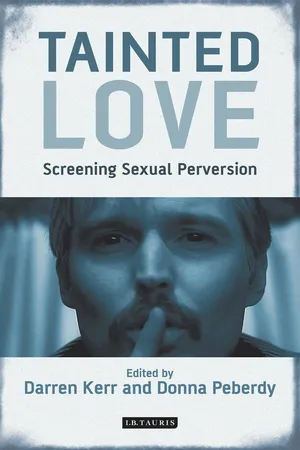
This is the first critical anthology to offer extended analysis of the representation of sexual perversion on screen. Interrogating the recent shift towards the mainstream in the cinematic representation of previously marginalised sexual practices, Tainted Love challenges the discourses and debates around sexual taboo, moral panics, degeneracy, deviance and disease, which present those who enact such sexualities as modern folk devils.
This timely collection brings together leading scholars who draw on a variety of critical approaches including adaptation, performance, cultural studies, queer theory, feminism and philosophy to examine screen representations of controversial sexualities from the weird and wonderful to the debased and debauched. Chapters explore provocative performances of hysteria and sexual obsession, 'everyday' perversion in neoliberal culture, the radical potential of sadomasochism, adolescent sexuality in the films of Larry Clark, intergenerational sex and incestuous relations in French cinema, sexual obsession in gay cinema, the straightness of necrophilia, the presentation of the paedophile, Swedish Erotica's 'good sex' and re-imagining the Marquis de Sade from film to slash fiction. In order to move past binary distinctions of good and bad, normal and abnormal, moral and immoral, Tainted Love seeks to critically interrogate perverse sexualities and sexual perversion on screen.
eBook - ePub
Tainted Love
Screening Sexual Perversion
- 304 pages
- English
- ePUB (mobile friendly)
- Available on iOS & Android
eBook - ePub
About this book
Information
II
Too Close for Comfort: Mainstream Perversion, Marginal Tastes
5
A Dangerous Method: Provocative Performances of Perversion
Donna Peberdy
In 2002, Bill Pullman – perhaps most recognised for his heroic and honourable performances as the President of the United States in science fiction blockbuster Independence Day (Roland Emmerich, 1996) and average man-next-door in the romantic comedies Sleepless in Seattle (Nora Ephron, 1993) and While You Were Sleeping (John Turteltaub, 1995) – took to the Broadway stage in a rather different role. ‘You have to realise that in the movie world, there’s the belief that the parts you play are somehow who you are. In Hollywood, you’re routinely told, “Don’t play a pedophile” ’, the actor commented in one interview.1 ‘With this play the transgression is even worse’, Pullman noted of Edward Albee’s domestic melodrama, in which he appeared as a husband who admits to having an affair with a goat. Pullman was initially reluctant to take on the role of a zoophile in The Goat, or Who is Sylvia? since it was such a departure from the ‘affable guy’ he played on screen. But he also saw theatre as a space where risks could and should be played out and where it was possible to ‘expand one’s understanding of humanity’.2 Hollywood, by comparison for the actor, was much more conservative in its treatment of sexuality. The risks were seemingly greater for actors playing sexually deviant characters on screen because taking on such roles may have a lasting impact on screen persona and reputation.
Given these ostensible risks, what is the attraction for an actor to take on such a role? For Pullman, playing a zoophile created a challenge to ‘find the dignity in this character’, in the hope that his performance would incite discussion and debate. The play’s message, Pullman believed, was that ‘we should feel compassion for those who have transgressed. We need boundaries, but sometimes we need to question those boundaries’.3 Echoing Pullman, Dylan Baker, who plays a paedophile in independent film Happiness (Todd Solondz, 1998), has commented that he hoped he would not ‘fall victim to typecasting’ but found the experience of getting into his Happiness character cathartic: ‘The ability to go in and really find the depths of this character was a little releasing and actually invigorating’, he noted, ‘it’s a very disturbing film, but at the same time I enjoyed myself immensely’.4 Similarly, Stanley Tucci has noted how ‘exciting’ he found the process of playing a child-molesting serial killer in The Lovely Bones (Peter Jackson, 2009). ‘Your whole organism tells you that you don’t want to do it’, Tucci responded when asked how he prepared for the role, continuing: ‘but you do want to do it, because it’s a fascinating study, and you want to create a real person’.5
The three actors express a shared aim to find and present something meaningful in their characterisations, in spite of their characters’ sexual perversions. The enjoyment and fascination in taking on such roles comes from playing characters who have transgressed social and sexual norms yet present the audience with a characterisation that may call into question previously-held assumptions and beliefs. The boundaries Pullman mentions refer to the boundaries of what is deemed normal and acceptable in terms of sexuality in society. But the roles also challenge the boundaries of representation and performance: what is at stake in playing a paedophile, a zoophile or other sexual perversion? The actors’ comments demonstrate how performing sexual perversion is already provocative due to the ostensible ‘risks’ and impact on persona.
I am particularly interested here in the provocative potential of the performance of sexual perversion. That is, the extent to which performance can impact how we understand sexual perversion and perverse sexualities. Acting in this context becomes the negotiation of risk and the transgression of multiple boundaries in order to raise questions and provoke discussion. To examine the implications of performing sexual perversion in more detail, this chapter focuses on two quite different case studies: Kevin Bacon’s performance of a convicted child molester in Nicole Kassell’s poignant and understated independent drama The Woodsman (2004) and Keira Knightley’s performance of sexual hysteria and sadomasochism in David Cronenberg’s cerebral historical fiction A Dangerous Method (2011). The two films feature actors performing sexual perversion in leading roles but it is how they perform their respective perversions that is especially significant. Both performances overwhelm their narratives in terms of impact, commanding attention beyond the film diegesis. Bacon and Knightley’s performances elicited more attention from reviewers than the films in which they appeared, which is unusual since acting is generally given short shrift in reviews. In this chapter, I explore how these performances not only engage with and challenge preconceived notions and stereotypes, but they also challenge the boundaries and norms of sexual identity and the performing body.
‘When will I be normal?’: Rehabilitating the Paedophile in The Woodsman
The Woodsman opens with convicted paedophile Walter’s release back into the community after serving 12 years in prison for molesting girls. The children, we find out later, were aged between nine and 14. Now in his mid-40s, Walter moves into an apartment that just so happens to overlook a school playground, only marginally further than the required 300 feet he must keep from children. He manages to find a job at a lumberyard, cautiously embarks on a relationship with straight-talking co-worker Vicki (played by Bacon’s wife Kyra Sedgwick), all the while being monitored by parole officer Sergeant Lucas (Mos Def ) and counselled by therapist Rosen (Michael Shannon). The film follows Walter’s rehabilitation from his perspective as he battles with both his sexual and social identity. His role clearly sits alongside other characterisations of sexual transgressors by the actor, including a child kidnapper in Trapped (Luis Mandoki, 2002), a gay prostitute in JFK (Oliver Stone, 1991), a stalker in In the Cut (Jane Campion, 2003) and a corrupt prison guard in Sleepers (Barry Levinson, 1996), who recurrently subjects the young male teens under his watch to verbal, physical and sexual abuse. In bringing its sexual transgressor centre stage, The Woodsman stands apart from these earlier films and others released around the time, such as L.I.E. (Michael Cuesta, 2001), Mystic River (Clint Eastwood, 2003), Mysterious Skin (Gregg Araki, 2004) and Little Children (Todd Field, 2006), that tell their stories from the perspective of the child victim or wider community. In doing so, The Woodsman gives space to explore a complex sexual identity typically presented as a straightforward stereotype.
‘ “The paedophile” is a concept’, writes Jenny Kitzinger, ‘enmeshed in a series of crass stereotypes which place the child sexual abuser “outside” society’. She continues, ‘In the tabloid press abusers are “animals”, “monsters”, “sex maniacs”, “beasts” and “perverts” who are routinely described as “loners” and “weirdos”. ’6 The ‘plethora of words’ used to describe the paedophile, as Carol-Ann Hooper and Ann Kaloski argue, conceals a ‘poverty of meaning’.7 Nonetheless, the paedophile has emerged ‘as arguably the most feared and vilified of all “predatory strangers” ’.8 The fictionalised paedophile has become increasingly visible on screen in the last two decades and is a character very much constructed and read via the popularised discourses presented to us by the mainstream media. He (rarely she) is most often a subsidiary figure, antagonist and villain, lurking in cinema’s shadows and alleyways; never the protagonist. The mainstream screen has historically inscribed the paedophile with deviance, dysfunction and danger, projecting the ‘unrepresentable’ act of child sexual abuse onto a physical form.9 He is rendered in narrow visual terms as an evil stranger, a predator prowling children’s playgrounds and stalking internet chat rooms, a pathological other and modern-day folk devil. He is, simply, a threat to children and a threat to society.
The Woodsman was released amid tabloid name-and-shame campaigns and media vigilantism in response to high-profile sexual assault and murder cases in the US and UK involving ‘known’ paedophiles.10 In many respects, the film conforms to the prevailing discourse around the ‘paedophile in the community’ and ‘stranger danger’ rhetoric that considers paedophiles as ‘inherently recidivist’ and ‘beyond the capacity for rehabilitation’.11 ‘While popular knowledge jars with the relatively low re-offending rates of child sexual offenders’, Simon Cross writes, ‘public concerns about paedophiles have become absorbed within a rhetoric of contemporary punitive populism reinforced by the popular press and other agencies’.12 The film knowingly constructs a familiar backdrop for its paedophile narrative in placing Walter literally overlooking a school playground, establishing him as a loner who keeps himself to himself at work, spends his time alone in his apartment or follows young girls he sees on the bus. He expresses his desire to ‘be normal’ in therapy sessions but he is not sure what that means or how to achieve it. Responses to Walter’s rehabilitation are differently articulated through minor characters: a receptionist at the lumberyard discovers Walter’s prior conviction and circulates his release sheet under the premise that ‘people have the right to know’; he is vilified by his parole officer, who is convinced it is only a matter of time before Walter re-offends; his brother-in-law vocalises his support for Walter and his recovery but is not comfortable having Walter attend his daughter’s birthday party.
Bacon’s motivation in taking on the role directly engages with two competing discourses around the paedophile: the popularised image of the predatory stranger and the statistical reality that paedophiles are often close relations, acquaintances or known in some other capacity.13 In an interview with the BBC, the actor noted:
These guys don’t have horns. If they were monsters we could send a superhero out to kill them, or a guy with a big sword – and that would make life a lot easier. The reality is much, much more frightening than that – they are friends of the family, in our churches, in our schools, riding on the bus next to us.14
Bacon commented in numerous interviews that his intention was to make Walter ‘human’: ‘I didn’t want anything sort of special about him, a crazy look in his eyes, a leer’.15 His comments reveal an intention to present a provocative character, one that goes against the standard script for the sex offender and seeks to unravel the popularised image of the paedophile. If, as Anne-Marie McAlinden has argued, ‘the fact child sex offenders may be “of us” rather than “other than us” is a deeply unpalatable truth for society to countenance’, it is Walter’s proximity, rather than otherness, that is the most disconcerting.16
Significantly, we find out very little about his character’s motivations. We are not given a backstory that explains why Walter molested young girls. Bacon’s performance is all we have in deciding whether or not Walter can successfully enter back into society. The actor worked with director Nicole Kassell in pre-production to strip back the dialogue from Steven Fechter’s original play in order to allow emotion to be expressed via his gestures and expressions rather than words. ‘I wanted to take his sadness, shame, history, his 12 years in prison, all that kind of stuff and put it in my belly and then find ways to let it out, through the eyes or voice or whatever’, the actor noted.17 His construction of an ambivalent, tormented man is all the more unsettling as a result.
Throughout the film, Bacon’s performance is characterised by self-consciousness, awkwardness and torment. His eyes are often the locus of anguish; conflict is portrayed via searching glances, darting pupils and downward glances at the floor, suggesting shame and unease. The cinematography amplifies Bacon’s performance of introspection, juxtaposing expressions of doubt and worry with close-ups of splashing water on his face and extended glances into mirrors. We wonder what Walter is thinking as we watch him silently watching himself. Vicki also watches Walter, trying to read him. ‘I used to think you were shy but now I think it’s something else’, she tells him after giving him a lift home from work, ‘something happened to you’. Her perceptiveness regarding Walter reveals her own past traumas and encourages Walter to disclose his ‘deep, dark secret’. ‘I’m not easily shocked’, she states matter-of-factly, all the more intrigued after their first, ‘intense’ sexual encounter. When Walter later confesses that he molested girls, we read him via Vicki’s reactions to his confession as she tries to comprehend the implications of what she is hearing. His confession is delivered calmly, his voice is measured but he avoids eye contact. ‘It’s not what you think’, Walter says, ‘I never hurt them. Never’. His res...
Table of contents
- Front Cover
- Title Page
- Copyright Page
- Contents
- List of Illustrations
- Acknowledgements
- Introduction: A Prelude to Perversion
- I REVILED BODIES: FANTASIES, REALITIES AND THE BOUNDARIES OF THE EXPLICIT
- II TOO CLOSE FOR COMFORT: MAINSTREAM PERVERSION, MARGINAL TASTES
- III COMING OF AGE: GENERATIONAL ENCOUNTERS AND DANGEROUS LIAISONS
- IV SEXUAL INFIDELITY: ADAPTING THE DEVIANT, RE-IMAGINING THE PERVERSE
- Filmography
- Select Bibliography
- List of Contributors
Trusted by 375,005 students
Access to over 1.5 million titles for a fair monthly price.
Study more efficiently using our study tools.
Frequently asked questions
Yes, you can cancel anytime from the Subscription tab in your account settings on the Perlego website. Your subscription will stay active until the end of your current billing period. Learn how to cancel your subscription
No, books cannot be downloaded as external files, such as PDFs, for use outside of Perlego. However, you can download books within the Perlego app for offline reading on mobile or tablet. Learn how to download books offline
Perlego offers two plans: Essential and Complete
- Essential is ideal for learners and professionals who enjoy exploring a wide range of subjects. Access the Essential Library with 800,000+ trusted titles and best-sellers across business, personal growth, and the humanities. Includes unlimited reading time and Standard Read Aloud voice.
- Complete: Perfect for advanced learners and researchers needing full, unrestricted access. Unlock 1.5M+ books across hundreds of subjects, including academic and specialized titles. The Complete Plan also includes advanced features like Premium Read Aloud and Research Assistant.
We are an online textbook subscription service, where you can get access to an entire online library for less than the price of a single book per month. With over 1.5 million books across 990+ topics, we’ve got you covered! Learn about our mission
Look out for the read-aloud symbol on your next book to see if you can listen to it. The read-aloud tool reads text aloud for you, highlighting the text as it is being read. You can pause it, speed it up and slow it down. Learn more about Read Aloud
Yes! You can use the Perlego app on both iOS and Android devices to read anytime, anywhere — even offline. Perfect for commutes or when you’re on the go.
Please note we cannot support devices running on iOS 13 and Android 7 or earlier. Learn more about using the app
Please note we cannot support devices running on iOS 13 and Android 7 or earlier. Learn more about using the app
Yes, you can access Tainted Love by Darren Kerr, Donna Peberdy, Darren Kerr,Donna Peberdy in PDF and/or ePUB format, as well as other popular books in Media & Performing Arts & Film & Video. We have over 1.5 million books available in our catalogue for you to explore.