The Polar North is known to be home to large gas and oil reserves and its positionholds signifi cant trading and military advantages, yet the maritime boundaries of the region remain ill-defined. In the twenty-first century the Arctic is undergoing profound change. As the sea ice melts, a result of accelerating climate change, global governance has become vital.
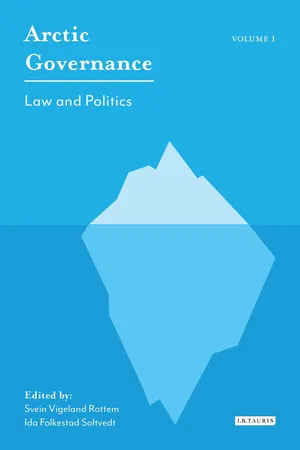
In this first of three volumes, the latest research and analysis from the Fridtjof Nansen Institute, the world's leading Arctic research body, is brought together. Arctic Governance: Law and Politics investigates the legal and political order of the Polar North, focusing on governance structures and the Law of the Sea. Are the current mechanisms at work effective? Are the Arctic states' interests really clashing, or is the atmosphere of a more cooperative nature? Skilfully delineating policy in the region and analysing the consequences of treaty agreements, Arctic Governance's uncovering of a rather orderly 'Arctic race' will become an indispensable contribution to contemporary International Relations concerning the Polar North.
eBook - ePub
Arctic Governance: Volume 1
Law and Politics
- 288 pages
- English
- ePUB (mobile friendly)
- Available on iOS & Android
eBook - ePub
Arctic Governance: Volume 1
Law and Politics
About this book
Information
PART I
GOVERNANCE
CHAPTER 1
THE DYNAMICS OF ARCTIC DEVELOPMENT
Introduction
The Arctic is undergoing change, some changes are abrupt, others more gradual. Important is also the changing perceptions of the Arctic. This chapter takes stock of the development in the Arctic with the overarching aim to answer the question: What is the prevailing view of the situation in the Arctic compared with commonly held views a decade or so ago?
The Natural Environment and Climate Change
The most visible and striking change in the Arctic over the last decade has been the shrinking ice cover caused by global warming. Over the last three decades the ice cover in September – when it is at its smallest - has shrunk by about 30 per cent.2 Other dramatic climate related impacts are increasing runoff from the Greenland ice cap, melting permafrost and extreme weather.
The Arctic undergoes annual seasonal changes more dramatic than found elsewhere.3 The temperature in some places can vary by 50 degrees Celsius in the course of the year. The extent of sea ice reduces by approximately 70 per cent from winter to summer, and the land which is covered by snow in winter experiences rich flora during the summer months. Fauna and flora have adapted to the seasonal variations, but not necessarily to the longer-term climate changes. The average temperature in the Arctic is increasing twice as fast as elsewhere in the world. But even if some changes are affecting the whole Arctic, it is important to know that conditions in different parts of the Arctic vary widely. Some would say, there is not one Arctic, but many Arctics. Most of the Norwegian part of the Barents Sea is, for instance, not affected by ice, unlike other parts of the Arctic at the same latitudes.
In the ocean, the ice-covered area grows and shrinks throughout the year, reaching a maximum in March and a minimum in September. The minimum area has in recent decades been shrinking at the rate of about 10 per cent per decade, but with large annual variations. The minimum sea ice in 2014 was the sixth smallest in recorded history.4 If this trend continues, the Arctic Ocean will be nearly ice-free in late summer within the next few decades. Sea ice plays a critical role in the lives of large animals, like polar bears, seals and walruses, as well as for the algae and plankton on which many Arctic birds, whales and fish stocks depend. Numerous ecosystems, on land and in the ocean, are found exclusively in the Arctic.
The Greenland ice sheet is also losing mass over time, since more ice is ‘calving’ from the glaciers, than new ice being formed. Whereas the waters surrounding Greenland are infested with icebergs, other areas of high Arctic activity, such as the Norwegian coast, are not affected.
Both the considerable climate variability and longer-term climate trends affect the prospects for economic activity over time. In the ocean, the reduction in sea-ice cover facilitates shipping, but higher air temperatures reduce permafrost and threaten to soften the ground, enough to hamper land-based transport and construction. In the atmosphere, the pressure difference between North Atlantic and Arctic air systems can cause severe winter weather in Europe and eastern North America at the same time as the Arctic itself experiences very mild weather. Similar effects are at play in Asia.
Industrial Development
Expectations for economic development grew rapidly in the early 2000s. In 2008 the United States Geological Survey (USGS) estimated that the Arctic might contain 13 per cent of the world's undiscovered oil and 30 per cent of its undiscovered gas.5 Of these hydrocarbon resources, 84 per cent were believed to be offshore, mostly in waters less than 500 meters deep. The resources are not evenly distributed: the highest concentrations are expected to be in north of Alaska and in the western part of Russia's Arctic. Russia's expected hydrocarbon resources in the Arctic are the largest outside of the OPEC countries.
The resources listed in these assessments are undiscovered – a fact often overlooked. They are geological probabilities based on sometimes relatively weak data, and comparisons with other regions with similar geological structures. Extensive and long-term exploration is required to actually locate and confirm reserves. Also, the assessments are based on the criterion that the resources can be extracted with the use of existing technology, but they do not take into account cost factors. As always with assessments of mineral resources – what can actually be produced is dependent on the relationship between the extraction cost and the international price of the commodity.6 The numbers from USGS continue to be misunderstood and misused, and with the unconventional gas and oil revolution, which to a large extent has happened after 2008, the percentage base in the USGS assessments becomes almost meaningless since it includes only the world's undiscovered conventional resources.
Nonetheless, there is a high potential for large mineral resources in parts of the Arctic, which remains a basic driver for industrial interest in the region. A decade ago, the development of hydrocarbons offshore and new onshore mineral projects was expected to take off. In 2008 Russia's Gazprom, Total of France and Statoil from Norway agreed to jointly develop the giant Shtokman gas condensate field in the Russian part of the Barents Sea. The project was huge in itself, but the companies also saw it as a bridgehead to the development of additional Arctic fields, which were regarded as a major future source of supply for the Atlantic LNG market as well as pipeline gas to the European continent.7 After spending more than US $ 1 billion in preparations, the companies concluded in 2012 that the project would have to be stopped. There were problems along the way, cost increases, and disagreement over technical solutions; but it was the gas market that was the straw that broke the proverbial camel's back. The rapid expansion of shale gas production in the United States took the whole world by surprise. The US went from being the world's largest importer of LNG to becoming a prospective exporter. This also had repercussions for other markets, since producers of LNG who had ramped up their output plans in anticipation of booming US imports now had to look for other outlets; for example in Europe, putting pressure on the price, and not least changing the long-term price outlook, which was vital for Shtokman and other expensive Arctic projects.
Whereas the shale gas revolution with ensuing over-supply and falling prices made much of the Arctic gas unprofitable, Arctic offshore oil was still regarded as commercially attractive. However, increasing costs and technological complications made the oil companies less aggressive than expected and, the speed and force of Arctic offshore oil development have abated in recent years. This is especially true for Alaska, but also in other parts of the Arctic there are concerns over costs – partly caused by stronger attention to environmental protection. Rising costs are a problem for the oil industry everywhere, but particularly painful in areas that already have high cost, and perhaps marginal profits like the Arctic. A prime example of the complications was the repeated delays in Shell's drilling campaign in the Alaskan offshore. The company withdrew from the Alaskan offshore in 2015, after having spent some 7 bill. USD there.8 Lower intensity in Arctic offshore development was well underway when the oil price was high. With oil prices well under US $100 per barrel, the speed of development is expected to decrease further. Oil companies maintain that the present low oil price does not affect exploration plans, since that process will take years and if results are positive, commercial production can only be envisaged some 15-20 years into the future. Logically, it is the price at that point and further on, that matters, and not today's prices. Nevertheless, the current low oil price is affecting the financial situation of oil companies and is making them scale back costly exploration projects. Some will also argue that in an emission constrained world, regulations that will affect the profitability of oil production are likely to be in place at the time Arctic fields have come on stream – something that changes the commercial calculations for long-term investment today.
An argument in favour of development of Arctic petroleum has been diversification of supply sources. This is still a valid argument for some countries, but in general, ample supplies of oil and gas from other regions mean that the Arctic has lost some of its significance in this regard. Big consumers like China and India have a wider choice of suppliers now, and even if interested in more diversification, it seems unlikely that they would pay more for supplies from one particular region, than from others.
There are big differences in the role of the government as well as organization of offshore petroleum activity in the various Arctic coastal states. In the US, Canada and Greenland the initiative is clearly in private hands. In Norway and Russia, the state is more directly involved, through its ownership in dominant companies as well as state development priorities. But in all countries national policies are important, pushing or holding back development, and each major investment project has its specifics.
In the Alaskan Arctic, security of supply and diversification of supplies used to be important political arguments favoring rapid offshore expansion. They have more or less disappeared now, which means that environmental counter-arguments have, in relative terms, become stronger. Nonetheless, it is the commercial assessment, as mentioned above, that is most important. In Canada there is no political push for Arctic offshore development. The oil industry in Alberta in southern Canada is booming and there are complications related to devolution of governance to the territories in the Canadian North which introduces an element of uncertainty in development, even if the offshore resources themselves are under federal jurisdiction. Also in Canada there is resistance on environmental grounds.
The strongest public support for increased activity seems to be in Greenland, as petroleum development is regarded as a prerequisite to establish a self-sustained economy – and on that basis, full independence from Denmark. But in Greenland also, there is a debate on the merits of offshore expansion.
In Norway, where petroleum production is the biggest sector of the economy, a logical argument for Arctic expansion is the need to sustain the oil industry, as production in fields further south is declining. But a strong environmental opposition has led to limiting areas which are to be opened for exploration and an increasingly heated debate related to the environmental consequences of continued reliance on petroleum is taking place.
Russia is highly dependent on petroleum revenues and the Arctic has been proclaimed as the resource base of the 21st century. The environmental opposition to Arctic drilling is minimal in Russia. After long hesitation and contradictory policies, a series of agreements were concluded between the state controlled oil company Rosneft and Western oil companies to explore and ultimately develop Arctic's offshore resources. Of these partnerships the alliance with ExxonMobil was the largest. The sanctions imposed by the US and EU after Russia's annexation of Crimea and support to separatists in Eastern Ukraine have more or less brought the Arctic offshore campaign to a stand-still, after very promising results were received in the first well drilled in the Kara Sea in August 2014. Rosneft maintains that it has alternative partners who can replace the Western majors, but there is much uncertainty of how reliable this claim is. In any case, Russia must also reconsider its policies in light of the low oil prices and it also has onshore alternatives that may be commercially more attractive.
Shipping
The Northern Sea Route (NSR) is the Russian term for the sea route between the Kara Gate in the west and the Bering Strait in the east – out to 200 nautical miles. It overlaps with, but is not the same as the Northeast Passage - the historical term for the sea passage between the Atlantic and the Pacific, north of Russia. Russia has established regulations for shipping in the NSR area based on Article 234 of the 1982 United Nations Convention on the Law of the Sea (UNCLOS), which gives the coastal state special regulatory rights in partly ice-covered areas, as well as historical rights.
Russia opened the NSR for international traffic in 1991, but little happened because the shipping industry found the environment too harsh and the commercial terms unattractive, despite the obvious lure of the sea route - shorter distance, and reduced sailing time between the Pacific and the Atlantic. Less than ten years ago there was still no international traffic along the NSR. But climate change and less sea ice had made the shipping industry pay clos...
Table of contents
- Front Cover
- Title Page
- Copyright
- Contents
- Illustrations
- Introduction
- Part I: Governance
- Part II: Law of the Sea
- Part III: The Arctic Council
- Epilogue
- Bibliography
Trusted by 375,005 students
Access to over 1.5 million titles for a fair monthly price.
Study more efficiently using our study tools.
Frequently asked questions
Yes, you can cancel anytime from the Subscription tab in your account settings on the Perlego website. Your subscription will stay active until the end of your current billing period. Learn how to cancel your subscription
No, books cannot be downloaded as external files, such as PDFs, for use outside of Perlego. However, you can download books within the Perlego app for offline reading on mobile or tablet. Learn how to download books offline
Perlego offers two plans: Essential and Complete
- Essential is ideal for learners and professionals who enjoy exploring a wide range of subjects. Access the Essential Library with 800,000+ trusted titles and best-sellers across business, personal growth, and the humanities. Includes unlimited reading time and Standard Read Aloud voice.
- Complete: Perfect for advanced learners and researchers needing full, unrestricted access. Unlock 1.5M+ books across hundreds of subjects, including academic and specialized titles. The Complete Plan also includes advanced features like Premium Read Aloud and Research Assistant.
We are an online textbook subscription service, where you can get access to an entire online library for less than the price of a single book per month. With over 1.5 million books across 990+ topics, we’ve got you covered! Learn about our mission
Look out for the read-aloud symbol on your next book to see if you can listen to it. The read-aloud tool reads text aloud for you, highlighting the text as it is being read. You can pause it, speed it up and slow it down. Learn more about Read Aloud
Yes! You can use the Perlego app on both iOS and Android devices to read anytime, anywhere — even offline. Perfect for commutes or when you’re on the go.
Please note we cannot support devices running on iOS 13 and Android 7 or earlier. Learn more about using the app
Please note we cannot support devices running on iOS 13 and Android 7 or earlier. Learn more about using the app
Yes, you can access Arctic Governance: Volume 1 by Ida Folkestad Soltvedt, Svein Vigeland Rottem, Ida Folkestad Soltvedt,Svein Vigeland Rottem in PDF and/or ePUB format, as well as other popular books in Politics & International Relations & Trade & Tariffs. We have over 1.5 million books available in our catalogue for you to explore.