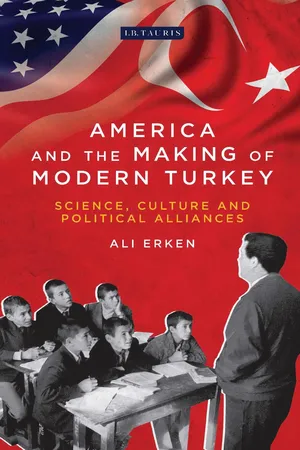
eBook - ePub
America and the Making of Modern Turkey
Science, Culture and Political Alliances
- 288 pages
- English
- ePUB (mobile friendly)
- Available on iOS & Android
eBook - ePub
About this book
After the fall of the Ottoman Empire, Mustafa Kemal Ataturk's government encouraged substantial American investment in education and aid. It was argued that Turkey needed the technical skills and wealth offered by American education, and so a series of American schools was set up across the country to educate the Turkish youth. Here, Ali Erken, in the first study of its kind, argues that these organizations had a huge impact on political and economic thought in Turkey - acting as a form of `soft power' for US national interests throughout the 20th Century. Robert College, originally a missionary school founded by US benefactors, has been responsible for educating two Turkish Prime Ministers, writers such as Orhan Pamuk and a huge number of influential economists, politicians and journalists. The end result of these American philanthropic efforts, Erken argues, was a consensus in the 1970s that the country must `westernize'. This mindset, and the opposition viewpoint it engendered, has come to define political struggle in modern Turkey - torn between a capitalist `modern' West and an Islamic `Ottoman' East. The book also reveals how and why the Rockefeller and Ford foundations funneled large amounts of money into Turkey post-1945, and undertook activities in support of `Western' candidates in Turkey as a bulwark against the Soviet Union. This is an essential contribution to the history of US-Turkish relations, and the influence of the West in Turkish political thought.
Information
CHAPTER 1
SCIENCE AND MEDICINE:
PILLARS OF REPUBLIC
PILLARS OF REPUBLIC
– the war is over but social, economic, and health problems are of the most urgent nature … Some of the diseases which plague Turkey are the result of our social standards, superstitions and systems of education. If we do not bring about radical change in our social affairs, it is impossible to advance in civilization. We cannot administer new organisms with the old mentality. We have to make our people acquainted with modern social precepts … We know very well that sanitary organizations are expensive and require specialists and all that, but necessity knows no law. The greatest calamity threatening our nation and public health is malaria. In some circles, it is declared that malaria is causing more destruction in Turkey than either syphilis or tuberculosis … Hakimiye-i Milliye
The Rockefeller Foundation and Pioneers of Scientific Medicine
Frederick Gates, born in 1853, was working as a Baptist minister in Minnesota when he met John D. Rockefeller in 1888. Gates had ambitions to found a University dedicated to the training of Baptist ministers and presented his plan to John D. Rockefeller.1 As a result, the University of Chicago was founded in 1892, thanks to a considerable donation by Rockefeller.2 Soon after Frederick Gates accepted an offer from John D. Rockefeller for coordinating his charitable activities and opened an office for him in New York in 1891.3 In the 1890s, John Rockefeller Jr decided to take an active role in his father's work, but he started with philanthropy and assumed a position at the New York office with Frederick Gates.4 John Rockefeller Jr and Gates turned their attention to the Southern states and proposed the foundation of a new philanthropic enterprise to help children living in the South. This initiative resulted in the establishment of the General Education Board in 1902 with $10 million of funding from John Rockefeller Jr.5 Gates also had a strong interest in the field of medicine and persuaded Rockefeller to set up the Rockefeller Institute for Medical Research in 1901.6 In charge of Rockefeller's expanding wealth, Gates played the leading role in the establishment of the Rockefeller Foundation (RF) in 1913. The Rockefeller Foundation was to channel its resources for the improvement of education and health under its official mission: “the advancement of human knowledge and the benefit of human welfare”.7 A year later, the International Health Division (IHD) within the Rockefeller Foundation was launched and quickly became the largest civil organisation in public health.8 In the first 30 years of its operations, the IHD was primarily concerned with the eradication of the hookworm virus, malaria and yellow fever in nearly 80 countries.9 There were, however, senior critics and skeptics of the Rockefeller's increasing interest in charitable works. For example, his donation of $600,000 to the University of Chicago10 in 1890 coincided with the passing of the Sherman Anti-Trust Act, restricting monopolistic practices against competition in the market, which would hit the Standard Oil.11 Donating his money to charitable activities would help Rockefeller evade paying higher income taxes and change his public image as a self-interested capitalist businessman.
Gates was obviously the mastermind behind deciding the fields of operation where the Rockefeller wealth would be distributed. He did not only seek to provide better treatment for the sick and expand the means of education, but also intended to shape social needs and preferences. As a former Baptist minister and lecturer at a Baptist Seminary, he became increasingly interested in scientific medicine, which he felt changed his approach towards the human mind and society. He seemed to be startled by the pace of scientific discoveries in medical science and the transformative force of scientific findings in human and social behaviour. In his memoirs, he wrote: “I had begun to realize how woefully neglected in all civilized countries and perhaps most of all in this country had been the scientific study of medicine.”12
Gates began to relate the developments in scientific medicine to the changing needs of modern industrial capitalism. He believed that other methods of medical treatment such as herbal cures, osteopaths, orthodox medicine, and homeopathy had served humanity a lot, but modern science surpassed them.13 In the modern world mystical medical practices or “quacks” would no longer function well and human beings could find better ways of treatment through scientific medicine. Moreover, modern medicine tended to see the human body as an organism similar to that of an industrial force, which could work more efficiently through preventive measures.14 According to Gates, a close follower of the ideas of William H. Welch, the founder of the John Hopkins School of Public Hygiene, healthier individuals would make up a stronger work force and increase the efficiency of production.15 In a speech at the Rockefeller Institute, William H. Welch argued that thanks to the advancement of scientific medicine:
Great industrial activities of modern times, efforts to colonize and to reclaim for civilization vast tropical regions, the immense undertaking to construct the Panama Canal were accomplished.16
Gates witnessed industrial transformation in his time and sought to combine scientific discoveries with social needs. He ascribed to medicine a role that would substitute for religion in social relations as he thought scientific medicine could instate “new moral laws and new social laws, new definitions of what is right and wrong in our relations with each other”.17 Scientific medicine could help repair maladies of social life, and serve as a means for accomplishing a wider social transformation. In line with these views, the Rockefeller Foundation was to serve:
… to advance the civilization of the United States and its territories and possessions and of foreign lands in the acquisition and dissemination of knowledge in the prevention and relief of suffering and in the promotion of any and all the elements of human progress.18
The International Health Board was itself undergoing a transformation after the World War under Wickliffe Rose, director of the Rockefeller Foundation's International Health Division from 1915 to 1923. In the foundational reports, the original purpose of the IHD19 had been stated:
Its immediate object was to extend measures for the relief and control of hookworm disease to countries throughout the World, and to follow up these measures with efforts to assist in the establishment of permanent agencies for public sanitation and spreading the knowledge of scientific medicine.20
In another statement, Rose remarked:
… all-important fields of activity call for an understanding of the spirit and technique of modern science, which is the method of knowledge. It is key to such dominion as man may ever exercise over his physical environment … appreciation of its spirit and technique determines mental attitude of a people, affects the entire system of education, and carries with it the shaping of a civilization.21
In the following years, especially after 1928, this purpose shifted towards the “accumulation and application of useful new knowledge” and the field of preventive medicine received more attention.22 Rose was of the opinion that medical science had “outstripped” its application and for that reason the IHD had to focus its attention on the spread of scientific medicine to deliver its benefit to the people in need of this service.23 In various countries surveys were carried out as Rose insisted that the use of scientific methods and collecting different cases were essential in developing a proper treatment for diseases.24 Rose also urged that fieldwork should be done through governments so as not to undermine the authority of government officials.25 The establishment of the Johns Hopkins University School of Hygiene and Public Health was another significant step, as it became a centre of training for American and foreign fellows. The IHD fellowships and institutional aids expanded so far that a number of new health centres in Europe, including Turkey, were established with Rockefeller funding.
The Rockefeller Foundation, as suggested by Gates and Rose, ascribed a pioneering role in the dissemination of scientific medicine to the rest of the world. The first and most serious investment was the opening of the Chinese Medical Board in 1914, just a year after the foundation of the Rockefeller Foundation. Rockefeller's interest in China had actually started almost a decade before owing to Gates' appreciation of the Christian missionaries who had established the Beijing School of Medicine in 1906.26 In 1908 Ernest Burton,27 appointed as the head of the Oriental Education Commission funded by Rockefeller to assist Christian missions in the region, proposed the foundation of a university in China on the same model as the University of Chicago.28 It seems that missionary activities and religious service gradually became less of a concern for the Rockefeller operations in the region. Gates himself started to treat scientific medicine as a more instrumental tool than religious missionaries in the expansion of Western civilisation, and in Wickliffe Rose's view, science was the primary determinant in shaping people's mental attitude. In a speech he made in 1921 at a ceremony at the Peking Union Medical College, John Rockefeller explained the Beijing School of Medicine's cause, referring to its role in bringing the “best of Western civilization in mental development and spiritual culture”.29 Charles Elliot, President of Harvard University, and Abraham Flexner, one of the prominent officers of the General Education Board, complained of a lack of inductive reasoning among the Chinese people, which was crucial to the Chinese path to modernisation.30 The introduction of scientific medicine into “tradition-bound China” was, thus, the first step in a wider project of cultural transformation through the diffusion of scientific norms.31
The Rockefeller Foundation initiated its activities in Turkey in the fields of health and medical service in the early 1920s. The late Ottoman reforms in medicine had played a pioneering role in Ottoman modernisation. Sultan Mahmud II's efforts to revise the study of medicine in the Empire involved the opening of the Mekteb-i Askeriye-i Tıbbiye, the first medical school, in 1837. Instructors and men of medicine from Europe were to teach at the medical school and, despite criticism, the Sultan was insistent that the language of instruction would be French instead of Arabic.32 Already incensed with these reforms, the religious elite in the Empire raised opposition to the teaching methods at the school. The instructors were however keen to follow the applications in Europe and demanded the practice of autopsy on human corpses, strongly denounced by the Ulama as unlawful. Sultan Mahmud defied these criticisms again and summoned an imperial decree approving the medical examination of human corpses for medical teaching.33 The Ulama's standing towards vaccination and quarantine was similar to that of autopsy, but each of these practices were later introduced to the medical school.34 Actually in the late nineteenth century intellectual circles in the Ottoman Empire were preoccupied with bridging science and religion. In Ilmihal-i Tıbbı, a famous book published in 1897 by Hüseyin Remzi, a graduate of the Imperial School of Medicine who was sent to France to meet Louis Pasteur for advanced training, it was strongly argued that Islamic deeds were compatible with the teaching of modern medicine.35 Religion was still the source of knowledge that needed further examination with the help of recent scientific findings. On the other hand, during his visit to Istanbul in the mid-nineteenth century, MacFarlane, a British travel writer, observed that many of the students in mekteb-i tıbbiye were reading the books of French and German thinkers, some of whom defended atheism.36 Not an admirer of the French enlightenment, MacFarlane seemed surprised by the appeal of the enlightenment philosophers of the time to the young Turkish students of the medical school.37 Abdullah Cevdet, for example, a student at the medical school, then a leading member of the Young Turks movement, was deeply impressed with the works of the French philosopher Le Bon. Born into an ulama family Abdullah Cevdet, similar to Frederick Gates, changed his views on the role of science in society and started to attribute to it a greater role in social life.38 Like him, many of the Young Turks were very impressed by German materialism and scientific Darwinism, believed in th...
Table of contents
- Front Cover
- Title Page
- Copyright
- Dedication
- Contents
- Preface
- Introduction
- 1. Science and Medicine: Pillars of Republic
- 2. Remedies of Underdevelopment
- 3. The Age of Experts
- 4. Humanities and Westernisation
- Conclusion
- Notes
- Bibliography
Trusted by 375,005 students
Access to over 1.5 million titles for a fair monthly price.
Study more efficiently using our study tools.
Frequently asked questions
Yes, you can cancel anytime from the Subscription tab in your account settings on the Perlego website. Your subscription will stay active until the end of your current billing period. Learn how to cancel your subscription
No, books cannot be downloaded as external files, such as PDFs, for use outside of Perlego. However, you can download books within the Perlego app for offline reading on mobile or tablet. Learn how to download books offline
Perlego offers two plans: Essential and Complete
- Essential is ideal for learners and professionals who enjoy exploring a wide range of subjects. Access the Essential Library with 800,000+ trusted titles and best-sellers across business, personal growth, and the humanities. Includes unlimited reading time and Standard Read Aloud voice.
- Complete: Perfect for advanced learners and researchers needing full, unrestricted access. Unlock 1.5M+ books across hundreds of subjects, including academic and specialized titles. The Complete Plan also includes advanced features like Premium Read Aloud and Research Assistant.
We are an online textbook subscription service, where you can get access to an entire online library for less than the price of a single book per month. With over 1.5 million books across 990+ topics, we’ve got you covered! Learn about our mission
Look out for the read-aloud symbol on your next book to see if you can listen to it. The read-aloud tool reads text aloud for you, highlighting the text as it is being read. You can pause it, speed it up and slow it down. Learn more about Read Aloud
Yes! You can use the Perlego app on both iOS and Android devices to read anytime, anywhere — even offline. Perfect for commutes or when you’re on the go.
Please note we cannot support devices running on iOS 13 and Android 7 or earlier. Learn more about using the app
Please note we cannot support devices running on iOS 13 and Android 7 or earlier. Learn more about using the app
Yes, you can access America and the Making of Modern Turkey by Ali Erken in PDF and/or ePUB format, as well as other popular books in History & Middle Eastern History. We have over 1.5 million books available in our catalogue for you to explore.