The means by which the Conservative Party have determined their party leadership has produced some of the most dramatic political theatre of the last four decades. The disputed succession to Harold Macmillan and the discrediting of the magic circle, the procedural changes designed to evict Edward Heath, the brutal political assassination of Margaret Thatcher, the bizarre resignation and immediate re-election of John Major, the putsch against lain Duncan-Smith and the ritual acclamation of Michael Howard, only to have him replaced by the unexpected election of David Cameron have demonstrated the capacity of the Conservatives for political intrigue.In this new evaluation Timothy Heppell assesses the way in which the Conservative Party have determined their leadership since the 1960s. By considering the events that led to each leadership election, the candidates standing and their campaigning strategies, he explains how and why respective victors were elected.
He argues the Conservatives have been maladroit when constructing their electoral procedures, they have returned unexpected party leaders, many of whom were to suffer from crises of legitimacy and accusations that they were default leaders. He observes how the dominance of ideology, as a destabilising influence on incumbents and a voting determinant in leadership elections, has been immensely disadvantageous to post-Thatcherite Conservatism.Rather than empowering incumbents to project their leadership credentials outwards to the electorate and against their Labour counterpart, successive post-Thatcherite Conservative party leaders have been forced to look inwards, devoting crucial time to the complexities of intra-party management and the threats against them from rivals from within the parliamentary party. Heppell concludes by asking whether the undisputed mandate and ideological pragmatism of David Cameron indicates that the Conservatives are learning from these mistakes in their own recent past.
eBook - PDF
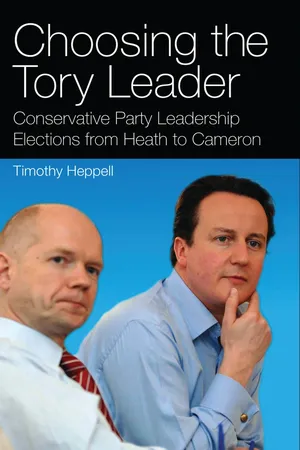
Choosing the Tory Leader
Conservative Party Leadership Elections from Heath to Cameron
- 269 pages
- English
- PDF
- Available on iOS & Android
eBook - PDF
Choosing the Tory Leader
Conservative Party Leadership Elections from Heath to Cameron
About this book
Information
Table of contents
- Cover
- Contents
- List of Tables
- Preface by Professor Andrew Taylor
- 1. Introduction
- 2. The War of the Macmillan Succession: The Catalyst for Electing the Party Leader
- 3. Edward Heath: The First Democratic Leader of the Conservative Party
- 4. The Peasants Revolt? The Election of Margaret Thatcher
- 5. Treachery with a Smile on its Face: The Downfall of Margaret Thatcher
- 6. Put Up or Shut Up: John Redwood Challenges John Major
- 7. You Cannot Be Serious: The Election of William Hague
- 8. The Quiet Man Emerges: The Election of Iain Duncan Smith
- 9. Back to the Future: Michael Howard becomes Conservative Party Leader
- 10. The Triumph of the Modernizers: The Election of David Cameron
- 11. Conclusion
- 12. Notes
- Appendix
- Bibliography
- Index
Trusted by 375,005 students
Access to over 1.5 million titles for a fair monthly price.
Study more efficiently using our study tools.
Frequently asked questions
Yes, you can cancel anytime from the Subscription tab in your account settings on the Perlego website. Your subscription will stay active until the end of your current billing period. Learn how to cancel your subscription
No, books cannot be downloaded as external files, such as PDFs, for use outside of Perlego. However, you can download books within the Perlego app for offline reading on mobile or tablet. Learn how to download books offline
Perlego offers two plans: Essential and Complete
- Essential is ideal for learners and professionals who enjoy exploring a wide range of subjects. Access the Essential Library with 800,000+ trusted titles and best-sellers across business, personal growth, and the humanities. Includes unlimited reading time and Standard Read Aloud voice.
- Complete: Perfect for advanced learners and researchers needing full, unrestricted access. Unlock 1.5M+ books across hundreds of subjects, including academic and specialized titles. The Complete Plan also includes advanced features like Premium Read Aloud and Research Assistant.
We are an online textbook subscription service, where you can get access to an entire online library for less than the price of a single book per month. With over 1.5 million books across 990+ topics, we’ve got you covered! Learn about our mission
Look out for the read-aloud symbol on your next book to see if you can listen to it. The read-aloud tool reads text aloud for you, highlighting the text as it is being read. You can pause it, speed it up and slow it down. Learn more about Read Aloud
Yes! You can use the Perlego app on both iOS and Android devices to read anytime, anywhere — even offline. Perfect for commutes or when you’re on the go.
Please note we cannot support devices running on iOS 13 and Android 7 or earlier. Learn more about using the app
Please note we cannot support devices running on iOS 13 and Android 7 or earlier. Learn more about using the app
Yes, you can access Choosing the Tory Leader by Timothy Heppell in PDF and/or ePUB format, as well as other popular books in Política y relaciones internacionales & Política comparada. We have over 1.5 million books available in our catalogue for you to explore.