- 352 pages
- English
- ePUB (mobile friendly)
- Available on iOS & Android
eBook - ePub
About this book
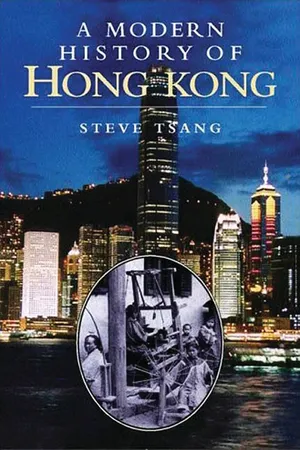
This major history of Hong Kong tells the remarkable story of how a cluster of remote fishing villages grew into an icon of capitalism. The story began in 1842 with the founding of the Crown Colony after the First Anglo-Chinese war - the original 'Opium War'. As premier power in Europe and an expansionist empire, Britain first created in Hong Kong a major naval station and the principal base to open the Celestial Chinese Empire to trade. Working in parallel with the locals, the British built it up to become a focus for investment in the region and an international centre with global shipping, banking and financial interests. Yet by far the most momentous change in the history of this prosperous, capitalist colony was its return in 1997 to 'Mother China', the most powerful Communist state in the world.
Information
Part I
The Foundations of Modern Hong Kong
Chapter 1
War and Peace
The Crown Colony of Hong Kong was a product of the First Anglo-Chinese War (1839–42), popularly known as the ‘Opium War’. This was, in fact, much more than a war over the opium trade, though the economic benefit of the trade for the British and the costs to the Chinese were certainly important considerations for policymakers on both sides. Basic changes in the modern world were in any event pushing Britain and China to a major confrontation as the 1830s drew to a close. Two forces stood out in this regard.
The most fundamental change, which brought confrontation closer than ever, was the Industrial Revolution. Great advancements in communication and other technologies as well as in organisational capacities in Europe had enabled the leading industrial nation, Britain, to project power in a substantial way across more than 10,000 miles of ocean. This was greatly assisted by the availability to the British of India and other imperial outposts as key staging posts for economic and imperial activities in the East. The continued process of the Industrial Revolution in Britain was also fuelled by capturing overseas markets, which meant Britain had, since the start of the Industrial Revolution, adopted an aggressive foreign policy backed by war and imperial expansion.1
These changes gave rise to the second factor. For the first time in human history, Britain – the premier power in Europe after the defeat of Napoleon, master of the oceans, workshop of the world and an expansionist imperial power – came face to face with the Celestial Chinese Empire.2
Although China would soon be revealed to be a ‘paper tiger’ in its confrontation with Britain, it deemed itself the greatest empire on earth. It saw itself as the centre of the universe with its emperor enjoying the mandate of heaven. This apparently extravagant claim of grandeur is not without basis.
China was clearly the world leader in scientific developments, communication, production technologies and administrative organisation until around the sixteenth century. At the height of its power in the early fifteenth century, China was the only country that had the capability to deploy a naval taskforce of an estimated 317 ships and 27,000 men across great distances, as its navy sailed as far as Malindi on the east coast of Africa, just north of Mombasa.3 To put this in perspective, Vasco de Gama did not make the first successful sea journey from Europe to India and back until 1498, over half a century later. Likewise, the Spanish Armada that sailed for England in 1588 – the destruction of which marked the rise of British naval supremacy – boasted a fleet of a mere 132 vessels. Similarly, the vast Chinese empire on land was held together by superior organisation and logistics in the pre-modern world. This enabled the Emperor to supervise urgent and important matters through a chain of relay riders that could deliver a despatch to a distance of 357 miles in 24 hours.4
The great advantage that China had over Europe was subsequently lost partly because of the dramatic advancements in Europe following the Industrial Revolution. It was also because the Chinese had fallen into the ‘high-level equilibrium trap’. By the time of late imperial China, ‘both in technological and investment terms, agricultural productivity per acre had nearly reached the limits of what was possible without industrial-scientific inputs, and the increase of population had therefore steadily reduced the surplus product above what was needed for subsistence’.5 Nevertheless, the Chinese economy continued to expand as its population rose exponentially. From the time when China first took a population count in 2AD to the end of the fourteenth century or the beginning of the Ming dynasty, its population fluctuated between 37 and 60 million.6 It reached an estimated 100 million in the 1650s, just after the Manchu or Qing dynasty superseded the Ming, rising to between 400 and 450 million in the 1850s. This dramatic increase demonstrated how efficient the Chinese economy had become in the pre-modern mode of production and management but it also had a negative effect on technological advancement.
Achieving this ‘high-level equilibrium’ allowed China to enjoy a degree of unity and stability over a vast empire unmatched for centuries in the pre-modern world but it also removed the incentive to innovate.7 Consequently, when the modernity unleashed by the Enlightenment and the Industrial Revolution enabled Europe to overcome great distance and knock on the gate of the Chinese Empire, the latter responded mostly by basking in its old glory and failing to recognise the real significance of this new development. Late imperial China had continued to operate without a central treasury, or reliable vital statistics, or civil laws that linked government operations with the rising economic trends, and had remained a gigantic ‘conglomeration of village communities’.8 It was the greatest and most advanced empire, to use a Western analogy, essentially still of the late medieval or at least pre-industrial kind when it found itself forced to deal with Queen Victoria’s emerging modern and rapidly industrialising British Empire.
Sharing little in outlook or core values in the handling of international relations, and increasingly tangled in expanding commercial and other relations that gave rise to conflicts and misunderstandings, the British and the Chinese empires behaved like all empires had previously done. They sized each other up, with the more powerful one moving towards a contest for supremacy when the furtherance of its perceived interests made this desirable. The scene for a major confrontation was set.
Tea, Opium and Trade
Late imperial China exercised strict controls over its external trade. It was in part because the vast expanse of the empire across various climatic zones had given it a very high degree of self-sufficiency. This condition underlined the arrogant claim that Emperor Qianlong made to King George III of Britain during Lord Macartney’s first embassy to China (1792–4). According to Qianlong, ‘our Celestial Empire possesses all things in prolific abundance and lacks no product within its own borders’ and ‘there was therefore no need to import the manufactures of outside barbarians in exchange of our own produce’.9 This attitude towards foreign imports and trade was further reinforced by the central government’s determination to avoid stability in the empire being disturbed by foreign influences, particularly the spread of religious beliefs. This Chinese attitude notwithstanding, trade between the two countries expanded, but from the middle of the eighteenth century it was mainly confined to the southern city of Canton (Guangzhou), far away from the imperial capital of Beijing (Peking). In the conduct of trade, the Chinese government relied on merchants, known as cohongs, as agents to deal with the British, who were required to send communications to senior officials through their Chinese merchant contacts and were subjected to numerous restrictions.10
On the British side, prior to 1834 the China trade was handled by the East India Company (EIC) under a monopoly. The EIC was founded in 1600 by a royal charter granted by Queen Elizabeth I, which gave it great scope to take any measures necessary to support trade in the perilous waters and often hostile environment in the East in order to compete against its bigger European rivals, particularly its Dutch counterpart. This included the privilege of raising armed forces and taking over the administration of territories deemed essential for trade under the charter. The costs of administration, maintaining order and security in the Company’s dominion in India were so high that by the late eighteenth century the EIC was almost constantly under great financial pressure. In order to augment its revenue and to counter the smuggling or illegal private trade that was going on between India and China, the EIC granted licences to private traders who engaged themselves in this increasingly lucrative country trade.11
In spite of the distance and the insular attitude of the Chinese Empire, the China trade was a significant one for Britain and the EIC. For much of the middle of the nineteenth century, China was the fourth most important source of imports for Britain and enjoyed a very favourable balance of direct bilateral trade.12 The most important British import from China was tea, followed by raw silk. The tea trade was important not only because tea had become practically a daily necessity in Britain by the 1830s, but also because the import duty London extracted from it was so high that it had also become a significant source of government income. It amounted to about 16 per cent of customs revenue in Britain in the five years preceding the First Anglo-Chinese War, and was sufficient to pay for about 83 per cent of the costs for maintaining the Royal Navy.13
The unfavourable balance of trade for Britain was redressed by a triangular trade involving British India, which at that time produced the only highly sought-after commodity in the otherwise largely self-sufficient China. This was opium, prohibited in China but imported through normal channels to Britain where it was openly available. Mainly taken orally for medicinal purposes and not (as was widely done in China) smoked, using opium was not at that time illegal or considered dangerous and immoral in Britain.14
The combined British and Indian trade with China produced a picture opposite to that of direct British trade with China. Once the export of opium from British India to China is included in the trade, the British side enjoyed a healthy balance of payments. In other words, the British export of opium from India would more than pay for the British import of tea and silk from China.15
For India or the EIC, revenue from the opium trade accounted for over 8 per cent of the overall revenue of British India for the five years preceding the First Anglo-Chinese War.16 By the end of the eighteenth century, the profits that the EIC generated from India were absorbed by the huge costs of governing India, and its profit came mainly from the China trade.17 Much was therefore at stake in the China trade for Britain and British India, for which important economic interests required the continuation of the lucrative opium trade.
This triangular trade was significant to the Chinese in a very different and almost opposite way. The long-established view that the Chinese economy suffered from the net physical outflow of silver – the key monetary medium in this period – as a result of the unfavourable balance of this trade has now been challenged.18 The actual flow of silver in and out of China was in fact distorted by the use of remittance by draft for settlement of international trade, for which London served as the financial hub.19 Whatever the reality, with the flow of silver there was a shortage in China.20 As a result, opinions within the Chinese officialdom increasingly depicted an exaggerated outflow of silver, which by 1837 had seriously alarmed Emperor Daoguang.21
Key policymakers and leaders of powerful cliques in the bureaucracy and the literati, such as Viceroy Lin Zexu, also believed the shortage of silver was a result of the opium trade.22 Furthermore, they were worried that opium smoking had become so widespread and entrenched that it had sapped the strength of the country. When military debilitation became evident in 1832 following the inability of the garrison to suppress a rebellion by the Yao minority in the Guangdong-Hunan border, even Emperor Daoguang became seriously concerned.23 Thus, this triangular trade had also become a matter of major significance for the Chinese Empire.
The 1830s therefore saw major debates among Chinese policymakers on the subjects of opium suppression and the control of this undesirable trade. Different options, ranging from cutting off the import by a trade embargo, to suppression to legalisation, were explored, examined and debated. Such policy deliberations and wider discussions were conducted in the context of the bureaucratic constraints imposed by the structure and vested interests of the empire, official jostling for imperial favour, a limited understanding of the military strength of the British and therefore the potential costs of a trade embargo.24 Suppression of the trade did not become policy until the eve of the First Anglo-Chinese War.
Diplomacy and Conflicts
If Sino-British trade caused friction in bilateral ties, the conduct of formal relations between the two empires was even more problematic and acrimonious. The great tension over ceremonial and protocol matters, particularly over the performance of the kowtow that wrecked Macartney’s first British embassy to China at the end of the eighteenth century, grew more problematic in the 1830s.25 The Chinese Empire did not see or treat Britain as an equal.
Until the end of its monopoly, the EIC almost exclusively handled what the British saw as the indignities involved in dealing with Chinese officials. They were deemed unpleasant and offensive but were tolerated by what was, above all, a profit-driven commercial organisation.
The taking over of the EIC’s roles in dealing with the Chinese authorities by a representative of the British government implied a basic change. The prestige, dignity and honour of the British Empire were now at stake, but this important development received no recognition from the Chinese.26 The basic differences in the correct manner of conducting relations between the two empires caused regular disputes. Since no compromise solution could be devised to satisfy both sides, in the long term either the British Empire – a rising power in the world scene – would have to continue to defer to the condescending Chinese approach, or the Chinese would be forced to accept the European norm in diplomatic relations.27
Until 1860, when the Chinese finally accepted a resident Minister Plenipotentiary to represent Britain, relations between the two countries were in fact conducted without diplomatic relations in the modern sense. Indeed, China did not send a resident diplomatic representative to Britain, its first to any Western power, until as late as 1877.28
Differences over the proper way to conduct bilateral relations came up as soon as Lord Napier set about discharging his responsibilities as the first ever British Chief Superintendent of the China trade in 1834, following the end of the EIC’s monopoly.29 In addition to taking over the management of British trade that the EIC used to supervise, Napier was also instructed by the British government to explore the possibility of extending trade beyond Canton and establishing diplomatic relations. The Chinese form for contacting the Viceroy in Canton was that communications should be styled as ‘petitions’ and conveyed through the cohongs. Acting to defend the ‘dignity’ of the British Empire, Napier broke with the Chinese rule and sailed up to Canton in a naval ship; he then insisted on announcing his arrival formally by presenting a letter to the Viceroy. This, from the Chinese point of view, unconventional approach caused considerable resentment and was firmly rejected by Viceroy Lu Kun. An impasse ensured for two months. It ended only when illness left Napier with no choice but to beat a less than dignified retreat to the Portuguese enclave of Macao where he soon died.
Napier was replaced as Chief Superintendent by two former EIC men in rapid succession, and both reverted to avoiding confrontation with the Chinese authorities.30 Even Napier’s third successor, Captain Charles Elliot, a Royal Navy rather than a Company man, at first attempted to take a conciliatory approach after he took up office in 1836. His prepa...
Table of contents
- Cover
- Dedication page
- Title page
- Contents
- Preface and Acknowledgements
- Maps
- Part I: The Foundations of Modern Hong Kong
- Part II: The Heyday of Imperial Rule
- Conclusion: Full Circle
- Notes
- Bibliography
- eCopyright
Trusted by 375,005 students
Access to over 1.5 million titles for a fair monthly price.
Study more efficiently using our study tools.
Frequently asked questions
Yes, you can cancel anytime from the Subscription tab in your account settings on the Perlego website. Your subscription will stay active until the end of your current billing period. Learn how to cancel your subscription
No, books cannot be downloaded as external files, such as PDFs, for use outside of Perlego. However, you can download books within the Perlego app for offline reading on mobile or tablet. Learn how to download books offline
Perlego offers two plans: Essential and Complete
- Essential is ideal for learners and professionals who enjoy exploring a wide range of subjects. Access the Essential Library with 800,000+ trusted titles and best-sellers across business, personal growth, and the humanities. Includes unlimited reading time and Standard Read Aloud voice.
- Complete: Perfect for advanced learners and researchers needing full, unrestricted access. Unlock 1.5M+ books across hundreds of subjects, including academic and specialized titles. The Complete Plan also includes advanced features like Premium Read Aloud and Research Assistant.
We are an online textbook subscription service, where you can get access to an entire online library for less than the price of a single book per month. With over 1.5 million books across 990+ topics, we’ve got you covered! Learn about our mission
Look out for the read-aloud symbol on your next book to see if you can listen to it. The read-aloud tool reads text aloud for you, highlighting the text as it is being read. You can pause it, speed it up and slow it down. Learn more about Read Aloud
Yes! You can use the Perlego app on both iOS and Android devices to read anytime, anywhere — even offline. Perfect for commutes or when you’re on the go.
Please note we cannot support devices running on iOS 13 and Android 7 or earlier. Learn more about using the app
Please note we cannot support devices running on iOS 13 and Android 7 or earlier. Learn more about using the app
Yes, you can access A Modern History of Hong Kong by Steve Tsang in PDF and/or ePUB format, as well as other popular books in History & 20th Century History. We have over 1.5 million books available in our catalogue for you to explore.