- 224 pages
- English
- ePUB (mobile friendly)
- Available on iOS & Android
eBook - ePub
About this book
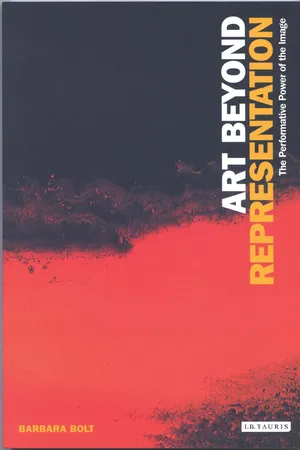
Refuting the assumption that art is a representational practice, this book engages with the work of Heidegger, Deleuze and Guattari, C.S. Pierce and Judith Butler. It argues for a performative relationship between art and artist. Drawing on themes as diverse as the work of Cezanne and Francis Bacon, the transubstantiation of the Catholic sacrament, and Wilde's novel "The Picture of Dorian Gray", she challenges the metaphor of light as entertainment. She suggests that too much "light" may in fact reveal nothing. Finally, she asks: how does an "embodied" practice fare within the culture of conceptual art?
Information
1
TRANSCENDING REPRESENTATIONALISM
By accident, and sometimes on the brink of an accident, I find myself writing without seeing. Not with my eyes closed, to be sure, but open and disorientated in the night; or else during the day, my eyes fixed on something else, while looking elsewhere, in front of me, for example when at the wheel: I then scribble with my right hand a few squiggly lines on a piece of paper attached to the dashboard or lying on the seat beside me. Sometimes, still without seeing, on the steering wheel itself. (Derrida 1993:3)
Art is a representational practice and its products are representations. This statement seems so obviously true, that we rarely pause to question its validity or even define its terms. When we speak, write, draw, take a photograph, construct a digital image or make a video, there seems little dispute that what we are involved in is making representations. Viewers and readers engage with representations. Countless books are written about it. But what is this thing we call representation, and why does it hold such a grip on our imagination? More to the point, why should this book plot a trajectory beyond representation?
In the visual arts, art theorists and historians continue to ground their discussions of art on the unquestioned assumption that art is representational. Thus Donald Brook begins his essay ‘On Non-verbal Representation’(1997) with the statement:
Among the problems raised by representational practices the most fundamental are surely those arising in connection with representations that might as well—in the unassuming terms of ordinary language—be called non-verbal. Of these, visible (or visual) representations are prominent, and have always served the purposes of discussion in an exemplary way. (Brook 1997:232)1
In Brook’s discussion of representational practices, the term representation is a given. Like many other writers on representation, Brook does not see the need to define the term. Representation remains unremarked.
This raises some fundamental questions. Why does representation continue to operate as the seemingly unassailable and assumed truth underpinning visual practice? Is it possible, for example, to think our productions outside of the paradigm of representation? What would it be like to conceive an image not as a representation? In all this wondering and imagining, however, I am caught short, forced to recognise that perhaps this mental activity, this capacity for imagining is itself representational. ‘Man as representing subject’, notes Heidegger, ‘fantasizes … he moves in imaginatio’ (Heidegger 1977a:147).
The question of representation is central to any debate around the making and interpretation of images. So much has been said against representation by philosophers (such as Heidegger, Deleuze and Irigaray) and so many attempts have been made by contemporary artists (particularly postmodern, post-colonial and feminist artists), to eliminate representation once and for all. And yet the spectre of representation continues to loom large as the system that prescribes the way we know our world.
So what is representation, how does it work and why does it cause so much debate amongst philosophers and artists? Commonsense understandings of the term, tend to conceive representation as a substitute for, or copy of “reality” in some imagistic form—film, literature or visual art. Such a conception has particular consequences for the arts. In the visual arts, for example, representation tends to be conflated with realism or figuration. Here representational art is opposed to abstract or so-called non-representational art. However, according to its critics, representation cannot be conceived so literally. It is not just concerned with realism or figuration, but rather, representation posits a particular relation to, or way of thinking about the world.
What is at issue is not so much representation in itself, but rather how, in the modern world, representation has come to be understood as the structure that enables representationalism to dominate our contemporary way of thinking. Representationalism is a system of thought that fixes the world as an object and resource for human subjects. As a mode of thought that prescribes all that is known, it orders the world and predetermines what can be thought. Representation becomes the vehicle through which representationalism can effect this will to fixity and mastery.
As one of its most trenchant critics, Martin Heidegger offers the clearest explication of representation and representationalism. In order to grasp the modern essence of the term representation, Heidegger suggests that, we must return to the etymological root of the word and concept ‘to represent’. In his enquiry, ‘to represent’ [vorstellen] is to:
Set out before oneself and to set forth in relation to oneself. Through this, whatever is comes to a stand as object and in that way alone receives the seal of Being. That the world becomes picture is one and the same event with the event of man’s becoming subiectum in the midst of that which is. (Heidegger 1977a:132)
For Heidegger, representation, or representationalism is a relationship where, whatever is, is figured as an object for man-as-subject. It is this objectification of what is by man-as-subject (subiectum) that constitutes the central focus of the critique of representation.
One of the greatest efforts in philosophy and art in modern times has been devoted to overcoming the limits of representation. Gilles Deleuze suggests that we must first experiment with these limits. He comments that it is:
A question of extending representation as far as the too large and the too small of difference; of adding a hitherto unsuspected perspective to representation … it is a question of causing a little Dionysian blood to flow in the organic veins of Apollo. (Deleuze 1994:262)
In this Chapter, I will take up this quest and demonstrate how, through practice, the perspective of handling or ‘handlability’ can disrupt the fixity of representationalism. Handlability involves our concrete dealings with things in the world, rather than our abstract thinking about the world. It is concerned with the logic of practice. In handling, as I will show, Dionysian blood comes to pulse through Apollo’s veins.
Before turning to the potential of handlability, this Chapter will set in place the grounds for the critique of representation and representationalism. Drawing on the philosophical criticisms offered by Martin Heidegger, Bruno Latour and Gilles Deleuze, the Chapter foregrounds the vice-like grip that representationalism holds on contemporary thought. This extended argument against representation and representationalism, is countered by Jacques Derrida’s defence of representation. Positioning himself against Heidegger, Derrida argues for an internal movement within representation. He suggests that this condition within representation overcomes the presumed and stultifying fixity of representationalism. Here, both Derrida and Deleuze agree that movement is the key to overcoming the fixity of representationalism. Heidegger’s position does not hold open a space for representation. However, his counter-representationalist understanding of handling and handlability provides a concrete way of thinking how this movement might occur.
My discussion will demonstrate the relevance of such debates for thinking a logic of practice. I will argue that the understandings that arise through handling or practice operate in a different register from those that belong to the representational paradigm of man-as-subject in relation to mere objects. In this conceptualisation of practice I hope to demonstrate a movement from representation as a mode of thought to representation as bodies in process.
Re-presentation
Representation may have its limits, but what would we know if representation did not structure our being-in-the-world? Were we to eliminate representation once and for all, would we be plunged into the abyss of chaos? If (as has been argued since Schopenhauer), we only know the world through representation, what of Martin Heidegger’s argument that Descartes ushered in the epoch of representation?2 What happened before representation? We know people made images and looked at them before Descartes, so how did they apprehend them if not as representations? What did the makers of these images think they were doing? And what of cultures not under the sway of Cartesianism, for example, pre-Socratic or Indigenous Australian cultures? How do they comprehend the image if not as representation? I will return to these questions in later Chapters, but firstly, I wish to set out the stakes involved in a representationalist relation to the world.
In the introduction to his paper ‘Sending: On Representation’ (1982) Jacques Derrida asks what it means to represent something. ‘One may say that we represent something (nous sommes en représentation)’. But then he continues: ‘Are we sure we know what this means, today?’ (Derrida 1982:295). Representation has a strong purchase on everyday life. We represent and are represented in many different ways; in parliaments, in the courts, in textual, verbal, aural, visual forms and so forth. As a painter, I am represented by a gallery at the same time as I paint representations. The extent to which representation permeates our lives is summed up in Bruno Latour’s observation that:
The most humble of us lives surrounded by a princely retinue of delegates and representatives. Every night, on television, our representatives in Parliament talk on our behalf. We have delegated to hundreds of non-human lieutenants the task of disciplining, making, and moving other humans or non-humans—lifts, cars, trains, machines. Hundreds of scientific disciplines and instruments constantly bring far away places, objects and time to us which are thus represented—that is presented again—for our inspection. In dozens of books, movies, plays and paintings, human and non-human characters represent us with our violence and our fears, populating our world with crowds of friends and enemies. (Latour 1988a:15-16)
Used in many different contexts, in many different ways, it seems extraordinary that one single word could create such a multifarious and colourful cast of characters. Political representatives sit side by side with technological and aesthetic representatives and representations. How can this be, and what is it that allows all these different events and things to operate under the one term, that of representation? And so it seems that some law, some shared or common quality will come to regulate this multiplicity, justify the use of the term representation and allow this representation to represent it. As I will show it is precisely this regulation or ordering—that allows one conception of representation to hold sway over all other conceptions—that is so opposed by Martin Heidegger in his critique of representation and representationalism.
The “re” of representation suggests that to represent, is to present again. In his article ‘Visualization and Social Reproduction’ (1988a), Latour claims that, in western culture there have existed two vastly different regimes of representation. In the first regime—a regime that he relates to early Christian and medieval understandings of representation—the re-presentation is presented anew as if for the first time. It involves presenting again and anew. In the second regime, which he equates with Cartesian understandings of representation, the representation stands in the place of an absent object. Thus:
what is meant by faithful is the ability to maintain through all the transformations of scale, all the various places and times, some inscriptions, some traces that allow those who hold them and look at them to return to the original setting without a prior acquaintance of the scene. (Latour 1988a:23)
In the first regime, coinciding with early Christian and medieval painting, there is a sense in which the representation is the thing. Such a sense of presence can be illustrated in relation to medieval paintings of Jesus Christ. Here, Christ is re-presented as the ‘ever present Christ’ (Latour 1988a:21). In the second regime of representation, there is an assumption of a gap between the thing or referent and its representation. According to this Cartesian regime, the representation stands in the place of the absent object. Representation is a model, not a re-presentation. Through this modelling, portrayals of distant places and times can be made. Latour exemplifies this by reference to the globe of the world represented in Hans Holbein’s painting The Ambassadors (1533). He claims that the globe provided explorers with a model of the world that helped facilitate the conquest of previously uncharted places.
Latour argues that, in contemporary western society, this second Cartesian regime of representation, where there is a standing-in-for another, has come to dominate our conception of representation. This regime accounts for our political understanding of representation, where a person stands for others. It also fulfils our aesthetic understanding of representation, where the work of art operates as an analogue for something beyond itself, where this something is no longer present. As I will argue in the next section, Heidegger equates this second regime of representation with the modern era. It is this Cartesian regime that becomes the subject of the critique of representation in this Chapter.
In western aesthetics, representation, conceived as a substitute for something else, first found its form in Renaissance art with the conjoining of the systems of perspective and mimesis. Perspective offered a window onto the world, whilst mimesis ensured that the view out this window corresponded with perceptual reality. This modelling created a visual system so powerfully real that western imaging—including digital imaging—continues to be held in its sway.
Our common sense understanding of representation has grown out of this modelling of the world. According to this mode of thought, re-presentation can be understood as a copy of a model. In the world of models and copies, the model exists “out there” as some pre-existing static reality which the copy then imitates. Reality is what-is; and the representation is only ever a copy of it. Representation reflects reality.3
The pre-occupation with models and copies can be traced back to Plato’s postulation of an Ideal world of Forms. In this conception, Ideal Form pre-exists any actuality. The image or what we have come to know as representation can only ever be an imperfect copy of an Ideal Form. The visual arts, even more than language or philosophy, are infected with models and copies. In the case of the western visual tradition, however, Aristotle’s interest in mimesis, rather than Plato’s Ideal Forms has come to inform the debate on models and copies.
As a consequence, in the West, discussions and debates around representation have been, as Bryson (1983) points out, underpinned by notions of ‘natural attitude’ and ‘essential copy’.4 Such notions inform diverse and often contradictory views about representation. On the one hand “commonsense” artistic judgements are often based on assessing the degree of exactitude between representation and reality. At quite a different level, the gap or lack between representation and reality has come to inform such theories as psychoanalysis and structuralism. Psychoanalytic theories, for example the theories of Jacques Lacan, are grounded in the assumption that the gap between representation and reality can never be bridged. Consequently, in this view, we are forever lacking.
As a result of this conceptual framing of representation, the critique of Cartesian representation has tended to be conflated with the critique of realism or figuration. In this conflation, representation equals realism which is opposed to abstraction or non-representation. However, what is at stake in the act of representation is not, as is commonly supposed, simply the realistic or figurative representation of a reality that “exists out there”. As I will argue in the next section, representation is not an outcome, but rather a mode of thinking and a relationship to the world that involves a will to fixity and mastery. According to such a conception, representation should not be confused with realism. Moreover, abstraction may be as representationalist as realism.
The Age of the World Picture
In his essay ‘The Age of the World Picture’ (1950) Heidegger designates the modern epoch as the era of repre...
Table of contents
- Cover
- Title page
- Copyright page
- Dedication
- Contents
- Illustrations
- Acknowledgements
- Introduction
- Transcending Representationalism
- Contingency and the Emergence of Art
- The “Work” of Art
- Shedding Light for the Matter
- Working Hot: A Materialist Ontology
- Conclusion
- Notes
- References
Trusted by 375,005 students
Access to over 1.5 million titles for a fair monthly price.
Study more efficiently using our study tools.
Frequently asked questions
Yes, you can cancel anytime from the Subscription tab in your account settings on the Perlego website. Your subscription will stay active until the end of your current billing period. Learn how to cancel your subscription
No, books cannot be downloaded as external files, such as PDFs, for use outside of Perlego. However, you can download books within the Perlego app for offline reading on mobile or tablet. Learn how to download books offline
Perlego offers two plans: Essential and Complete
- Essential is ideal for learners and professionals who enjoy exploring a wide range of subjects. Access the Essential Library with 800,000+ trusted titles and best-sellers across business, personal growth, and the humanities. Includes unlimited reading time and Standard Read Aloud voice.
- Complete: Perfect for advanced learners and researchers needing full, unrestricted access. Unlock 1.5M+ books across hundreds of subjects, including academic and specialized titles. The Complete Plan also includes advanced features like Premium Read Aloud and Research Assistant.
We are an online textbook subscription service, where you can get access to an entire online library for less than the price of a single book per month. With over 1.5 million books across 990+ topics, we’ve got you covered! Learn about our mission
Look out for the read-aloud symbol on your next book to see if you can listen to it. The read-aloud tool reads text aloud for you, highlighting the text as it is being read. You can pause it, speed it up and slow it down. Learn more about Read Aloud
Yes! You can use the Perlego app on both iOS and Android devices to read anytime, anywhere — even offline. Perfect for commutes or when you’re on the go.
Please note we cannot support devices running on iOS 13 and Android 7 or earlier. Learn more about using the app
Please note we cannot support devices running on iOS 13 and Android 7 or earlier. Learn more about using the app
Yes, you can access Art Beyond Representation by Barbara Bolt in PDF and/or ePUB format, as well as other popular books in Art & Art General. We have over 1.5 million books available in our catalogue for you to explore.