eBook - ePub
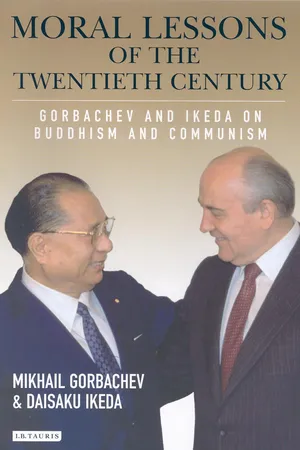
Moral Lessons of the Twentieth Century
Gorbachev and Ikeda on Buddhism and Communism
- 224 pages
- English
- ePUB (mobile friendly)
- Available on iOS & Android
eBook - ePub
Moral Lessons of the Twentieth Century
Gorbachev and Ikeda on Buddhism and Communism
About this book
Mikhail Gorbachev and Daisaku Ikeda are contemporaries raised in different cultures: Gorbachev is a statesman whose origins are the Marx-inspired world of communism while Ikeda is Buddhist inspired by the thirteenth century Japanese sage, Nichiren. Moral Lessons of the Twentieth Century emerged from a series of conversations between these two men. Together they explore their experiences of life amidst the turmoil of the twentieth century and together they search for a common ethical basis for future development. They conclude that values are born of culture and that peace, progress and social justice can only be achieved through sincere communication and cultural exchange. As the new century begins, they have sought to turn the spotlight on the challenges which face humanity. The book is a call for dialogue in pursuit of values that bridge culture and time.
Information
CHAPTER ONE
Chance, Will, or Fate?
Ikeda: You and I are specialists in different fields—you in politics, I in Buddhism. In this dialogue, since our goal is to investigate the best ways for human beings to think and act, we must necessarily range far and wide over a spectrum of topics far exceeding our individual specialties. I hope the differences in our backgrounds and primary areas of experience and knowledge will intensify the interest of what we have to say. Most important of all, we must put what we have seen, done, and thought to good use for the sake of the youth of this new century.
Your appearance in the political arena in the 1980s was truly fateful for world history. Perestroika, of which you were the father, led to the end of the Cold War, the democratization of East Europe, and the downfall of the totalitarian communist regime in Russia. These events were sudden and totally unexpected. They changed the face of civilization and the fates of nations, ethnic groups, and individual human beings. They enriched humanity by the unique transformation of a communist totalitarian system into a democratic society.
Thinking about Perestroika today, when the historical scale of the transformations you initiated is making itself clearly felt, I often wonder how it all became possible. What personal qualities enabled you to undertake global democratic reforms? What would have happened to Russia—and to the world community—if, in 1985, you had not become general secretary of the Central Committee of the USSR?
In a speech you delivered at Soka University in April 1993, you partly answered these questions by saying, “The fate of each of us is inscrutable. We create our own lives. Nonetheless, each of us does have a destiny.” When did you recognize your own fate and your historical mission? What do life, politics, fate, and history mean to you? Did you feel the influence of fate on your activities? What helped you overcome the apparently insuperable?
Gorbachev: My destiny was formed by my experience, by the things I lived through. It arose from a sense of responsibility. Indeed, for me, destiny and mission are synonymous with a sense of responsibility. All my actions were permeated by the belief that ethical democracy was possible in the former Soviet Union.
But democracy is incompatible with violence against individuals. Democracy devoid of morality is unacceptable. True democracy is impossible under conditions in which tanks fire on defenseless people and a whole nation is gripped by fear.
My generation—called the Sixty-somethings—strove almost instinctively for freedom and did everything possible to accelerate liberation from the Stalinist heritage. For me the Stalinist purges were no mere hearsay. My own grandfather was thrown into prison in 1937, and everyone in our village avoided us. Even neighbors ostracized us. I cast no blame on them. In those days, no one knew whose turn would come next. But the memories remain deep in my heart.
Many of us children of the Stalinist epoch were ignorant of the subtleties of liberalism. Still, we were highly zealous worshippers of freedom in everything, large and small. We strove for what we lacked: freedom of speech, discussion, and information. We dreamed of being able to determine our own fates.
Sooner or later, the Soviet people had to take account of their past, tell the truth about their sufferings, and pull the country together. This was their awakening to liberty. I am glad my like-thinkers and I—and not somebody else—were given the chance to break our country’s standstill and begin democratic reforms.
Ikeda: The reforms were dramatic and might have been cataclysmic. But, as if by miracle, one of the greatest events of the 20th century took place with comparative tranquility and without the horrors that accompanied the collapse of Yugoslavia. Everyone agrees that the presence of Mikhail S. Gorbachev played a major part in minimizing the difficulties. Historians of the future will endorse Václav Havel’s comment that Gorbachev assumed his post a typical bureaucrat and left it a true democrat.
One of your close associates, Alexander S. Tsipko, evaluates your political activities in his Proshchanie s Kommunizmom [Breaking with Communism]:
No matter how paradoxical it seems at first glance, the fate of democracy in Russia depends much more on Gorbachev than on Yeltsin. I am not speaking of the current moment, but of democracy as a moral value, as a guideline for political development . . . As a personality and a human being, Gorbachev is connected with his reforms and with the future of democratic reforms in Russia. He stands at the source of our post-communist history. (Alexander S. Tsipko, Komyunizumu tono Ketsubetsu [Proshchanie s Kommunizmom], trans. Tsuneko Mochizuki [Tokyo: Simul Press, 1993], p. 311)
Gorbachev: The soul of Bolshevism was leftist extremism. Though an a-political artist, the great Russian opera singer Feodor Chaliapin (1873–1938) accurately describes it in Maska i dusha [Mask and Soul], his memoirs:
In that combination of stupidity and cruelty—Sodom and Nebuchadnezzar—that is the Soviet regime, I see something fundamentally Russian. This is our native monstrosity in all its aspects, forms, and degrees . . . The trouble was that our Russian builders simply could not lower themselves to think about ordinary human beings in terms of a sensible, human-scale architectural plan. Instead, they absolutely had to raise a tower to the skies—a Tower of Babel. They could not be satisfied with the ordinary, healthy, bold stride with which a man walks to work and home again. They had to dash into the future with seven-league steps.
‘Let’s break with the past!’ And all at once it becomes necessary to sweep away the whole world, leaving not a trace behind. And most important—all our Russian smart guys surprisingly know all about everything. They know how to turn a hunchback cobbler into a glorious, god-like Apollo. They know how to train a rabbit to light matches. They know what the rabbit needs to be happy. And they know what it will take to make the rabbit’s offspring happy in two hundred years. (F. I. Shaliapin, Maska i dusha: moi sorok let na teatrakh [Moscow: V/O “Soiuzteatr” STD SSSR, 1991], p. 222)
Actually, although they did not and could not know these things, their conviction that they did caused immense suffering.
Ikeda: And, once again, as has often happened in Russia, the peasantry suffered most cruelly. With your own peasant background, you fully understand their misery in, for instance, the agricultural collectivization of 1932. To the horror of the whole world, Bolshevik politicians created artificial famines that cost the lives of millions of peasants in the Ukraine, one of the great European grain-producing zones.
Gorbachev: Very true. The destruction of the peasants and their morality can be called one of the greatest evils perpetrated by the Bolsheviks.
Ikeda: In contrast to this Bolshevik mindset, by its nature Buddhism is not a teaching that an exalted being condescends to teach a lower being. It is based on ideas of equality, compassion, and symbiosis, according to which human beings are honest with each other and strive together for perfection. My own teacher Josei Toda, who had unique social talents and was second president of Soka Gakkai, revealed this to me.
In Buddhist philosophy, the highest being is a Buddha, who has attained inexhaustible wisdom, compassion, perspicacity, and the will to overcome difficulties. This being is, however, no deification capable of miracles and mystical actions. A Buddha is a human being filled with energy, the joy of life, and love for all living things.
Mahayana Buddhism teaches that each human being is innately capable of attaining the Buddha state. All people are absolutely equal. Discrimination on the basis of differences such as race is excluded. We can all develop and perfect ourselves to what we think are inaccessible heights. Differences make each individual unique, promote mutual spiritual enrichment, and diversify human society.
But the independent, unique individual must not wait for happiness to be bestowed. Mutual assistance and support consist not in foisting formulas for happiness on others, as even the most high-minded Bolsheviks wanted to do, but in cooperating in the discovery of the inexhaustible source of spiritual power within human beings.
Gorbachev: Certainly, we live in symbiosis with others and to a large extent are indebted to them—first of all to parents, spouses, and children. For much of my own success in life I am indebted to Moscow University. Its special atmosphere, respect for science, and concentration on students as well as the student friendships I formed there played a big role. I was the happiest man on earth when I first entered its sacred halls.
I am very critical of the simple reasoning that lays everything at destiny’s door. We are guided most of all by interests, attractions, and the ideas and ideals of our time. We act within fixed frames of reference that are not easy to cross. Nothing begins with a blank page. I do not mean that everything in history happens in robot fashion. Even Marx, the materialist, recognized freedom of choice. Much more depends on us precisely because we are free. In its own turn, our inborn nature determines much in us.
Ikeda: The rapid current of time and unexpected events sometimes drastically alter our plans. In the pursuit of new destinies, we do things we once considered unacceptable. Obviously inherent in each of our lives are diverse life factors and a predisposition to various spheres of activity. But each of us also contains something stable—a spiritual system, a moral reaction, an absence of or an attraction to systematic education and culture. I think your driving life force has always been, first and foremost, a passion for enlightenment, the readiness to accept new knowledge and truths. The dogmatism of ignorance that sometimes compels politicians to commit acts of terror and cruelty is foreign to you. World history provides numerous examples of such cruelty. Robespierre and Lenin, two dogmatists absolutely certain of the soundness of their own ideas, opted for the use of terror. You, on the other hand, adopted the trial-and-error method, fully aware that you were the trailblazer and that your path was thorny and unexplored.
Gorbachev: In my life, as probably in yours, much has depended on chance. Looking back, I see that, from an early age, I was aware of a calling to social activity. When I was a boy, other children chose me to be their leader; they needed me. I worked with the Komsomol organization throughout my university days. Nonetheless, my fate might have turned out differently if, after graduation from Moscow State University in 1955, I had not gone home to Stavropol.
As a matter of fact, things were working out in favor of my remaining in Moscow. The university assignment committee had selected 12 graduates from the law faculty, including me, to work at the Office of the Public Prosecutor of the USSR. Rehabilitation of victims of Stalinist repression was in full swing and we 12 were going to work in newly organized departments verifying the legality of the ways state-security organs conducted their affairs. I envisioned my future work to be struggling for the triumph of justice, which coincided completely with my own political and moral convictions.
On June 30, returning to my dormitory after passing the final state examination, I discovered in my post box an official letter inviting me to my future workplace—the USSR Public Prosecutor’s Office. I was expecting a discussion of my new duties. But when, elated and smiling, I crossed the threshold of the office indicated in the letter, a seated bureaucrat delivered the dry, official notification: “It is considered impossible to employ you in the organs of the USSR Public Prosecutor’s Office.” That was a real blow.
It seems that, only the night before, the government had issued a secret decree forbidding the recruiting of young law-school graduates to work in central organs of justice. It was claimed that one of the many reasons for the outburst of mass repression in the 1930s had been entrusting others’ fates to green young people lacking professional and practical experience. As paradoxical as it sounds, I, a representative of a family that had suffered repression, became the unwilling victim of this new “struggle to establish socialist legality”.
All my plans suddenly collapsed. Of course, I could have looked for a cozy place at the university to enable me to remain in Moscow. But, after considering and weighing everything, I decided to go back to the country.
Thanks to this occurrence, I discovered myself and set out on the right path towards achievements that are now independent of me. Was it all the result of chance, of fate?
Ikeda: For the most part, my youthful experiences were dominated by a reevaluation of the standards overturned by the Japanese defeat in World War II. Before the war, we had been forced to believe in the sanctity of imperial Japan and the emperor. Then, out of the blue, democracy replaced all that—with the assistance of the Occupation Forces. Bewildered by the drastic reorientation of official ideology, young people thirsted for spiritual support. I remember this period and the experiences associated with it very well. I longed to study but had to help our family. My father was seriously ill, and my older brothers had not yet returned from the front. I worked during the day and at night attended a trade school attached to the factory. Study materials were in short supply. We had to work literally in the dark because the electricity was constantly being turned off. I contracted tuberculosis. High temperatures and coughing up blood often kept me at home. Reading was my one pleasure. A group of young people my own age formed a booklovers’ club where we discussed philosophy and the books we were reading.
It was at this stage that I met the man who was to exert an enormous influence on the rest of my life. One hot summer evening, a friend from my elementary school days invited me to a philosophical discussion held at a private house where some 20 people had gathered. There, a man of about 40 was lecturing on the Buddhist teachings of the great Japanese priest Nichiren Daishonin. His simple, easy-to-understand, relaxed style of talking generated an inspirational atmosphere. That man was Josei Toda, who was to be my life teacher. Was it fate that brought us together? Maybe.
His forthright, trenchant answers to my questions convinced me that he could quench my thirst for knowledge and provide me with the key to truth. In discussing the teachings of Nichiren, he said: “The most important thing in the study of complex Buddhist philosophy is to grasp its essence through practical action. You must live according to the principles proposed by Nichiren, fundamentally improving your own life and helping others as you do so.”
Toda was an extraordinary person. During the war, in spite of pressure from official Shintoism, he had staunchly maintained his Buddhist principles. For this, the militarists condemned him to two years’ imprisonment. His courageous refusal to sacrifice his beliefs played the deciding role in my choosing him as a mentor.
My encounter with Mr Toda led me to accept the Buddhist faith. I became a Buddhist not because I immediately understood the essence of the teachings, but because this great humanist, so unlike ordinary religious leaders, evoked my profound trust and respect.
Before becoming a Buddhist, I had professed no religion. Our generation had been indoctrinated by official Shinto, thrust on us with the aim of raising military morale and national consciousness during World War II. From my youngest years, I had been forced to believe in the totalitarian ideology that, ultimately, led to national tragedy.
Religion ought to serve humanity and its happiness. But, as history and particularly Japanese experience show, faith is all too often manipulated to inculcate blind submission. Knowing this, I did not become a zealous believer all at once. At first, I was unable to rid myself of confusion and indecision. Moreover, I was seriously ill and uncertain whether I would have the strength to put humanistic Buddhist ideas to practical use. Doing so was, after all, a complicated task requiring enormous energy and endurance. But, gradually, from Mr Toda’s teachings and my personal experience I came to understand that a certain law really does guide our lives and the universe, and that there is a religion revealing the essence of that law and leading to full harmony with it.
At the beginning of our conversation you said your destiny arose from your sense of responsibility. That sense transforms mere fortune into destiny. Buddhism finds what you call a strong sense of responsibility in a single moment in the individual’s life (ichinen). The mighty efforts produced moment by moment by this prodigious will springing from each person’s character, bringing forth a dramatic impact I call “human revolution”, can transform a human personality and the world around that person.
Mahatma Gandhi demonstrated its power. The endurance and ...
Table of contents
- Cover
- Title page
- Copyright page
- Contents
- Preface
- 1. Chance, Will, or Fate?
- 2. Perestroika and Freedom
- 3. Humanity, Faith, and Religion
- 4. Roots
- 5. A New Civilization
- Postscripts
- The Crisis of Human Dignity Daisaku Ikeda and Mikhail Gorbachec
- Glossary
Trusted by 375,005 students
Access to over 1.5 million titles for a fair monthly price.
Study more efficiently using our study tools.
Frequently asked questions
Yes, you can cancel anytime from the Subscription tab in your account settings on the Perlego website. Your subscription will stay active until the end of your current billing period. Learn how to cancel your subscription
No, books cannot be downloaded as external files, such as PDFs, for use outside of Perlego. However, you can download books within the Perlego app for offline reading on mobile or tablet. Learn how to download books offline
We are an online textbook subscription service, where you can get access to an entire online library for less than the price of a single book per month. With over 1.5 million books across 990+ topics, we’ve got you covered! Learn about our mission
Look out for the read-aloud symbol on your next book to see if you can listen to it. The read-aloud tool reads text aloud for you, highlighting the text as it is being read. You can pause it, speed it up and slow it down. Learn more about Read Aloud
Yes! You can use the Perlego app on both iOS and Android devices to read anytime, anywhere — even offline. Perfect for commutes or when you’re on the go.
Please note we cannot support devices running on iOS 13 and Android 7 or earlier. Learn more about using the app
Please note we cannot support devices running on iOS 13 and Android 7 or earlier. Learn more about using the app
Yes, you can access Moral Lessons of the Twentieth Century by Mikhail Gorbachev,Daisaku Ikeda in PDF and/or ePUB format, as well as other popular books in History & 20th Century History. We have over 1.5 million books available in our catalogue for you to explore.