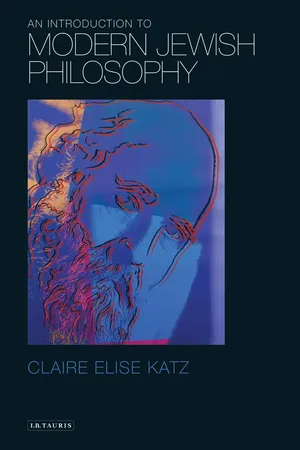
How Jewish is modern Jewish philosophy? The question at first appears nonsensical, until we consider that the chief issues with which Jewish philosophers have engaged, from the Enlightenment through to the late 20th century, are the standard preoccupations of general philosophical inquiry. Questions about God, reality, language, and knowledge - metaphysics and epistemology - have been of as much concern to Jewish thinkers as they have been to others. Moses Mendelssohn, for example, was a friend of Kant. Hermann Cohen's philosophy is often described as 'neo-Kantian.' Franz Rosenzweig wrote his dissertation on Hegel. And the thought of Emmanuel Levinas is indebted to Husserl. In this much-needed textbook, which surveys the most prominent thinkers of the last three centuries, Claire Katz situates modern Jewish philosophy in the wider cultural and intellectual context of its day, indicating how broader currents of British, French and German thought influenced its practitioners. But she also addresses the unique ways in which being Jewish coloured their output, suggesting that a keen sense of particularity enabled the Jewish philosophers to help define the whole modern era.
Intended to be used as a core undergraduate text, the book will also appeal to anyone with an interest how some of the greatest minds of the age grappled with some of its most urgent and fascinating philosophical problems.
- 256 pages
- English
- ePUB (mobile friendly)
- Available on iOS & Android
eBook - ePub
An Introduction to Modern Jewish Philosophy
About this book
Information
1
Mendelssohn and the Enlightened Mind
In the opening sentence of his compact essay “What is Enlightenment?,” the eighteenth-century German philosopher, Immanuel Kant, asserts, “Enlightenment is man’s emergence from his self-imposed immaturity.”1 He then adds that the motto of the Enlightenment is to have the courage to use one’s understanding—to know what reason tells us to do, and then to act in accordance with that reason. Kant explains that men and women have been convinced that it is far more dangerous to go out on one’s own, to learn to walk by oneself than to let others be our guardians. Like the British philosopher, John Stuart Mill, who will argue a similar point eighty-five years later in England, Kant describes our state as a learned domesticity––indeed one where we have been shown the risks of learning to use our own reason without also having been shown the advantages. As a result, moving out of our own immaturity is a difficult task, requiring strength to go against received wisdom and the force of the community. Only a few succeed in doing so.
Kant’s essay is a call for freedom, a call to throw off the shackles of immaturity that keep one confined. The danger that would result from this freedom, however, is not the danger that the protectors claim threatens those whom they hope to confine. Rather, the danger would result from the knowledge those freed now have of those who kept them in intellectual chains. Enlightenment, then, Kant says, must be attained slowly.
What, then, is this freedom for which Kant calls? It is the freedom to use reason publicly, what we would now call “freedom of speech” or “freedom of expression.” He cites examples where the common phrase of the day instructs not to argue, but to drill, not to argue but to believe, not to argue but to pay (e.g., the tax collector). Our lives are structured so that if we go against what those in positions of authority tell us—and the one thing they tell us is not to question them—then we put ourselves at risk, even if the risk is simply imagined. The freedom of thought that Kant promotes is not simply freedom of conscience, though it includes that as well. It is also the freedom of thought to express that thought publicly—to argue with those who claim to have authority over us. It is only when we exercise this freedom that we can bring about the enlightenment of all humankind.
Addressing church authority, Kant says
would not a society of clergymen, such as a church synod or a venerable classis (as those among the Dutch call themselves) be justified in binding one another by oath to a certain unalterable symbol in holding an unremitting superior guardianship over each of their members, and by this means over their people, and even to make this eternal? […] Such a contract, concluded for the purpose of closing off forever all further enlightenment of the human race, is absolutely null and void, even if it should be confirmed by the highest power, by parliaments, and by Imperial Diets, and by the most solemn peace treaties.2
Speaking about the time in which he lives, Kant says that although we are not enlightened, we do live in an age of enlightenment, where these acts, where the steps out of immaturity are made possible by those who in positions of authority do not prescribe others’ behavior but allow them freedom in, for example, religious matters. He tells us at the end of the essay that he focused on religious matters specifically because on the one hand, our rulers have no interest in governing matters of the arts and sciences (if only that were true today!) and because the form of immaturity that characterizes those under the protective sway of religious leaders Kant finds the “most pernicious and disgraceful of all.”
We can take Kant’s worry, then, as the starting point for Mendelssohn’s motivation to respond to a variety of critics: some who wanted him to convert to Christianity and some who wished for him to explain the more philosophical question, “Can one be both a Jew and also hold the position Mendelssohn holds with regard to religious authority?” That is, are there limits to religious authority, and if so, what are they? This question will take many forms over the course of the next few hundred years, but in short, the question originates from an assumption that there is a fundamental contradiction in being both Jewish and being “something else,” whether that something else is a citizen of a nation (not Israel) or simply an “enlightened” human being, however we understand that term. Put more generally, the question is: can one be particular (read here as not Protestant) when living in a state governed by a people viewed as universal? The question is not much different from the one we ask today regarding the Muslim or the Jew living in France, a country which considers itself to be governed by secular laws. In response to a similar question, Mendelssohn published his landmark book, Jerusalem; or, On Religious Power and Judaism, in 1783, just one year before Kant’s aforementioned essay. In light of the popularity that Mendelssohn enjoyed as a scholar of the German intellectual community, the response to this book was less enthusiastic than what one might have expected. It is worth noting some of Mendelssohn’s biographical details in order to place this work into its proper context.
Mendelssohn’s Life
Moses Mendelssohn was born in 1729 in Dessau, Germany, and at the age of 14, he moved to Berlin to study under Rabbi David Fränkel. During this time Friedrich II (the Great) succeeded to the Prussian throne in 1740. In 1753, Mendelssohn began work as a clerk in the Bernhard family silk factory and in 1761 he became the manager. On a trip to Hamburg in 1761, his first trip away from the city since moving there, he was introduced to Fromet Gugenheim. The introduction, made by Sarah Bernhard, the daughter of the owner of the factory where Mendelssohn was employed, led to a romantic relationship. His letters about the affair reveal a deeply romantic love story, which culminated in their wedding in the summer of 1762. Even before they were married, Mendelssohn encouraged his beloved “to acquire an education befitting a philosopher,” yet when it appeared she was spending too much time on her studies he urged her to limit her intellectual investment.
Yet even during the age of Enlightenment, a permit was needed for Mendelssohn and his wife to live inside the city of Berlin, which at the time was resistant to increasing its number of Jewish residents. On March 26, 1762, Mendelssohn was able to inform his fiancée that permission was granted. Although a seemingly minor inconvenience, this incident points to the fragile status of and the careful balance in Mendelssohn’s life as an intellectual Jew in the German intellectual community. Certainly these points appear to be operating in the background while Mendelssohn is writing both Jerusalem; or, On Religious Power and Judaism (1783) and his much shorter essay “What is Enlightenment?” (1784).
In spite of Friedrich II’s own intellectual engagement and the view of him as an enlightened monarch, he nonetheless penned several edicts that prevented Jews from becoming fully integrated citizens. The most “draconian” of these edicts was that of 1750: Revidierte General Privilegium und Reglement declared Jews inferior and “tolerated only by the grace of the royal house”.3 The edict divided the Jews into “six groups according to their economic benefit to the state” (Feiner 38). Mendelssohn, because of his status as a private tutor, was lumped together with the servants, “the least privileged order. People in his category were expressly forbidden to marry within the city limits under penalty of expulsion” (Feiner 39).
These edicts notwithstanding (or maybe because of them, since they inspired resistance from those who were more tolerant) and the anti-Semitism that persisted in Europe, Mendelssohn enjoyed respect and popularity as both a scholar of philosophy and a Jewish sage. He was part of the Berlin intellectual community and maintained a deep friendship with the philosopher Gotthold Lessing, from 1753 until Lessing’s death in 1781. One of his greatest admirers, Lessing wrote the play Nathan der Weise (Nathan the Wise), an homage to his friend in which he modeled Nathan on Mendelssohn. Mendelssohn’s publishing career spanned over thirty years, literally until his own death in 1786, and included essays and books on Plato, Rousseau, metaphysics, logic, the emotions (or sensual feelings), the Enlightenment, and of course, religion. We can now turn to Mendelssohn’s writings to see how he handles the question of religious authority understood within the context of the Enlightenment.
“On the Question: What is Enlightenment?”
Although written one year after Jerusalem, Mendelssohn’s essay “What is Enlightenment?” provides an interesting context for his longer work on Judaism. In light of the prejudice that Mendelssohn and his fellow Jews continued to experience, engaging the question of what is Enlightenment could not have been more pressing. How, in the age of Enlightenment, which prized reason and truth, could such religious prejudice still exist? In Jerusalem, Mendelssohn identifies the boundaries of state and religious power, and his essay on enlightenment ties together themes regarding both a virtuous disposition (based on moral or religious upbringing) and the intellect. Just as Jerusalem challenged the view that one could be a German citizen and also maintain a Jewish identity—a discussion that continues well into the twentieth century—“What is Enlightenment?” also engages the question of truths and their relationship to deeply held prejudices, whose shattering might rock the very foundations of religion and morality. When Mendelssohn’s friend, Herz Homberg, was rejected by the Emperor for a university post because he was a Jew, Mendelssohn is reported to have said in response, “Very infrequently extraordinary people do what ordinary people expect of them, for they are extraordinary people. What His Majesty [the Emperor] has decided in your case is therefore not exceptional” (Feiner 189).
The irony that Mendelssohn’s biographer notes—that Homberg was working to implement the Emperor’s toleration laws regarding Jewish education, which required a balanced curriculum combining religious study and general subjects in the humanities, natural sciences, and foreign languages—is particularly poignant in this age of Enlightenment (Feiner 154). The educational reform was made in exchange for greater Jewish acceptance as citizens within Prussian society. That Emperor Josef II issued edicts that were to increase tolerance of the Jews made his resistance to this university appointment all the more troubling. If the emperor who mandates increased Jewish tolerance will not make such an appointment, then who will?
In a letter to Homberg, Mendelssohn expressed his sentiment that hypocritical toleration was more of a concern than open persecution (Feiner 190). Thus, in the last years of his life, Mendelssohn was left with the most fundamental of problems facing the enlightenment: religious prejudice. He writes, “The prejudices against my nation are too deeply rooted as to enable their easy eradication,” and he wondered if this inability to free oneself of religious prejudice raised questions for the Enlightenment project as a whole. If one could not use reason to free oneself of the deepest prejudices, then what extraordinary power did reason hold? In his letter to the Swiss physician, Johann Georg Zimmermann, dated September 1784, Mendelssohn wrote:
We dreamed of nothing but the Enlightenment and believed that the light of reason would illumine all around it with such power that delusion and inflamed fanaticism would no longer be able to be seen. But as we can see, from beyond the horizon the night rises once more with all its specters. Most frightening of all is that evil is so active and influential. Delusion and enthusiasm [Schwärmerey] act, and reason makes do with words. (Feiner 191)
Two things haunted Mendelssohn during these last years. The first was the continued presence of an oppressive establishment religion that threatened religious tolerance. The second was a new intellectual movement, Sturm und Drang (storm and stress), that threatened the Enlightenment by replacing reason with emotion, spontaneity, naturalness, and so forth (Feiner 191). What becomes clear in Mendelssohn’s concerns is that the success of the Enlightenment, indeed the truth of the Enlightenment, is its ability to overcome religious prejudice through reason. Robust religious tolerance, then, becomes the litmus test of an enlightened individual and an enlightened nation.
In response to what Mendelssohn saw as the breakdown of the Enlightenment, he published a short essay in 1785 in which he placed the blame for the Enlightenment’s unraveling in its own lap. Because Mendelssohn’s project was to negotiate the relationship between religious belief and reason, rather than replace one with the other, he saw any extreme, on either side, as both potentially dangerous and also potentially false. He took issue with the extreme disbelievers, like Voltaire, as he did with the religious fanatics. Each extreme was dangerous to the Enlightenment in its own way. Thus, if one uses this point as a frame, then looking back to the essay at hand, “What is Enlightenment?,” we see that his aim in this essay is to circumscribe not only the limits of the Enlightenment but also its dangers (Feiner 192).
Mendelssohn opens this essay by engaging in a discussion of semantics. The words enlightenment, education, and culture are new, he says, but does this mean that society did not have these attributes before they were named? Could not an attribute be present even if there is not a word to name it? At the time of his writing this essay, the boundaries between these concepts were not yet clear. Education was synonymous with enlightenment, and both were synonymous with culture. They were all modifications of social life and they were the result of man’s diligence to better his circumstances. For Mendelssohn, the more social conditions were brought into harmony with man’s calling, the more we could say that a particular group was educated (53).
Although Mendelssohn claims that at the time of this writing, there is no distinct boundary between these terms, his goal in this essay is to discern what those distinctions are. His claim is that education comprises both culture and enlightenment. He then proceeds to distinguish between culture and enlightenment and then explain how they both contribute to what is meant by education. He observes that culture
appears to be more oriented toward practical matters: (objectively) toward goodness, refinement, and beauty in the arts and social mores; (subjectively) toward facility, diligence, and dexterity in the arts and inclinations, dispositions, and habits in social mores. The more these correspond in a people with the destiny of man, the more culture will be attributed to them, just as a piece of land is said to be more cultured or cultivated, the more it is brought, through the industry of men, to the state where it produces things that are useful to men. Enlightenment by contrast seems to be more related to theoretical matters: to (objective) rational knowledge and to (subjective) facility in rational reflection about matters of human life, according to their importance on the destiny of man. (53–54)
What Mendelssohn refers to as the “destiny of man” for him is the “measure and goal of all our striving and efforts,” the end to which we should always have our sights set (54). Mendelssohn claims that language attains enlightenment through sciences, that is through theoretical endeavor, but it gains culture through actual use: social intercourse, poetry, and so forth (54). Both are necessary for the language to be considered “educated.” Significantly, Mendelssohn emphasizes the role of both theory and practice in education. He maintains this distinction and the importance of both throughout this essay. He asserts that language is the best indicator of education, of both culture and enlightenment (54).
The essay then moves to a discussion of the destiny of man, which can be separated into two different discussions: the destiny of man as man and the destiny of man as citizen.4 Because culture is already the application, or the practice, of the individual, with regard to culture, then, the destiny, or calling of man as both man and citizen coincide. Man as man has no need of culture. It is only man as a citizen, as an individual who lives with others, who needs the practical value. Yet, while Mendelssohn be...
Table of contents
- Author Bibliography
- Title Page
- Copyright Page
- Dedication
- Contents
- Acknowledgements
- List of Abbreviations
- Glossary
- Preface
- Introduction: What is Jewish Philosophy?
- 1 Mendelssohn and the Enlightened Mind
- 2 From Modern to Post-modern: Hermann Cohen and Hannah Arendt
- 3 Jewish Existentialism: Shestov, Buber, and Rosenzweig
- 4 Emmanuel Levinas and Abraham Joshua Heschel: Response to Modernity
- 5 The Limits of Philosophy
- Concluding Remarks
- Notes
- References, Sources and Suggested Reading
Trusted by 375,005 students
Access to over 1.5 million titles for a fair monthly price.
Study more efficiently using our study tools.
Frequently asked questions
Yes, you can cancel anytime from the Subscription tab in your account settings on the Perlego website. Your subscription will stay active until the end of your current billing period. Learn how to cancel your subscription
No, books cannot be downloaded as external files, such as PDFs, for use outside of Perlego. However, you can download books within the Perlego app for offline reading on mobile or tablet. Learn how to download books offline
Perlego offers two plans: Essential and Complete
- Essential is ideal for learners and professionals who enjoy exploring a wide range of subjects. Access the Essential Library with 800,000+ trusted titles and best-sellers across business, personal growth, and the humanities. Includes unlimited reading time and Standard Read Aloud voice.
- Complete: Perfect for advanced learners and researchers needing full, unrestricted access. Unlock 1.5M+ books across hundreds of subjects, including academic and specialized titles. The Complete Plan also includes advanced features like Premium Read Aloud and Research Assistant.
We are an online textbook subscription service, where you can get access to an entire online library for less than the price of a single book per month. With over 1.5 million books across 990+ topics, we’ve got you covered! Learn about our mission
Look out for the read-aloud symbol on your next book to see if you can listen to it. The read-aloud tool reads text aloud for you, highlighting the text as it is being read. You can pause it, speed it up and slow it down. Learn more about Read Aloud
Yes! You can use the Perlego app on both iOS and Android devices to read anytime, anywhere — even offline. Perfect for commutes or when you’re on the go.
Please note we cannot support devices running on iOS 13 and Android 7 or earlier. Learn more about using the app
Please note we cannot support devices running on iOS 13 and Android 7 or earlier. Learn more about using the app
Yes, you can access An Introduction to Modern Jewish Philosophy by Claire Elise Katz in PDF and/or ePUB format, as well as other popular books in Philosophy & Jewish Theology. We have over 1.5 million books available in our catalogue for you to explore.