- 864 pages
- English
- ePUB (mobile friendly)
- Available on iOS & Android
eBook - ePub
About this book
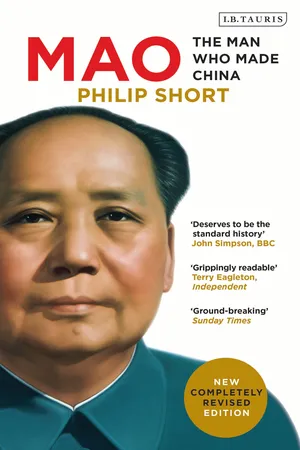
One of the great figures of the twentieth century, Chairman Mao looms irrepressibly over the economic rise of China. Mao Zedong was the leader of a revolution, a communist who lifted hundreds of millions out of poverty, an aggressive and distrustful leader, and a man responsible for more civilian deaths than perhaps any other historical figure. Now, four decades after Mao's death, acclaimed biographer Philip Short presents a fully updated and revised edition of his ground-breaking and masterly biography. Vivid, uncompromising and unflinching, Short presents in one-volume the man behind the propaganda - his family, his beliefs and his horrors. In doing so he shows us both the human being Mao was, and the monster he became.
Information
CHAPTER ONE
A Confucian Childhood
In winter, in Hunan, the wind howls bone-cold across bare fields of dry yellow earth, kicking up the dust so that it stings the eyes of the horses and makes men squint as they lean into the frozen air, their faces like leather masks. This is the dead season of the year. The peasants, in unheated mud-brick huts, bundle themselves up in layers of dirty, quilted cotton, drawing their hands up into their sleeves so that only their heads protrude warily from the folds of blue cloth, tortoise-like, waiting for better days.
Mao was born into a Hunanese peasant household in the village of Shaoshan, a few days after the winter solstice, the great mid-winter festival when the Emperor Guangxu in far-off Beijing was borne in solemn procession to the Temple of Heaven to perform the sacrificial rites and give thanks for another year safely passed.1 It was the nineteenth day of the eleventh month of the Year of the Snake by the old calendar, December 26 1893 by the new.2
By tradition, which was strictly adhered to in the case of a firstborn son, the baby was not bathed until three days after the birth.3 A fortune-teller was then called in and a horoscope drawn up, which showed that the family was lacking in the water element. Mao's father therefore named him Zedong, because the character ze, ‘to anoint’, which has the secondary meaning, ‘beneficent’,4 is held in Hunanese geomantic lore to remedy such a deficiency.I That marked the start of a year of the Buddhist and Daoist folk-rituals with which Chinese peasants through the ages have tempered the harshness of their existence, adding a touch of colour and excitement to the severe Confucian teachings around which their lives were fashioned and society revolved. After four weeks, the baby's head was shaved, apart from a small tuft left on the crown by which ‘to hold him to life’. A few copper cash, or sometimes a small silver padlock, attached to a red cord, were placed around his neck for the same purpose. In some families, the hair that had been cut was mixed with the hairs of a dog and sewn into the child's clothing so that evil spirits would see him as an animal and leave him alone. Others made a boy-child wear an earring so that the spirits would think he was a girl and not worth bothering with.
By the standards of the time, Mao's family was comfortably off.5 His father, Shunsheng,6 had enlisted at the age of sixteen in the army of the Viceroy of Hunan and Hubei, and within five or six years had accumulated a small capital, with which he bought land. By the time Mao was born, the family owned two-and-a-half-acres of rice paddy, a substantial holding in a county renowned as being among the wealthiest and most fertile in one of the richest rice-growing provinces in China.7 His father, a thrifty man who counted every copper cash, later bought another acre and took on two farm labourers. He gave them a daily ration of rice and, as a special concession once a month, a dish of rice cooked with eggs – but never meat.
His penny-pinching coloured Mao's image of his father from an early age. ‘To me,’ he later recalled pointedly, ‘he gave neither eggs nor meat.’ Although there was always enough to go round, the family ate frugally. To Mao as a small boy, this stinginess was compounded by a lack of paternal affection, a deficiency made all the more glaring by the warmth and gentleness of his mother. It blinded him to his father's good points, the single-mindedness, drive and determination which Mao would later demonstrate in such abundance in his own life. While still a child he came to view the family as split into two camps: his mother and himself on one side, his father on the other.
A combination of parsimony and unrelenting grind soon made Mao's father one of the most prosperous men in Shaoshan, which then had a population of about 300 families, most of them also surnamed Mao, theirs being the dominant clan.
In those days, a peasant family in Hunan was thought to be doing well if it had an acre-and-a-half of land and a three-roomed house.8 Mao's parents had more than twice that much, and built a large, rambling farmhouse, with a grey-tiled roof and upturned eaves, beside a cascade of terraced rice-fields tumbling down a narrow valley. Pine woods stood behind and there was a lotus pond in front. Mao had a bedroom to himself, an almost unheard-of luxury, and when he was older would sit up late at night reading, hiding his oil-lamp behind a blue cloth so that his father would not see. Later, after his brothers were born, they too had rooms of their own.9 His father's capital amounted to two or three thousand Chinese silver dollars, ‘a great fortune in that small village’, as Mao himself acknowledged.10 Rather than extend his own land-holdings, he bought mortgages on other peasants' land, thus indirectly becoming a landlord.11 He also purchased grain from poor farmers in the village and sent it for resale in the county seat, Xiangtan, thirty miles away.12 A sprawling agglomeration of several hundred thousand people, Xiangtan was then the hub of the provincial tea trade and an important entrepot and financial centre because of its position on the Xiang River, Hunan's largest navigable waterway and the main artery of trade in the province. From Shaoshan, it was two days' journey by oxcart along a rutted earthen track, although porters could do it in one, carrying 80 kilograms of merchandise on their backs.
Much as he might complain about his father's meanness, Mao inherited his sense of thrift. Throughout his adult life, at least where his own person was concerned, he was famously unwilling to buy anything new if the old one could be patched up and made to serve a little longer.13
The earthiness of his childhood proved equally tenacious.14 Hygiene was rudimentary, and washing as much a rarity as in medieval Europe. ‘A total apathy in regard to matter in the wrong place pervades all classes from the highest to the lowest,’ wrote a contemporary observer. ‘Gorgeous silks conceal an unwashed skin, and from under the rich sable cuffs of the official protrude fingernails innocent of soap or penknife.’15 To the end of his days, Mao preferred a rub with a steaming towel to washing with soap and water.16 Nor did he ever get the hang of using a toothbrush. Instead, like most rural southerners, he rinsed his mouth with tea.17
The other constants of peasant life were bedbugs, lice and itch-sores. When Mao itched, he scratched: at Bao'an, in the 1930s, he had no compunction about lowering his trousers, while receiving a foreign visitor, to search for an uninvited guest in his underwear.18 In part, he disdained convention; in part, it was ingrained peasant habit. Nowhere was that more viscerally evident than in his attitude to the workings of his own body. The Chinese as a nation have always been unfazed by natural processes which send Anglo-Saxons in particular into contortions of squeamishness. Small children were, and in many parts of the countryside still are, brought up wearing split trousers so that they can squat and relieve themselves wherever the urge takes them. Adults used communal latrines, where defecation was a social event. Mao was never reconciled to Western-style lavatories with a seat and flushing water. Even at Zhongnanhai in the early 1950s, when he was already Head of State, it was one of the duties of his personal bodyguards to follow him out into the garden with a shovel, and dig a hole in the ground for Mao to perform his bowel movement. The practice ended only after Zhou Enlai arranged for a specially built latrine which met with Mao's approval to be installed next to his bedroom.19 He was equally ill at ease with Western-style beds, insisting all his life on having hard wooden boards to sleep on.
When Mao was six he started helping in the fields like other children of his age, carrying out the small tasks which Chinese peasant families always left to the old and the very young: watching over the cattle and tending the ducks.20 Two years later, his father sent him to the village school – an important decision for it cost four or five silver dollars a year, nearly six months of a labourer's wages.21
Among all except the very wealthy, every family's dream in nineteenth-century China was to have a son whose brilliance in expounding the classical Confucian texts would win him a place of honour in the imperial examinations, opening the way to an official career with all the prestige, and opportunities for ‘squeeze’, which that entailed. In the words of one of the most sympathetic Western observers of Chinese life at that time:
Education is the royal road to the honours and emoluments that the state has to bestow, and it is by means of it that the wildest ambition that ever ran riot through a young man's brain can ultimately be satisfied. In the West there are many ways by which a man may rise to eminence, and finally occupy a prominent position as a member of Parliament, or as holding some office under Government that will bring him before the notice of the public. In China they are all narrowed down to one, and it is the one that leads from the schoolhouse … It may be confidently asserted that every schoolboy carries in his satchel a possible viceroyship when … untrammelled by parliaments, he may rule over twenty or thirty millions of people.22
Yet the dream was for the few. Most of the population was too poor to take even the first step: learning to read and write.23
Mao's mother, Wen Qimei, literally ‘Seventh Sister’, the peasant custom then being not to name girls, but simply to number them in order of their birth, may have had dreams for him. Three years older than her husband, she was a devout Buddhist. She introduced her son to the mysteries of the village temple with its fantastic images of arhats and bodhisattvas, blackened by grime and smoke, the air heavy with the smell of incense; and later she grieved when, as an adolescent, his faith began to falter.
Mao's father did not dream. His ambitions, typical of the small landlord he had become, were much more down-to-earth.24 He himself was barely literate, having had but two years' schooling. He wanted his son to do better, but for strictly practical ends: to keep the farm accounts, and then later, after an apprenticeship with a rice merchant in Xiangtan, to take over the family business and support his parents in their old age.25
Royal road it might be, but a village school in the last days of the Chinese Empire was a grim place, calculated to dampen the boldest spirit.26 It consisted of a single room with bare mud-brick walls and a floor of beaten earth, unheated in winter, sweltering in summer, with a central door and two small apertures at each end allowing in air and a little light to pierce the gloom. The school year began in February, on the 17th of the First Moon, two days after the Lantern Festival, which brought to an end the festivities marking the Chinese New Year. Each boy waited at the school gate, carrying a small desk and stool which he had brought from home. Usually there were about twenty of them, the youngest, like Mao, seven or eight years old, the oldest seventeen or eighteen. They all wore identical loose jackets, cross-tied at the front, of homespun blue cotton, and loose, baggy trousers made from the same material. The teacher sat at a table, with an ink-stone and water-dropper, a small earthenware teapot and cup, bamboo tallies to record the presence of each pupil, and a stout bamboo rod before him. Tradition held that he should show no sign of interest in, or sympathy for, his students lest it endanger his authority, which was absolute.
Mao's teacher was in that mould. He belonged to the ‘stern-treatment school … harsh and severe’, Mao remembered.27 They learned to fear his bamboo rod, which he used frequently, and his ‘incense board’ – a slatted wooden washboard on which a pupil would be made to kneel for the time it took an incense-stick to burn down.28
If the material conditions were depressing, the method of teaching was more so. There were no picture books to excite the imaginations of Mao and his classmates, no simple stories to capture the attention of their young minds. Instead, they were subjected to a system of rote-learning, which had been handed down almost unchanged for 2,000 years and whose guiding principle was to keep knowledge the preserve of the elite by making it as difficult as possible to acquire.
The first schoolbook with which the children of Mao's generation were presented was the Three Character Classic, so-called because each of its 356 lines contains three Chinese characters. Written in the eleventh century to introduce young people to Confucian ideas, it opens with the words:
Men at their birth are by nature radically good,
In this, all approximate, but in practice widely diverge.
In this, all approximate, but in practice widely diverge.
To which a fifteenth-century commentator adds:
This is the commencement of a course of education and explains first principles … That which heaven produces is called ‘man’; that which it confers is called ‘nature’; the possession of correct moral...
Table of contents
- Cover
- About the Author
- Epigraph
- Title
- Dedication
- Contents
- Acknowledgements
- List of Maps
- List of Illustrations
- Note on Spelling and Pronunciation
- Chinese Views of Mao: Preface to the New Revised Edition
- Prologue
- 1. A Confucian Childhood
- 2. Revolution
- 3. Lords of Misrule
- 4. A Ferment of ‘Isms’
- 5. The Comintern Takes Charge
- 6. Events Leading to the Horse Day Incident and its Bloody Aftermath
- 7. Out of the Barrel of a Gun
- 8. Futian: Loss of Innocence
- 9. Chairman of the Republic
- 10. In Search of the Grey Dragon: The Long March North
- 11. Yan’an Interlude: The Philosopher is King
- 12. Paper Tigers
- 13. The Sorcerer’s Apprentice
- 14. Musings on Immortality
- 15. Cataclysm
- 16. Things Fall Apart
- Epilogue
- Afterword
- Dramatis Personae
- Notes
- eCopyright
Trusted by 375,005 students
Access to over 1.5 million titles for a fair monthly price.
Study more efficiently using our study tools.
Frequently asked questions
Yes, you can cancel anytime from the Subscription tab in your account settings on the Perlego website. Your subscription will stay active until the end of your current billing period. Learn how to cancel your subscription
No, books cannot be downloaded as external files, such as PDFs, for use outside of Perlego. However, you can download books within the Perlego app for offline reading on mobile or tablet. Learn how to download books offline
Perlego offers two plans: Essential and Complete
- Essential is ideal for learners and professionals who enjoy exploring a wide range of subjects. Access the Essential Library with 800,000+ trusted titles and best-sellers across business, personal growth, and the humanities. Includes unlimited reading time and Standard Read Aloud voice.
- Complete: Perfect for advanced learners and researchers needing full, unrestricted access. Unlock 1.5M+ books across hundreds of subjects, including academic and specialized titles. The Complete Plan also includes advanced features like Premium Read Aloud and Research Assistant.
We are an online textbook subscription service, where you can get access to an entire online library for less than the price of a single book per month. With over 1.5 million books across 990+ topics, we’ve got you covered! Learn about our mission
Look out for the read-aloud symbol on your next book to see if you can listen to it. The read-aloud tool reads text aloud for you, highlighting the text as it is being read. You can pause it, speed it up and slow it down. Learn more about Read Aloud
Yes! You can use the Perlego app on both iOS and Android devices to read anytime, anywhere — even offline. Perfect for commutes or when you’re on the go.
Please note we cannot support devices running on iOS 13 and Android 7 or earlier. Learn more about using the app
Please note we cannot support devices running on iOS 13 and Android 7 or earlier. Learn more about using the app
Yes, you can access Mao by Philip Short in PDF and/or ePUB format, as well as other popular books in History & Historical Biographies. We have over 1.5 million books available in our catalogue for you to explore.