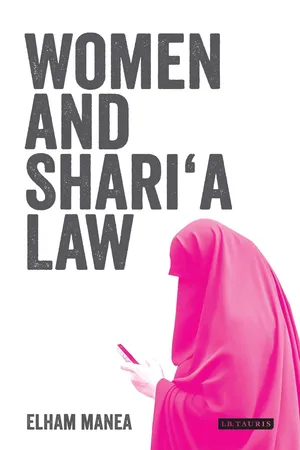
- 320 pages
- English
- ePUB (mobile friendly)
- Available on iOS & Android
eBook - ePub
About this book
In response to recent media controversy and public debate about legal pluralism and multiculturalism, Manea argues against what she identifies as the growing tendency for people to be treated as 'homogenous groups' in Western academic discourse, rather than as individuals with authentic voices. Building on her knowledge of the situation for women in Middle Eastern and Islamic countries, she undertakes first-hand analysis of the Islamic shari'a councils and Muslim arbitration tribunals in various British cities. Based on meetings with the leading sheikhs - including the only woman on their panels - as well as interviews with experts on extremism, lawyers and activists in civil society and women's rights groups, Manea offers an impassioned critique of legal pluralism, connecting it with political Islam and detailing the lived experiences of women in Muslim communities.
Information
CHAPTER 1
A CRITICAL REVIEW OF THE ESSENTIALIST PARADIGM
As you may have noticed from the way I outlined my argument, I went through a journey of transformation, of learning and research, and through it I learned that what we are dealing with is not only one person's absurd suggestion.
Giordano's suggestion is the tip of an iceberg. It is an expression of a paradigm of thinking – I call it the Essentialist Paradigm – and it has four specific ideological features. The first is a combination of multiculturalism and legal pluralism in a social context. The second is group rights, the third is cultural relativism, and the fourth is the white man's burden.
First Feature: Combining Multiculturalism with Legal Pluralism in a Social Context
The very title of Giordano's article, ‘Legal Pluralism: An Instrument for Multiculturalism’, contains two important terms: legal pluralism and multiculturalism. When combined, they lead to a relativist approach to fundamental human rights and gender justice. The call to combine the two terms within a social context is one fundamental feature of the Essentialist Paradigm.
I tend, like Kenan Malik, a left-leaning, Indian-born English thinker, to distinguish between two types of multiculturalism. One type he calls the lived experience of diversity: ‘the experience of living in a society that is less insular, more vibrant and more cosmopolitan.’1
This type I welcome and embrace. This type appreciates people with different roots and origins living together on a basis of mutual respect and acceptance. No one's origin, colour, race, religion or gender is seen as lesser than another's. We are equal by virtue of being humans. Full stop.
To use the words of Anne Phillips, the British Professor of Political and Gender Theory, it is a type of multiculturalism grounded in the rights of the individuals, not those of the groups.2
But it is the second type of multiculturalism that I criticise and find problematic. This is what Malik calls multiculturalism as a political process. The aim here is to manage that diversity, and as such it entails a set of policies that try to institutionalise diversity. This type puts people into ethnic and cultural boxes, defines individual needs and rights by virtue of the boxes people are in, and uses those boxes to shape policy.3 This policy is implemented in Britain.
Similarly, when multiculturalism as a political process is combined with the policy of legal pluralism, it tends to divide people into boxes: of origin, culture, religion and, ultimately, gender. It sets them apart, and places them into parallel legal enclaves. Each enclave is governed by a different set of rules: rules that may or may not subscribe to the same notions of law and justice dominant in the larger society. As a result, people are not defined as individual members of a larger society or a nation that applies the same rules and laws to all of its members. Instead they are defined primarily as members of a cultural or religious group. Each group has innate and essential cultural features that demand special treatment and hence special laws for it to survive. This last aspect is often referred to as group rights.
Second Feature: Group Rights
The notion of group rights is a second feature of the Essentialist Paradigm, a notion famously espoused by the father of legal pluralism, the Canadian philosopher Charles Taylor. I am aware that other philosophers and scholars have influenced the discourse on group rights. I am using his work as an example especially as his idea of the politics of recognition, introduced in his edited volume, Multiculturalism: Examining the Politics of Recognition, has permeated much of the thinking by proponents of legal pluralism. He, too, refers to the politics of multiculturalism. But he refers to it in terms of the demands that minority or subaltern groups make for recognition:
The demand for recognition in these latter cases is given urgency by the supposed links between recognitions and identity, where the latter term designates something like a person's understanding of who they are, of their fundamental defining characteristics as a human being. The thesis is that our identity is partly shaped by recognition or its absences, often by the misrecognition of others, and so a person or group of people can suffer real damage, real distortion, if the people or society around them mirror back to them a confining or demeaning or contemptible picture of themselves. Nonrecognition or misrecognition can inflict harm, can be a form of oppression, imprisoning someone in a false, distorted, and reduced mode of being.4 [emphasis in original]
Taylor uses several examples to explain his idea. He says that black people have suffered in white societies that projected a demeaning image of them – and that some black people have internalised that image. Similarly, women in particular societies have been induced to adopt an image of themselves as inferior and have internalised an image of their own inferiority. The self-depreciation of both groups becomes one of the most potent instruments of their own oppression. Therefore they must purge themselves of this imposed and destructive identity. Taylor says that a society's misrecognition of these groups’ identities is not only a failure to give them the respect they are due. It also inflicts harm and grievous wounds that saddle the victims with crippling self-hatred: ‘Due recognition is not just a courtesy we owe people. It is a vital human need.’5
Society may indeed project a demeaning picture on an individual by virtue of their colour, gender and/or religion, but the process is complicated and not as straightforward as Taylor describes.
I will give a personal example to illustrate this point.
I still remember how I felt when I came to Switzerland 21 years ago. Suddenly I was very conscious of my colour. I am an Arab, with Yemeni and Egyptian roots, and never before had I given a second thought to my colour, a bronze or light brown. In fact, I felt pride in my looks. You may consider it strange to read the word ‘pride’. But I was raised in a loving family, one that gave me the feeling that I am both precious and beautiful. This feeling remained with me when I moved to Washington, DC, with a Fulbright scholarship, to pursue a master's degree. There I lived in a multicultural context and felt very much appreciated. I also realised that my colour, among other features, made me somehow ‘exotic’, which made me very popular as a young single woman.
In Switzerland it was not a matter of not being appreciated that made me feel conscious of my colour. My husband and I tended to live and socialise with Swiss people like us: educated people with professions that brought them in direct contact with the outside world. Our neighbours of nearly two decades are open and embracing. With some I nurture close and warm relationships. So the issue was not appreciation. Rather, what made me conscious of my colour was the feeling that I stood out among the others because of it. So what made me feel different was not an actual demeaning picture projected to me by society, but the fact of being ‘coloured’ in an all-white society. It took me a while to address this feeling of being uneasy about my colour: to recognise its roots, to internalise the knowledge that ‘being different’ does not mean ‘being lesser’, and to finally come to the conviction, yet again, that this is my colour, and it is beautiful.
By the same token, as a girl living in a Yemeni social context, some people tried to give me the impression that I was ‘an inferior being’ and ‘should behave as other girls do.’ It goes without saying that I was not behaving as they thought I should.
I said before that I was raised in a loving family. Both of my parents loved and respected me. More important, especially in North Yemen's patriarchal and tribal context, I had a father who did not subscribe to the notion that a girl has less worth than a boy. That was not a given; my father only came to that conclusion through a personal journey of education and growth. His education and then travels as a diplomat were certainly instrumental in this process. It was he who always gave me the feeling that I am a free person, and independent, and that I can strive to be whatever I want to be. This conviction was reflected in the way I was raised and in the fact that I was allowed to do things that other girls on his side of the family did not do.
The safe haven of my family sharply contradicted some of the messages I received from the wider society. I vividly remember an incident when I was 11, walking on the outskirts of our neighbourhood. A group of young boys started to throw stones at me, calling me a ‘whore’, because I was wearing trousers and did not cover my hair. These boys were conveying a message they had internalised from their own family and societal context: girls wear a headscarf and later they wear a sharshaf, the two pieces of black cloth that cover the woman from head to toe, complemented with another one that hides the face. And any girl who does not wear the headscarf and then the sharshaf is not a ‘proper’ girl. I can assume that their using the word ‘whore’ was an expression of their childish conviction of that message.
Despite the pain I felt from this incident, please notice that I deliberately used the word ‘some’ when I referred to the messages I received from the wider society. This is important because while some of these messages were negative – and very negative as in the incident above – others were positive, and still others were neutral. My family socialised with groups of families who shared the same norms about perceptions of girls and their rights. From this group I received the message of acceptance. Being a girl was not a source of shame or a burden. My father's side of the family, on the other hand, had learned to accept my ‘otherness’ in a way that made their message ‘neutral’: ‘You may not subscribe to the way we believe girls should behave in our societal context, but we accept you.’
So I do agree with Taylor that sometimes society may project a demeaning image on the individual, but I also tend to see the situation as more complex. Society is not homogeneous; it is complex and often made up of subgroups. The message I was getting from the wider society was likewise not homogeneous or static, and it changed according to the subgroups within which I was socialising.
Most important, sometimes a religious, gender or cultural identity can be imposed on a person, even if that person does not perceive himself/herself as such. Consider the person who is called a Muslim, ‘perceived’ as a Muslim and ‘treated’ as a Muslim, despite the fact that this person may not be religious at all or may prefer to be called and identified by his or her nationality. Here in Switzerland I want to be perceived as a citizen, a Swiss person with Arab origins. After all, that is what we do with other people of other religions; we identify them by their nationalities, not their religion. So why insist on reducing me to a religious identity?
This does not seem to be the argument of Charles Taylor. And just as he considers the message of the overall society to be homogeneous, he tends to see identity and with it culture and society as something static, something that does not change – a whole that has inherent and given traits.
Identity to him is ‘who we are, where we are coming from,’ and thus ‘the background against which our tastes and desires and opinions and aspirations make sense.’ But in his paradigm, identity does not exist in a vacuum. It is very much intertwined with the concept of what he calls authenticity: ‘There is a certain way of being human that is my way. I am called upon to live my life in this way and not in imitation of anyone else's life.’6 This ‘notion gives importance to being true to myself. If I am not, I miss the point of my life; I miss what being human is for me.’7 [emphasis in original]
This notion of authentic identity has given rise to what he calls the ‘politics of difference’, making distinctions the basis of differential treatment:
The aim is to cherish distinctness, not just now but forever. After all, if we are concerned with identity, then what is more legitimate than one's aspiration that it never be lost?8
Cherishing distinctions requires introducing policies of ‘collective goals’ designed for ‘cultural survival’. He insists that a society with strong collective goals can still be liberal, if it is ‘also capable of respecting diversity, especially when dealing with those who do not share its common goals; and provided it can offer adequate safeguards for fundamental rights.’9
Fundamental rights aside, Taylor considers it quite possible that the rights of individuals will be restricted if the state focuses on safeguarding the collective goals; he also acknowledges that the pursuit of the collective end will probably involve treating insiders and outsiders differently.
***
Charles Taylor's concept of identity is not concerned with identity at the individual level. He focuses on the collective identity of a cultural group. This cultural group may be aboriginal bands or French Canadians, especially Quebeckers. It could also be a group designated by its gender, for example women. It could be a religious group, like the Muslims. His main motivation in describing the politics of recognition and hence difference is the fear of ‘imposing’ a hegemonic culture on the culture of a minority. Taylor's aim, and this should be emphasised, is to protect and safeguard minority rights, and to insure they are not violated. So from this perspective his aim is certainly noble.
The problem lies in his attempt to ensure that the collective identity of a cultural group can survive. Here he falls into an essentialist trap: focusing on the authentic identity of a cultural group assumes that it has fundamental unchangeable traits. This assumption ignores the fact that cultures do change, that they are not static. What we yesterday considered to be part of our cultural norms and identity may today look quite abhorrent.
In addition, minority groups are not homogeneous, as he assumes. They do not represent one cultural block with similar and standardised features and traits. Often members of minority groups have a complex set of identities that they express differently in different settings. Taylor also ignores the power structures within minority groups, which further complicate matters, especially when some claim to be representatives of a certain cultural group and with it assume the right to define what is the authentic identity of their group and what is not.
Taylor was trying to protect a certain right for particular groups of people, but his effort led to a mess. Why do I use the word mess? Because when we propagate the concept of group rights, we also justify the violation of human rights within minority groups as an expression of different cultural concepts of rights and justice. Women's rights have been violated with impunity on this very ground. In fact, this very argument is being espoused on the international level by oppressive tyrannical regimes. So the consequences of propagating this model are felt not only on the national level but also on the international level.
Culture does change. If you have forgotten, let me remind you.
Consider the fact that between 1877 and the mid 1960s, the Jim Crow caste system was quite acceptable in Southern states of the United States. The system treated Blacks as a degenerate caste and second-class citizens; it excluded them from public transport and public facilities, from serving on juries, and from entering certain jobs and neighbourhoods. And it severely regulated social interactions between the races. During that period it was quite normal to have separate hospitals, prisons, schools, churches, cemeteries, and public accommodations for Blacks and Whites. These laws and policies were sustained and supported by a whole range of religious, educational and ‘scientific’ discourses. The mainstream Christian interpretation at the time taught that ‘whites were the Chosen people, blacks were cursed to be servants, and God supported racial segregation.’10 Scientists (craniologists, eugenicists, phrenologists, and Social Darwinists) at every educational level bolstered the belief that Bla...
Table of contents
- Front Cover
- Title Page
- Copyright
- Dedication
- Contents
- List of Tables
- Acknowledgements
- Introduction: The Debate
- 1. A Critical Review of the Essentialist Paradigm
- 2. Islamic Law in the West: The Case of Britain
- 3. Legal Pluralism in Practice
- 4. Islamic Law and Human Rights Between Theory and Reality: Britain as a Showcase
- 5. Islamism and Islamic Law in the West: Stating the Obvious? Britain as an Example
- 6. Contextualising the Debate in Women’s Reality: Shariʽa Law Contested
- Conclusion
- Notes
- Bibliography
- Back cover
Trusted by 375,005 students
Access to over 1.5 million titles for a fair monthly price.
Study more efficiently using our study tools.
Frequently asked questions
Yes, you can cancel anytime from the Subscription tab in your account settings on the Perlego website. Your subscription will stay active until the end of your current billing period. Learn how to cancel your subscription
No, books cannot be downloaded as external files, such as PDFs, for use outside of Perlego. However, you can download books within the Perlego app for offline reading on mobile or tablet. Learn how to download books offline
Perlego offers two plans: Essential and Complete
- Essential is ideal for learners and professionals who enjoy exploring a wide range of subjects. Access the Essential Library with 800,000+ trusted titles and best-sellers across business, personal growth, and the humanities. Includes unlimited reading time and Standard Read Aloud voice.
- Complete: Perfect for advanced learners and researchers needing full, unrestricted access. Unlock 1.5M+ books across hundreds of subjects, including academic and specialized titles. The Complete Plan also includes advanced features like Premium Read Aloud and Research Assistant.
We are an online textbook subscription service, where you can get access to an entire online library for less than the price of a single book per month. With over 1.5 million books across 990+ topics, we’ve got you covered! Learn about our mission
Look out for the read-aloud symbol on your next book to see if you can listen to it. The read-aloud tool reads text aloud for you, highlighting the text as it is being read. You can pause it, speed it up and slow it down. Learn more about Read Aloud
Yes! You can use the Perlego app on both iOS and Android devices to read anytime, anywhere — even offline. Perfect for commutes or when you’re on the go.
Please note we cannot support devices running on iOS 13 and Android 7 or earlier. Learn more about using the app
Please note we cannot support devices running on iOS 13 and Android 7 or earlier. Learn more about using the app
Yes, you can access Women and Shari'a Law by Elham Manea in PDF and/or ePUB format, as well as other popular books in Theology & Religion & Islamic Theology. We have over 1.5 million books available in our catalogue for you to explore.