- 256 pages
- English
- ePUB (mobile friendly)
- Available on iOS & Android
eBook - ePub
About this book
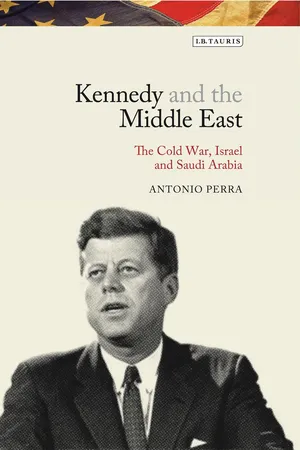
At the height of the Cold War, the John F. Kennedy administration designed an ambitious plan for the Middle East-its aim was to seek rapprochement with Nasser's Egypt in order to keep the Arab world neutral and contain the perceived communist threat. In order to offset this approach, Kennedy sought to grow relations with the Kingdom of Saudi Arabia and embrace Israel's defense priorities-a decision which would begin the US-Israeli 'special relationship'. Here, Antonio Perra shows for the first time how new relations with Saudi Arabia and Israel which would come to shape the Middle East for decades were in fact a by-product of Kennedy's efforts at Soviet containment. The Saudi's in particular were increasingly viewed as 'an atavistic regime who would soon disappear' but Kennedy's support for them-which hardened during the Yemen Crisis even as he sought to placate Nasser-had the unintended effect of making them, as today, the US' great pillar of support in the Middle East.
Information
CHAPTER 1
FROM SENATOR TO PRESIDENT: JFK AND THE MAKING OF A NEW MIDEAST APPROACH
The Senator Who Wanted to be President
By the end of the 1950s the Middle East had become without doubt one of the most important stages for the Cold War. The need for oil still dominated the minds of the American policy makers, as consumption, points out Yergin, was growing at ‘a pace that simply would not have been conceivable at the beginning of the post-war era’,1 while the region was progressively becoming the global centre of production,2 with profits expected to ‘reach $10,000 million a year by 1975.’3 The events of Suez and the nationalisation of the canal had proven the importance of its geo-strategic passages for Western economic interests, while simultaneously marking the gradual loss of influence of the former European empires and the handover of their power to Washington. The question of the rising tension between Arabs and Israelis and the issue of the Palestinian refugees were still very much on the table as no significant steps towards conciliation had been made. Israel's reprisal attacks against the Arab countries, Jordan in particular, and the occasional episodes of ‘Arab harassment’4 along the Israeli borders, were causing incidents of varying severity, further contributing to the instability of a region already stormy with inter-Arab disputes.5 In this regard, the local crisis that occurred in 1958 in Jordan and Lebanon, the Iraqi coup of July 1958 and the union between Egypt and Syria into the UAR federation in February 1958 proved not only that the wave of Arab nationalism was not a phenomenon to be underestimated, but that Nasser was the key regional player to deal with. Even more frightening, the Soviet Union was a step ahead of the United States in the region, as it was managing to exploit its propaganda to distance the Arab world from Washington. In July 1958, the National Security Council informed Eisenhower that ‘Many Arabs believe that the USSR, on the contrary, favours the goals of Arab nationalism and is willing to support the Arabs in their efforts to attain these goals without a quid pro quo’, pointing out that the political trends in the Near East were ‘inimical to Western interests.’6 Indeed, during the 1950s, Moscow had managed to conclude several military agreements with the Arab leaders, such as the Czech arms deal with Nasser right before the Suez crisis, or the one with Iraqi leader Qasim in 1958, and to exploit internal divisions within the Arab world to present itself as true supporter of the Arabs' ambitions. On the other hand, given Eisenhower's opposition to Arab nationalism, the United States was portrayed as a force eager to ‘turn back the wheel of history’, and working for ‘the preservation of colonialism.’7
As events in the Middle East were developing, a young politician from Boston, Massachusetts, was learning how to exploit the failures of the administration to his personal advantage, in his quest for the presidency of the United States. Arguably the White House had indeed always been John F. Kennedy's objective, as he grew up with one lesson from his father in mind: ‘If you can't be captain, don't play.’8 Acknowledging the fact that his contribution in congressional discussions about global issues could encourage party leaders to take his political ascent more seriously, from the very early stages of his senatorial career, Kennedy entrenched himself in the world of international affairs, particularly the Middle East, not only because the region was Eisenhower's hot-spot, but also because its explosive dynamics had made it critical for the Cold War.9
At the age of 35, Kennedy became senator, after having defeated Henry Cabot Lodge Jr. in the 1952 Congressional elections. He knew that, as Dallek has acutely pointed out, being so young he ‘would be one of the least-influential members of the Senate’, especially in an era in which, as Truman put it later in 1960, only leaders ‘with the greatest possible maturity and experience’10 were taken into consideration. Thus, in order to prove his credentials as leader and to gain political credibility, he had to take a stand on the most controversial issues and prove in Congress that he belonged to a new generation of progressive and innovative policy makers who could move America forward in an era dominated by competition with the Soviet Union.11 The Middle East offered Kennedy the perfect platform to prove to Congress he was a credible politician.
Kennedy had been interested in the Middle East since he was very young. In 1939, although still a student, he wrote a long letter to his father, businessman and Government Official Joseph Kennedy, regarding the issue of Palestine and the British White Paper. Kennedy took a rather firm position, showing great analytical skills and interest in the region, and labelling the White Paper as a theoretically good solution that would not work. The idea behind the White Paper was the creation of a mixed Palestine, governed by both Palestinian Arabs and Jews, proportionally to the number of their population. ‘It surely sounds like a fair plan’, Kennedy wrote to his father, ‘but they need something that would actually work and not something that merely sounds good.’ Consequently, he hypothesised the separation of the country into two autonomous districts both with governmental powers ‘to the extent that they do not interfere with each other and that British interest is safeguarded.’12
However, although a personal intellectual interest in the world of foreign policy and in the Middle East in particular was also part of Kennedy's background, a clever and focused campaigning strategy was behind the numerous stands he took in front of Congress. In 1952, Kennedy commented that ‘foreign policy […] overshadows everything else’,13 and in light of this belief, eager to reach the highest office in the United States, he followed Eisenhower's foreign policy closely, sure that this could be the key to the White House.
This resulted in Kennedy's increasing criticism of the policies designed by Eisenhower and Dulles and their general approach to the Middle East, which brought him that domestic and international attention he sought, both from other members of Congress and foreign political personalities. It is not a coincidence that one of Kennedy's most famous speeches in the Senate in opposition to France's ambitions in Algeria ‘made him a good name among the Arabs.’14 Yemeni Chargé d'Affaires, Assayed Ahmad Zabarah, praised the young Senator, as he commented: ‘A beautiful speech by an excellent man’.15 Even the Egyptian press, rarely inclined to spend good words about American politicians, was quite impressed with Kennedy's Algeria speech, branding Eisenhower's position as ‘indefensible.’16 Consequently, with each failure of the White House, Kennedy strengthened his conviction that ‘the old ways will not do’ and that it was time ‘for a new generation of leadership’,17 for which he undoubtedly wanted to be the spokesman. Kennedy learned valuable lessons from the old administration's mistaken approach to the Middle East and, although in 1958 Eisenhower had tried to adjust his policy with the NSC 5820/1, a new strategy centred upon the need to establish a working relationship with the Arab nationalists,18 Kennedy had the merit of realising the real regional challenges years in advance.
Kennedy considered the Middle East during the Eisenhower years a ‘monument to Western misunderstanding.’19 During a conference in 1957, Kennedy attacked Eisenhower's Baghdad Pact, the US-sponsored regional organisation born in 1955 which included Iran, Iraq, Pakistan and Turkey, as well as Britain, describing it as a ‘clumsy tool to treat Communist infiltration.’20 Indeed, noticing that Eisenhower's ‘tools’ were trembling under the weight of Arab nationalism, regional fighting, and the imperialist attitude that the American policies were conveying, Senator Kennedy began to base his criticism on the basic assumption that Washington's policy makers had been dealing with the Middle East ‘far too long almost exclusively in the context of the East–West struggle.’21 In fact, he strongly believed that the reason the approach had failed up to that point was the fact that the previous administration had disregarded the challenging peculiarities of the Middle East, dealing with the regional issues exclusively, as he wrote in his 1960 book The Strategy for Peace, ‘in terms of our own battle against International Communism.’22
Kennedy spoke at length of the urgency to ‘formulate […] a new approach to the Middle East’ based on the need to accept the forces of Arab nationalism and to channel them ‘along constructive lines.’23 Refusing to ‘talk only in terms of guns and money’,24 a clear reference to the Eisenhower Doctrine, Kennedy commented that ‘The Middle East needs water, not war; tractors, not tanks; bread, not bombs’,25 and that the United States should never ‘consider the problem of the nations of the Middle East apart from the economic and social conditions which surround them.’26 Concurring with economist Walt Rostow's theory that economic development and social and political modernisation could help the Third World countries to resist ‘the blandishments and temptations of Communism’,27 Kennedy concluded that it was crucial for the United States to help ‘move more than half the people of the less-developed nations into self-sustained economic growth’,28 and thus shield them from the Soviet ambitions.
This is why Kennedy never fully subscribed to any of Eisenhower's policies in the Middle East, believing that, being designed exclusively to prevent Soviet infiltration, they disregarded the real regional challenges: the issue of Arab nationalism and of social and economic development. This is not to say that the young Senator underestimated the relevance of the Cold War; he was, on the contrary, very sensitive to it, as any politician with presidential aspirations would have been at that time. Kennedy always acknowledged the great threat that international communism constituted because, as he declared during a press conference in January 1961, ‘the issue of war and peace is involved, and the survival of perhaps the planet, possibly our system; and therefore this is a matter of primary concern to the people of the United States and the people of the world’.29 But he also knew that, as he stated in his book, ‘We were wrong in believing that what was so clear to us could be made equally compelling to other peoples with problems very different from our own.’30 The failures of the Eisenhower administration moved him to realise that only by understanding and playing along with certain regional dynamics could the threat of the Soviet Union be removed from the Middle East.
As the Suez crisis was developing during the spring and summer of 1956, Kennedy agreed, albeit reluctantly, to try to run for the office of Vice President, along with presidential candidate Adlai Stevenson, in order to take the next step in his political career. He ‘did not really want to be vice president’, as he confessed to Ted Sorensen, already a member of his entourage, but Kennedy recognised that in 1956 it was ‘the only game in town’,31 and that the chances of success were high because Eisenhower's health problems had made his re-election rather doubtful.32 Eventually the vice presidential nomination was won by Senator Estes Kefauver, but the defeat allowed Kennedy to turn back against Eisenhower's foreign policy, particularly that towards the Middle East.
In reference to the Baghdad Pact, the ineffectiveness of which had been proved by the Soviet arms deal signed in September 1955 by Egyptian President Nasser and Czechoslovakia, the Senator asserted: ‘We are neither members nor non-members of the Baghdad Pact, but some sort of half-member’,33 arguing that, without the presence of its main promoter and contributor, the organisation was left with no real power. Eisenhower and Dulles saw it differently. They argued that the real issue ‘was that the British have taken it over and run it as an instrument of British policy – that has drawn down upon it a tremendous amount of criticism’, causing Nasser to be pushed ‘into the deal with the Russians.’34
This was certainly a reasonable assessment, as the government in London, fearing that Eisenhower's policies were designed ‘to take [Britain's] place in the Middle East’,35 joined the organisation in an attempt to maintain some sort of control over the region. However, even though the British presence had undoubtedly contributed in giving an imperialist feel to the organisation, in his 1957 article A Democrat Looks at US Foreign Policy Kennedy contended that among the reasons behind the fragility of the pact there was also the lack of ‘identity of interests among all States of the Middle East’, and the false American assumption that there was actually one just because of their geographic proximity. ‘Our response to the Soviet challenge in […] the Middle East has been exaggeratedly military’, he continued, arguing that while the Soviet Union was using new political, diplomatic and economic techniques to ingratiate itself with the Middle East, based largely on propagandist support of the Arabs' ambitions, Washington had tried too hard to develop a system of alliances among countries that had nothing to tie them together.36 Kennedy's analysis was far from groundless, and many questioned the effectiveness of the Baghdad Pact. For instance, in an article appeared in the Pittsburgh Press in 1956 entitled ‘Baghdad Pact Is Problem’, it was quite plainly stated that ‘None of these steps is seen as contributing to peace and stability in the Middle East.’37 After all, just one month before Kennedy's article, the same Baghdad Pact Council had issued a communiqué on the ‘ever present danger of subversion in the Pact area’, a threat that the organisation was quite clearly unable to contain.38
Kennedy commented on how the administration, unable to tackle the real issues of the Middle East, had just ‘tinkered with notions of a Middle East defence pact’ without being able to decide ‘who would be defended and against whom.’ Kennedy labelled the pact ‘a creature of crisis jugged in its ups and downs and ambiguous in its direction’,39 and after the Iraqi revolution of 1958 and its consequent withdrawal from the organisation, he simply acknowledged the obvious: ‘We relied in the Middle East on the Baghdad Pact, and yet when the Iraqi government was changed, the Baghdad Pact broke down.’40 In The Strategy of Peace, Kennedy finally wrote: ‘Military pacts provide no long-term solutions. On the contrary, they tend dangerously to polarize the Middle East, to attach us to specific regimes, to isolate us very often from the significant nationalist movements.’41
Suez, the Doctrine and Kennedy's Bid for Power
The Suez crisis offered Kennedy a perfect opportunity to prove his point: it was time to develop a new approach to the Middle East and to change the course of American foreign policy. With a vice-presidential campaign to run, maturity to prove and political credibility to gain, the senator sharpened his criticism against the Eisenhower administration. During the many conventions he was invited to attend, he repeatedly returned to the issue of Suez, in order to highlight the limits of the Eisenhower administration and the need for a change in the government.
On 5 October 1956, Kennedy stated: ‘The security and leadership of the United States […] are currently th...
Table of contents
- Front Cover
- Title Page
- Copyright
- Dedication
- Contents
- Acknowledgements
- Chronology
- Introduction
- 1. From Senator to President: JFK and the Making of a New Mideast Approach
- 2. Kennedy, the Cold War and the Middle East: An Overview
- 3. Kennedy’s Policy of Rapprochement with Nasser
- 4. Kennedy, Israel and the Policy of Containment
- 5. The Yemen Crisis
- Conclusion
- Notes
- Bibliography
Trusted by 375,005 students
Access to over 1.5 million titles for a fair monthly price.
Study more efficiently using our study tools.
Frequently asked questions
Yes, you can cancel anytime from the Subscription tab in your account settings on the Perlego website. Your subscription will stay active until the end of your current billing period. Learn how to cancel your subscription
No, books cannot be downloaded as external files, such as PDFs, for use outside of Perlego. However, you can download books within the Perlego app for offline reading on mobile or tablet. Learn how to download books offline
Perlego offers two plans: Essential and Complete
- Essential is ideal for learners and professionals who enjoy exploring a wide range of subjects. Access the Essential Library with 800,000+ trusted titles and best-sellers across business, personal growth, and the humanities. Includes unlimited reading time and Standard Read Aloud voice.
- Complete: Perfect for advanced learners and researchers needing full, unrestricted access. Unlock 1.5M+ books across hundreds of subjects, including academic and specialized titles. The Complete Plan also includes advanced features like Premium Read Aloud and Research Assistant.
We are an online textbook subscription service, where you can get access to an entire online library for less than the price of a single book per month. With over 1.5 million books across 990+ topics, we’ve got you covered! Learn about our mission
Look out for the read-aloud symbol on your next book to see if you can listen to it. The read-aloud tool reads text aloud for you, highlighting the text as it is being read. You can pause it, speed it up and slow it down. Learn more about Read Aloud
Yes! You can use the Perlego app on both iOS and Android devices to read anytime, anywhere — even offline. Perfect for commutes or when you’re on the go.
Please note we cannot support devices running on iOS 13 and Android 7 or earlier. Learn more about using the app
Please note we cannot support devices running on iOS 13 and Android 7 or earlier. Learn more about using the app
Yes, you can access Kennedy and the Middle East by Antonio Perra in PDF and/or ePUB format, as well as other popular books in History & Middle Eastern History. We have over 1.5 million books available in our catalogue for you to explore.