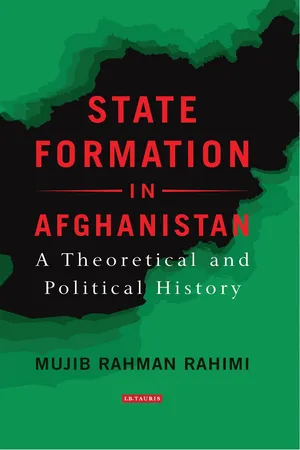
The creation of Afghanistan in 1880, following the Second Anglo-Afghan War, gave an empowering voice to the Pashtun people, the largest ethnic group in a diverse country. In order to distil the narrative of the state's formation and early years, a Pashtun-centric version of history dominated Afghan history and the political process from 1880 to the 1970s. Alternative discourses made no appearance in the fledgling state which lacked the scholarly institutions and any sense of recognition for history, thus providing no alternatives to the narratives produced by the British, whose quasi-colonial influence in the region was supreme. Since 1970, the ongoing crises in Afghanistan have opened the space for non-Pashtuns, including Tajiks, Hazaras, and Uzbeks, to form new definitions of identity, challenge the official discourse and call for the re-writing of the long-established narrative. At the same time, the Pashtun camp, through their privileged position in the political settlements of 2001, have attempted to confront the desire for change in historical perceptions by re-emphasising the Pashtun domination of Afghan history.
This crisis of hegemony has led to a deep antagonism between the Pashtun and non-Pashtun perspectives of Afghan history and threatens the stability of political process in the country.
- 352 pages
- English
- ePUB (mobile friendly)
- Available on iOS & Android
eBook - ePub
About this book
Information
CHAPTER 1
THEORETICAL FRAMEWORK
Introduction
To deconstruct the official discourse of state formation in Afghanistan a set of theoretical tools and categories are used to conduct the research. Thus, the aim of this chapter is to formulate, organize and elucidate the theoretical tools, concepts, techniques and perceptions utilized throughout the enquiry. Inspired mainly by the work of post-structuralists such as Jacques Derrida, Michel Foucault, and the theory of discourse developed by Ernesto Laclau and Chantal Mouffe, a retroductive approach is adopted in this research. Instead of applying a normative solution to a political problem it is attempted to construct a set of theoretical tools and categories to study, explain, interpret, reconstruct, deconstruct and problematize the official discourse.
In order to formulate and organize the theoretical framework, it is presented in four categories: the discourse theory, agonism, colonialism, and the state debate. First, the chapter begins with a brief introduction to the discourse theory, its core assumptions and how it is different from essentialist and reductionist traditions of enquiry. Second, it presents and elucidates Derrida's conception of discourse as a ‘text’ or ‘writing’, and his technique of deconstruction or ‘double reading’. Third, it presents briefly Foucault's perception of discourse, and his technique of archaeology, genealogy and then the synthesization of the two in what he calls problematization. Fourth, it presents in some detail the core theoretical assumptions and tools of discourse theory developed by Laclau and Mouffe which constitute the base of my research.
In the next part of the chapter the concept of ‘agonism’ and Mouffe's perception of ‘agonistic pluralism’ is explained as the theoretical base to present the civilizational discourse to defuse the radical antagonism in the period of hegemonic crisis in Afghanistan. Then it moves to discuss and elucidate the perception of colonialism, post-colonialism, orientalism and colonial knowledge, and how they help us to understand the impact and credibility of the colonial discourse in the very constitution of Afghanistan. The last part of the chapter engages with the state debate; the perception of pre-modern and modern state, the nation state, nationalism, the European origin of the nation state, and nationalism and how they expanded to include or impact other parts of the world, the perception of post-colonial nation state, and finally the state debate in Afghanistan.
Discourse Theory
Discourse theory ontologically stresses the ultimate contingency of every social meaning and practice, hence it rejects the essentialist or reductionist theories of knowledge production, and stands against approaches in social science borrowing their model of knowledge and methods from natural science believing that the goal of social science is to explain phenomena and events in objective universal terms. The underlying assumption of this trend is a particular picture of value-free research and knowledge for causal account of phenomena which can be empirically tested and confirmed. The overall aim of research in this tradition is the production of universal laws and theories that are falsifiable by independent testing. In turn these universal laws and theories serve as the basis for predicting comparable or future events and processes. This copied model of natural science, because of the success of natural science in explaining the physical world, exerts a visible influence in social science in traditions such as logical positivism, behaviouralism, certain forms of structural functionalism, critical realism and Marxism.
In recent decades this positivist hegemony has been challenged by a range of interpretive and critical traditions of analysis such as ethnography, psychoanalysis, deconstruction, post-analytical philosophy and post-structuralism. Whereas the goal of positivism is the objective explanation of an independently existing reality, the goal of interpretative critical approaches is to understand and interpret a world of meaningful social practices from the inside rather than viewing the objective reality as a disengaged spectator.1
Discourse theory does seek to provide novel interpretations of events and practices by elucidating their meaning; it does so by analysing the way in which political forces and social actors construct meaning within incomplete and undecidable social structure. This is achieved by examining the particular structure within which social agents take decisions and articulate hegemonic projects and discursive formations.2
Hence, contrary to essentialist or reductionist traditions of research and enquiry, discourse theory not only opposes any principle of an a priori logic underlying the construction of social and political identities, but also the discourse theory practitioner does not claim to be conducting value-free or objective investigations as he/she is situated in a specific discursive formation and within a specific tradition which constituted him/her as a subject like other subjects. Generally speaking, by opposing the essentialist or reductionist theories of knowledge production, this poststructuralist framework will inform and guide the research.
Derrida's and Foucault's Perception of Discourse
In conducting this research I found Derrida's and Foucault's techniques and methods are used frequently. I use Derrida's conception of discourse as text or writing, and his logic of différance in studying the official discourse of state formation in Afghanistan as an exclusionary political act. He argues for a conception of discourse as a ‘text’ or ‘writing’, in which all human and social experiences are structured according to the logic of différance.3 Derrida's concept of différance, according to Howarth ‘captures the way in which meaning is produced; both by interplay of different traces and by the necessary deferment of some possibilities not actualized or signified by the play of traces.’4 Thus, it argues for the historicity and contingency of the identity formation, because every affirmation of identity is also premised on the active deferring of certain possibilities. For instance, the production of identity x entails the deferral of u, v or w, which represent other possible identities not actualized by any particular project or discursive articulation. Identity x not only lacks an essence, as it is ‘incomplete’ and could be different, but its meaning depends on the complex ‘play of differences’ between itself and those identities from which it is actively differentiated.5 In the second and third chapters of the book, it is demonstrated how the official discourse in the process of its constitution actively deferred the actualization of other possibilities, draws the social borders between ‘us’ and ‘them’, ‘us’ the Afghans and Afghanistan, as the ‘essence’ or ‘insider’ and ‘them’, the foreigners, as the ‘outsiders’ or ‘accidentals’ dichotomy and how it remained incomplete and vulnerable to the excluded forces. Derrida's deconstructive reading of ‘binary oppositions’ in structural linguistics (speech/writing; signifier/signified) entails that these oppositions consist of a privileged essence (an ‘inside’) and excluded or secondary term (an ‘outside’), which is merely accidental or contingent. Contrary to the view that the outside simply threatens or undermines the purity of the inside, as it is showed in chapter six, Derrida argues that if the outside is required for the definition of the inside, then it is just as necessary as the inside itself.’6 To account for this, Derrida introduces a new conceptual articulation or ‘infrastructures’, which combine the inside and outside in a new syntheses and the relationship between origin (‘essence’, ‘inside’) and supplement (‘accident’, ‘outside’) in these new syntheses is undecidable.
I also extensively use Derrida's deconstruction technique or method in my research. His deconstruction method entails what might be deemed a ‘double reading’ of philosophical texts and discourses. On the one hand, this involves an initial endeavour to reconstruct ‘in the most faithful, interior way’ the logics of a dominant discourse or text and its intention, so as to provide the most ‘charitable’ and plausible interpretation possible. On the other hand, deconstruction seeks to pinpoint ‘from a certain exterior’, the gaps, tensions, paradoxes, limits, and ‘points of undecidability’ in discourses or texts, which enable the discourses or texts to both cohere and ‘organize themselves’, but which simultaneously serve to undermine their coherence and unity to open the space for a new interpretation or understanding.7 Using this method, in the second and third chapters of the book, I attempt to reconstruct and provide the first reading of the official discourse in the most plausible way possible. The fourth and fifth chapters are allocated to the deconstruction or second reading of the official discourse. Furthermore, in the first reading, and also in the deconstructive move, to destabilize the official narrative, the gaps, tensions and paradoxes in the official discourse are pointed out.
In deconstructing the official discourse of state formation in Afghanistan I also use Foucault's perception of discourse, and his technique of archaeology, genealogy and problematization. Foucault argues that discourses shape material bodies and forms, and constitute human beings as subjects: ‘Discourses are… not to be treated as groups of signs (signifying elements referring to contents or representations) but as practices that systematically form the objects of which they speak’.8 It is shown systematically in different parts of the book, how the official discourse using its privileged position, managed to produce its subjects in Afghanistan. Discourses, according to him, transmit and produce power, and also reinforce it, but at the same time undermine and expose it, render it fragile and make it possible to thwart it.9
Discourses are tactical elements or blocks operating in the field of force relations; there can exist different and even contradictory discourses within the same strategy; they can, on the contrary, circulate without changing their form from one strategy to another, opposing, strategy.10
From this ‘strategic’ perspective, discourses are the means for different forces to advance their interests and projects, while also providing points of resistance for counter-strategies to develop. Foucault further argues that in every society the production of discourse is controlled, organized, redistributed, and certain discourses are actively forbidden or suppressed.11 Foucault adds that power and knowledge directly imply one another and one cannot presuppose one without the other. Hence, to him, discourse is the product of power relations and forces that form them, ‘it is in discourse that power and knowledge are joined together.’12 Informed by his insight, it is explained how the Afghan/Pashtun government infused its power through the official discourse, and how it used the colonial knowledge to reinforce the ‘picture’ it constructed as the only regime of truth by controlling and forbidding the opposing discourses. Meanwhile, it is also showed how the excluded forces, to advance their interests and projects, use discourse as a counter-strategy to challenge the official narrative.
To engage in critical study of the discourses in Afghanistan, I widely rely on Foucault's unique techniques and methods of enquiry; archaeology, genealogy and then the synthesization of these in what he later calls problematization. To Foucault, archaeology describes the rules of formation that structure discourses, and genealogy examines the historical emergence of discursive formations with a view of exploring possibilities that were excluded by the exercise of power and systems of domination.13 Howarth, in drawing the distinction between employing the two methods, states that first, ‘an archaeologist wears the mask of a spectator who simply describes discourse, while the genealogist diagnoses and offers cures for the problems of the contemporary societies by examining their historical emergence and formation.’ Second, the archaeologist suspends the values of truth, knowledge and meaning, the genealogist recognizes the impossibility of avoiding these questions. Third, the archaeologist studies discourses as autonomous rule-governed practices, the genealogist produces a form of history that can account for the constitution of knowledge, discourses, and domains of objects that necessarily involve the complex interaction of discursive and non-discursive practices. Howarth then asserts that genealogy is explicitly concerned with the centrality of power and domination in the constitution of discourses, identities and institutions and involves the adoption of a critical ethos toward them. Thus, the genealogist seeks to uncover the ‘lowly origins’ and ‘play of dominations’ that produced the phenomenon, while also showing possibilities excluded by the dominant powers. In doing so, the genealogist discloses new possibilities foreclosed by existing interpretations.14 Hence, a genealogical analysis is an exercise of deconstruction; as it fragments what were considered to be unitary entities and decomposes ideas into their constituent elements, as historical, contingent and a possibility out of many others. Later Foucault endeavours to articulate both of the methods in a new approach he calls ‘problematization.’15 The strategy of problematization carries an intrinsically ethical connotation as it seeks to show that the dominant discursive constructions are contingent and political, rather than necessary.16
Discourse Theory of Laclau and Mouffe
In constructing the theoretical framework, I engage briefly with the theory of discourse or the School of Essex developed by Laclau and Mouffe17 and its core concepts and tools that form the base of my research. According to Howarth they draw critically upon structuralist, post-structuralist and Marxist traditions of thinking to extend the scope of discourse theory to embrace all social practices and relations. Let us begin with furnishing the basic framework of the discourse theory that forms the logic and pattern of this research. This will enable us to comprehend the frequent use of discourse-related terminologies and their connotations in different parts of the book. The concept of discourse in Laclau and Mouffe's theory means that all objects and actions are meaningful, and their meaning is conferred by particular systems of significant differences. To elucidate this, Howarth presents the example of a forest standing on the path of a proposed motorway, which 1) may represent an obstacle impeding the rapid implementation of the new motorway, or 2) might be viewed as a site of special interest for scientist and naturalist, 3) or as a symbol of the nation's threatened natural heritage. The meaning or ‘being’ of the forest here depends on the particular systems of difference or discourses that constitute its identity. Each of these discursive structures is a social and political construction, which establishes a system of relations between different objects and practices, while providing subject positions with which social agents can identify. Furthermore, in broader social and political terms ‘hegemonic projects’ will attempt to weave together different strands of discourses to dominate or structure a field of meaning to fix identities of subjects and practices in a particular way.18
Howarth argues that discourse theory begins with the assumption that all objects and actions are meaningful, and their meaning is the product of a historically specific system of rules. Hence it studies the way in which social practices construct and contest the discourses that constituted the social reality. These practices are possible because systems of meaning are contingent and can never completely exhaust a social field of meaning.19 To elaborate on this, Howarth proposes the need to understand the working definition of three basic categories put forward by Laclau and Mouffe: discursive, discourse and discourse analysis.
Discursive means that ‘all objects are objects of discourse’ and their meaning depends upon a socially constructed system of rules and significant differences; ‘a horizon of meaningful practices and significant differences’ or a ‘world of meaningful discourses and practices.’20
Discourse, on the other hand, refers to ‘historically specific systems of meaning which form the identities of subjects and objects.’ Hence ‘discourses are concrete systems of social relations and practices that are intrinsically political, as their formation...
Table of contents
- Front Cover
- Title Page
- Copyright
- Dedication
- Contents
- Acknowledgements
- List of Maps
- Introduction
- 1. Theoretical Framework
- 2. Reconstructing the Official Discourse of State Formation in Afghanistan: 1880–2010
- 3. Reconstructing the Discourse of State Formation in English Literature on Afghanistan: 1809–2010
- 4. Historiographies, Treaties, Cartographies and Atlases: Problematizing the Official Discourse of State Formation in Afghanistan
- 5. Dislocation, Diversification and Decolonization of the Official Discourse of State Formation in Afghanistan
- 6. Transforming Radical Antagonism to Plural Agonism
- Conclusion
- Notes
- Bibliography
Trusted by 375,005 students
Access to over 1.5 million titles for a fair monthly price.
Study more efficiently using our study tools.
Frequently asked questions
Yes, you can cancel anytime from the Subscription tab in your account settings on the Perlego website. Your subscription will stay active until the end of your current billing period. Learn how to cancel your subscription
No, books cannot be downloaded as external files, such as PDFs, for use outside of Perlego. However, you can download books within the Perlego app for offline reading on mobile or tablet. Learn how to download books offline
Perlego offers two plans: Essential and Complete
- Essential is ideal for learners and professionals who enjoy exploring a wide range of subjects. Access the Essential Library with 800,000+ trusted titles and best-sellers across business, personal growth, and the humanities. Includes unlimited reading time and Standard Read Aloud voice.
- Complete: Perfect for advanced learners and researchers needing full, unrestricted access. Unlock 1.5M+ books across hundreds of subjects, including academic and specialized titles. The Complete Plan also includes advanced features like Premium Read Aloud and Research Assistant.
We are an online textbook subscription service, where you can get access to an entire online library for less than the price of a single book per month. With over 1.5 million books across 990+ topics, we’ve got you covered! Learn about our mission
Look out for the read-aloud symbol on your next book to see if you can listen to it. The read-aloud tool reads text aloud for you, highlighting the text as it is being read. You can pause it, speed it up and slow it down. Learn more about Read Aloud
Yes! You can use the Perlego app on both iOS and Android devices to read anytime, anywhere — even offline. Perfect for commutes or when you’re on the go.
Please note we cannot support devices running on iOS 13 and Android 7 or earlier. Learn more about using the app
Please note we cannot support devices running on iOS 13 and Android 7 or earlier. Learn more about using the app
Yes, you can access State Formation in Afghanistan by Mujib Rahman Rahimi in PDF and/or ePUB format, as well as other popular books in History & 19th Century History. We have over 1.5 million books available in our catalogue for you to explore.