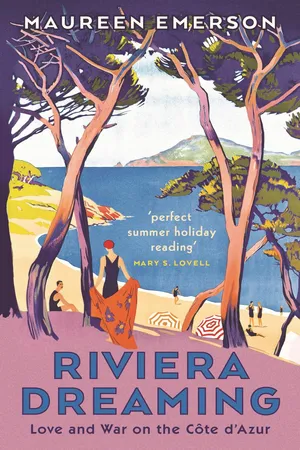
Step inside the Riviera's most glamorous villas and discover the real lives that shaped the Côte d'Azur's golden age.
In 1926 Barry Dierks, a young American architect, arrived in Paris and fell in love with France. With his partner, an ex-officer in the British Army, he built a white, flat-roofed Modernist masterpiece that rested on the rocks below the Esterel, with views across the Mediterranean. They called it Le Trident.
Le Trident transformed their fortunes. As word spread, commissions poured in from across the Riviera's social world. Dierks and Sawyer designed more than seventy of the coastline's most recognisable houses, including Somerset Maugham's La Mauresque, Jack Warner's Villa Aujourd'hui, Maxine Elliott's Château de l'Horizon, and the Marquess of Cholmondeley's Villa Le Roc.
These villas became stages for Jazz Age decadence, intimate dramas, artistic breakthroughs, and the upheavals of war, revealing a Riviera far richer and stranger than its postcard image.
Bringing together vivid personalities, architectural insight and richly researched history, Riviera Dreaming captures a world where creativity, reinvention and intrigue collided on the edge of the Mediterranean.
- 264 pages
- English
- ePUB (mobile friendly)
- Available on iOS & Android
eBook - ePub
About this book
Trusted by 375,005 students
Access to over 1.5 million titles for a fair monthly price.
Study more efficiently using our study tools.
Information
PART ONE
Lights and Music
The English Visitor calls the entire coast from Marseilles to Genoa the Riviera; but the French distinguish their portion as the Côte d’Azur, and the Italians distinguish theirs as The Riviera di Ponente.
S. Baring-Gould, A Book of the Riviera
1
Le Trident — 1925
How This Coast Smells of Riches!
Laurence Binyon, For Dauntless France
So wrote the American Jane de Glehn, wife of the English artist Wilfred de Glehn, when she first set foot on the Riviera after the 1918 Armistice of World War I.1 A member of the Red Cross Committee, who had worked in the devastated areas of the Haute Marne and was now in the south to report on the medical conditions, she felt the train from the north had deposited her in paradise: ‘To eyes fresh from the ruined homes of Eastern France, from the ghastly desolations and sublime endurances of the Front, this previous world of moneyed idleness, these innumerable villas perched on the hills and clouded with flowers, these glowing white walls and basking blue bays’ filled her with bemused delight.2
Europe had been ablaze and the fires had gone out. Now the Riviera began slowly to return to a semblance of its former self. During the war the area had become a vast hospital for the wounded, but gradually the old life of catering to privileged visitors returned, although in an increasingly different form. Suddenly everything seemed possible. Moving pictures, wonderfully designed automobiles, new music, liberating fashions were all exhilarating. By the early twenties the towns along the coast were alive with a fevered post-war excitement. Among the palm trees, oleander and bougainvillea the belle époque, with its ornate architecture and amply dressed winter visitors, was over. The owners of the great villas of Victorian times were getting older and entering a new era which would transform their way of life in resorts where they had held sway for so long. As a result of the Bolshevik revolution the Russian nobility had either disappeared from the coast, leaving their beautiful onion-domed churches as proof of passage or, now being poor, become taxi drivers, hotel managers and servants. Their sumptuous villas were converted into hotels or taken over by other, richer expatriates. As the trauma of the war faded, crowds of international socialites, both old and new, came to luxuriate in the beauty of the coast.
To this awakening Riviera full of promise, two young men of very different backgrounds arrived to seek their fortunes and begin a new life. Barry Dierks, an American from Pennsylvania, was 26 years old. Slim and handsome, with blond wavy hair, he treated life with insouciance and good humour. Eric Sawyer, 10 years older, was an Englishman from Buckinghamshire. Dark-haired and stockier than the elegant Barry, he possessed a gravitas that was in contrast to the latter’s puckish sense of fun. The difference between the two was appealing and as a couple they would become much sought after, being described by their close friend the author and composer Beverley Nichols as ‘those two charmers’.3
Born in Butte, Montana, in 1899, at 12 years old Barry Dierks moved with his family to the suburb of Edgewood in Pittsburgh, Pennsylvania. Here, with his sister Elizabeth, they settled at 335 Locust Street to what seems to have been a pleasant suburban life. Barry’s father, W. C. Dierks, was the respected general manager of the firm of C. C. Mellor, representatives of Steinway pianos. They were a musical family, his mother being an active member of the Edgewood ‘Tuesday Music Club’, still in existence today. Little is known of Barry’s parents. Neither he nor his sister would have children, causing the family trail to go cold. Elizabeth Dierks married a Princeton engineering graduate and became Elizabeth Anderson. And although she and her husband visited Barry occasionally over the years, the sibling bond does not seem to have been strong. This was in contrast to Barry’s relationship with his mother to whom, as late as age 44, he would sign his letters ‘your own boy’.4
A sub-lieutenant in the American Army during the war, but without seeing active service, in 1921 Barry graduated as an architect from the Carnegie Institute of Technology. An entry in the alumnae yearbook of 1921 states that he is deemed ‘the Petronius of the school’ (Petronius having been a Roman courtier during the time of Nero, a voluptuary; a no-holds-barred satirist and an arbiter of taste). The entry continues: ‘He is very imaginative’ but has ‘never made an 8.30 in his life because that time is devoted to matching his necktie with his socks. Women bore him. However Barry is a real “medalist” and we predict a great future ahead for him.’5 The writer had foresight.
Like so many cultivated Americans of the time, Barry was drawn to the Old World and the year of his graduation found him enrolling at the École des Beaux Arts in Paris. One of the most famous of the Beaux Arts studios was run by the architect Léon Jaussely and Barry was lucky enough to be accepted as his pupil. He found Paris with all its dignified beauty to be extremely agreeable, even more so when he was awarded one gold and three silver medals for his work at the Beaux Arts. To help fund his studies, he took a cashier’s job at a merchant bank where Eric Sawyer happened to be the general manager.
While Barry’s background was firmly middle-class provincial American, Eric’s was firmly British. Born in Aldershot, Surrey, in 1889, he was the third of five children. His father, William Harcourt Sawyer, was a distinguished career soldier who won the Sword of Honour at the Royal Military Academy at Sandhurst. His mother was born Edith Mary Hanbury, always known as Mary, whose family home was Blythewood House (now Hitcham House) near Burnham in Buckinghamshire. Mary Sawyer was a distant relative of Sir Thomas Hanbury who, in 1867 with his brother Daniel, created the famous Hanbury Gardens at La Mortola near Ventimiglia on the Italian Riviera. The gardens became known for their dramatic planting on a calcareous clay hillside which sweeps steeply down to the Mediterranean. Through the estate runs the Via Julia Augusta of 241 BC which linked Rome to Gaulle, running through Genoa to Menton, above Monaco and on through Cannes, then over the Esterel Mountains to Frejus, Marseilles and finally to Arles. A total of around 800 kilometres. At La Mortola this ancient route is now sunk below ground level but still evocatively visible. Thomas Hanbury would later buy land at Wisley in England in order to donate it to the Royal Horticultural Society so the latter could move from Chiswick in London to bigger premises. The Hanbury family connection, remote though it was, would do no harm to Barry and Eric’s future social standing.
Educated at Cheltenham College in Gloucestershire, Eric did not follow his father into the army but graduated as an engineer from the Royal School of Mines in London. Military service did not elude him and as an officer during the 1914–18 war he acquitted himself well. Serving with the ill-fated British Expeditionary Force in both France and Belgium, followed by a post in the Claims Commission in the Intelligence Corps, he was mentioned in dispatches and awarded the Légion d’Honneur and Croix de Guerre by the French government. By the time he was demobbed in 1919 he had achieved the rank of lieutenant-colonel and, although he would wear a soldier’s uniform once again, now his way of life changed irrevocably. However, he would always refer to himself as Colonel Sawyer. Having served in France he stayed on perhaps, like so many others, appreciating the aura of tolerance and lack of interference. With an apartment in 15 Boulevard des Italiens in Paris, he was comfortably part of the cosmopolitan set of the city.
Almost every evening Barry and Eric would repair to the bars of the Ritz Hotel on the Place Vendôme. In the frenetic gaiety of post-war Paris the Ritz bars were the place to see and be seen. They became the melting pot of the demi-monde and, as the playwright Noel Coward saw it, the semi-monde of the capital. The hotel itself had begun life in the seventeenth century as an aristocratic town house. In 1897 the architect Charles Mewès transformed the building for the hôtelier Cesar Ritz and, among other luxuries, it became the first in the world to have a bathroom for every bedroom. Over the years kings, sultans and aristocrats of society and the arts flocked to its all-embracing luxury.
Now those who jostled into Le Café Parisien through the side entrance on the rue Cambon were joined by a vibrant new clientele. After the armistice of 1918 Paris was awash with soldier students who had served with the American Expeditionary Force. It was felt by their superior officers that to follow training in the arts, in that most artistic of cities, was to be encouraged and, after all, they were on the spot. The journalist O.O. McIntyre wrote in the Rochester Evening Journal of 1928 of the cocktail hour when Americans headed for the Ritz bars where, using a baseball term, ‘everything is as American as the seventh inning stretch’. Among the cosmopolitan crowd, English was the common language. They came to drink champagne cocktails or dry martinis, some with more than a touch of absinthe, and socialise with other expatriate Americans. Although the hotel housed several bars, accounts of the time seem to mention only the Petit Bar and the small panelled Ladies Bar, the salon de correspondence – for women weren’t yet allowed in the other bars in spite of the sterling work many had accomplished during the war.
At this point in history the United States had firm links with France. In 1914, in a programme of aid unprecedented in history, socialites, bankers, merchants and young graduates of American Ivy League universities had come together, turned their thoughts towards Europe, formed committees and began to pour money, equipment and themselves into the Allied cause. The country felt indebted to France for the support the latter had provided during the American War of Independence. However, as Alfred Allan Lewis stated in Ladies and Not-So-Gentle Women, the American impresario Elisabeth Marbury would later remark dryly: ‘The French did not ask for charity. France’s friends did the asking while she was worshipped for her grace in receiving.’6 But the links were strong and, for many, the social attitudes of the French appealing. As far as the private lives of individuals were concerned, France did not judge. Both men and women found a haven in which they could liberate inclinations unacceptable in their homeland, for while homosexuality was simply illegal in Britain, in the United States it was classed as a ‘clinical mental disorder’. Napoleon had decriminalised homosexuality and France did not condemn those who, although they did not usually break the ties with their own countries, found here a refuge for their particular proclivities.
In 1926 Noel Coward wrote a play which he called Ritz Bar – the title being later changed to Semi-Monde. It is hard to understand now why it was considered so scandalous, for although the sexual preferences of the characters are fairly clear, they are subtly drawn. Only the theme of adultery is obvious, but in England the Lord Chamberlain, Rowland Baring, censored it, declaring the play immoral. Philip Hoare in his biography of Noel Coward wrote of the frustration of Coward, over lunch, vented to the author Beverley Nichols: ‘I cannot agree’, remarked Coward, ‘that it is within the province of the Lord Chamberlain, or of anybody else, to concern himself with what I happen to do with my thighs.’7 In fact Semi-Monde wasn’t staged until 1977, probably due to the perceived value of the work and its need for a large cast, rather than its immorality.
But Coward knew his Ritz and its habitués well, and those who float through its lobbies and bars in Semi-Monde are surely true to life. ‘You haven’t’, queries Marion to an acquaintance in the play, ‘seen a dark little American girl with a sort of wood-violet face loitering, have you?’8
From his book Twilight: First and Probably Last Poems, Beverley Nichols in ‘Ladies of the Ritz’ would describe a group of elderly women ‘half dead and half alive’ sinking into chairs in the grand salon until:
Now from the shadows creep the stallions
magnificently muscled and equipped
dark-suited, double-breasted, heavy-lipped.9
For the clientele of the Ritz would always provide and receive diverse services.
Both Barry and Eric, so different in background and character, felt very much at home among the cocktails, repartee and flâneurs of the Ritz Bar. Here they would meet useful acquaintances, make loyal friends and pick up certain information that would change the course of their lives. Already lovers, they would become life-long partners, their relationship surviving the attention of many admirers and the vagaries of war.
Who did they see, greet and converse with as they relaxed over their cocktails in those early years of the 1920s? They would have rubbed shoulders with the musician and song writer Cole Porter and his wife Linda, arriving from their sumptuous apartment on the rue Monsieur. With Scott Fitzgerald, a still impecunious Ernest Hemingway, perhaps even with Rudolph Valentino and Charlie Chaplin, for the Ritz was their preferred hotel in Paris. Coco Chanel, who made it one of her homes for 30 years, would have walked the corridors as her own – and the voice of the outrageous American actress Tallulah Bankhead may have rung out from the Ladies Bar. Some habitués became close friends, such as Nichols and Coward, the latter having in common with Barry that they were both the sons of piano salesmen. It was here they first met another regular visitor, Somerset Maugham, who would soon play an important part in their lives.
At this time the couple were undecided what course their future would take, but an event at the Ritz helped make the decision for them. Much credit must be paid to Georges, the barman, for creating an opportunity which would facilitate the aspirations Barry and Eric had for the future. The short-lived Dawes Plan had recently been launched, proposed by Charles G. Dawes, an irascible vice-president of the United States. The plan was set up in 1924 to manage the reparation payments demanded from Germany after the war. The scheme involved a large loan from the US government to allow for foreign investment in Germany and stayed in effect until replaced by the Young Plan in 1929. One evening Georges, seeing Barry alone in the bar, discreetly suggested he sit near two men, who were obviously enjoying their cocktails, and one of whom was talking loudly to the other. The discourse of the voluble gentleman was on the imminent investments which the Dawes Plan anticipated and the companies which were set to profit from these. This was an opportunity not to be missed, and Barry called Eric immediately. On being asked by him, ‘How good is your information?’ Barry’s reply was, ‘Straight from the horse’s mouth’.10 They took advantage of this knowledge rapidly, placing their funds in some of those companies whose names had been so freely declaimed. Their investments did well, allowing them to plan their future together and begin to seek their fortune.
The south of France, the Midi, stretches down to the coast from the Alps in the north, from the Atlantic Ocean in the west to the Italian border in the east. Although on the same land mass, in weather, atmosphere and lifestyle it is very different to the rest of France – virtually another country. Barry and Eric went south, to the Riviera. Having now decided they would spend their lives together, they began the search for land on which to build a house which would also act as a showcase for Barry’s architectural practice. There seem to have been three prerequisites for the plot – the price of land; privacy so they could enjoy a lifestyle which would not, perhaps, be always acceptable to neighbours; and, above all, desire to be on the sea. So it was under the flame-red peaks of the Esterel Mountains, above the indigo Mediterranean and 11 kilometres to the west of Cannes, that they built their future home.
They chose a piece of coast at Miramar near the village of Theoule, between La Napoule to the east and St Raphael to the west. The plot they purchased in 1925 was isolated and no more than a rock face at l’Esquillon, a steep jagged cliff which swept from the hills above to the sea below. The land was situated below the coast road, the Corniche d’Or.
The small towns along this stretch of coast have much history. At St Raphael, Napoleon Bonaparte landed in August 1799 after his Egyptian campaign and marched towards Paris and his eventual election as first consul four months later. Towards the end of the nineteenth century the town became a popular coastal resort, particularly for artists and writers. It was in 1924 at the Villa Marie at Valescure on the outskirts of St Raphael that Scott Fitzgerald wrote much of The Great Gatsby. Nearer Miramar itself is the village of Agay, with its deeply curved sandy bay, beloved of the author Guy de Maupassant and the author/aviator Antoine de St Exupery.
The Corniche d’Or road begins at the old Roman settlement of Fréjus, west of St Raphael and famous for its Roman arenas. It then continues on to Mandelieu, six kilometres before Cannes. This spectacular road, almost always in sight of the sea, runs parallel to the railway line which runs from Marseilles to Italy, sometimes travelling under and sometimes over the road, using two imposing viaducts. The railway reached this stretch of the Riviera in 1863, but the corniche road was not built until 40 years later, sponsored by the Touring Club de France and officially opened in 1903. Until that time access along the coast was by narrow, dusty, sometimes tortuous paths. The completion of the Corniche d’Or created a continuous stretch of road along the Riviera. Those who now speed along this road to the coastal towns drive between the beauty of the jagged red rocks rising on one side and the steep incline to the sea sparkling far below while, high above, the scrubland rises away into the hills.
At Theoule, the district of the Var is left behind and the Alpes Maritimes begin. The small stretch of coast which is Miramar comes under the auspices of Theoule. The latter has a natural harbour which was, in the fifth century, one of the most important ports on the coast. When trading there ceased, it became a simple fishing village before evolving into yet another coastal resort. La Napoule, further east again and also once a Roman settlement, had been favoured by rich visitors since the 1880s. Its ancient fortress was almost in ruins when it was bought by the American millionaire Henry Clews, and his beloved wife Marie, in 1917. Clews was an artist and sculptor and between them the couple recreated the ruin as a medieval château and there lived a fantastical life, often attired in the costume of the Middle Ages, among the gargoyle-like sculptures of its owner. In contrast, Marie’s white peacocks would wander frequently onto the nearby railway track, indifferent to the Train Bleu racing to its Riviera destinations from Paris.
At the Hôtel des Bains at La Napoule in 1898, Oscar Wilde and the journalist and publisher Frank Harris ate a breakfast of little red mullet, beefsteak with apple sauce, cheese and a sweet omelette while discussing the relative merits of the ma...
Table of contents
- Front Cover
- Title Page
- Copyright Page
- Dedication
- Table of Contents
- List of Plates
- Acknowledgements
- Part One – Lights and Music
- Part Two – All Change
- Notes
- Bibliography
- Plates
Frequently asked questions
Yes, you can cancel anytime from the Subscription tab in your account settings on the Perlego website. Your subscription will stay active until the end of your current billing period. Learn how to cancel your subscription
No, books cannot be downloaded as external files, such as PDFs, for use outside of Perlego. However, you can download books within the Perlego app for offline reading on mobile or tablet. Learn how to download books offline
Perlego offers two plans: Essential and Complete
- Essential is ideal for learners and professionals who enjoy exploring a wide range of subjects. Access the Essential Library with 800,000+ trusted titles and best-sellers across business, personal growth, and the humanities. Includes unlimited reading time and Standard Read Aloud voice.
- Complete: Perfect for advanced learners and researchers needing full, unrestricted access. Unlock 1.5M+ books across hundreds of subjects, including academic and specialized titles. The Complete Plan also includes advanced features like Premium Read Aloud and Research Assistant.
We are an online textbook subscription service, where you can get access to an entire online library for less than the price of a single book per month. With over 1.5 million books across 990+ topics, we’ve got you covered! Learn about our mission
Look out for the read-aloud symbol on your next book to see if you can listen to it. The read-aloud tool reads text aloud for you, highlighting the text as it is being read. You can pause it, speed it up and slow it down. Learn more about Read Aloud
Yes! You can use the Perlego app on both iOS and Android devices to read anytime, anywhere — even offline. Perfect for commutes or when you’re on the go.
Please note we cannot support devices running on iOS 13 and Android 7 or earlier. Learn more about using the app
Please note we cannot support devices running on iOS 13 and Android 7 or earlier. Learn more about using the app
Yes, you can access Riviera Dreaming by Maureen Emerson in PDF and/or ePUB format, as well as other popular books in Personal Development & History of Architecture. We have over 1.5 million books available in our catalogue for you to explore.