- 344 pages
- English
- ePUB (mobile friendly)
- Available on iOS & Android
eBook - ePub
About this book
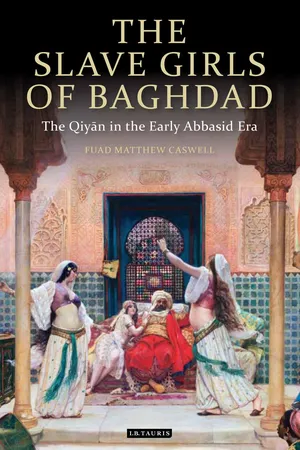
The history of courtesans and slave girls in the medieval Arab world transcends traditional boundaries of study and opens up new fields of sociological and cultural enquiry. In the process it offers a remarkably rich source of historical and cultural information on medieval Islam. 'The Slave Girls of Baghdad' explores the origins, education and art of the 'qiyan' - indentured girls and women who entertained and entranced the caliphs and aristocrats who worked the labyinths of power throughout the Abbasid Empire. In a detailed analysis of Islamic law, historical sources and poetry, F. Matthew Caswell examines the qiyans' unique place in the society of ninth-century Baghdad, providing an insightful and comprehensive cultural overview of an elusive and little understood institution. This important history will be essential reading for all those concerned with the history of slavery and its morality, culture and importance in the early Islamic era.
Information
CHAPTER ONE
THE SOCIAL SCENE
Slavery in Islam
Slavery was practised in the Middle East long before the dawn of Islam. Slaves were mostly the booty of wars and tribal raids. The three monotheistic religions – Jewish, Christian and Muslim – accepted slavery as normal, simply like owning property. They acknowledged that slaves had souls, but that was not regarded as a religious or ethical bar to accepting or even promoting their social and legal status as slaves. Thus, slavery continued to be practised under Islam, but with a general exhortation to be kind to the slaves. There is a Qur’ānic injunction against ill-treating them:1 the Prophet exhorted his people to invoke Allāh’s protection by showing kindness to the weak, being slaves and women.2 The Prophet also referred to the slaves as brothers:3 ‘Your brothers are your servants whom Allāh had subjugated to you. He who has dominion over his brother should give him to eat what he eats and be clothed with what he wears.’
While Islam sanctions slavery it yet considers the manumission of a slave an act of piety, commonly undertaken as thanksgiving or by way of expiation for a sin. A slave may enter into a contract (mukātaba) with his master whereby he will secure his release in return for a sum of money which he, as freedman or client (mawlā), will then pay over a period of time, a practice not unlike peculium in Roman law. The mukātaba, notwithstanding the term (literally, ‘a written contract’) can also be effectively established orally, provided this is done in the presence of competent witnesses, that is two men or one man and two women. The proscription of usury facilitates the fulfilment of the obligation by the slave to pay the price. A client remains subject to obligations of fealty to his former master: if he dies without leaving issue his estate is inherited by his former master, subject to the untrammelled right of the former slave specifically to bequeath one third of its net value. If the former slave is survived by minors, the former master becomes their custodian.4 The Prophet was reported as saying:5 ‘Let none of you say my man slave and my woman slave, rather let it be said my boy, my girl and my lad.’
However, the terms ‘abd (man slave) and ama (woman slave) were very common in everyday usage. Even to-day, with slavery no longer practised, the terms ‘abd and ‘abda continue to be used among some speakers as referring simply to a black man and a black woman, but with no connotation of slavery.
The status of slaves under Islamic law is close to that of chattels.6 They can be bought, hired out and sold; they can be shared by more than one master, and can be mortgaged. Further, slaves are in general terms heritable assets, being passed on as slaves to the heirs, and then often sold by auction in the normal course of the administration of the estate. The progeny of a slave mother and a slave father are themselves slaves, the property of the woman’s master. He may sell them individually subject only to the proviso that no child under the age of seven is to be separated from his or her mother. A child born by a woman slave to a free man is a free person. When a woman slave gives birth to a child by a free man she acquires the status of umm walad (mother of child). She may no longer be sold, given away as a gift, or bequeathed. She remains in the possession and dominion of her master in his lifetime, and becomes a free woman on his death.7 That said, it remains that the slave is a person with recognised obligations and rights: he can marry, can be punished for committing a crime, and can carry out procuration in business matters. A slave man might marry up to two slave women; a slave woman might marry a free man who was not her owner, but only with the latter’s consent.
The great Arab conquests produced a vast number of slaves, who were often marketed wholesale for as little as one or two dirhams a head. They were divided among the soldiers who captured them, subject to the payment of one-fifth of their value to the treasury (bayt al-māl) to answer to the claims of ‘the Orphan, the Poor and the Follower of the Way’.8 In addition, slaves were often received as tribute from non-Muslims, and that continued to be the practice long after the end of the great conquests.9
Under Islamic law an ama (female slave)is defined as a woman who has been taken as war booty, or born of parents both slaves, or bought. The following is an interesting episode, told as part of the hagiography of ‘Alī b. Abī Ṭālib. It was in the reign of ‘Umar when the daughters of Khosroes were taken as war booty and conveyed to Medina, where ‘Umar ordered them to be auctioned. It was the custom of the noble women of Persia to cover their faces, and when the auctioneer pulled the veil off the face of one of them, she slapped him for his insolence. He reported her to ‘Umar, who was minded to have her and her sisters scourged. But ‘Alī intervened, citing a saying of the Prophet: ‘Respect the honourable among the people brought low, and the rich among the people reduced to penury’, and adding that the daughters of kings were not to be auctioned. He paid their prices, and gave them as brides to his son Ḥasan, to Muḥammad b. Abī Bakr and to ‘Abdallāh b.‘Umar respectively. They were to give birth to three of the most eminent Arabs, namely ‘Alī b. Ḥasan, otherwise known as Zayn al-‘Ābidīn, Qāsim b. Muḥammad and Sālim b.‘Abdallāh.
When the great conquests came to an end, the supply of slaves as war booty dried up, but the demand for them did not abate – the economy as well as the social and cultural life of the nation had become dependent on slavery. The conquests had been rapid, and resulted in what had been a relatively small nation becoming the custodian and beneficiary of a vast empire, which required a large number of slaves to service. Lands of the conquered people were expropriated and distributed to members of the armed forces, to civil servants, and to those rendering special services to the caliph. The lands of the Sassanians were lotted and thus disposed of by the caliph ‘Umar on the grounds that they were no longer owned by anyone:10 ‘Because such land has the status of property that belonged to no owner nor inheritor so that it is permissible for the Imām to bestow it on whosoever exerted himself in the service of Islam.’
There were also special grants made of the lands classified as waste, i.e. unproductive. The grantee would have it for life on condition that he revived it. This was based on a Prophetic saying that whosoever revived dead land shall own it (iḥyā’ al-mawāt, literally ‘land revival’); it may have required no more than the digging of a well to fulfil the condition. Grants could also be made heritable, subject only to the liability to pay a tithe.11 In order to farm the revenue of the new empire, the Arabs could rely on the indigenous clients . At the same time, the slaves who were acquired as war booty provided a plentiful supply of labour, both domestic and for use in all manner of commercial enterprises.12 The supply was used in a way which, once established, required a further steady supply. The drying-up of the source of slaves as war booty left a serious gap, which was filled by the use of a thriving international trade in slaves. There was in the Abbasid period a slave market in every major city. There was a market for the fair-skinned Europeans and those from Western Asia, collectively referred to as ṣaqāliba,13 and for the Atrāk of central Asia. The slave market of Samarkand had one of the largest turnovers, mirrored by markets in North Africa for the supply of Berbers and Nubians, and by the East African trade in black slaves collectively referred to as ḥabash (Abyssinians) and zanj (sub-Saharan blacks). There had existed before Islam an active international slave trade in Hijaz, with established slave markets in different centres, chief among which were Mecca and ‘Ukāẓ.14 But it was in the Abbasid period, as a result of the vast revenues of the far-flung empire, that slaves in very great numbers entered Arab society.15 This is illustrated by the following numbers quoted by al-Iṣfahānī: al-Rashīd and his wife Zubayda were said to be the owners of about 1,000 slave-girls each;16 about the same number was owned by each of al-Amīn, al-Ma’mūn,17 al-Wāthiq and al-Mu‘taṣim,18 while al-Mutawakkil was said to have 4,000.19
Female slaves
The sl...
Table of contents
- Cover
- Title Page
- Copyright Page
- Contents
- Abbreviations and conventions
- Transliteration
- Glossary
- Introduction
- 1. The social scene
- 2. Imā’ shawā‘ir and qiyān
- 3. Four slave-women poets ‘Inān
- 4. Some other slave-girl poets: short biographical notes
- 5. Al-Imā’ al-shawā‘ir as eulogists
- 6. Al-Imā’ al-shawā‘ir as mourners
- 7. Al-Imā’ al-shawā‘ir as satirists and lampoonists
- 8. Notable free women
- 9. Amatory poetry
- 10. Singing
- 11. The singing slave girls
- 12. Decline and fall
- 13. Epilogue
- Appendix I: The Abbasid caliphs and their accession dates
- Appendix II: Non-Arab mothers of Abbasid caliphs
- Appendix III: Some 3rd/9th-century jawārī: poets, singers, composers
- Appendix IV: Some qiyān trade slogans
- Notes
- Bibliography
Trusted by 375,005 students
Access to over 1.5 million titles for a fair monthly price.
Study more efficiently using our study tools.
Frequently asked questions
Yes, you can cancel anytime from the Subscription tab in your account settings on the Perlego website. Your subscription will stay active until the end of your current billing period. Learn how to cancel your subscription
No, books cannot be downloaded as external files, such as PDFs, for use outside of Perlego. However, you can download books within the Perlego app for offline reading on mobile or tablet. Learn how to download books offline
Perlego offers two plans: Essential and Complete
- Essential is ideal for learners and professionals who enjoy exploring a wide range of subjects. Access the Essential Library with 800,000+ trusted titles and best-sellers across business, personal growth, and the humanities. Includes unlimited reading time and Standard Read Aloud voice.
- Complete: Perfect for advanced learners and researchers needing full, unrestricted access. Unlock 1.5M+ books across hundreds of subjects, including academic and specialized titles. The Complete Plan also includes advanced features like Premium Read Aloud and Research Assistant.
We are an online textbook subscription service, where you can get access to an entire online library for less than the price of a single book per month. With over 1.5 million books across 990+ topics, we’ve got you covered! Learn about our mission
Look out for the read-aloud symbol on your next book to see if you can listen to it. The read-aloud tool reads text aloud for you, highlighting the text as it is being read. You can pause it, speed it up and slow it down. Learn more about Read Aloud
Yes! You can use the Perlego app on both iOS and Android devices to read anytime, anywhere — even offline. Perfect for commutes or when you’re on the go.
Please note we cannot support devices running on iOS 13 and Android 7 or earlier. Learn more about using the app
Please note we cannot support devices running on iOS 13 and Android 7 or earlier. Learn more about using the app
Yes, you can access The Slave Girls of Baghdad by F. Matthew Caswell in PDF and/or ePUB format, as well as other popular books in History & Middle Eastern History. We have over 1.5 million books available in our catalogue for you to explore.