- 422 pages
- English
- ePUB (mobile friendly)
- Available on iOS & Android
eBook - ePub
The Future of Mining in South Africa: Su
About this book
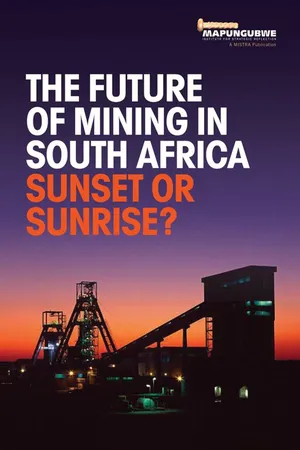
The future of mining in South Africa is hotly contested. Wide-ranging views from multiple quarters rarely seem to intersect, placing emphasis on different questions without engaging in holistic debate. This book aims to catalyse change by gathering together fragmented views into unifying conversations. It highlights the importance of debating the future of mining in South Africa and for reaching consensus in other countries across the mineral-dependent globe. It covers issues such as the potential of platinum to spur industrialisation, land and dispossession on the platinum belt, the roles of the state and capital in mineral development, mining in the era of the Fourth Industrial Revolution, the experiences of women in and affected by mining since the late 19th century and mine worker organising: history and lessons and how post-mine rehabilitation can be tackled. It was inspired not only by an appreciation of South Africaís extensive mineral endowments, but also by a realisation that, while the South African mining industry performs relatively well on many technical indicators, its management of broader social issues leaves much to be desired. It needs to be deliberated whether the mining industry can play as critical a role going forward as it did in the evolution of the countryís economy.
Information
ONE
_____
Introducing the debates
SALIMAH VALIANI
AT THE TIME OF WRITING, a number of developments in the world of South African mining were unfolding. The agitation caused by Mining Charter 2017 had largely subsided, particularly for mining companies wanting far less responsibility in sharing the wealth of mining than that assigned to them in the Charter. The Draft Mining Charter 2018 – softening the black economic empowerment requirements on companies and giving them more time to achieve them – had been released for public comment after satisfying companies and other consulted stakeholders. The Minister of Minerals and Resources had just completed visits to mining-affected communities across South Africa – a cursory nod to a North Gauteng High Court ruling recognising mining-affected communities as relevant parties in the (later withdrawn) legal review of Mining Charter 2017. And, after nearly two decades of litigation, 29 mining houses had settled out of court to compensate some 100,000 former workers still alive who had contracted silicosis and tuberculosis in gold mines from 1965 onwards.
With these developments, little has actually changed. Remaining, as ever, are the issues of long-term investment in mineral-based development; agreement on appropriate roles and responsibilities for capital and the state; mine worker health and safety; mining-induced societal and environmental damage; post-mine clean-up; the intersection of mining and climate change; mine worker retrenchment and union renewal; and the most socially effective distribution of mineral revenues and use of land. Though not always discussed in the same quarters, these issues give rise to a host of perspectives and positions. Many of them clash. To put the question of the future of mining in South Africa, as MISTRA does in this edited volume, is an attempt to frame debates in a unifying manner and bring them under a single roof – that of ‘the future’.
But the debates must be had – views presented, contested, rebutted and expanded – to allow for the possibility of reaching consensus, if not unity. Given mounting socio-political tensions and intensifying environmental consequences of mining in South Africa, one of the oldest and largest extractive economies of the African continent, the time to debate with the aim of consensus, and ultimately change, is no later than now. The words of Somadoda Fikeni (2018), from the launch of the Indlulamithi South Africa Scenarios 2030, are instructive: ‘Time belongs to all of us, and time belongs to no one.’
Many of the same debates around mineral extraction are unfolding in other countries and continents, with varying ‘meetings of minds’ resulting. Elements of these debates and meetings of minds are pertinent to discussions around the future of mining in South Africa, while the reverse is also true. The discussion in this introduction thus highlights key points of chapters in this volume while simultaneously linking them to mining-related concepts and developments emanating from beyond South Africa. The volume is offered as a tool to position debates on national, subnational, as well as international scales – particularly given the oneness of the world mineral market and the increasingly acknowledged ecological interconnectedness of all parts of the world. In other words, the positions, empirical evidence and questions presented in this volume are argued to be vital both to debating the future of mining in South Africa and to larger debates on mining and mineral dependence globally.
In one of the most recent essays from Africa about the natural resource curse in Africa – a notable piece in that the bulk of current scholarly work on African economies is by non-Africans based outside of Africa (Chelwa, 2017) – Takavafira Masarira Zhou (2017: 280) argues that ‘the curse’ is not natural resources, but rather ‘bad stewardship of resources’. Zhou is responding to longstanding discussions about the tendency of resource-rich countries to experience low economic growth rates, overvalued or/and fluctuating currencies, unstable domestic demand leading to retarded investment, poor price prediction and the pauperisation of labour (Baran, 1957; Lewis, 1984; Gelb, 1988; Auty, 1993).
Similar to Zhou, Joel Netshitenzhe, in chapter 2 of this volume, takes the position that the resource curse is a product of social agency and hence strategic planning and focused interventions can amount to the inverse of the experiences associated theoretically with the phenomenon. What is required, according to Netshitenzhe, is that the collective of partners in mining – private companies, workers, mining communities and the state – come together to develop a vision and programme that aligns with the objectives of South Africa’s National Development Plan (NDP). Netshitenzhe offers a comprehensive organising framework for the vision, highlighting key issues and the most current related innovations. The following are the components of the framework: extraction, infrastructure, modernisation, backward linkages, forward linkages, research and development, ownership, jobs and human resource development, social and labour plans, exploration regime, land utilisation, post-mining activities and informal mining. These components, and the systematic way in which they are presented and linked to the NDP, provide a sound springboard for envisioning and discussion, both in this volume and beyond.
Netshitenzhe is optimistic that a coming together of collective partners will lead to intellectual engagement, envisioning and programming, while Zhou (2017: 280) underlines that it is ‘people’, particularly those with power, who abuse natural resources. Nevertheless, both agree that judicious management of resources is the solution. Taking a more systemic view, Taft (2017) argues that ‘institutional capture’ is the process whereby energies set up to serve the public interest – regulators, government departments and so on – serve private interests instead. Taft, a former opposition party leader of the oil-rich Canadian province, Alberta, examines how the oil industry has grown into a state within the Canadian state over the past 25 years. The ‘deep state of oil’ thus makes for seemingly contradictory commitments of the Canadian federal government, for instance, assuring both the construction of a pipeline connecting Alberta’s tar sand-derived oil1 to the Pacific and the cutting of greenhouse emissions by 30 per cent by 2030. Taft’s study shows that such institutional capture can be a phenomenon of not only African countries, but resource-rich countries broadly.
The task of social agency, however, remains. Edwin Ritchken, in chapter 3, elaborates on the status quo of the platinum group metals (PGMs) in South Africa, which is the near opposite of Taft’s ‘deep state’. Ritchken argues that what exists in South Africa is a fragmented, incapacitated state – uninformed about the potential national value of PGMs – combined with two companies in control of the supply of PGMs but not investing in them adequately. Concretising Netshitenzhe’s emphasis on social agency through a focus on PGMs – one of South Africa’s greatest, underdeveloped mineral endowments – Ritchken argues for a ‘development coalition’, or collaboration among a ‘critical mass of key role players’ aiming for mutually desirable development outcomes and the long-term future of the metals. Some of the actions he suggests can be taken up by such a coalition: supporting agricultural development by making land, water and other enabling assets (large amounts of which are held by mining companies) available to rural communities; making waste dumps and streams available for processing by emerging miners; leveraging procurement to drive local production of mining equipment; and providing long-term security of platinum supply to the associated export development zone.
The optimism around PGM-based industrial, export and green development potential in South Africa is problematised by Sonwabile Mnwana in chapter 7. Stressing the ‘intricate dynamics’ of rural land holding in South Africa, Mnwana argues that these are yet more pronounced in South Africa’s platinum belt, where African families access land through customary rights. Through collusion with local chiefs and the state, mining companies enjoy easy entry into these lands. Using archival and interview data from the Bakgatla area of today’s North West province, Mnwana shows how these processes have not only led to yet another round of dispossession in rural communities on the platinum belt, but also how they tend to privilege mining capital when struggles over rural land ensue.
On a deeper level of abstraction, Mnwana shows how the very meaning of land has changed for African peasants struggling through various rounds of dispossession. As a resource to be worked up into crops and food, land was seen as something to be shared widely, with expanding numbers of people when necessary. As the same land increasingly became a source of minerals, African peasants moved to seeing land as something to be possessed, in ever-smaller numbers. In a sense this reveals a lesser weighting given to minerals and money, and a greater weighting given to land and fruits of the land.
Put slightly differently, the value of land is infinite when used for cultivation and finite when used to extract minerals. Beyond Mnwana’s study, this notion is reflected in current thinking around the valuing of natural capital. Natural capital can be defined as the world’s stock of natural assets including geology, soil, air, water and all living things. ‘Ecosystem services’ are the many use-values derived from natural capital by humans: food, water, plant materials forming the basis of fuel, medicines and construction materials, as well as the less tangible such as climate regulation and flood defence provided by forests (World Forum on Natural Capital, 2018).
Former World Bank economist Herman Daly was one of the first to introduce these notions to development policy discussions as far back as the mid-1990s (Daly, 2007). Some of Daly’s major contributions to policy and measurement issues are: to not count natural capital as income, to tax resource throughput more and labour and income less and to maximise the productivity of natural capital in the short run while investing in increasing its supply in the long run (Daly, 2007). Subsequent calculations in The Little Green Data Book of the World Bank show that in sub-Saharan Africa, adjusted net savings (as percentage of gross national income)2 in the first decade of the 21st century, thus including the years of relatively high growth, not only declined but dipped below zero to -1.3 per cent. According to the Little Green Data Book, this suggests ‘unsustainable development and declining wealth’ (World Bank, 2013: vii). For South Africa, adjusted net savings in 2014 was 2.1 per cent. This compares with a 2014 average of 5.5 per cent for the sub-Saharan Africa group and 23.7 per cent for the upper middle-income country group (World Bank, 2016: 189).
An example of the logic of valuing natural capital extended fully is El Salvador’s 2017 law banning all metal mining. Political parties from across the spectrum and even the Roman Catholic Church united in the effort to turn a 10-year moratorium into national law. The shift was driven by the united will to save dwindling clean water supply in the country (Palumbo and Malkin, 2017).
Looking at the issue of valuing natural capital from the opposite end of the kaleidoscope, as it were, Shingirirai Mutanga tackles the question of post-mine clean-up in South Africa in chapter 8. The magnitude of the question is considerable given the more than 6,000 estimated derelict and ownerless mines in the country (Winde, 2018: 7). Mutanga underlines the major challenges posed by disused or resource-depleted mines: acidification of water bodies, degraded soil quality, biodiversity loss, obliteration of natural landscapes and the multiple ripple effects on human wellbeing. Beginning with a discussion of the 2015 United Nations Sustainable Development Goals (SDGs), Mutanga highlights the links between SDG 6 and mining. SDG 6 aims to ensure access to clean water and sanitation for all. As indicated by the United Nations Development Plan (2016), more than 40 per cent of the world’s population is affected by water scarcity. Within this global conundrum, South Africa has been declared a water scarce country (Mujuru and Mutanga, 2016). The juxtaposition of the water scarcity challenge with the mining industry underlines the tremendous threat posed by abandoned mines, which are emitting acid mine drainage to dwindling fresh water bodies.
As Mutanga demonstrates, acid mine drainage (AMD) arising from gold mining has been the most commonly documented challenge in South Africa due to the volumes involved. While the source of AMD is largely abandoned mines and their associated waste dumps, the problem of acid water spreads far beyond. Mutanga, like others in the field, highlights the West Rand in Gauteng province, where AMD has exposed residents to numerous health hazards leading to displacement, for instance the displacement of 10,000 households in Khutsong. Mutanga points out that the environmental health impacts of AMD in South Africa have not been systematically surveyed, but long-term exposure to AMD has been shown to result in increased rates of cancer, decreased cognitive function, skin lesions, health problems in pregnant women, neural problems and possible mental retardation (Claassen, 2006). Illustrating the connections between water and land contamination, as well as those between rural and urban impacts, Mutanga gives the example of farms rendered unproductive by salts emanating from AMD which cannot be sold for urban expansion purposes because the land cannot support urban properties due to remaining underground mine tunnels.
As a passage out of this ensemble of problems, Mutanga offers ‘systems thinking’, a formal, abstract and structured endeavour to think about systems holistically. Mutanga argues that systems thinking makes explicit causal-effect assumptions between related variables in a system, enabling independent assessment and improvement of mental models behind particular thinking. In addition to understanding the causes, effects and feedback loops related to disused and abandoned mines, systems thinking can be applied to understanding the linkages between different agencies – both private and public – proposed to intervene in post-mine rehabilitation. The methodology is useful to deepen understanding of observed phenomena and to establish consequences of different options available at a decision point. Mutanga concludes that comprehensive cost and benefit analysis of mining prior to extraction is the route to a full shift to sustainability so that unsolvable destruction is prevented from the onset.
Focusing on the Fourth Industrial Revolution, Ross Harvey, in chapter 5, addresses the challenge of preventing mining-related environmental destruction in a different way. Harvey showcases emerging digital technologies which can be used at the rock face to selectively mine and pre-concentrate material for subsequent metal extraction and avoid many of the negative environmental impacts associated with mining. These technologies can be built into mining equipment and pre-programmed for specific mines in the South African context. They include automated rock-face mapping, material characterisation and fragmentation analysis, and rock preconditioning. The machines that cut hard rock are also increasingly able to identify and exploit natural rock cleavages to make cutting more efficient.
Similarly, Harvey shows how crushing technology is becoming more effective, phasing out the big crushers typically required at a processing plant. In the case of copper mining, for instance, crushing is one of the largest components of a mine’s energy consumption and greenhouse gas emissions. These can be reduced by in-pit mobile crushing and a shovel feeding the run-of-mine ore directly onto a belt conveyor handling system, thereby eliminating the use of trucks.
Connecting a number of new technologies together means that mining operations could become less energy intensive, argues Harvey, rendering the option of being solar or wind powered both more financially attractive and more operationally viable. But the technologies have to be adopted by mining companies and adapted to differing ore bodies. Harvey thus challenges the mining industry in South Africa to transform itself structurally by taking up new technologies and by creating vertical and horizontal linkages to drive changes in the economy as a whole. This would be not unlike the industrially innovative path chosen by the mining industry in the early 20th century, as demonstrated by Gqubule in chapter 4. For the 21st century, Harvey proposes the industry become a driver in South Africa’s move towards a low-carbon growth trajectory, realising the potential of the Fourth Industrial Revolution to enable systems of production and consumption that renew rather than destroy the earth’s ecological systems (Harvey, 2016).
While Harvey acknowledges the need for a ‘just transition’ for the increasing numbers of mine workers facing the job losses implied in automated technology and the phasing out of coal, Hameda Deedat, in chapter 11, addresses the ‘messy’ details of just transition in the South African context. From Deedat’s standpoint as a labour ed...
Table of contents
- Cover Page
- Title Page
- Copyright Page
- Contents
- Preface
- Acknowledgements
- Contributors
- Chapter 1: Introducing the debates
- SECTION ONE: TRANSFORMING MINING FOR A MORE INCLUSIVE FUTURE
- SECTION TWO: THE FUTURE CONTEXTUALISED IN THE INDUSTRY’S CONTINUING PAST
- SECTION THREE: BEYOND MINING: JUST TRANSITION AND WELLBEING
- Concluding remarks: Exhausting the debates: Moving to action?
- List of abbreviations
- Index
Trusted by 375,005 students
Access to over 1.5 million titles for a fair monthly price.
Study more efficiently using our study tools.
Frequently asked questions
Yes, you can cancel anytime from the Subscription tab in your account settings on the Perlego website. Your subscription will stay active until the end of your current billing period. Learn how to cancel your subscription
No, books cannot be downloaded as external files, such as PDFs, for use outside of Perlego. However, you can download books within the Perlego app for offline reading on mobile or tablet. Learn how to download books offline
Perlego offers two plans: Essential and Complete
- Essential is ideal for learners and professionals who enjoy exploring a wide range of subjects. Access the Essential Library with 800,000+ trusted titles and best-sellers across business, personal growth, and the humanities. Includes unlimited reading time and Standard Read Aloud voice.
- Complete: Perfect for advanced learners and researchers needing full, unrestricted access. Unlock 1.5M+ books across hundreds of subjects, including academic and specialized titles. The Complete Plan also includes advanced features like Premium Read Aloud and Research Assistant.
We are an online textbook subscription service, where you can get access to an entire online library for less than the price of a single book per month. With over 1.5 million books across 990+ topics, we’ve got you covered! Learn about our mission
Look out for the read-aloud symbol on your next book to see if you can listen to it. The read-aloud tool reads text aloud for you, highlighting the text as it is being read. You can pause it, speed it up and slow it down. Learn more about Read Aloud
Yes! You can use the Perlego app on both iOS and Android devices to read anytime, anywhere — even offline. Perfect for commutes or when you’re on the go.
Please note we cannot support devices running on iOS 13 and Android 7 or earlier. Learn more about using the app
Please note we cannot support devices running on iOS 13 and Android 7 or earlier. Learn more about using the app
Yes, you can access The Future of Mining in South Africa: Su by Salimah Valiani in PDF and/or ePUB format, as well as other popular books in Technologie et ingénierie & Économie du développement. We have over 1.5 million books available in our catalogue for you to explore.