- 384 pages
- English
- ePUB (mobile friendly)
- Available on iOS & Android
eBook - ePub
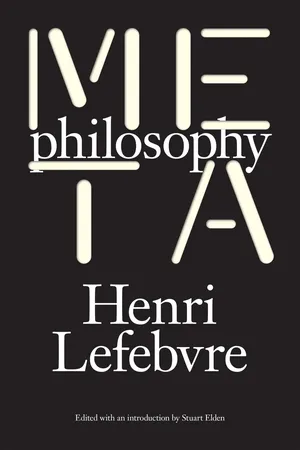
Metaphilosophy
About this book
In Metaphilosophy, Henri Lefebvre works through the implications of Marx's revolutionary thought to consider philosophy's engagement with the world. Lefebvre takes Marx's notion of the "world becoming philosophical and philosophy becoming worldly" as a leitmotif, examining the relation between Hegelian-Marxist supersession and Nietzschean overcoming. Metaphilosophy is conceived of as a transformation of philosophy, developing it into a programme of radical worldwide change. The book demonstrates Lefebvre's threefold debt to Hegel, Marx and Nietzsche, but it also brings a number of other figures into the conversation, including Sartre, Heidegger and Axelos. A key text in Lefebvre's oeuvre,Metaphilosophy is also a milestone in contemporary thinking about philosophy's relation to the world.
Information
Topic
PhilosophySubtopic
Philosophical CriticismCHAPTER 1
Prolegomena: Notice to Readers
The reader is advised to cast a glance at these tables before consulting the main text, and finally to return to the tables, which will then acquire their full meaning.
If the said reader believes that he notices contradictions (in the main text or the tables), he is asked to take a second look at them, for he may be confusing contradictions in things and men with incoherence on the part of the author. If careful examination convinces him of such incoherence, the author would be grateful to hear of it.
TABLE OF FORMS, SYSTEMS, STRUCTURES
Preliminary comments
This table, which certainly needs further completion, seeks above all to show the uneven development of forms, systems and structures, that is to say, the entanglement between ends and beginnings, ‘de-structurings’ and ‘re-structurings’, that history offers us. The forms, systems and structures considered are either products of praxis, or works of poiesis. It is important not to disassociate the two aspects of creative capacity. This table seeks to show how works and products have been deposited (secreted) by activity throughout its historical trajectory, and how they break up or dissolve. We could cite here a well-known text of Engels:
The family represents an active principle … Systems of consanguinity, on the contrary, are passive; recording the progress made by the family at long intervals apart.
And Marx adds that ‘the same is true of the political, juridical, legal, religious, and philosophical systems in general’.1 We leave aside the living body as network, system of systems, hierarchy of self-regulations, as well as the cortex, organ of accumulation, experience and memory. Just as we neglect the earth as an ensemble of self-regulations (atmosphere, precipitation, climate, soil, etc.). We take certain propositions as established. These stabilities exist and constitute the ‘real’. A vast and conflictual (dialectical) becoming pervades them, which philosophies call ‘cosmos’ or ‘world’, ‘God’, ‘divine providence’, ‘spirit’, ‘life’, ‘will’, and so forth. At each level of stability, this becoming seems exhausted. It seems reduced to a ‘residue’. Then contradictions resurge: becoming recommences. It breaks or dissolves the stabilities. If we grasp creative capacity in human history using the terms ‘praxis’ and ‘poiesis’, we are not seeking to construct an ontology under this cover. We must not ‘ontologize’ history.
A. So-called archaic systems. These arise in precapitalist societies, particularly agricultural ones. Cosmogonies and mythologies of which several survivors remain: symbols, proverbial expressions (modified by the act of writing, the predominance of signs over symbols and, today, of signals over signs).
The signs of the zodiac (and astrological cosmogony);
The symbolism of the elements (earth, fire, air, water);
Languages and objects (flowers, precious stones, the ring);
The symbolism of dreams;
Mythological systems (in particular the symbolism of Mother Earth, Greek mythology, etc.);
Temporal and spatial cycles (governed by the number 12, number of the circle and the sphere);
Qualified space–times (represented and structured according to the numbers 2, 3, 4, 5, 6 and 7, according to cosmogonies and societies).
B. Transitional systems, attached to biological, physiological and territorial determinations, then broken by industrialization, but not without leaving survivors and traces. These are above all systems of objects:
Systems of dress (determined by sex, age, caste or group, region, nation);
Systems of food (according to the use of a staple: wheat, rice, maize, fat, oil, butter, etc.);
Systems of kinship (reduced by simplification to the conjugal family);
Systems of ludic objects (ball, football, board game, tarot, playing cards, etc.).
C. Major constituted forms. These forms, issuing from urban life, have more generality than the previously mentioned systems:
| Origin | Brief description |
| Greece | Form of knowledge and knowledge of form: theory of Logos (denotations); grammar, syntax, form of discourse; formal logic, coherence of discourse; geometry (defined and homogeneous space), ‘perfect system’ (teleion sustema): homogeneity of octaves in music. |
| Greece and Rome | Rhetoric: practical use of discourse; political use of discourse; theory of figures of rhetoric (code of connotations). |
| Rome | Formal law (governing equivalences: exchange, contracts, transmission of goods). |
| 13th century | Codification of rituals and customs (love, etiquette, etc.). |
| 15th century | Formalization of spatial and temporal perception (perspective, standardizing of time). |
| 16th and 17th centuries | Homogeneous and infinite space-time (Galileo, Descartes, Newton). |
| 18th century | Developed tonal system (Rameau). Combinatory conception of intelligence (Leibniz, Condillac, etc.). Civil code (promulgated at the start of the 19th century, following earlier development with various interpretations of the law: generalized rules of exchange of goods and ‘fair’ contracts based on the equivalence of goods and properties). |
| D. Ruptures, dissolutions, de-structurings (in Europe) | |
| Renaissance | Systematization of the dominant theology. |
| 15th to 19th century | The peasant community. |
| 17th and 18th centuries | The extended patriarchal family (lineage and household) with its system of kinship: cousinage, neighbourage. |
| 19th century | Formal logic (attacked by dialectical thought, made flexible by the findings of science). |
| 19th century | Dogmatic and systematic philosophy (critique by Karl Marx of the Hegelian system, the teleion sustema of philosophy). |
| End of 19th to early 20th century | Competitive capitalism (with its blind and spontaneous self-regulations: under the double pressure of monopolies and the working class). |
| End of 19th to early 20th century | Language, logos (fetishized and corroded, attacked by the image, etc.). |
| Around 1910 | Classical perspective (reference to the horizon line); tonal system (reference to the tonic); absolute space–time (reference to Euclidean dimensions, the circular clock); system of nature (reference to mechanics, vital spontaneity); ‘real’ and solid perception; art (fetishized and in the process of dissolution, like language – process of destruction and self-destruction: Dadaism, surrealism); shift from signs to signals. |
| 20th century | Local and national systems of objects (clothing, furniture, food) and situations (trades, functions and roles). |
| 1945 | Collapse of philosophico-political systematization on a biological basis (racism) or territorial basis (fascism). |
| 1953–6 | Collapse of philosophico-political systematization on a class basis (‘socialism’ as constituting a completely autonomous system in full development, and the ‘capitalist system’ another system in full degeneration). |
| Second half of 20th century | Virtual or complete explosion of the city. Possible explosion of the planet (perspective of the ‘nuclear’ death of the Earth). |
| E. New constitutions | |
| 20th century | Everydayness (functionalized and structured in the disassociation of work and habitat, private life and leisure). The world of the image (audiovisual; the world made spectacle). The car (with its demands, pilot object in the ‘world of objects’: prestige, destruction of cities; with its codification, the ‘highway code’, perfect system of the modern age). Technicality (technological objects) and its social base (techno-bureaucracy). The system of survival (survival as system). |
PRAXIS: PRELIMINARY COMMENTS
The Greek word ‘praxis’ was reintroduced by Marx to avoid the confusions of the current word ‘practice’. It did not avoid contamination. Today ‘praxis’ encompasses several different meanings. It can denote any social activity, and thus human activity (including technology, poiesis and also theoretical knowledge). It can also be contrasted with pure theory and knowledge, or that which claims to be so, which then brings praxis close to practice in the current sense. Finally, it can denote specifically social activity, that is to say, relationships between human beings, distinguished by legitimate abstraction from relations with nature and matter (technology and poiesis). It is the final meaning that we are seeking to discern and define. Is this not also the sense of the word in Greek? Pragmata are affairs in general, things treated or managed by human beings in their active relations.
We shall develop the thesis of a multiplicity of possible analyses of praxis. The analysis of the Greek thinkers (determinism/chance/will) does not seem to us incompatible with the distinction between the dominated and non-dominated sectors, even in history, nor with the difference between repetitive praxis and revolutionary praxis. The point of view of growth (technological, economic) and that of (social) development are complementary.
The concept of praxis denotes this as determined and yet open onto the possible, as inexhaustible in the face of analysis. This concept also denotes praxis as site and origin of concepts. Praxis in the precise sense would then be the human ‘real’, on condition that it is separated neither from history and historical tendencies, nor from the possible. All praxis is situated in a history; it is a creator of history. Total history would thus be a history of praxis; it would tend (at the extreme) towards complete knowledge of human development. We shall simply give here a few stages and moments of it:
1.Division of labour. Inequality of labour. Growing split between groups labouring on matter (pastoralists, farmers, artisans, workers) and groups operating on other human groups (warriors, priests, administrators, traders, educators, etc.). Inequality of functions and struggle for the relative social surplus product (in penury).
2.Exchange and trade (trade in men and trade in goods). Money, market and language. The ...
Table of contents
- Cover Page
- Title Page
- Copyright Page
- Contents
- Introduction: A Study of Productive Tensions
- Chapter 1: Prolegomena: Notice to Readers
- Chapter 2: The Superseding of Philosophy
- Chapter 3: Philosophy in Crisis
- Chapter 4: Opening of the Testament: Inventory of the Legacy
- Chapter 5: The Search for Heirs
- Chapter 6: Mimesis and Praxis
- Chapter 7: Philosophy as Message
- Chapter 8: Metamorphosis of Philosophy: Poiesis and Metaphilosophy
- Postface: Marxism and Poetry
- Notes
- Index
Trusted by 375,005 students
Access to over 1.5 million titles for a fair monthly price.
Study more efficiently using our study tools.
Frequently asked questions
Yes, you can cancel anytime from the Subscription tab in your account settings on the Perlego website. Your subscription will stay active until the end of your current billing period. Learn how to cancel your subscription
No, books cannot be downloaded as external files, such as PDFs, for use outside of Perlego. However, you can download books within the Perlego app for offline reading on mobile or tablet. Learn how to download books offline
Perlego offers two plans: Essential and Complete
- Essential is ideal for learners and professionals who enjoy exploring a wide range of subjects. Access the Essential Library with 800,000+ trusted titles and best-sellers across business, personal growth, and the humanities. Includes unlimited reading time and Standard Read Aloud voice.
- Complete: Perfect for advanced learners and researchers needing full, unrestricted access. Unlock 1.5M+ books across hundreds of subjects, including academic and specialized titles. The Complete Plan also includes advanced features like Premium Read Aloud and Research Assistant.
We are an online textbook subscription service, where you can get access to an entire online library for less than the price of a single book per month. With over 1.5 million books across 990+ topics, we’ve got you covered! Learn about our mission
Look out for the read-aloud symbol on your next book to see if you can listen to it. The read-aloud tool reads text aloud for you, highlighting the text as it is being read. You can pause it, speed it up and slow it down. Learn more about Read Aloud
Yes! You can use the Perlego app on both iOS and Android devices to read anytime, anywhere — even offline. Perfect for commutes or when you’re on the go.
Please note we cannot support devices running on iOS 13 and Android 7 or earlier. Learn more about using the app
Please note we cannot support devices running on iOS 13 and Android 7 or earlier. Learn more about using the app
Yes, you can access Metaphilosophy by Henri Lefebvre, Stuart Elden, David Fernbach in PDF and/or ePUB format, as well as other popular books in Philosophy & Philosophical Criticism. We have over 1.5 million books available in our catalogue for you to explore.