- 241 pages
- English
- PDF
- Available on iOS & Android
eBook - PDF
About this book
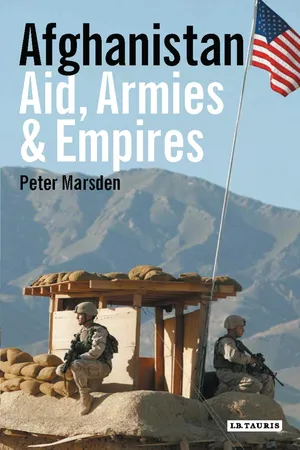
As the battle for Afghanistan intensifies, with the NATO-led coalition seemingly unable to defeat the Taliban, and struggling in its nation building efforts, Afghanistan expert Peter Marsden looks at why it is that the Great Powers, from 19th-century Britain to the 20th-century Soviet Union to 21st-century America, have so often been frustrated in attempting to impose their will on this strategically vital country. In comparing the three interventions, Marsden uncovers a number of similarities. The rhetoric of 'development' coming from the capitals of the West has, he finds, a well-established heritage. Every would-be occupier has used some form of aid to try and turn Afghanistan into the kind of country that would suit their geopolitical objectives. Marsden, who has worked with British NGOs in Afghanistan for 20 years, draws on his own experience as well as extensive archive research to establish how these grand interventions appear from the Afghan perspective, and why it is that ordinary Afghans seem to be better off when they are attracting less, not more, attention from the world powers. He argues that the Americans have yet to learn the lessons that the Soviets and the British before them learned: that no amount of financial, military or humanitarian aid will 'stabilise' the country if it comes with violence and foreign occupation. Afghanistan - Aid, Armies and Empires offers both an exploration of the relationship between aid and power, and a fresh and original history of Afghanistan through the prism of great power politics.
Information
Table of contents
- Cover
- Contents
- 1. Introduction
- 2. The Great Game
- 3. The Build-Up to the Soviet Intervention
- 4. The Soviet Military Intervention
- 5. The Build-up to the US-Led Intervention
- 6. The US-Led Military Intervention
- 7. The Relationship between US Strategy and the Aid Process
- 8. The Specific Impact of Development and Humanitarian Assistance
- 9. The Interface between NGOs and the International Military
- 10. Conclusions
- Endnotes
- Index
Trusted by 375,005 students
Access to over 1.5 million titles for a fair monthly price.
Study more efficiently using our study tools.
Frequently asked questions
Yes, you can cancel anytime from the Subscription tab in your account settings on the Perlego website. Your subscription will stay active until the end of your current billing period. Learn how to cancel your subscription
No, books cannot be downloaded as external files, such as PDFs, for use outside of Perlego. However, you can download books within the Perlego app for offline reading on mobile or tablet. Learn how to download books offline
Perlego offers two plans: Essential and Complete
- Essential is ideal for learners and professionals who enjoy exploring a wide range of subjects. Access the Essential Library with 800,000+ trusted titles and best-sellers across business, personal growth, and the humanities. Includes unlimited reading time and Standard Read Aloud voice.
- Complete: Perfect for advanced learners and researchers needing full, unrestricted access. Unlock 1.5M+ books across hundreds of subjects, including academic and specialized titles. The Complete Plan also includes advanced features like Premium Read Aloud and Research Assistant.
We are an online textbook subscription service, where you can get access to an entire online library for less than the price of a single book per month. With over 1.5 million books across 990+ topics, we’ve got you covered! Learn about our mission
Look out for the read-aloud symbol on your next book to see if you can listen to it. The read-aloud tool reads text aloud for you, highlighting the text as it is being read. You can pause it, speed it up and slow it down. Learn more about Read Aloud
Yes! You can use the Perlego app on both iOS and Android devices to read anytime, anywhere — even offline. Perfect for commutes or when you’re on the go.
Please note we cannot support devices running on iOS 13 and Android 7 or earlier. Learn more about using the app
Please note we cannot support devices running on iOS 13 and Android 7 or earlier. Learn more about using the app
Yes, you can access Afghanistan by Peter Marsden in PDF and/or ePUB format, as well as other popular books in History & Asian History. We have over 1.5 million books available in our catalogue for you to explore.