The first full and comprehensive examination of the turbulent financial and economic relationship between Italy and Albania in the twentieth century, which throws new light on Italian Fascist imperialism. "Italy and Albania" retraces the complicated foreign and economic strategy that led in 1939 to the "union of the two crowns" of Italy and Albania. Drawing on original research, Roselli shows how Italy's strategy towards Albania veered between the extremes of a minimum of economic penetration and a maximum of political interference. He shows how, from an Albanian perspective, King Zog's policy was an impossible balancing act between the conflicting interests of foreign powers. Often presented as a trophy of Fascist foreign policy, the Italian experience in Albania in the interwar period can be regarded as a major economic failure. The huge inflow of Italian capital to Albania - consisting almost entirely of government money - failed not only to set in motion a stable expansion of the Albanian economy but also to produce a return for Italy in terms of the exploitation of the country's natural resources or its trade with Albania.
Contemporary observers were impressed by the strength of Albania's currency, its monetary regime based on the gold standard, and its strong balance of payments. But this was largely window dressing, behind which there was an extremely backward economy that siphoned resources out of Italy, without that country gaining any appreciable advantage. Seen in this light, the events of 1939 -the Italian occupation of Albania and the Union between the two countries - become the inevitable consequence of a state of economic affairs that was unacceptable to Fascist Italy. Italy's involvement in Albania did not end with the defeat of Fascism, as the long international controversy surrounding the gold of the Albanian Central Bank demonstrates. This book makes a major contribution to our understanding of the history of both countries and the make up of Europe today.
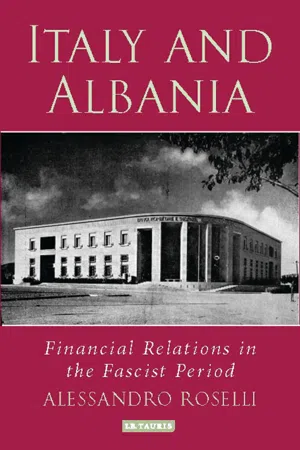
- 239 pages
- English
- PDF
- Available on iOS & Android
eBook - PDF
About this book
Information
Table of contents
- Cover
- Half Title
- Title
- Copyright
- Dedication
- Epigraphy
- Contents
- Figures and tables
- Foreword
- Preface
- Chronology
- Albanian Prime Ministers,and Italian and British diplomatic envoys to Albania (1913–1943)
- 1 Italy and Albania,1900–1920
- 2 The Albanian economy and the Balkan context: the Calmès Report
- 3 The League of Nations: a missed opportunity
- 4 The creation of the National Bank of Albania and the SVEA
- 5 The balance of trade, the balance of payments and the exchange rate of the Albanian franc
- 6 Albanian monetary policy
- 7 The occupation of Albania and the union between Italy and Albania
- 8 A short-lived ‘lira area’
- 9 Some observations on Albania’s income and the economic aspects of the Italian presence
- 10 The question of the ‘Albanian gold’
- 11 Summary and conclusions
- Appendix
- Notes
- References
- Index
Trusted by 375,005 students
Access to over 1.5 million titles for a fair monthly price.
Study more efficiently using our study tools.
Frequently asked questions
Yes, you can cancel anytime from the Subscription tab in your account settings on the Perlego website. Your subscription will stay active until the end of your current billing period. Learn how to cancel your subscription
No, books cannot be downloaded as external files, such as PDFs, for use outside of Perlego. However, you can download books within the Perlego app for offline reading on mobile or tablet. Learn how to download books offline
Perlego offers two plans: Essential and Complete
- Essential is ideal for learners and professionals who enjoy exploring a wide range of subjects. Access the Essential Library with 800,000+ trusted titles and best-sellers across business, personal growth, and the humanities. Includes unlimited reading time and Standard Read Aloud voice.
- Complete: Perfect for advanced learners and researchers needing full, unrestricted access. Unlock 1.5M+ books across hundreds of subjects, including academic and specialized titles. The Complete Plan also includes advanced features like Premium Read Aloud and Research Assistant.
We are an online textbook subscription service, where you can get access to an entire online library for less than the price of a single book per month. With over 1.5 million books across 990+ topics, we’ve got you covered! Learn about our mission
Look out for the read-aloud symbol on your next book to see if you can listen to it. The read-aloud tool reads text aloud for you, highlighting the text as it is being read. You can pause it, speed it up and slow it down. Learn more about Read Aloud
Yes! You can use the Perlego app on both iOS and Android devices to read anytime, anywhere — even offline. Perfect for commutes or when you’re on the go.
Please note we cannot support devices running on iOS 13 and Android 7 or earlier. Learn more about using the app
Please note we cannot support devices running on iOS 13 and Android 7 or earlier. Learn more about using the app
Yes, you can access Italy and Albania by Alessandro Roselli in PDF and/or ePUB format, as well as other popular books in Économie & Histoire économique. We have over 1.5 million books available in our catalogue for you to explore.