Debates on the relationship between Islam and the West rage on, from talk of clashing civilizations to political pacification, from ethical and historical perspectives to distrust, xenophobia and fear. Here Mohammad Salama argues that the events of 9/11 force us to engage ourselves fully, without preconditions, in understanding not just the history of Islam as a religion, but of Islam as a historical condition that has existed in relationship to the West since the seventh century.
Salama compares the Arab-Islamic and European traditions of historical thought since the early modern period, focusing on the watershed moments that informed the two traditions' ideas of intellectual history and perceptions of one another. He draws attention to European intellectual history's entangled links with the Islamic philosophy of history, especially the complexities of orientalism and modernity. Recent critical reflections on the work of Ibn Khald?n confirm this intertwined and troubled relationship, reflecting major disparities and contradictions. At the same time, recent Arab writings on Europe's intellectual history reveal a struggle against erasure and intellectual superiority.
Calling for a new understanding of the relationship between Islam and the West, Salama argues that Islam has played a major role in enabling and positioning various paths of Western historiography at crucial moments of its development, leaving palpable imprints on Islamic historiography in the process. He proposes an answer to a fundamental question: how to make sense of the mechanics of production in Arab-Islamic and Western historiographies, or how to identify the ways in which they have both failed to make sense of themselves and of each other in an increasingly disenchanted postnationalist world. Spanning an impressive array of recent writings on these themes as well as older foundational texts in both traditions - including al-Tabar?, Ibn Khald?n, Hegel, al-Jabart?, Toynbee, Foucault, Edward Said, and Hourani - this book is both timely and crucial for all those interested in Islamic and Middle Eastern studies, Western and Islamic philosophies of history, modernity, and the relationship between Islam and the West.
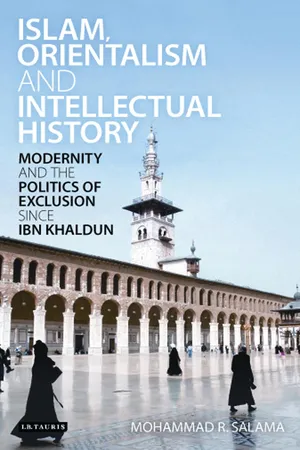
eBook - PDF
Islam, Orientalism and Intellectual History
Modernity and the Politics of Exclusion Since Ibn Khaldun
- 289 pages
- English
- PDF
- Available on iOS & Android
eBook - PDF
Islam, Orientalism and Intellectual History
Modernity and the Politics of Exclusion Since Ibn Khaldun
About this book
Information
Table of contents
- Cover
- Contents
- Illustrations
- Note on Translation and Transliteration
- Acknowledgments
- Prologue: Thinking about Islam and the West
- 1. Fact or Fiction?
- 2. Postcolonial Battles over Ibn Khaldun
- 3. How did Islam make it into Hegel's Philosophy of World History?
- 4. The Emergence of Islam as a Historical Category in British Colonial Thought
- 5. Disciplining Islam
- Epilogue
- Notes
- Bibliography
- Index
Trusted by 375,005 students
Access to over 1.5 million titles for a fair monthly price.
Study more efficiently using our study tools.
Frequently asked questions
Yes, you can cancel anytime from the Subscription tab in your account settings on the Perlego website. Your subscription will stay active until the end of your current billing period. Learn how to cancel your subscription
No, books cannot be downloaded as external files, such as PDFs, for use outside of Perlego. However, you can download books within the Perlego app for offline reading on mobile or tablet. Learn how to download books offline
Perlego offers two plans: Essential and Complete
- Essential is ideal for learners and professionals who enjoy exploring a wide range of subjects. Access the Essential Library with 800,000+ trusted titles and best-sellers across business, personal growth, and the humanities. Includes unlimited reading time and Standard Read Aloud voice.
- Complete: Perfect for advanced learners and researchers needing full, unrestricted access. Unlock 1.5M+ books across hundreds of subjects, including academic and specialized titles. The Complete Plan also includes advanced features like Premium Read Aloud and Research Assistant.
We are an online textbook subscription service, where you can get access to an entire online library for less than the price of a single book per month. With over 1.5 million books across 990+ topics, we’ve got you covered! Learn about our mission
Look out for the read-aloud symbol on your next book to see if you can listen to it. The read-aloud tool reads text aloud for you, highlighting the text as it is being read. You can pause it, speed it up and slow it down. Learn more about Read Aloud
Yes! You can use the Perlego app on both iOS and Android devices to read anytime, anywhere — even offline. Perfect for commutes or when you’re on the go.
Please note we cannot support devices running on iOS 13 and Android 7 or earlier. Learn more about using the app
Please note we cannot support devices running on iOS 13 and Android 7 or earlier. Learn more about using the app
Yes, you can access Islam, Orientalism and Intellectual History by Mohammad R. Salama in PDF and/or ePUB format, as well as other popular books in History & Middle Eastern History. We have over 1.5 million books available in our catalogue for you to explore.