eBook - ePub
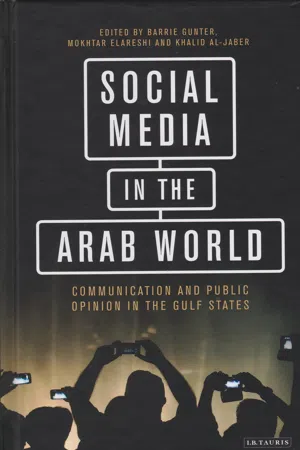
Social Media in the Arab World
Communication and Public Opinion in the Gulf States
- 288 pages
- English
- ePUB (mobile friendly)
- Available on iOS & Android
eBook - ePub
Social Media in the Arab World
Communication and Public Opinion in the Gulf States
About this book
Following the Arab Spring, the use of social media has become instrumental in organising activist movements and spreading political dissent in the Middle East. New online behaviours have transformed traditional communication channels, enabling young people of all backgrounds to feel politically empowered. But now that spring has turned to winter, what are the long-term implications of internet activism in the region? Social Media in the Arab World provides a unique insight into the role of online communications as a force for change in the Gulf States. Featuring examples as diverse as neo-patrimonial politics in Saudi Arabia and the ways an online presence affects the status of women in Kuwait, the chapters examine shifts in the political, social and religious identities of citizens as a result of increased digital activism. With contributions from a variety of inter-disciplinary experts, this wide-ranging study examines the consequences of changing power dynamics brought about by popular social media. In doing so, this book offers an original perspective on the long-term implications of internet usage in the Arab world and is essential reading for students and researchers working across the region.
Information
1
The Significance of Social Media in the Arab World
Barrie Gunter and Mokhtar Elareshi
The events of the so-called ‘Arab Spring’ have their genesis in public discontent with their ruling classes and the social and economic opportunities provided for ordinary people in their societies that had festered over many years. New technologies linked to the internet and mobile phones played a critical role as communication platforms that enabled formerly disparate individuals to become organised swiftly into groups with a common purpose.1 In this context, there has been a great deal of discussion and speculation and some research among academics and practitioners alike about what role the new media, especially social media, are currently playing and what impact they will have in future social and political developments in the Arab world.2
This edited book is designed to shed new light on these matters. It focuses on social media usage in the Gulf Cooperation Council (GCC) region and the links between these and the traditional media. The GCC states comprise Bahrain, Kuwait, Qatar, Oman, Saudi Arabia and United Arab Emirates. The book covers the different roles played by social media across a range of social, cultural, political, economic and religious contexts in the region. The GCC cannot be considered in isolation from the remainder of the region. Developments in the use of online social media in the Gulf States form part of a wider sphere of technological revolution spanning the entire Middle East and North Africa (MENA) Arab world. Although the world’s attention was drawn to the events that occurred in these countries from 2011, seeds were being sown for a number of years before then. The growth in the use of blogs, micro-blogs and social media sites was observed from 2005, and these technologies quickly became adopted as tools of political activists.3
The analysis of ‘social’ media forms part of a wider interest in the role allegedly played by ‘new’ media in shaping political activism and outcomes. It is important to be clear about the definition of these terms because there has been much loose writing about new media. We can take our cue from the work of Sean Aday and his colleagues who identified three major categories of ‘new’ media: Blogging, ‘social’ networks such as Facebook, hosting services such as YouTube, micro-blogging services such as Twitter, and short text messaging primarily via mobile phones and email.4 These various services provide platforms for interpersonal communication and information exchanges that can take place between one individual and another or between one individual and many others.
In a political context, these different communications channels can provide sources of information that supplement or displace the mass media as sources of reporting and debate.5 They might also be used by specific individuals and groups to forge and maintain links with like-minded others and to organise live events. Because ‘new’ media channels are under the control of the users, they can publish whatever they want whenever they choose without facing the usual restrictions of professional gatekeepers who determine news agendas in the mainstream media.6 As we see in Chapters 4 and 10, when numerous arrests were taking place in the GCC region following the recent 2011 Arab uprisings, online users were jailed for their online activities, especially when these were linked to views about political oppression.
There is, of course, a risk attached to the use of new media sources in that recipients of their messages cannot always be sure about the authenticity of the information they contain or the credibility and agenda of the sources – if the sources are known at all. The online community, however, tends to engage in self-policing of content particularly in regard to the accuracy and balance of new media messages that are posted to mass recipients – a phenomenon that has been referred to as ‘gatewatching’.7
Even in the online world, and despite its democratic goals as far as information production and reception are concerned, elite content providers emerge. Some bloggers, Facebook and Twitter users attract more followers than do others.8 This is true regardless of whether the bloggers in question are specialists in political affairs or write about celebrity, fashion and lifestyle issues. Some bloggers can achieve an almost celebrity-like status if they command the regular attention of millions of followers. They may also come to dominate the setting of specific agendas among those followers on a scale that matches old-style mass communication. For some writers, this phenomenon has called into question whether the internet is a site of true democracy or has in fact been hijacked by dominant information providers and opinion leaders.9
The debate about whether digital democracy really exists has been further fuelled by the observation that most internet users are not political activists and their online consumption patterns tend to be dominated by content generated by the mainstream news media that also operate in online settings. In the United States, for example, some of the most widely-accessed political blogs have close links to traditional media organisations.10 Even independent bloggers depend heavily on mainstream news media sources for their source materials.11 Network analysis of communications links and information flows between different categories of websites in the UK revealed the dominance of the major news media as principal ‘hubs’ from which multiple other sites retrieve content. The presence of independent bloggers with this kind of hub status was rare.12
What is clear is that the ‘new’ media have reached a point of parity with the ‘old’ media (newspapers, magazines, radio and television) in some communities. Some confusion is caused by the migration of old media into new media environments where they actively cross-promote between their ‘old’ and ‘new’ media outputs.13 Nevertheless, the gatekeeping controls that the old media were able to exert over the flow of information have been diluted or can be circumvented by the many new media channels that now have mass reach. This is a significant development in non-democratic countries in which governments have traditionally exerted centralised control over the media and their outputs.
New media have given citizens of those countries opportunities to speak out on issues of their choosing and to reach large numbers of other people at home and abroad with their opinions and personal observations of events. These same new media channels also provide the citizens of non-democratic nations with opportunities to obtain news from uncensored sources and, hence, to absorb different news agendas from the ones promulgated by their own government-controlled media.14 One term that has been coined to describe this process is the ‘disintermediation’ of the mainstream media. The digitalisation of interpersonal communication between private citizens has scaled up these communications from the highly localised to the highly public on a mass scale.15
Based on the previous discussion, there are several reasons for producing this book at this time. It has already been well documented that online social networking platforms played an active part in the different national uprisings collectively grouped under the ‘Arab Spring’ in 2011. Much has been written about these events in the Western world, but a variety of perspectives on their form and impact exist among scholars and commentators in the Arab world. The current volume represents a ‘one-stop shop’ collection of writings from within the Middle East and North Africa region.
Further, there has been an increased academic research focus on the growth and use of online social media in the GCC countries that have adopted a variety of theoretical and methodological perspectives.16 This burgeoning body of work is also represented here. As social media use has become more widespread across the Arab world, not only as a toolkit for political activists but also as important communications devices for ordinary citizens in their regular professional and private lives, there is a growing need to understand their longer-term implications for Arab societies. This book aims to gather together the latest research evidence alongside what is also known from extensive research conducted in the West and to provide a fresh overview and critical analysis of the field. The contributing authors are all active experts in the field currently engaged in conducting their own research or analysis of the spread and impact of digital communications technology in the Arab world.
This book is different from other books in the market because it represents the first overview of its kind that covers the GCC region. As events continue to unfold in the Middle East that may lead to the redrawing of geo-political maps and radical changes in the ways in which some Arab societies function, new media technologies remain centre stage. It is important, therefore, to consider not only what has already happened but what is likely to take place in the future and how social media use has evolved among specific user groups with their own vested political, religious, cultural, social and military agendas. More stable parts of the Arab world, such as the GCC, have closely observed the changes taking place in less stable areas and the mediating role that digital communications technologies have played. There is a need for a deeper understanding of the power of social media and of how the use of these platforms can and should be controlled for the greater good. This understanding must not grow out of prejudice or from anecdotal experience alone. It is best based on systematic and objective empirical inquiry and evidence. The status of such evidence and the establishment of an effective research agenda for the future are desperately needed. It is the aim of this book to facilitate this process.
As well as the preceding considerations, the evolution of social media has occurred alongside dramatic changes to the wider media landscape of the GCC region. Some of the latter changes have been catalysed by the adoption of social media by ordinary citizens who have begun ...
Table of contents
- Cover
- Half Title
- Endorsment
- Title Page
- Copyright Page
- Table of Contents
- List of Tables
- About the Contributors
- Note on Sources, Citations and Bibliography
- Acknowledgements
- 1 The Significance of Social Media in the Arab World
- 2 The Role of Social Media as a Decisive Actor in Saudi Arabia
- 3 Arab Social Media: From Revolutionary Euphoria to Cyber Realism
- 4 Social Media and Unethical P2P Diplomacy in the Bahrain Uprising
- 5 Mobile Phone and Internet Usage in the GCC Region: University Students’ Perspectives
- 6 Social Media Usage and the Changing Context in the United Arab Emirates
- 7 Women and Online Political Participation in Kuwait
- 8 The New Media as Alternative Medium in the GCC Region
- 9 Social Media, Surveillance, and Spying in the Bahrain Uprising
- 10 Social Media and Political Change in the Gulf
- 11 The Future of Social Media in the GCC Region
- Bibilography
Trusted by 375,005 students
Access to over 1.5 million titles for a fair monthly price.
Study more efficiently using our study tools.
Frequently asked questions
Yes, you can cancel anytime from the Subscription tab in your account settings on the Perlego website. Your subscription will stay active until the end of your current billing period. Learn how to cancel your subscription
No, books cannot be downloaded as external files, such as PDFs, for use outside of Perlego. However, you can download books within the Perlego app for offline reading on mobile or tablet. Learn how to download books offline
Perlego offers two plans: Essential and Complete
- Essential is ideal for learners and professionals who enjoy exploring a wide range of subjects. Access the Essential Library with 800,000+ trusted titles and best-sellers across business, personal growth, and the humanities. Includes unlimited reading time and Standard Read Aloud voice.
- Complete: Perfect for advanced learners and researchers needing full, unrestricted access. Unlock 1.5M+ books across hundreds of subjects, including academic and specialized titles. The Complete Plan also includes advanced features like Premium Read Aloud and Research Assistant.
We are an online textbook subscription service, where you can get access to an entire online library for less than the price of a single book per month. With over 1.5 million books across 990+ topics, we’ve got you covered! Learn about our mission
Look out for the read-aloud symbol on your next book to see if you can listen to it. The read-aloud tool reads text aloud for you, highlighting the text as it is being read. You can pause it, speed it up and slow it down. Learn more about Read Aloud
Yes! You can use the Perlego app on both iOS and Android devices to read anytime, anywhere — even offline. Perfect for commutes or when you’re on the go.
Please note we cannot support devices running on iOS 13 and Android 7 or earlier. Learn more about using the app
Please note we cannot support devices running on iOS 13 and Android 7 or earlier. Learn more about using the app
Yes, you can access Social Media in the Arab World by Barrie Gunter, Mokhtar Elareshi, Khalid Al-Jaber, Barrie Gunter,Mokhtar Elareshi,Khalid Al-Jaber in PDF and/or ePUB format, as well as other popular books in History & Middle Eastern History. We have over 1.5 million books available in our catalogue for you to explore.