- 272 pages
- English
- ePUB (mobile friendly)
- Available on iOS & Android
eBook - ePub
About this book
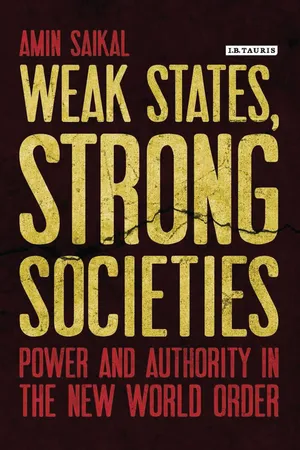
Since the disintegration of the Soviet Union and the end of the Cold War, the previously well-established organisation of world politics has been thrown into disarray. While during the Cold War, the bipolarity of the world gave other powers a defined structure within which to vie for power, influence and material wealth, the current global political landscape has been transformed by a diffusion of power. As a result, the world has seen the rise of sub-national or quasi-/non-state actors, such as Hezbollah, al-Qaeda and the movement that calls itself Islamic State, or ISIS. These dramatic geopolitical shifts have heavily impacted state-society relationships, power and authority in the international system. Weak States, Strong Societies analyses the effect of these developments on the new world order, arguing that the framework of 'weak state, strong society' appears even more applicable to the contemporary global landscape than it did during the Cold War. Focusing on a range of regional contexts, the book explores what constitutes a weak or strong state. It will be essential reading for specialists in politics and international relations, whether students or academic researchers.
Information
CHAPTER 1
FRAMING AN INQUIRY
Introductory perspectives
There are a great variety of state/society relationships in the world, and also a bewildering array of spatial and temporal contexts that shade our perceptions of strengths and weaknesses. This array reflects such basic conditions as geography, weather, resources, size, population density, stage of development, technological setting, continuity of leadership, religion, culture, and many more. Acknowledging this context dependence injects a cautionary note into any reliance on analytic and ahistoric approaches to guide inquiry into that intriguing category of political entities that can be described as being “strong societies” embedded in “weak states.”
Conceptually, it seems also important to question whether “societies” should be automatically considered coterminous with “states.” Do some states have multiple societies within their borders? For instance, minorities predominantly resident in a particular region within a state (Kurds in Iraq or Turkey, Pashtuns in Afghanistan, and Catalans or Basques in Spain) seem to exist in a distinct “society” even if enjoying the nationality associated with the state, such as engaging in international travel using a national passport and casting votes in national elections. Societal decentralization often takes the form of a federated state structure. Such societies are strong in the sense of being culturally autonomous and politically semi-autonomous, often with their own language, culture, traditions, institutions, and grievances. If their relations to the dominant state are hostile, these societal formations can be thought of as “captive nations.”
If such societies claim rights of self-determination, which is an inalienable right of all “peoples,” then there is posed an international law issue of some magnitude. Supposedly, it is not valid to assert a right of self-determination in the full sense of secession if it would fragment a sovereign state enjoying diplomatic status. At the same time, if the secessionist project is successful in creating a separate existence acknowledged as such by other states and the UN, then a new state comes into existence (Bosnia, Slovenia, and Croatia). It is difficult to generalize about this relationship between society and state because there exist so many variations, both with regard to the nature of the state/society relationship and what kinds of strength and weakness are being considered.
Another preliminary observation that complicates, in a different manner, such an interpretative exercise, is the historical experience of the non-West in the period since 1945. Two important intersecting and contradictory phenomenon can be discerned. First, the colonial experience carried with it a nationalist message that was given a certain global salience when proclaimed by Woodrow Wilson after the First World War World War as “the right of self-determination,” which was meant by Wilson to apply narrowly to the peoples living in what had been the Ottoman Empire, and was not intended to challenge the legitimacy of the European colonial empires. Whatever Wilson's intentions, this limited innovation in political identity was quickly universalized by Vladimir Lenin and others to apply to the entire colonial world by Lenin and others. It is a memorable anecdote that Ho Chi Minh, who was in Paris working as a pastry chef during the Versailles peace talks, was so impressed by the relevance of the ideal of self-determination to the future of Vietnam that he petitioned Wilson asking that he might study at Princeton, the university that Wilson had administered before he became president of the US.
My Hegelian point is that articulating this ideal as related to the nationalist evolution of the European states induced in diverse ways the strengthening of many societies vis-à-vis the colonial states, making such state structures less able to maintain internal law and order than had been the case earlier, superimposing a national societal layer of domestic unity without distinguishing in some instances the societal identity of one or more ethnic or religious sub-state societies. Nationalist resistance temporarily created a strong society vis-à-vis the colonial state, but often postindependence both the state and society were weak.
The contradictory observation is that the colonial state, in particular, deployed many instruments to weaken society, including disempowering the indigenous population from having the capacity to govern. As a result, when independence came, the postcolonial state was weak with respect to competencies needed for good governance, lacking the educational and bureaucratic base to administer society in an effective and humane manner. The intentionally disempowered postcolonial state was also often challenged by the postcolonial society that had been deliberately weakened by the colonial experience, either through a divide-and-rule mentality or by way of enforced civilizational assimilation.
This emphasis on overall context and the importance of the colonial backdrop for many states and societies conditions inquiry, and might be clarified by reliance on case studies of varying transitions from colonial to postcolonial status. Joel Migdal uses case studies, but within an analytic framing of state/society relations.1 It would also be illuminating to compare civilizational experiences of state/society interaction around strong society/weak state hypotheses. I will venture one such impressionistic comparison—the soft revolutions in East Europe during the late 1980s and the so-called Arab Spring that commenced at the start of 2011. In both settings, the governments lacked political legitimacy, and securitized state/society relations so as to maintain order in the face of an alienated and hostile population. These East European societies had greater experience with political independence and possessed political cultures that conceived of themselves as part of the West, and sought the benefits of post-Enlightenment modernity. Such a background translated into relative strength in the form of societies which were capable of replacing the satellite regimes that had governed subject to Soviet hegemonic guidelines with constitutional democracies that did not have the burden of severe polarization, although there were certainly diverse views about the construction of the post-Communist state.
In contrast, the countries in the Middle East and North Africa (MENA) region were without a deep experience of modernity, and even those non-Arab countries at the edge of the region that self-consciously embraced the Western path—that is, Turkey and Iran—did so in the face of a deep Islamic culture among the masses that resisted the adoption of the Western path, and experienced strong indigenous cultural revivals and also divisive forms of polarization. What is exhibited throughout MENA is a different type of strong society that reverts to traditional cultural ways, and generates counterrevolutionary movement tendencies to restore a coercive state apparatus that imposes its will on a dissatisfied and subjugated citizenry.
The Egyptian experience since 2011 is paradigmatic, and because it is the central and most populous state in the region, its narrative deserves special attention. Three phases can be distinguished: (1) the largely nonviolent challenge to the corrupt authoritarianism of Hosni Mubarak's rule; (2) an experimental period of inclusive democracy that included parliamentary and presidential elections, as well as a constitutional referendum, that brought the Muslim Brotherhood to power and confirmed the democratic weakness of Egyptian urban liberal elites; and (3) an orchestrated crisis of legitimacy directed at the elected government of Mohamed Morsi culminating in a popularly backed military coup against the elected political leadership followed by a bloody crackdown on all opposition, but especially the Muslim Brotherhood, whose status changed from governing party to criminalized terrorist organization. A new constitution was drafted, new elections held, and General Abdel Fattah el-Sisi, the coup leader, was elected president.
In effect, the strong Egyptian state of the Mubarak era based on its capabilities to establish order was reconstituted, partly by popular demand in view of widespread disappointment with the democratic interlude between January 2011 and June 2013. The experience of overthrowing two governments based on the mobilization of discontent has undoubtedly changed state/society relations in significant ways, making it more difficult for the state to dominate society and creating in society a sense of having the right and capacity to hold the state accountable. In this regard, the state/society interaction in Egypt, and throughout the Arab world, has altered the weak/strong assessment in unpredictable ways.
Does this Egyptian story reveal to us a strong or weak state? A strong or weak society? This is the puzzle. I would contend that the state is weak if it needs to keep order by a reliance on the apparatus of state terror and police brutality, and that society is strong if it sets limits on consensual government and exhibits a capability to mount effective resistance if these unwritten limits are overstepped.
Conceptual clarification
An initial conceptual issue is to clarify what is meant by “strong” and “weak” from both state and societal perspectives, as well as nationally and internationally. A conventional idea of a “strong” state is the possession of a preponderance of hard power resources sufficient to address effectively the full range of internal and external challenges to political order and territorial integrity of a sovereign state. That is, this conception of the strong state, with an ideological lineage associated with political realism, is essentially based on being an effective state. Authoritarian states that sustain stability provide good examples, for instance, Mubarak's Egypt or Joseph Stalin's Soviet Union. Another idea of a strong state is an emphasis on a capacity to meet such challenges with minimum reliance on hard power, depending more fundamentally on soft power by way of respect for law, consent from the citizenry to govern via free elections, and creative diplomacy to establish everyday order and national security at acceptable levels. That is, such a strong state is viewed by the preponderance of people under its control and internationally as a legitimate state, and is illustrated by states that qualify both as constitutional democracies and are not faced with serious threats of insurrectionary violence or external attack.
The European idea of nation-state was essentially generated as a state-building strategy that sought to overcome the medieval heritage of identity as local and based on religious affiliation. Nationalism filled the void, and created a political entity consisting of a state that represented a society internationally as well as governing it internally within fixed boundaries. To create an effective state presupposed a corresponding loyalty, identity, and coherence, which was achieved by an ideology of nationalism divorced from religion, ethnicity, and local affinities. This idea of the nation-state was essentially a fiction as minorities often felt that the state was dominated by either a given ethnicity or religious orientation, and that claims of national unity were hiding patterns of domination. When the state is successful in generating the loyalty and identification of people resident within its boundaries, then the actuality of a nation-state has been achieved, giving strength to the state that can mobilize its citizens for a variety of actions ranging from sacrifices in wartime to the celebration of national holidays.
From the time of Niccolo Machiavelli to the present, it has been understood by leading political thinkers that it is better to rely on the respect of the governed than to impose order by inducing fear. Governing on the basis of consent and respect is self-perpetuating, while governing on the basis of state terror and force gives rise to oppositional plots and can lead to insurrection. At the same time, making all generalizations unreliable in specific instances, the primary public demands are associated with sustaining order so that there is security in everyday life and the economy functions to provide the population with what is needed for subsistence. There is a proverb popular in the Arab world that expresses this expectation: “people would rather endure 100 years of tyranny than a single year of chaos.” With this outlook, maintaining order is the defining attribute of what is perceived to be a strong state.
With regard to “strong” societies, the emphasis would be upon zones of autonomy in which local forces provide human security and order, or upon a capacity to resist external intervention from above or without on the basis of nonaccountable local and ethnic leadership and nationalist patterns of loyalty that distinguish between loyalty to the state and loyalty to the nation or nations, or to a particular community. The anti-colonial wars of the prior century as occurred in Indonesia, Indochina, and Algeria are illustrative of societies making a transition from “weak” (easily dominated by external actors) to “strong” (capable of restoring nationhood and territorial sovereignty in the face of exploitative foreign ruling elites), that is, of becoming a sustainable nation-state. The warlord or militia state is one in which nationalist sentiments on the scale of the state is only operative in relation to external enemies, and when such a threat subsides, then decentalized societal and ethnic patterns of governance and deep cultural traditions generate tolerable levels of order most of the time.2
Weak states/strong societies are most vividly characterized by situations of conflict and resistance where the nation is the site of struggle for controlling the future of the country, and the state is either an antagonist or marginalized. Some of these issues have been explored by Mary Kaldor in her depiction of the distinctiveness of “new wars,” although not with this distinction in mind.3 What is evident is that the weak state cannot deal with such security threats as insurrectionary violence, civil strife, drug cartels, transnational crime, and external intervention, nor can the weak society. The strong society, however, has impressive soft power capabilities based on nationalist sentiments and perseverance that can often outlast the hard power dominance of intervening forces collaborating with a weak state. As the Afghan proverb expresses this inverted balance of forces: “you have the watches, we have the time.” In effect, the governmental center of authority is weak, and easily displaced by a hard power regime changing intervention, which occurred in Afghanistan (2002) and Iraq (2003), but the society was unconquerable, and thus strong. The dimension of time can offset deficiencies in weaponry and combat capabilities.4 The indigenous society has the psycho-political edge in such conflicts because of its nationalist resistance to foreign rule that became unconditional, but not until the last half of the twentieth century and only then exhibited a willingness to persevere against the militarily superior foreign adversary, accepting huge sacrifices to achieve its goals. In contrast, the intervening side, calculating on the basis of hard power expectations, tends to have a conditional commitment to its goals, losing the will to persist if the costs exceed certain levels, becoming disillusioned with such undertakings as casualties rise and prospects for success diminish.
The American response to the September 11, 2001 attacks by way of overseas warfare illustrate the resilience and resolve of strong societies that became the scene of such regime-changing interventions. George W. Bush epitomized a failure to distinguish between regime change involving the governing elite in a state and exerting control over the society when he spoke about the early battlefield success after the March 2003 invasion of Iraq beneath the banner “mission accomplished.” Yes, the mission of overthrowing the regime of Saddam Hussein was accomplished, but the real purpose of the attack was to create a new stable Western oriented state/society nexus that would serve both strategic and neoliberal interests not only in Iraq, but also in the region.
The Vietnam War may be a primary instance of soft power resistance prevailing on the basis of determined nationalist resistance despite extreme hard power inferiority. What followed the societal victory in Vietnam, however, was the imposition of a coercive version of a strong state, sustaining security by coercive means. In effect, in anticolonial contexts the countries of Indochina displayed extraordinary strength, first against the French colonial rule and then against their American successor, but when it came to postcolonial realities, these societies seemed weak in relation to authoritarian and corrupt states. In effect, strength and weakness of societies and states are partly historically determined, with non-Western societies weak before the spread of the ethos of nationalism and the rise of indigenous confidence in the ability to challenge colonial structures of domination. For some participants, including Jawaharlal Nehru, a vital event was the defeat of Russia by Japan in the 1905 war that was interpreted as an Asian country triumphing over its European adversary.
Global setting
As argued, the historical, ideological, and geopolitical context is important in interpreting the weak state/strong society phenomenon. During the Cold War, geopolitical discipline empowered the political leadership in many otherwise weak states, or states that were able to inhibit insurrectionary violence only with the help of outside forces. Often geopolitical rivalry can produce a surge of societal strength, as during the Iranian Revolution when the Iranian people briefly united to overthrow the Shah's regime, but quickly regressed in the face of oppressive policies of the new Islamic leadership, which seemed to craft an Islamic or theocratic version of a strong state that proved capable of handling both external challenges (e.g., Iraq, 1980) and internal dissent. The September 11 attacks have created new forms of geopolitical discipline and the rise of transnational insurrectionary violence that exerts unprecedented pressure on state-centric conceptions of world order. The advent of drone warfare and global surveillance networks, as well as the countervailing capabilities of extremist politics able to inflict major harm on major states, suggests a reality where almost no states are “strong” in the sense of being able to uphold their security on their own, and no societies are “strong” in the sense of being able to mount resistance to authoritarian centralization or deal with mega-terrorist tendencies that are either transnational or in their midst.
International law, United Nations authority
The Westphalian assumptions embedded in the United Nations Charter were altered, if not subverted to a significant extent, by the ge...
Table of contents
- Front Cover
- Title Page
- Copyright
- Contents
- List of Tables
- Preface
- Contributors
- Abbreviations
- Introduction
- 1. Framing an Inquiry
- 2. From Nation-States to Member States: State – Society Relations and State Transformation in Contemporary Europe
- 3. The Dynamics of Federalism: Belgium and Switzerland
- 4. State – Society Relationships in Eastern Europe and World Politics
- 5. State – Civil Society Dynamics in Morocco and Algeria: A Case of Divide and Rule?
- 6. Afghanistan and Iraq: State-Building in Countries with Strong Societies
- 7. State – Society Dynamics and Authoritarian Stability in Central Asia
- 8. Weak States and Strong Societies in Southeast Asia
- 9. The Crisis of the State in Africa and the Unending Search for the Reinvention of the State in Somalia
- 10. Strong States, Strong Societies, Weak Democracies? Assessing State – Society Relationships in Latin America
- Conclusion
- Bibliography
Trusted by 375,005 students
Access to over 1.5 million titles for a fair monthly price.
Study more efficiently using our study tools.
Frequently asked questions
Yes, you can cancel anytime from the Subscription tab in your account settings on the Perlego website. Your subscription will stay active until the end of your current billing period. Learn how to cancel your subscription
No, books cannot be downloaded as external files, such as PDFs, for use outside of Perlego. However, you can download books within the Perlego app for offline reading on mobile or tablet. Learn how to download books offline
Perlego offers two plans: Essential and Complete
- Essential is ideal for learners and professionals who enjoy exploring a wide range of subjects. Access the Essential Library with 800,000+ trusted titles and best-sellers across business, personal growth, and the humanities. Includes unlimited reading time and Standard Read Aloud voice.
- Complete: Perfect for advanced learners and researchers needing full, unrestricted access. Unlock 1.5M+ books across hundreds of subjects, including academic and specialized titles. The Complete Plan also includes advanced features like Premium Read Aloud and Research Assistant.
We are an online textbook subscription service, where you can get access to an entire online library for less than the price of a single book per month. With over 1.5 million books across 990+ topics, we’ve got you covered! Learn about our mission
Look out for the read-aloud symbol on your next book to see if you can listen to it. The read-aloud tool reads text aloud for you, highlighting the text as it is being read. You can pause it, speed it up and slow it down. Learn more about Read Aloud
Yes! You can use the Perlego app on both iOS and Android devices to read anytime, anywhere — even offline. Perfect for commutes or when you’re on the go.
Please note we cannot support devices running on iOS 13 and Android 7 or earlier. Learn more about using the app
Please note we cannot support devices running on iOS 13 and Android 7 or earlier. Learn more about using the app
Yes, you can access Weak States, Strong Societies by Amin Saikal in PDF and/or ePUB format, as well as other popular books in Politics & International Relations & 20th Century History. We have over 1.5 million books available in our catalogue for you to explore.