eBook - ePub
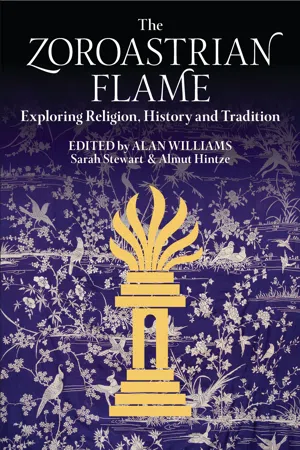
The Zoroastrian Flame
Exploring Religion, History and Tradition
- 400 pages
- English
- ePUB (mobile friendly)
- Available on iOS & Android
eBook - ePub
The Zoroastrian Flame
Exploring Religion, History and Tradition
About this book
For many centuries, from the birth of the religion late in the second millennium BC to its influence on the Achaemenids and later adoption in the third century AD as the state religion of the Sasanian Empire, it enjoyed imperial patronage and profoundly shaped the culture of antiquity. The Magi of the New Testament most probably were Zoroastrian priests from the Iranian world, while the enigmatic figure of Zarathushtra (or Zoroaster) himself has exerted continual fascination in the West, influencing creative artists as diverse as Voltaire, Nietzsche, Mozart and Yeats. This authoritative volume brings together internationally recognised scholars to explore Zoroastrianism in all its rich complexity. Examining key themes such as history and modernity, tradition and scripture, art and architecture and minority status and religious identity, it places the modern Zoroastrians of Iran, and the Parsis of India, in their proper contexts. The book extends and complements the coverage of its companion volume, The Everlasting Flame.
Information
PART I
THEME AND APPROACHES
1
LOOKING TO THE PAST IN THE GĀTHĀS AND IN LATER ZOROASTRIANISM
The study of Zoroastrianism has a great deal to offer the world, not least because the modern concept of ‘religion’ as it is usually understood in the West today may have its origin in the Zoroastrian tradition. Zoroastrianism was the first Iranian religion – and may indeed have been the first social movement in history – to claim identity on the basis of adherence to beliefs rather than tribal or traditional practices. The individual is invited to join a community of men and women whose ‘worldview’ (daēnā) differentiates them from those around them. If one joined this group, pronouncing a formal profession of faith, one belonged to what must originally have been a novel social category: a group that was based upon a common creed. Much later the ancient concept of daēnā gave rise to the Middle Persian word dēn and the New Persian din, which can be used for ‘religion’ in our modern sense of the word, that is a set of beliefs that bind people together, thereby creating a community. This new worldview included several other elements that the Abrahamic religions have accepted and come to take for granted, but without which their beliefs might not have developed as they did.
It may be useful at this stage to clarify what we mean when we speak of ‘Zoroastrianism’. In the past this concept conjured up an image of a static, undifferentiated and essentially unchanging system of beliefs and observances, beginning with the Prophet Zarathustra and continuing down to our day. It is certainly possible to think of Zoroastrianism in this way, but this approach means that one loses the perspective of development and change. In reality, change was probably at least as significant for the history of Zoroastrianism as was continuity. The task students of Zoroastrianism face at present is to interpret the extant sources while taking into account both its unchanging tenets and the many developments the tradition underwent. That task is made all the more challenging because during the first millennia of its existence Zoroastrianism was transmitted orally. Zoroastrian priests, who could not fall back on a corpus of written exegesis, were confronted by the needs and questions of a lay public that were conditioned by contemporary culture and conditions. The priests’ replies therefore had to be based on a combination of their knowledge of the tradition and their common sense, and must also have been informed by the culture of their particular period of history.
Elements of continuity and development can be aptly illustrated by examining the question of ‘looking back’. While one might have expected Zoroastrians of all ages to have looked back first and foremost to the period of the religion’s founder, as is the case in Christianity and Islam, the reality was more complex. The figure whose ‘looking back’ was to have the greatest impact on Zoroastrianism was the Prophet Zarathustra himself. Zarathustra was a priest of a perhaps somewhat conservative, cattle-breeding community some time before 1000 bce. The conditions of his time forced him to look back. His community, it seems, had settled in a region that was dominated by a cognate people,1 whose language and practices were intelligible to Zarathustra and his followers, but seemed to them utterly misguided.
It is now widely accepted that Zarathustra’s community was involved in a conflict with members of this cognate culture. The opponents were more powerful than Zarathustra’s people, who regarded them as ‘deceitful’ and felt that there ‘was no decent life for the cattle breeder’ in their culture.2 Zarathustra, as a priest, understood the roots of this conflict in religious terms, and arrived at very significant new insights.3 To understand his teaching we need to remind ourselves that Zarathustra lived in a different culture from ours. As has been shown by Rezania,4 early Zoroastrianism distinguished between two ‘times’, that is between two concurrent modes of reality. One, called ‘limited time’, is equivalent to our everyday reality, with good alternating with bad, heat with cold, that is, the dynamic, ever-changing, time-bound reality we all experience. Underlying this mundane world, however, was ‘unlimited time’ or ‘timeless time’, a parallel, unchanging, absolute reality that is distinct from everyday affairs, but nevertheless plays a role in them. Absolute reality, remote though it is, could be accessed by an able priest such as Zarathustra, who was thus capable of being in touch with the divine sphere.
The present writer’s study of the Gāthās suggests that the distinction between an archetypal mode of being and a mundane one, was a crucial element of Zarathustra’s thinking. It appears to be the key to his interpretation of the reality of his day: he came to the conclusion that only those aspects of mundane reality that corresponded to eternal reality were ‘good’, and all else represented evil. He also believed that eternal reality had been fully manifest in actual reality ‘in the beginning’, that is at a primeval stage in the world’s history. Zarathustra, in other words, formulated his criteria for good and evil by looking back to this ideal.5 On this basis, Zarathustra came to understand the tensions of his time as a reflection of the distinction between two groups of supernatural beings. First there were the daēvas who appear to have been as anthropomorphic, unpredictable and self-willed as their Greek and Roman counterparts (the theoi and dei.) These daēvas inspired the morals and behaviour of Zarathustra’s opponents. Zarathustra’s group, on the other hand, worshipped the ahuras, who were originally divine personifications of ‘abstract’ concepts, and of natural phenomena such as the sun. These ahuras were bound to follow the laws of asha, ‘Truth’ or ‘Righteousness’. Just as Truth underlies all manifestations of what is good, the ideal ‘timeless time’, reflecting reality as it was originally intended by the ahuras, had been present in pre-Eternity, is present in our time of trials and tribulations, and will still be there when evil has been overcome and ‘limited time’ ceases to play a role.
Zarathustra stressed the vast superiority of the ‘moral’ ahuras over the self-willed daēvas. He invoked a whole group of ‘abstract’ concepts that could be helpful to him, as ahuric divinities. These divinities, Zarathustra taught, owed their origin to the greatest ahura of all: Ahura Mazdā, or Lord Wisdom. The Gāthās suggests that, in order to play a role in our physical world, the qualities of these divinities had to be embodied or internalized by humans, who thus became earthly ‘vehicles’ for the concept(s) in question. Only material beings, notably humans, could act directly in this world, and in the battle against evil the divinities needed humans as much as men needed divine inspiration and guidance.
Although there is no doubt that in later Zoroastrian sources Ahura Mazdā is the Creator, Kellens has argued with some justification that this does not appear to be the case in Zarathustra’s own Gāthās.6 An analysis of the facts shows that whenever the verb da- ‘to create’ is used for Ahura Mazdā’s creative activities, the word always refers to the institution of fundamental laws of existence (mąnthra or dāta), or to the creation of prototypes such as the ‘Soul of the Cow’, and certain divinities – in other words, to beings who essentially belong to ‘timeless time’. In the Gāthās, Ahura Mazdā is not normally represented as intervening directly in the affairs of our world. He belongs even more strictly to the sphere of ‘timeless time’ than the other divine beings. However, his laws or concepts may be realized through those other divine beings, who are capable of acting in our world at least partly because they can be ‘embodied’ by humans.
The Gāthās clearly show that ‘in the beginning’,7 before our time began, the fundamental laws of existence were laid down by Ahura Mazdā, and all was ideal. However, these ‘laws’ were just that: laws that could either be obeyed or ignored. Although the eternal structure is sound, in other words, it is up to human beings to realize its perfection, or not, as the case may be. Humans must understand these laws, and choose to follow them. The daēvas and their followers did neither, and Zarathustra’s claim is that after ‘the Beginning’, the world was damaged by the daēvas and their followers. Zarathustra fears, moreover, that these powers of evil may damage the world a second time in his day,8 and exhorts his own group to resist such daevic tendencies, in the knowledge that the ultimate reality, to which the world must one day return, is ...
Table of contents
- Cover
- Title Page
- Copyright Page
- Contents
- List of Illustrations
- Notes on Contributors
- Preface and Acknowledgements
- Note on Transliteration
- Introduction Alan Williams
- Part I Theme and Approaches
- 1 Looking to the Past in the Gāthās and in Later Zoroastrianism Philip G. Kreyenbroek
- 2 No One Stands Nowhere: Knowledge, Power and Positionality across the Insider–Outsider Divide in the Study of Zoroastrianism Yuhan Sohrab-Dinshaw Vevaina
- Part II Antiquity and Tradition
- 3 The ‘Sacrifice’ (Yasna) to Mazdā: Its Antiquity and Variety Alberto Cantera
- 4 A Zoroastrian Vision Almut Hintze
- 5 Continuity, Controversy and Change: A Study of the Ritual Practice of the Bhagaria Priests of Navsari Dastur Firoze M. Kotwal
- 6 Between Astral Cosmology and Astrology: The Mazdean Cycle of 12,000 Years and the Final Renovation of the World Antonio Panaino
- 7 Refashioning the Zoroastrian Past: From Alexander to Islam Touraj Daryaee
- Part III Tradition and Culture
- 8 On the Image of Zarathustra James R. Russell
- 9 Ancient Iranian Motifs and Zoroastrian Iconography Vesta Sarkhosh Curtis
- 10 Extracts from a Calendar of Zoroastrian Feasts: A New Interpretation of the ‘Soltikoff’ Bactrian Silver Plate in the Bibliothèque Nationale, Paris Frantz Grenet
- 11 The Dēnkard and the Zoroastrians of Baghdad Albert de Jong
- 12 Friendship in the Pahlavi Books Jamsheed K. Choksy
- 13 Literary Interest in Zoroastrianism in Tenth-Century Iran: The Case of Daqiqi’s Account of Goshtāsp and Zarathustra in the Shāhnāmeh Ashk Dahlén
- Part IV Modernity and Minorities
- 14 The Sacred Armour of the Sudreh-Kusti and its Relevance in a Changing World Shernaz Cama
- 15 Riding the (Revolutionary) Waves between Two Worlds: Parsi Involvement in the Transition from Old to New Jenny Rose
- 16 Co-opting the Prophet: The Politics of Kurdish and Tajik Claims to Zarathustra and Zoroastrianism Richard Foltz
- 17 Collision, Conflict and Accommodation: A Question of Survival and the Preservation of the Parsi Zoroastrian Identity Khojeste P. Mistree
- 18 Ideas of Self-Definition among Zoroastrians in Post-Revolutionary Iran Sarah Stewart
- Plates
Trusted by 375,005 students
Access to over 1.5 million titles for a fair monthly price.
Study more efficiently using our study tools.
Frequently asked questions
Yes, you can cancel anytime from the Subscription tab in your account settings on the Perlego website. Your subscription will stay active until the end of your current billing period. Learn how to cancel your subscription
No, books cannot be downloaded as external files, such as PDFs, for use outside of Perlego. However, you can download books within the Perlego app for offline reading on mobile or tablet. Learn how to download books offline
Perlego offers two plans: Essential and Complete
- Essential is ideal for learners and professionals who enjoy exploring a wide range of subjects. Access the Essential Library with 800,000+ trusted titles and best-sellers across business, personal growth, and the humanities. Includes unlimited reading time and Standard Read Aloud voice.
- Complete: Perfect for advanced learners and researchers needing full, unrestricted access. Unlock 1.5M+ books across hundreds of subjects, including academic and specialized titles. The Complete Plan also includes advanced features like Premium Read Aloud and Research Assistant.
We are an online textbook subscription service, where you can get access to an entire online library for less than the price of a single book per month. With over 1.5 million books across 990+ topics, we’ve got you covered! Learn about our mission
Look out for the read-aloud symbol on your next book to see if you can listen to it. The read-aloud tool reads text aloud for you, highlighting the text as it is being read. You can pause it, speed it up and slow it down. Learn more about Read Aloud
Yes! You can use the Perlego app on both iOS and Android devices to read anytime, anywhere — even offline. Perfect for commutes or when you’re on the go.
Please note we cannot support devices running on iOS 13 and Android 7 or earlier. Learn more about using the app
Please note we cannot support devices running on iOS 13 and Android 7 or earlier. Learn more about using the app
Yes, you can access The Zoroastrian Flame by Sarah Stewart, Alan Williams, Almut Hintze, Sarah Stewart,Alan Williams,Almut Hintze in PDF and/or ePUB format, as well as other popular books in Teología y religión & Historia de la religión. We have over 1.5 million books available in our catalogue for you to explore.