- 320 pages
- English
- ePUB (mobile friendly)
- Available on iOS & Android
eBook - ePub
About this book
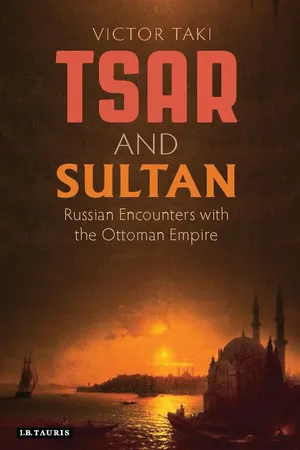
Tsar and Sultan offers a unique insight into Russian Orientalism as the intellectual force behind Russian-Ottoman encounters. Through war diaries and memoirs, accounts of captivity and diplomatic correspondences, Victor Taki's analysis of military documents demonstrates a crucial aspect of Russia's discovery of the Orient based on its rivalry with the Ottoman Empire. Narratives depicting the brutal realities of Russian-Turkish military conflicts influenced the Orientalisation of the Ottoman Empire. In turn, Russian identity was built as the counter-image to the demonised Turk. This book explains the significance of Russian Orientalism on Russian identity and national policies of westernisation. Students of both European and Middle East studies will appreciate Taki's unique approach to Russian-Turkish relations and their influence on Eurasian history.
Information
CHAPTER 1
AT THE THRESHOLD OF FELICITY
…and Sultan Bajazet himself, before whom Europe trembled, heard for the first time the haughty language of the Muscovite.1
On 16 February 1853, the Russian steam frigate Thunderer pulled to the wharf of Topkhana in Pera, the Christian-inhabited suburb of Constantinople located across the gulf of the Golden Horn from the Ottoman capital. The Russian war vessel carried the extraordinary and plenipotentiary envoy of Nicholas I, Prince A.S. Menshikov general-admiral, minister of the navy, governor-general of Finland and general-adjutant of the tsar.2 A great-grandson of Peter the Great's famous favourite and a personal friend of Nicholas I, His Serene Highness descended ashore accompanied by a suite of Russian dignitaries and the greetings of a crowd of Ottoman Greeks who gathered to watch his arrival. Met by the entire personnel of the Russian mission, Menshikov proceeded to the magnificent palace of the Russian embassy recently reconstructed after the great fire of 1845.3 In the words of the British chargé d'affaires in Constantinople Colonel Hugh Rose, ‘no expense or efforts have been spared for the purpose of imparting to the Russian Embassy all the advantages that accrue from personal influence, display and entertainment’.4 Nor did the Russian government neglect ‘to impart to [this Embassy] the most powerful of influences amongst Turks, intimidation’. A day or two thereafter, a second steam frigate arrived carrying the Commander of the Russian Black Sea Fleet Vice-Admiral V.A. Kornilov and the chief of staff of the Russian Fifth Army corps General A.A. Nepokoichitskii with other officers. As this naval and army top brass proceeded to inspect the Ottoman fortifications at the Dardanelles and Smyrna, the Russian troops were mobilized and moved to the frontier, while the Black Sea Fleet received the order to be ready to sail off from Odessa and Sevastopol.
The Russian envoy accompanied this ostentatious display of power and intimidation with symbolic gestures, by means of which he sought to reassert Russia's high standing in Constantinople that had deteriorated under his less commanding predecessors. Upon presenting his credentials, Menshikov paid his first visit to the Grand Vizier Mehmed Ali Pasha wearing civilian dress rather than his military uniform as expected. After the audience, the Russian envoy declined the invitation of the Ottoman ‘Introducer of the Ambassadors’, to call upon the minister of foreign affairs, Reis-effendi Fuad Pasha. Apprised of the latter's anti-Russian attitudes, Menshikov passed by the door of the reis-effendi's office that was opened to receive him and left the Porte. ‘The affront was the more galling’, wrote Rose, ‘because great preparations had been made for the purpose of receiving the Russian ambassador with marked honors; and a great concourse of people, particularly the Greeks, have assembled for the ceremony’.5
Historians unanimously denounced Menshikov's provocative behaviour as one of the factors that precipitated the Crimean War. His ostensible insolence may indeed appear to be the very opposite of modern diplomatic conduct. And yet the affronts of the Russian envoy at the ‘Threshold of Felicity’ were more than products of his personal eccentricities.6 Similar thrusts had been characteristic of the Russian–Ottoman diplomatic relations ever since their inception in the late fifteenth century. They served as symbolic expressions of tensions and antagonisms that existed between the two empires. Through them the ambassadorial ceremony became a field of struggle, no less important than the diplomatic negotiations around territories, fortresses, prisoners or war contributions.
The present chapter seeks to place the actions of the Russian envoys to Constantinople into the context of the Russian–Ottoman relations in the early modern period. Autocratic political cultures of Russia and the Ottoman Empire raised the importance of the diplomatic ritual and its contestation in the relations between the tsar and the sultan, as did their lack of a common language and the location of the two polities on the peripheries of the European state system.7 The desire of the Russian rulers to overcome their initial inferiority explains the early efforts of the tsarist envoys to assert their master's status vis-à-vis the sultan by means of constant disputes over and occasional violations of the Ottoman ambassadorial ceremony. The shift of the balance of power in Russia's favour during the 1700s aggravated the tensions around the diplomatic ritual. Whereas the tsarist diplomats tried to add ceremonial gains to the battlefield victories, their Ottoman counterparts sought symbolic compensations for the lost battles. The Russian eighteenth-century extraordinary embassies to Constantinople thereby became a continuation of the Russian–Ottoman wars by other means.
The chapter also examines the process of integration of the permanent Russian representatives in Constantinople into the diplomatic corps that had emerged in the Ottoman capital prior to the appointment of the tsar's first resident envoy in 1702. Like their relations with the Ottoman officials and the sultan, the interaction of the Russian diplomats with the envoys of European powers on the shores of the Bosphorus for a long time was influenced by considerations of honour and prestige. The Westernization of the Russian upper classes in the late seventeenth and eighteenth centuries made the European diplomats in Constantinople a reference group for the tsar's envoys to the sultan. In their customary contestations of the ambassadorial ceremony, the Russian representatives began taking into consideration the manner in which the sultans and grand viziers treated their Venetian, French, British or Habsburg counterparts. Ceremonial disputes with the Ottomans thereby became a means of asserting Russia's prestige among the European powers.
It will also be demonstrated that the integration of the Russian ministers into the diplomatic corps of Constantinople affected their perception of the Russian–Ottoman relations and led them to Orientalize the Ottoman diplomatic practices. The essence of this process consisted in re-describing the peculiar Ottoman manner of conducting foreign relations as a manifestation of the generic Orient. The latter represented a collection of clichéd images and vocabularies developed by Western Europeans with reference to Asian societies that they had encountered in the medieval and early modern periods. Russian elites borrowed these images and vocabularies together with other aspects of European culture during the eighteenth century. As the most Westernized segment of the tsarist elites, post-Petrine diplomats were the first Russians to attribute to the Ottoman Empire some of the ascribed qualities of the Orient, namely the total foreignness to the European notions and the inability to change. As will become clear in the concluding section of this chapter, the Orientalization of the Ottoman diplomatic ritual helped Russian diplomats to assert their own ‘European’ identity. It also occasioned the first Russian critique of the perceived discrepancy between the professed principles and actual practices of the European diplomats in the context of the Eastern Question.
The Muscovite Envoys
Historians of diplomacy argue that it performed three main functions: representation, negotiation and intelligence gathering.8 While all three have been present since the beginning of modern diplomacy in the fifteenth and sixteenth centuries, the relative importance of each varied depending on the period. Thus, negotiation required a well-developed communication system, a certain sophistication of political thought and, above all, the development of a special language. It could not therefore assume its full importance until relatively late in the early modern era. Intelligence gathering had to wait until the final establishment of the system of permanent diplomatic missions in the European capitals, which, for various reasons, did not occur until the second half of the seventeenth century. By contrast, the temporary embassies exchanged until the end of the eighteenth century were best suited for the function of representation. The richly dressed and often aristocratic ambassador with his big entourage embodied his royal master at a foreign court, whereby the ambassadorial audience assumed the aspect of the meeting of the two rulers. Therefore, the way he moved was as important as the words he spoke for the maintenance of his ruler's honour and status.
Taken in its representational aspect, the early modern diplomacy is essentially about the movement of human bodies and their relation to one another in space.9 The Renaissance arte dello stato, or a body of knowledge permitting the prince to maintain his or her state had relatively little in common with the eighteenth-century cameralist science of statecraft and still less so with modern political science focusing on institutions. Studies of early modern governmentality pioneered by Michel Foucault indicate the mastery of oneself as the starting point of the art of government.10 One of the key aspects of this mastery was the prince's control of his or her body in the sense of correct and imposing posture, poses, attitudes, gestures and movements. The self-disciplining dancing in the grand baroque court ballets helped the pudgy Louis XIV to assume the plenitude of authority.11 At a time when governance consisted substantially of the maintenance of the ruler's grand status among his or her subjects and vis-à-vis other rulers, the state was essentially an extension of the ruler's body, and so was the embassy.12
An early modern embassy was not only a form of embodiment, but also a spatial phenomenon that included three principal aspects. Apart from the royal audience, one can distinguish between the ceremony of the entry of the embassy into the foreign capital city and the journey that it had to make in order to reach its destination. Each of these stages – the journey, the entry procession and the court audience – has its peculiarities as a type of movement of bodies invested with intense symbolic significance. The embassy as journey accentuated the importance of the territory, of borders and of the political structure of the visited polity, which was enacted in the encounters of the ambassador and his suite with the local authorities and populations on their way to the capital. The embassy as entry procession was a political theatre in which the dispatching and the receiving side competed in the display of ostentation, grandness and orderliness, whereby the ambassadorial train functioned as an epitome of the polity that sent it, while their escorts did the same for the receiving side. Finally, the embassy as audience ceremony had the aspect of the meeting of the two rulers, one of which was represented by the ambassador. At all these stages, the importance of bodies moving collectively or individually was at least as great as the exchange of words, which tended to be formulaic and scarce.
Considered from this point of view, the history of the Russian–Ottoman relations during the sixteenth and the seventeenth centuries reveals a number of striking asymmetries. For one thing, the embassies that the Muscovite rulers dispatched to Constantinople are almost twice as numerous as the number of embassies sent by the sultans to Moscow.13 This numerical imbalance reveals that, for various reasons, the relations with the Ottoman sultans were of greater importance to the Muscovite tsars than vice versa, even though the initiative of establishing the relations belonged to Sultan Bayezid II.14 In this, they were not too different from the French, British or Habsburg rulers who in this period likewise dispatched largely unreciprocated diplomatic missions to the sultan's capital. This purely numerical correlation of the number of embassies undoubtedly reveals a more fundamental asymmetry between the self-presentation of the sultans and the Muscovite rulers. Whereas the Ottomans pretended to be ‘the abode of the rulers’ and the ‘refuge of the world’, to whom all other potentates were fundamentally vassals and tributaries, the grand dukes of Muscovy and later the tsars sought to assert their equal rank with the sultans, whom they addressed as ‘brothers’. For a long time, such incongruity of the claimed statuses reflected the real power balance between Muscovy and the Ottoman Empire, in which the latter was clearly the stronger one.15 It is noteworthy that the ambassadorial report of the first Ottoman ambassador to reach Moscow, Kamal (Kemal) Feodorit, did not initially contain the term ‘brotherhood’ with reference to the proposed amicable relations between Grand Duke Vasilii III and Sultan Selim I, which was introduced only at the insistence of the Muscovite side.16
As if recognizing the actual asymmetry of the Russian–Ottoman relations, the tsars made every effort to prevent the Crimean khans from serving as mediators in their relations with the Porte. In the conditions of the vassal relationship that existed between the Khanate and the Ottoman Empire since 1475, such mediation would only confirm the Russian ruler's inferiority to the sultan. The character of the Russian–Crimean relations presented an even greater problem. Unlike the Ottoman Empire that positioned itself as a continuation of the Seljuk sultanate, the Arab caliphate and Byzantium, the Crimean khans claimed the heritage of the Golden Horde, whose tributary Muscovy had been in the fourtheenth and fifteenth centuries. As the descendents of Genghis Khan, the Crimean Ghirays enjoyed the highest symbolic status in the world of Eurasian steppe politics. This status gave them the ground to demand the tribute that Muscovy used to pay to the Golden Horde until its dissolution at the end of the fifteenth century. The ‘gifts’ that the Russian rulers would send to the Crimea up until 1700 indeed resembled such a tribute.17 The quasi-tributary nature of Muscovy's relation to the Crimea finds another illustration in the fact that their diplomatic correspondence employed the term ‘tsar’, the Slavic equivalent of the Turkic ‘khan’, with reference to the khans of Crimea and not to the rulers of Muscovy.18 In view of the double asymmetry of the Crimean–Ottoman and Muscovite–Crimean relations, the Crimean mediation in the relations between the Russian tsars and the Ottoman sultans threatened to undermine the claim of the former to the eqaulity of status with the latter.
The disadvantageous balance of power along the Muscovite–Ottoman frontiers had direct consequences for the Russian embassies. Although better trodden than the road of the Ottoman envoys to Moscow, the path of the Russian ambassadors to Constantinople was full of challenges. To begin with, the ambassadors had to go through the lands of the Don cossacks. Although in the service of the tsars, the cossacks would not let the ambassadors pass promptly unless they received from the latter the tsar's salary (donskoi otpusk) and were ‘in friendship’ with Moscow at that particular moment. Next, the ambassadors had to make the transit between the cossack ‘capital’ Cherkassk and the Ottoman fortress of Azov. This could be more or less difficult depending upon whether the cossacks were at peace with the Ottomans or not, and this Moscow never totally controlled. Dealing with the Ottoman governor in Azov could be quite a challenge in itself. The ambassadors were provided with a special rescript as well as a gift of sable furs to smooth the passage. An especially greedy pasha delayed the embassy of A.I. Nesterov in 1667 for more than a month that passed in constant bickering over the amount and quality of the ambassador's gift vs. the number of horses and carts and/or ships that the pasha was ready to provide. Once on a ship and past the Kerch Strait that connects the Azov Sea with the Black Sea, the embassy's next likely stop was Caffa, where the local pasha could make some further delay pointing to the late season, the absence of seaworthy vessels and the necessity for the ambassadors to take the safer but much longer way through the Crimea, Edisan, Budjak, Moldavia, Wallachia and Rumelia.19 Even when the ambassadors insisted on taking the sea route (which they did most of the time in the sixteenth and seventeenth centuries), such a voyage could prove a big trial because of bad season, the difficulties of Black Sea navigation, poor vessels and the general aversion of the pre-Petrine Russians for naval explorations.
By contrast, the Ottoman envoys had a much greater advantage when travelling to Moscow. In this case they could take the land route which passed through the Ottoman-controlled territories along the Western and northern coast of the Black Sea, and after crossing the vassal Crimea, enter directly into the Muscovite domains. It is true, however, that the road could be as physically hard for the Ottomans as it was for the Muscovites. In fact, Kamal Feodorit, the first Ottoman envoy to reach Muscovy, nearly died of ‘winter fatigue’ in the steppe on his way to the Russian capital in 1514.20 The Ottoman embassies could also be attacked by the Don cossacks, who even killed the Ottoman ambassador Thomas Kantak...
Table of contents
- Front Cover
- Title Page
- Copyright
- Dedication
- Contents
- Acknowledgements
- List of Illustrations
- Introduction
- 1. At the Threshold of Felicity
- 2. Captivity Narratives
- 3. The ‘Turkish Campaigns’
- 4. ‘The Sick Man’
- 5. Peoples of Empire
- Conclusion
- Notes
- Bibliography
- Plates
Trusted by 375,005 students
Access to over 1.5 million titles for a fair monthly price.
Study more efficiently using our study tools.
Frequently asked questions
Yes, you can cancel anytime from the Subscription tab in your account settings on the Perlego website. Your subscription will stay active until the end of your current billing period. Learn how to cancel your subscription
No, books cannot be downloaded as external files, such as PDFs, for use outside of Perlego. However, you can download books within the Perlego app for offline reading on mobile or tablet. Learn how to download books offline
Perlego offers two plans: Essential and Complete
- Essential is ideal for learners and professionals who enjoy exploring a wide range of subjects. Access the Essential Library with 800,000+ trusted titles and best-sellers across business, personal growth, and the humanities. Includes unlimited reading time and Standard Read Aloud voice.
- Complete: Perfect for advanced learners and researchers needing full, unrestricted access. Unlock 1.5M+ books across hundreds of subjects, including academic and specialized titles. The Complete Plan also includes advanced features like Premium Read Aloud and Research Assistant.
We are an online textbook subscription service, where you can get access to an entire online library for less than the price of a single book per month. With over 1.5 million books across 990+ topics, we’ve got you covered! Learn about our mission
Look out for the read-aloud symbol on your next book to see if you can listen to it. The read-aloud tool reads text aloud for you, highlighting the text as it is being read. You can pause it, speed it up and slow it down. Learn more about Read Aloud
Yes! You can use the Perlego app on both iOS and Android devices to read anytime, anywhere — even offline. Perfect for commutes or when you’re on the go.
Please note we cannot support devices running on iOS 13 and Android 7 or earlier. Learn more about using the app
Please note we cannot support devices running on iOS 13 and Android 7 or earlier. Learn more about using the app
Yes, you can access Tsar and Sultan by Victor Taki in PDF and/or ePUB format, as well as other popular books in History & 19th Century History. We have over 1.5 million books available in our catalogue for you to explore.