eBook - ePub
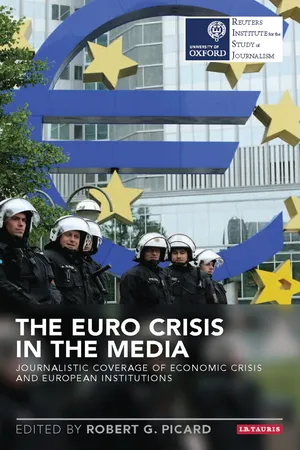
The Euro Crisis in the Media
Journalistic Coverage of Economic Crisis and European Institutions
- 320 pages
- English
- ePUB (mobile friendly)
- Available on iOS & Android
eBook - ePub
The Euro Crisis in the Media
Journalistic Coverage of Economic Crisis and European Institutions
About this book
The Euro Crisis produced the most significant challenge to European integration in 60 years testing the structures and powers of the European Union and the Eurozone and threatening the common currency. This book explores how the financial and political crisis was portrayed in the European press and the implications of that coverage on public understanding of the developments, their causes, responsibilities for addressing the crisis, the roles and effectiveness of European institutions, and the implications for European integration and identity. It addresses factors that shaped news and analysis, the roles of European leaders, and the extent to which national and pan-European debates over the crisis occurred. In doing so, it provides a clear and readable explanation of what the portrayals tell us about Europe and European integration in the early twenty-first century."
Information
1
Understanding the Crisis
Robert G. Picard
The euro crisis produced the most significant challenge to European integration in 60 years by testing the structures and powers of the European Union and the eurozone and by threatening the common currency. Although the crisis is identified by a singular term, it was actually a group of interrelated economic crises that exacerbated fundamental differences in the EU and called into question its governance and common identity. The financial and political emergency was shaped by financial problems in the banking sector, national fiscal policies, and sovereign debt incurred by eurozone nations. Although those short- and mid-term challenges have now been partially addressed, the European and the global economies are still enduring the longer-term effects of the events and political divisiveness created by the crisis. These were evident in the 2014 elections to the European Parliament in which opponents to a strong EU garnered notable support and gained significant voices in the Parliament.
European news coverage since the emergence of the crisis in 2008 has played a central role in shaping public perceptions of the crisis and public reactions to the responses of policy makers. It has created highly mediated portrayals of Europe, European institutions, EU members and the euro, and Europeanness itself. The lenses provided by news organisations across Europe affected public understanding of the developments, their causes, the responsibilities for addressing the crisis, and the roles and effectiveness of European institutions, and these portrayals have significant implications for European identity and integration.
Coverage of Europe and its institutions has been criticised as highly limited, elite oriented, and subordinate to national institutions and politics (Lloyd and Marconi, 2014; Meyer, 2005; Trenz, 2004). Assessing European news coverage presents particular challenges because European-wide news media effectively do not exist and coverage of European institutions and issues is refracted through the prisms of national media or English-language business papers and specialist journals that are read across borders. Europeans are thus provided with national frames from which news is constructed and perceived (Bryant and Oliver, 2008; Kopper, 2007; Scheufele and Tewksbury, 2007; Weaver, 2007). These national frames tend to emphasise domestic interests and address common European interests as secondary.
In doing so, news media rely on national leaders, symbols, and places in order to give an often inattentive audience some connection to the stories told. If it is true that all politics is local, so are all news media. Consequently, previous research has shown most coverage of Europe is routed through the perspectives of political and economic institutions of individual European member states (Adam, 2007; Gattermann, 2013; Machill et al., 2006; Trenz, 2004). The means and extent to which this coverage takes place is influenced by the national culture of journalism, so some media will do more than others in covering the EU and its institutions as a centre of power. There is some evidence that news has been somewhat more Europeanised in some media than in the past (Meyer, 2005; Peter et al., 2003).
The adequacy of the accounts news enterprises provide on major matters concerning citizens of Europe, how they attempt to make these interesting to a broad range of people, and how varied are the views on issues of the day, is crucial. The grand, enduring themes they convey about the EU and the European states are fundamental to understanding the development of the EU in the minds of its member states and citizens.
The analyses in this book address the challenges posed by news coverage of the euro crisis. They explore how the European press addressed those issues, and the implications of that coverage for understanding Europe, its institutions and relations within the EU between 2010 and 2012, and its future development. That period of time was selected for the analysis because it marked a period of intense European scrutiny, action, and discussion of the crisis that informed previous and subsequent policy.
The scope and scale of the crisis produced opportunities for it to be framed and interpreted in multiple ways across Europe and for those descriptions to compete for attention and acceptance by the public and policy makers. Multiple factors influenced that coverage, yet little comparative work has been undertaken to understand their influence on the press in different countries and ultimately the views of the crisis presented to the citizens of member states and Europe as a whole. Political and communication theory indicate that news coverage is shaped by opinions of domestic and international elites, leading news providers, and variations in national media systems and journalistic cultures. Such differences would be expected to produce differences in information and understanding of the crisis and perspectives on potential responses to the crisis across Europe. This book explores those factors and what the coverage tells us about perceptions of Europe and European institutions and the range, limits, and spheres of European political debate. It also addresses the adequacy of existing explanations for understanding the influences of media on public opinion and political action when multiple sovereign states and multinational governance are involved.
The central questions are how debates take place and are framed in the press and the extent to which domestic and European debate takes place.
What is the crisis about?
Before addressing the coverage, it is important that the context of the euro crisis be fully understood. The causes are complex, involving multiple European and national economic and political factors related to fiscal and monetary policies and structural abilities to influence those policies (Noord and Székely, 2011). Weakened banks and flawed banking systems, national sovereign debt and budgetary challenges, loss of confidence in government policy, and an emphasis on national rather than European political interests have all been shown to contribute to its development and response (Authers, 2012; Bastasin, 2012; Beblevý et al., 2011; Lapavitsas, 2012).
The proximate issues changed as the crisis unfolded and developed over time. In its initial stages, European banks and financial institutions suffered from the effects of generous domestic lending policies and then from the subprime mortgage crisis in the US because many had invested in derivatives of those mortgages. Local housing bubbles in countries such as Ireland or Spain only made the situation worse. This destabilised banks, leading to bank failures and weaknesses and – despite state support for banks and nationalisation of weak banks – credit became harder to obtain, leading to a decline in production and consumption that pushed Europe into a recession. The national economies of a number of southern European countries soon became the focus of the crisis because the recession reduced governmental income and they lost the ability to service sovereign debt that had grown because they had fiscal policies that spent public funds well in excess of state revenues. Sovereign debt is money borrowed by countries, often to pay for construction of infrastructures and public buildings, but also to pay for government costs when tax revenues do not provide sufficient income. Southern European states had essentially expended all their abilities to borrow funds and could not maintain their existing budgets and debt structure.
States can use monetary policies to ameliorate the effects of such debt and revenue challenges by devaluing their currencies. This was not possible during the crisis because Greece, Italy, and Spain – the three largest countries with sovereign debt issues – had all adopted the euro. As they could not control monetary policy for the euro because it was used in 18 eurozone countries, the nations with sovereign debt issues were denied a traditional mechanism through which a state can influence its economy. The problems of the countries with sovereign debt issues did not remain in those countries, but spilled over to the entire eurozone, reducing global confidence in the euro currency, decreasing its exchange value, and pushing the economic effects onto other countries that used the euro but whose fiscal policies were more conservative.
Fundamental questions about the nature of the crisis existed during the crisis and remain salient today. It was debated whether the crisis was driven by externally economic and financial causes, national policies, the currency, structural conditions of the EU, or other factors. Even the beginning point of the crisis remains obscure because of contested views on its cause(s). Some argue it began with subprime mortgages in the US, housing bubbles in a number of countries, weak banking regulation, sovereign debt, government manipulation of economic data, and other factors. This volume is not intended to definitively answer those questions, but rather to reveal how news coverage in European nations addressed such competing interpretative frames and the implications for public opinion, and what public responses they suggested to the crisis.
Who are the players and what do they do?
The effects of the developments brought a number of European institutions into play, notably the European Commission and the European Central Bank (ECB), and it induced major eurozone countries to take action to protect the euro and their own economies and to stabilise the countries with sovereign debt issues through loans and compulsory introduction of austerity measures. A wide variety of institutions and individuals came to play roles in the crisis. Most had official positions, but some thrust themselves or were thrust into leadership positions addressing the crisis even when they were not institutionally placed to do so. Understanding their roles is fundamental in comprehending the news coverage of the crisis and its impact.
National governments played an important role in responding to the crisis, but most of the response was initially at the executive level, which then pushed parliaments to accept and implement policy responses. The European Commission, the executive of the EU, struggled to find a way to react because it had never faced such a significant challenge, lacked many powers of executive branches in member states, and its leadership was constrained.
National central banks and the ECB were active in the crisis. Central banks are national institutions that manage a country’s currency, money supply based on the nation’s monetary policy, and interest rates, and supervise the reserves and support liquidity of retail and commercial banks operating in the country. The powers of central banks of countries with the euro as their currency are limited because they cannot control monetary policy at the domestic level, even though they still have significant regulatory and interest rate influences. The ECB is an institution of the EU that acts as the central bank for the euro and implements monetary policy across states that use the euro as their currency. The bank operates independently of the EU institutions and national governments. The ECB traditionally supported states in the eurozone with collateralised loans to their central banks, but it had to respond to the crisis to shore up the euro and began making purchases of national government bonds to do so.
The International Monetary Fund (IMF) responded to the crisis to help stabilise national economies. The IMF is an intergovernmental organisation that works to create financial stability, improve economic conditions worldwide, and promote trade. It provides funding to finance balance of trade payments and to alleviate national economic crunches. During the euro crisis, it supported national governments by lending to governments with debt problems and other governments whose economies were affected by the crisis.
Private financial institutions holding governmental debt played significant roles relative to the countries with high sovereign debt. These institutions – banks, investment funds, and so on – purchase governmental bonds from national governments at specified rates of return, effectively lending money to governments to carry out projects and operations. They expect to make a profit on the activity and the amount is based on the degree of risk and return expected. Government bonds for European countries have traditionally been relatively safe investments. During the crisis, these financial institutions suffered from the subprime mortgage crisis, the banking crisis, and the recession, which led them to be highly demanding in dealings with governments that owed them money.
During the initial bank-related aspects of the crisis, domestic prime ministers and central bank leaders played significant roles. The response to the sovereign debt aspects of the crisis differed, however. Because of the lack of strong leadership in the European Commission, several European leaders – notably the Chancellor of Germany and the President of France – became de facto European leaders in attempting to resolve the sovereign debt and they aligned with bankers to force change in the nations with debt and budget deficit issues.
A variety of options for addressing the sovereign debt and budget deficits existed. In simplest terms, three approaches could be taken: austerity policies, economic growth policies, or a combination. Austerity involved profoundly cutting government expenditures – including social services – to balance budgets and reforming labour policies and structures. Growth policies would involve expenditures designed to spur economic development. The leaders responding to the crisis and bankers chose the first, which stabilised the euro and their national economies, but sacrificed the national economies of the nations with debt problems and pushed them deeper into recession with high unemployment and few social benefits for citizens.
Major developments in the crisis
The 28 member states of the EU were affected differently and in varying time frames by the crisis. Some were intimately involved; some only peripherally. Some faced domestic economic emergencies; for others it was an external issue. Some were involved in creating solutions; others were not. Two-thirds of the members used the euro; one-third did not. Nevertheless, all countries felt some economic and political effects.
The major developm...
Table of contents
- Halftitle
- Editorial
- Title Page
- Copyright Page
- Contents
- Tables and Figures
- Contributors
- 1. Understanding the Crisis
- Part I National and European Discourses
- Part II Characterisations and Interpretations
- Part III Influences on Coverage
- Part IV Where is the Coverage Taking Europe?
- Notes
- Bibliography
- Appendix 1: Description of Methods
- Appendix 2: List of Variables
Trusted by 375,005 students
Access to over 1.5 million titles for a fair monthly price.
Study more efficiently using our study tools.
Frequently asked questions
Yes, you can cancel anytime from the Subscription tab in your account settings on the Perlego website. Your subscription will stay active until the end of your current billing period. Learn how to cancel your subscription
No, books cannot be downloaded as external files, such as PDFs, for use outside of Perlego. However, you can download books within the Perlego app for offline reading on mobile or tablet. Learn how to download books offline
We are an online textbook subscription service, where you can get access to an entire online library for less than the price of a single book per month. With over 1.5 million books across 990+ topics, we’ve got you covered! Learn about our mission
Look out for the read-aloud symbol on your next book to see if you can listen to it. The read-aloud tool reads text aloud for you, highlighting the text as it is being read. You can pause it, speed it up and slow it down. Learn more about Read Aloud
Yes! You can use the Perlego app on both iOS and Android devices to read anytime, anywhere — even offline. Perfect for commutes or when you’re on the go.
Please note we cannot support devices running on iOS 13 and Android 7 or earlier. Learn more about using the app
Please note we cannot support devices running on iOS 13 and Android 7 or earlier. Learn more about using the app
Yes, you can access The Euro Crisis in the Media by Robert G. Picard in PDF and/or ePUB format, as well as other popular books in Economics & Economic Policy. We have over 1.5 million books available in our catalogue for you to explore.