- 320 pages
- English
- ePUB (mobile friendly)
- Available on iOS & Android
eBook - ePub
About this book
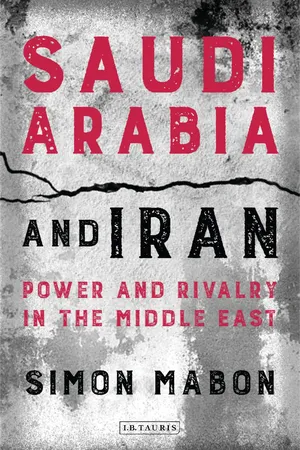
In the wake of the 1979 Iranian revolution, relations between states in the Middle East were reconfigured and reassessed overnight. Amongst the most-affected was the relationship between Iran and Saudi Arabia. The existence of a new regime in Tehran led to increasingly vitriolic confrontations between these two states, often manifesting themselves in the conflicts across the region, such as those in Lebanon and Iraq, and more recently in Bahrain and Syria. In order to shed light upon this rivalry, Simon Mabon examines the different identity groups within Saudi Arabia and Iran (made up of various religions, ethnicities and tribal groupings), proposing that internal insecurity has an enormous impact on the wider ideological and geopolitical competition between the two. With analysis of this heated and often uneasy relationship and its impact on the wider Middle East, this book is vital for those researching international relations and diplomacy in the region.
Information
1
THE MIDDLE EAST IN INTERNATIONAL RELATIONS
“First say to yourself what you would be; and then do what you have to do.”
Epictetus
The field of International Relations (IR) is concerned with explaining the interaction of actors, operating at state, sub-state and trans-state levels. As the late Fred Halliday notes, “the task of social science, IR included is [. . .] namely to explain, in as persuasive a manner as possible, what has occurred and to identify what constitute significant contemporary trends” within the discipline.1 The heterogeneous theories of IR suggest that the behaviour of a state is determined by various factors ranging from security concerns to state institutions, from identity to the construction of the international system.
This book examines the impact of identity incongruence upon regional security across the Middle East, with a particular focus upon the rivalry between Saudi Arabia and Iran after the Iranian revolution of 1979. The phrase identity incongruence stems from the work of Raymond Hinnebusch, who articulates incongruence between identity and territory;2 however, this book expands upon the idea of identity incongruence to include tensions between states and national identities, sub-and trans-state identities, and to consider the ensuing problems of legitimacy. The notion of identity incongruence is often overlooked when considering the Middle East; it is not possible to fully understand the nuances of Middle Eastern politics without understanding the true essence of identity groups and, thus, identity incongruence. Indeed, there are very few states within the Middle East that do not possess a degree of identity incongruence, which challenges the notion of a coherent nation-state that underpins several approaches to IR. When the level of identity incongruence challenges the sovereignty of a state, either territorially or ideologically, and necessitates a response from the ruling elite, then identity incongruence results in an internal security dilemma. The nature of this response, in turn, can impact upon the regional security environment, given both a shared normative environment and the incongruence of identity and territory. Thus, understanding identity incongruence can explain the impact that internal dynamics have upon external relations, namely in the form of an internal-external security dilemma.
Given the pervasive nature of conflict and the prominent role played by identity within the Middle East, the book focuses upon security, building upon three of the five security issues articulated by Barry Buzan,3 notably military, political, and societal, leaving examination of economic and environmental security issues to other scholars. These three understandings of security are the focus of the work, due to the prominent role played by identity within each conception of security, and it is through analysing the impact of identity incongruence that the work explains the nature of the rivalry. In undertaking this task, the book draws predominantly upon the modified Realism of Hinnebusch and the Constructivism of Michael Barnett,4 seeking to offer a new framework for analysing Middle Eastern IR and broadening understandings of security.
Within each state are a plethora of identities, several of which are conflicting in nature; indeed, national identities are often challenged by different ethnic, tribal or religious identities. Given the existence of myriad identities within the region, it is irrefutable that these identities will impact both upon internal stability and relations and competition between states. Nevertheless, analysis of the influence of these identities has been hitherto scant, particularly with regard to the impact that identity has upon the relationship between Saudi Arabia and Iran. Despite the importance of identities across the region, literature examining Middle Eastern security has predominantly been focussed upon hard power calculations.
In contrast, this book concentrates upon how competing identities within Saudi Arabia and Iran have impacted upon relations between the two states, specifically how the state’s response to internal challenges, stemming from identity incongruence, has complicated the rivalry. It suggests that the state’s response to identity incongruence has ramifications for regional security, in an internal-external security dilemma, where the external security dilemma occurs in the guise of a soft power security dilemma. The move from the internal to the external is referred to as “the Incongruence Dilemma”.5
The Middle East in International Relations Theory
Much has been written on IR theory, with recent work seeking to resolve ontological and epistemological disputes both within and across theories. However, very few scholars have applied IR theory to the Middle East. Those scholars who have undertaken such a task include luminaries such as Anoushiravan Ehteshami, Raymond Hinnebusch and Fred Halliday.6 Many of the applications of IR theory to the Middle East apply Realist approaches to the region, yet adopting a singular position belies the complexity of the region and fails to appreciate the importance of identity.
The existing literature examining the IR of Middle Eastern states attempts to bridge the gap between the theoretical world of IR and the empirical world of regional studies in order to provide a comprehensive analytical framework for examining the IR of the Middle East. While recent work in IR has employed Sociological or Constructivist approaches, it is beneficial to begin analysis with one of the more celebrated yet contested theories of IR.
The Realist Tradition
The main starting point for most IR scholars is Realism, which, although as a theory contains numerous different interpretations, is predominantly concerned with power.
Numerous authors have contributed to the theory of Classical Realism, notably Edward Hallett Carr7 and Hans Morgenthau.8 For the Classical Realist, the main unit of analysis is the state,9 which is taken to be a rational actor and the main driving factor within IR is the state’s pursuit of interests, defined as power. Understanding interest as power provides continuity for analysing different actors,10 and circumvents problems of defining national interest.
Carr’s 1939 work, The Twenty Years’ Crisis, offers a damning critique of liberal utopianism, which had prevailed post World War One. Carr suggests that one should be more concerned with how the world is, than how it ought to be.11 At the heart of Carr’s work is a concern with the notion of scarcity, the ensuing conflict between the haves and have-nots and a desire to maintain the status-quo of the haves.
Morgenthau’s Politics Among Nations: The Struggle for Power and Peace extrapolates on Carr’s ideas, offering a theoretical development of Classical Realism. Morgenthau articulates how different accounts of world politics demonstrate a dispute between two schools who:
differ fundamentally in their conceptions of the nature of man, society, and politics. One believes that a rational and moral political order, derived from universally valid abstract principles, can be achieved here and now. It assumes the essential goodness and infinite malleability of human nature [. . .] It trusts in education, reform, and the sporadic use of force to remedy these defects. The other school believes that the world, imperfect as it is from the rational point of view, is the result of forces inherent in human nature.12
For Morgenthau, “politics, like society in general, is governed by objective laws that have their roots in human nature”.13 Indeed, for Morgenthau, this Realist tradition can be traced back through history, notably in the work of Sun Tzu, Thucydides, Machiavelli and Hobbes.
While Morgenthau’s work is compelling, there are several criticisms that must be noted. Firstly, Morgenthau holds the state as a unitary actor, ignoring internal dynamics and ideology. Secondly, Marxists contend that Realism is concerned with a reproduction of capitalist relations of production and that the theory lacks engagement with the impact of economic factors upon foreign policy. Lastly, post-modernists reject claims of objectivity. This book builds upon the first criticism, of the state as a unitary actor, seeking to unpack this notion and give credence to the competing identity groups existing within the state. The argument also addresses aspects of the post-modernist criticism, accepting that while there are objective and verifiable facts, often narratives and events within the Middle East are contestable.
Kenneth Waltz’s 1979 work, A Theory of International Politics,14 introduces Neo-Realism, also known as Structural Realism, as a theory that examines the relationship between the states and the international system. In contrast to Classical Realism, Neo-Realism focusses upon the nature of the international system, rather than the nature of states. The international system Waltz describes is a trans-historic, anarchic system within which states are free from the threat of coercion from a higher rule. Accordingly, the international system is governed by security concerns, defined by the distribution of power within. States are again held to be unitary actors who behave in a rational way, seeking to maximise their own security; the international system is one of self-help, wherein states are required to guarantee their own security.
Waltz argues that security is preserved through a balance of power, which holds that states counter threats facing them, with the aim of introducing parity into a relationship. A further way states can improve their security is through bandwagoning, particularly relevant to weaker states, who struggle to counter threats through a balance of power. Thus, weaker states can bandwagon with the stronger states or coalitions who can guarantee their security; consequently, alliances are born.15
While Neo-Realism revitalised the Realist tradition, it does incite several serious criticisms,16 in particular stemming from its state-centric approach. Waltz rejects the idea of reducing examination of the international system to anything beyond the state level, arguing that by doing so one encourages a proliferation of variables. Yet, in undertaking analysis based on a state-centric position, Waltz’s theory ignores much of the context needed to truly understand the IR of the Middle East.17
Furthermore, the Neo-Realist rejects the impact of trans-state ideologies, which seems counter-intuitive, as Pan-Arabism pervaded Middle Eastern states throughout the 1960s. Pan-Arabism greatly influenced the behaviour of Arab states, which can be seen with regard to the 1967 War with Israel. However, a counter argument to this suggests that Arab leaders, motivated by self-interest and a desire to maintain internal and external legitimacy, led to what Michael Barnett refers to as the symbolic dance to war.18 Indeed Barnett suggests that the 1967 War was a result of symbolic competition rather than of Pan-Arabism.19
Additionally, given the security-dominated paradigm of Neo-Realism, alliance building should have pervaded the region, yet no Middle Eastern state has formally allied itself with Israel, arguably the dominant military power in the region. This appears to suggest that adopting a theory grounded purely in power politics is counter-intuitive, further, that ideological imperatives must, to a certain degree, govern a state’s behaviour. However, it is possible that alliance formation across the region may occur through the medium of covert diplomacy. This suggestion has been supported by the release of WikiLeaks cables that allege Israel is engaging in dialogue with the United Arab Emirates, despite not possessing official diplomatic ties.20 Further, Waltz’s assertion that the international system is ahistoric poses problems. The Neo-Realist holds that the international system has remained constant since the time of Thucydides,21 an assertion that seems questionable, given the evolution of the state, of economics and of military affairs.
A more contemporary aspect of the Realist tradition is an attempt to fuse the Classical and Neo-Realist positions in what has been termed “Neo-Classical Realism” by Gideon Rose.22 Neo-Classical Realism seeks to fuse both internal and external dynamics, with Rose suggesting that:
[T]he scope and ambition of a country’s foreign policy is driven first and foremost by its place in the international system and specifically by its relative material power capabilities [. . .] the impact of such power capabilities on foreign policy is indirect and complex, because systemic pressures must be translated through intervening variables at the unit level.23
While Neo-Classical Realism appears to combine the best aspects of both Classical and Neo-Realism, it fails to adequately address the focus upon material understandings of power and of ideologies.
Constructivism
One response to the ontological and epistemological claims made by the various Realist po...
Table of contents
- Cover
- Title
- Copyright
- Dedication
- Contents
- Preface to the Paperback Edition
- Acknowledgements
- Maps
- Introduction
- 1. The Middle East in International Relations
- 2. Arabian Gulf vs Persian Gulf
- 3. History, Politics and Narratives of State-Building
- 4. Religious Incongruence
- 5. Ethno-Tribal Incongruence
- 6. The Response of the State
- 7. Internal-External Security Dilemmas
- Conclusions
- Notes
- Bibliography
Trusted by 375,005 students
Access to over 1.5 million titles for a fair monthly price.
Study more efficiently using our study tools.
Frequently asked questions
Yes, you can cancel anytime from the Subscription tab in your account settings on the Perlego website. Your subscription will stay active until the end of your current billing period. Learn how to cancel your subscription
No, books cannot be downloaded as external files, such as PDFs, for use outside of Perlego. However, you can download books within the Perlego app for offline reading on mobile or tablet. Learn how to download books offline
We are an online textbook subscription service, where you can get access to an entire online library for less than the price of a single book per month. With over 1.5 million books across 990+ topics, we’ve got you covered! Learn about our mission
Look out for the read-aloud symbol on your next book to see if you can listen to it. The read-aloud tool reads text aloud for you, highlighting the text as it is being read. You can pause it, speed it up and slow it down. Learn more about Read Aloud
Yes! You can use the Perlego app on both iOS and Android devices to read anytime, anywhere — even offline. Perfect for commutes or when you’re on the go.
Please note we cannot support devices running on iOS 13 and Android 7 or earlier. Learn more about using the app
Please note we cannot support devices running on iOS 13 and Android 7 or earlier. Learn more about using the app
Yes, you can access Saudi Arabia and Iran by Simon Mabon in PDF and/or ePUB format, as well as other popular books in History & Middle Eastern History. We have over 1.5 million books available in our catalogue for you to explore.