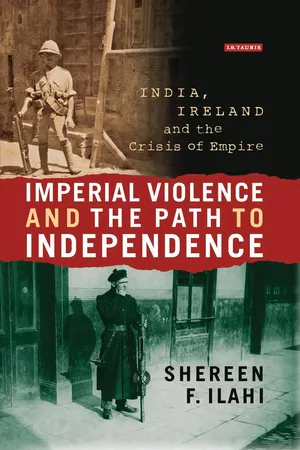
eBook - ePub
Imperial Violence and the Path to Independence
India, Ireland and the Crisis of Empire
- 272 pages
- English
- ePUB (mobile friendly)
- Available on iOS & Android
eBook - ePub
About this book
In the aftermath of World War I, the British Empire was hit by two different crises on opposite sides of the world--the Jallianwala Bagh, or Amritsar, Massacre in the Punjab and the Croke Park Massacre, the first 'Bloody Sunday', in Ireland. This book provides a study at the cutting edge of British imperial historiography, concentrating on British imperial violence and the concept of collective punishment. This was the 'crisis of empire' following the political and ideological watershed of World War I. The British Empire had reached its greatest geographical extent, appeared powerful, liberal, humane and broadly sympathetic to gradual progress to responsible self-government. Yet the empire was faced with existential threats to its survival with demands for decolonisation, especially in India and Ireland, growing anti-imperialism at home, virtual bankruptcy and domestic social and economic unrest. Providing an original and closely-researched analysis of imperial violence in the aftermath of World War I, this book will be essential reading for historians of empire, South Asia and Ireland.
Information
CHAPTER 1
PUNJAB ‘DISTURBANCES’
On 20 August 1917, Secretary of State for India, Edwin Montagu, declared that the government would, upon war's end, unveil a plan for ‘increasing association of Indians in every branch of the administration and the gradual development of self-governing institutions with a view to the progressive realization of responsible government in India as an integral part of the British Empire’. British despotism seemed near its end with, ‘the most momentous utterance ever made in India's chequered history’ that ‘marks the end of one epoch and the beginning of a new one’.1 This declaration, combined with Wilsonian rhetoric about the right of all peoples to self-determination, raised the expectations of Indian nationalists for self-government when the war ended.
However, while Europe celebrated the end of the Great War and began peace deliberations in Paris, the British governing India worried about the expiration of their wartime emergency powers of surveillance and arrest.2 In March 1919, the raj passed the Anarchical and Revolutionary Crimes Acts, more commonly referred to as the Rowlatt Acts (named after their architect, Justice Sir Sidney Rowlatt), to continue those extraordinary powers into peacetime. British administrators feared, among other things, that Pan-Islamism might infect Indian Muslims who felt sore over the Ottoman Empire's defeat. The Rowlatt Acts intended to combat enemy forces, whether within India or outside of it, planning a violent overthrow of British rule. Some British newspapers condemned the passage of the Acts as counter to Montagu's wartime promise. One equated these laws to ‘giving scorpions to hungry children who were promised food’.3 India sacrificed a lot for the war effort and expected greater self-government in return, so the government's behaviour appeared hypocritical, ‘talking reforms but practicing coercion’.4 A left-leaning paper hoped for the repeal of ‘all this pernicious legislation’ and for India to receive ‘the very fullest right of Free Speech, Free Press, and – greatest of all – the right of self-determination, on behalf of which so many sons of India fought and died in Europe and Asia’.5 The Westminster Gazette presciently warned that the Rowlatt Acts repeated in India the mistakes made in Ireland during the war: ‘coupling the promise of Home Rule with the threat of Conscription’.6
But incidents both before and during the war heightened British fears of a revolt, which made the Rowlatt Acts feel necessary to some. In 1912, a Bengali revolutionary attempted to assassinate the viceroy, Lord Charles Hardinge, in Delhi on the day the city formally replaced Calcutta as the capital.7 Since the 1905 partition of Bengal during Lord Curzon's viceroyalty, many young, male, urban-elite revolutionaries from the three dominant Hindu castes in Bengal, the bhadralok (‘respectable people’), became anti-British bomb-throwers and assassins. Their efforts to win independence resulted in some 14 ‘terrorist’ acts in 1914 Bengal, and 36 the following year before declining steadily over the next three years.8 This partly inspired the Ghadr Party, a revolutionary association founded in 1913 by Lala Har Dayal, comprised mostly of Punjabi Sikhs living in San Francisco and committed to the violent overthrow of the British raj.9 When the Great War started, many of them returned to Punjab and attempted a rising in February 1915, unsuccessfully. The party encouraged disaffection among Sikh soldiers in the Indian Army and planned to mutiny until its demise in August 1915. The raj uncovered other plots such as the Silk Letter conspiracy in the summer of 1916. The British caught a messenger in the Punjab with letters written in Persian on silk sewn inside his clothes. He intended to deliver these letters from a former teacher at the Muslim Deobandi School, Obeidullah Sindhi, who now called himself the Home Minister for a provisional, independent Indian government in exile in Kabul, Afghanistan. Obeidullah wanted to attack the raj with Afghani and Indian troops, buttressed by a fifth column of Indian Muslims.10 Although these half-baked conspiracies represented only a fraction of Indian Muslim opinion, they fuelled British paranoia and provided justification for the Rowlatt Acts.
The government not only contended with the threat of violent revolutionaries, but also worried about Hindu-Muslim unity developing into a mass movement against the empire. Just after the war, the Khilafat Movement, which called for the retention of the Turkish Sultan as Caliph of the Muslim world, witnessed an unprecedented coalition of Hindus and Muslims. Indian Muslims united against the postwar treatment of the Ottoman Empire, and, by 1920, joined with Gandhi and other leaders of the Indian National Congress Party as part of the Non-cooperation Movement of peaceful, civil disobedience meant to resist British rule.11 British authorities felt scared by these developments, along with new calls for self-determination by some ‘extreme’ Indian nationalists who invoked Wilsonian rhetoric after the war.12 Mohammad Ali Jinnah's speech in December 1916 to the All-India Muslim League summed up the situation well:
We have a powerful and efficient Bureaucracy of British officers responsible only to the British Parliament, governing, with methods known as benevolent despotism, a people that have grown fully conscious of their destiny and are peacefully struggling for political freedom.13
But even peaceful nationalism worried British officials who proved willing to resort to harsh, punitive methods rather than end their ostensibly ‘benevolent despotism’.
The inhabitants of Punjab ran the gamut from moderate nationalists to violent extremists, and recent developments convinced British officials of the necessity of the Rowlatt Acts. Like the rest of India, Punjab suffered hardships during the Great War which continued unrelieved in the war's aftermath. Not only were some 60,000 Indian soldiers killed while fighting for Britain, but also the war resulted in unprecedented inflation in the province, during which time the price of wheat jumped by 47 per cent, the price of cotton more than tripled, sugar cost 68 per cent more and the price of food grains nearly doubled.14 Punjab's population of 20 million, over half of whom were Muslim, a third Hindu and the rest Sikhs, endured these difficulties.15 Although the government interceded by seizing wheat from merchants and selling it at a lower price, the poor still suffered.16 Meanwhile, India exported tonnes of food to the military.
The economic impact of the war certainly created more disaffected Punjabis. Indian defence spending jumped by 300 per cent, thereby resulting in taxation hikes and mass printing of currency. From 1918 to 1919, taxes increased 30 per cent in Lahore alone, the capital city of Punjab, and by 55 per cent in Amritsar.17 Wages remained stagnant as the cost of living rose. Rural Punjabis suffered from high debt as well as the international flu epidemic of 1918 that killed 5 million Indians across the subcontinent and which, in the Punjab, was made worse by a malaria epidemic the same year. This was aggravated by particularly bad harvests just after the war.18 Unsurprisingly, in 1918 and 1919, Punjab witnessed frequent looting and food robberies which frightened British officials. Their fears were compounded by the constant threat of Bolshevism and severe labour unrest at home, as well as by the beginning of an all-out guerilla war in Ireland.19 They therefore failed to take adequate note that the vast majority of Indians remained loyal during the war. After all, even Gandhi had recruited Indian soldiers to fight in Europe.
The Indian elections of January 1919, the same month and year as the beginning of the Anglo-Irish War, also heightened tensions in Punjab. In particular, the introduction of a reserved seating system for minorities (for example, reserving three seats for Sikhs in municipal elections) upset many Hindus who, as a group, would have performed better without such a reservation. Anxieties worsened as candidates for office hired ‘hooligans to intimidate the voters’.20 British residents felt unsafe among the upheaval, especially with the increasing number of demobilized soldiers.21 So, the authorities turned to coercion, as embodied in the Rowlatt Acts.22
The experience of unrest during the war years taught many British officials the importance of dealing quickly and harshly with any outbreak of rebellion. The Rowlatt Acts allowed Indians to be tried without a lawyer, without the right of appeal and without a jury. Courts could sit in camera and use evidence that would otherwise be inadmissible under normal circumstances. Not only did suspects have to put up a bond for good behaviour and keep their home address on file with the police, but they also could be arrested and searched without a warrant, and confined without trial for up to a year, renewably.23
Although defended by Punjab's Lt. Gov. Michael O'Dwyer as ‘a reasonable and practical measure intended to take the place of the Defence of India Act, but much less drastic in its provisions’, the harshness of the Rowlatt Acts made little sense to most Indian nationalists and to some British Liberals.24 Surely, Indian loyalty and sacrifices during the war deserved better. More importantly, these acts betrayed the regime's intentions toward eventual Indian self-government and they directly inspired Gandhi to start the satyagraha (soul force) peaceful resistance movement. Montagu privately expressed his disapproval of the Rowlatt Acts. He felt implementing them was ‘moving in a vicious circle’ rather than preventing crime. The repressive legislation would ‘bring recruits to the revolutionary party’. After all, he explained, ‘If you are humiliating, irritating, antagonising, law-abiding citizens, they or their friends or their admirers are very likely to join the ranks of those people whom you have got to watch, and that this goes on seems to me to be indisputable’.25 Ironically, the martial law regime that would take the place of the Rowlatt Acts engaged in this kind of behaviour far more than Montagu could have imagined.
To make matters worse for tough-minded administrators in India, it remained unclear how the Montagu-Chelmsford (Montford) reforms might affect Britain's control over its subjects, especially since most Indians appeared rather ungrateful for them. Montagu thought he offered India a great deal given Britain's imperial interests, and expected disappointment only from extremists:
Being both convinced that the main defect in the existing system was the fact that it denied responsibility to Indians, and being equally convinced that the time was not ripe for complete self-government, we speedily realized that the problem was to find some way of giving responsibility in certain matters while reserving it in others, and to provide some means of periodically and deliberately enlarging the sphere made over to responsible control […] the provinces were the right areas in which to begin progressive realization of responsible government. Anything smaller was too small […] I am hopeful of receiving considerable support from sober and moderate [Indian] men. No scheme which the British Government could bring before Parliament could satisfy those who are radically opposed to British rule, whose hostility must therefore in any case be expected. 26
‘Sober and moderate’ Indians should understand, he thought, the impossibility of giving India anything more than dyarchy, a system of power-sharing. But the majority of Indian nationalists found the Montford reforms of 1919 wanting.27 Britain limited Indian power sharing to the provincial level. The more important areas of revenue, finance, law and order were reserved for British officials responsible only to the provincial lieutenant governor. Even so, hardline imperialists, including O'Dwyer, felt disgusted by the reforms, as if the government gave too much power away.
Viceroy Chelmsford, on the other hand, defended the reforms he and Montagu hoped to implement. Strikingly, when explaining the logic behind Montford, he compared the situation to Ireland:
Now let me briefly put what has been the governing motive with me. I have had constantly before my mind the precedent of Ireland. I suppose that one of our chief difficulties in Ireland has been the hostility of the Roman Catholic priesthood. In the days when we might have won their sympathy and cooperation we neglected and estranged them. Is not something of the same sort possible in India with the educated Indian? They are both a small minority in the midst of the population, but they both possess unlimited power of influencing an ignorant people for harm.28
Clearly, both Chelmsford and Montagu underestimated Indian disappointment with dyarchy, but both believed in the necessity of not further alienating middle-class Indian opinion. They learned from Ireland what could happen if concessions were not made before the entire population became disaffected.
Michael O'Dwyer
Sir Michael O'Dwyer was born 28 April 1864, the sixth son of John O'Dwyer, a Catholic landowner in Barronstown, County Tipperary, in Southern Ireland. He attended St. Stanislaus College in Tullamore (central Ireland) until 1882 when he won admission to Balliol College, Oxford, with the aim of joining the Indian Civil Service (ICS). Sir Michael was proud of his Irish lineage, which he traced back 400 years. He was prouder still of his ancestors' dogged resistance to British imperial expansion into their lands, however futile. He regretted ‘the tragic course of events’ that transpired between Britain and Ireland, preferring the constitutional opportunity for Home Rule in the 1880s and in the early years of the Great War to the violent war for Irish independence which took place only a few years later.29
O'Dwyer's formative years in Ireland coincided with a turbulent period in Irish history. The 1870–80s witnessed the Home Rule movement, steep economic decline and a fierce land war in which the demand for fixity of land tenure and reduction of rents connected with revolutionary leaders. Soaring evictions of tenant farmers too poor to pay exorbitant rents resulted in violent retaliation against landlords.30 O'Dwyer's family estate experienced some of this rural agitation and, in 1882,...
Table of contents
- Front Cover
- Title Page
- Copyright
- Map
- Contents
- List of Plates
- Selected Chronology
- Introduction
- 1. Punjab ‘Disturbances’
- 2. Inquiry, Reactions and the Principle of Minimum Force
- 3. The Anglo-Irish War
- Conclusion
- Notes
- Bibliography
- Plates
- Back cover
Trusted by 375,005 students
Access to over 1.5 million titles for a fair monthly price.
Study more efficiently using our study tools.
Frequently asked questions
Yes, you can cancel anytime from the Subscription tab in your account settings on the Perlego website. Your subscription will stay active until the end of your current billing period. Learn how to cancel your subscription
No, books cannot be downloaded as external files, such as PDFs, for use outside of Perlego. However, you can download books within the Perlego app for offline reading on mobile or tablet. Learn how to download books offline
Perlego offers two plans: Essential and Complete
- Essential is ideal for learners and professionals who enjoy exploring a wide range of subjects. Access the Essential Library with 800,000+ trusted titles and best-sellers across business, personal growth, and the humanities. Includes unlimited reading time and Standard Read Aloud voice.
- Complete: Perfect for advanced learners and researchers needing full, unrestricted access. Unlock 1.5M+ books across hundreds of subjects, including academic and specialized titles. The Complete Plan also includes advanced features like Premium Read Aloud and Research Assistant.
We are an online textbook subscription service, where you can get access to an entire online library for less than the price of a single book per month. With over 1.5 million books across 990+ topics, we’ve got you covered! Learn about our mission
Look out for the read-aloud symbol on your next book to see if you can listen to it. The read-aloud tool reads text aloud for you, highlighting the text as it is being read. You can pause it, speed it up and slow it down. Learn more about Read Aloud
Yes! You can use the Perlego app on both iOS and Android devices to read anytime, anywhere — even offline. Perfect for commutes or when you’re on the go.
Please note we cannot support devices running on iOS 13 and Android 7 or earlier. Learn more about using the app
Please note we cannot support devices running on iOS 13 and Android 7 or earlier. Learn more about using the app
Yes, you can access Imperial Violence and the Path to Independence by Shereen Ilahi in PDF and/or ePUB format, as well as other popular books in Politics & International Relations & 20th Century History. We have over 1.5 million books available in our catalogue for you to explore.