Every time gardens welcomed us, we said to them,
Aleppo is our aim and you are merely the route.'
Al-Mutanabbi
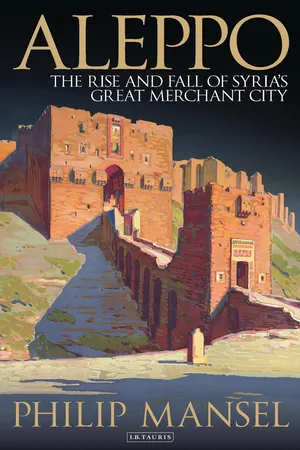
Aleppo lies in ruins. Its streets are plunged in darkness, most of its population has fled. But this was once a vibrant world city, where Muslims, Christians and Jews lived and traded together in peace. Few places are as ancient and diverse as Aleppo – one of the oldest, continuously inhabited cities in the world – successively ruled by the Assyrian, Persian, Greek, Roman, Arab, Ottoman and French empires. Under the Ottomans, it became the empire's third largest city, after Constantinople and Cairo. It owed its wealth to its position at the end of the Silk Road, at a crossroads of world trade, where merchants from Venice, Isfahan and Agra gathered in the largest suq in the Middle East. Throughout the region, it was famous for its food and its music. For 400 years British and French consuls and merchants lived in Aleppo; many of their accounts are used here for the first time. In the first history of Aleppo in English, Dr Philip Mansel vividly describes its decline from a pinnacle of cultural and economic power, a poignant testament to a city shattered by Syria's civil war.
- 272 pages
- English
- ePUB (mobile friendly)
- Available on iOS & Android
eBook - ePub
About this book
Information
Part I
A History
Chapter One

The Ottoman City
Situated at the crossroads of Europe, Asia and Africa, ruling an area stretching from Bosnia to Yemen, the Ottoman Empire needed foreign allies. It favoured Constantinople’s re-emergence as an international capital, after its decline in the last centuries of the Byzantine Empire. Mehmed the Conqueror and his successors encouraged or forced Turks, Greeks, Armenians and Jews to settle there, and welcomed European embassies. Similarly they favoured Aleppo’s development as an international trading city. Part of the Ottoman Empire’s enduring success, compared to previous Turkic states like the Seljuk sultanate in Anatolia, came from its ability to keep foreign allies and to incorporate different peoples and religions in its administrative and financial structures. Local Christian and Jewish hierarchies were made responsible for paying taxes and enforcing laws in their respective communities.
Aleppo shows that the Empire was not only an imperial autocracy, and a Muslim Turkish state, but also a complex of communities. Each group could follow its own faith and traditions. Self-interest and realism discouraged them from temptation to rebel. As long as the sultan’s suzerainty was acknowledged, and taxes were paid, the Empire could rule with a light hand. Aleppo had found a state which suited it, both geographically and economically. It was no longer a frontier city, but an entrepôt at the centre of an empire.
Yavuz Selim’s first acts in Aleppo announced the character of the Ottoman administration. They included the appointment of Turks, rather than Arabs, as governor and kadi (Muslim religious judge); the diminution of customs rates from 20 per cent to 5 per cent; and the lowering of the tax on Christian pilgrims going to Jerusalem.1
The governor of the province of Aleppo ruled a large area between the Mediterranean and the Euphrates. His authority was balanced by that of other officials appointed directly from Constantinople, the aga of the elite corps of 700 janissaries who controlled the city walls and the two military commanders of the city and the citadel. By the eighteenth century, according to Alexander Russell, a Scottish doctor residing in the city from 1740 to 1753, the governor was assisted by a divan or council, meeting every Friday. It included the principal government and religious officials, and
the principal effendis [gentlemen] and Agas, together with the Shahbinder or head of the merchants […] Business relating to the city and all parts of the Province is transacted in the divan, the Bashaw always affecting to be desirous of exact information. He inquires with much formality concerning the city markets, the disposition of the people, the state of trade and the condition of the villages.
In theory the governor could not inflict capital punishment without a formal trial and had to listen to opinions in the divan:
The different interests operating in the Divan, in some measure counterbalance one another and not withstanding the frequent violation of the people’s rights, the ordinary course of affairs proceeds more equitably than might be expected in a government where the people are commonly supposed to be the mere slaves of despotic power.2
Syrian ulama or religious authorities called the Ottoman sultan ‘Sultan al-Rum’ (Rum – an Arab and Turkish word for Anatolia, the area once ruled by Roman or Byzantine emperors). They regarded him as foreign, but in later periods often went to study in Constantinople, just as the different kadis (judges) and sheikhs al-islam (leading Muslim authorities) were generally sent from Constantinople to Aleppo.3 As in other Ottoman provinces, the rivalry between Turks and Arabs, dating back to the ninth century when Turkish commanders had begun to dominate the Abbasid caliphate, was reflected in the military and political dominance of Turks. A seventeenth-century Ottoman historian born in Aleppo, Mustafa Naima, describes the fear of Aleppo and Ottoman officials felt by ‘the Arabs of the sort acustomed to the desert and the open lands’.4 The first governor of Aleppo of local origin, Ibrahim Pasha Katiraghasi, was not appointed until 1799, and lasted only five years.5
Aleppo functioned as an Ottoman base during the Empire’s frequent wars with Iran under the Safavid shahs. They were caused by territorial disputes over control of Iraq, as well as by religious hatred between Sunni Ottomans and Shi‘a Iranians – dating from quarrels over the succession to the Prophet Muhammad, between Sunni supporters of his Umayyad cousins and Shi‘a followers of his son-in-law Ali. Ali had been murdered in 661 and his son Hussein in 680 – murders still dividing Shi‘a and Sunni Muslims today. The geographical ambitions of the two empires envenomed the religious hatred of the two groups. After campaigning against Iran, Suleyman ‘the Magnificent’ himself spent part of the winters of 1534–5, 1548–9 and 1553–4 resting in Aleppo. It was the only Arabic-speaking city to receive regular visits from an Ottoman sultan.6
Since 1535 one of the Sultan’s main allies had been the King of France: they were united by a shared fear of Spain and the House of Austria, as well as shared desire for trade. A sign of the Ottoman–French alliance, which would influence Aleppo for the subsequent 400 years, was the presence there in 1548–9 of the French ambassador Monsieur d’Aramon, at the same time as the Sultan, whom he was advising on tactics against Iran.7
Aleppo began to acquire an Ottoman layer of khans, mosques and fountains, in addition to its Umayyad, Ayyubid and Mamluk buildings. Inscriptions in honour of Ottoman sultans appeared on the walls of the Great Mosque, where the sultan’s firmans or decrees were read out. The first Ottoman mosque was built by the governor Husrev Pasha in 1537–46.8
Ottoman rule favoured diversity. A German doctor called Leonhard Rauwolff, who visited the city in 1573 in search of medicinal herbs, heard a story that, when Suleyman the Magnificent was staying in Aleppo, there was debate in his council over whether, for their ‘unsufferable usury’, to expel Jews from the province. The Sultan asked his advisers to consider a flowerpot
that held a quantity of fine flowers of divers colours, that was then in the room and bid them consider whether each of them in their colour did not set out the other the better […] The more sorts of nations I have in my dominions under me, as Turks, Moors, Grecians etc., the greater authority they bring to my kingdoms and make them more famous. And that nothing may fall off from my greatness, I think it convenient that all that have been together long hitherto, may be kept and tolerated so still for the future.
The council agreed ‘unanimously’.9 Such Ottoman belief in the advantages of diversity, also reflected in Mehmed II’s policy of repeopling Constantinople, in the recruitment of janissaries from non-Turks and in numerous Ottoman texts praising the virtues of different races, is another reason for the Empire’s survival.10
The only serious threat to Ottoman authority came in the early seventeenth century, from a family of Kurdish chiefs called Canbulatoglu, ancestors of the Jumblatts, Druze leaders in Lebanon today. In 1603–7 Ali Pasha, leader of the clan, led moves for autonomy or independence in Aleppo, encouraged by the Grand Duke of Tuscany and his Order of Saint Stephen, who wanted to recreate the crusader Kingdom of Jerusalem.11 Far from being averse to foreign intervention, local leaders often initiated it. Shah Abbas of Iran, who was in communication with the Grand Duke of Tuscany, also had plans to seize the city, and a Mediterranean port, in order to export silk direct from Iran to Europe, without paying Ottoman customs dues.12
Chapter Two
Emporium of the Orient World
Conquest had made Aleppo Ottoman; trade made it a world city. At the junction of Anatolia, the Fertile Crescent and the Syrian Desert, where the Silk Road approached the Mediterranean, Aleppo was a natural destination for merchants. Caravans of camels arrived every year from India, Iran, the Gulf, Erzerum, Damascus and the Arabian Peninsula. They halted in Aleppo before proceeding to the ports of Iskenderun on the Mediterranean, Smyrna on the Aegean, or Constantinople. In 1550 Jacques Gassot, a French diplomat, wrote of Aleppo: ‘Elle est fort marchande et plus que Constantinople ou autre ville de Levant.’1
For the English traveller Thomas Coryate, Aleppo was ‘the principall emporium of all Syria or rather of the Orient world’.2 Leonhard Rauwolff observed
great caravans of pack horses and asses, but more camels arrive there daily, from all foreign countries, viz. from Natalia, Armenia, Aegypt and India etc. with convoys, so that the streets are so crouded that it is hard to pass by one another. Each of these Nations have their peculiar champ [khan] to themselves.3
In 1574 the most global of grand viziers, Sokollu Mehmed Pasha, who commissioned buildings from the Balkans to the Black Sea, also paid for the construction of the Khan al-Gumruk or customs inn, near the entrance to the main souk. A symbol of Aleppo’s role as an international trading city, for centuries it would be the residence of the French, Dutch and English consuls. At one time there were 344 shops in the khan and its endowment made it one of the largest landowners in the city.4
Aleppo received a further boost after 1590, when Iskenderun on the Mediterranean, seventy-five miles away by road, was officially opened by the Ottoman government for international trade, replacing the previous port Payas, twenty miles to the north. Merchants in Aleppo were informed by messages tucked under pigeons’ wings of the arrival of ships in Iskenderun. The journey took three or four days for people on horseback, but only six hours for well-trained pigeons.5
By 1600 there were fifty-three khans and fifty-six souks in Aleppo. The dark, narrow, vaulted souks were the largest in the Middle East. They stretched for twelve kilometres; through the souks of the rope-makers, the saddlers, the tanners or the spice-merchants, it was said that a blind man could make his way by following the smell of the merchandise.6 There were also at least eight weekly markets outside the city walls, every Friday, where people from the surrounding countryside came to sell their produce.7 Ten gates in the city walls later gave their names to districts of the city: among them Bab Antaki, the gate of the road to Antakya; Bab el-Nasr, the gate of victory; and Bab el-Farraj, the gate with a fine view of gardens outside the walls.8 After Constantinople and Cairo, Aleppo was the third largest city in the Empire.
One of the first Englishmen to trade in Aleppo was John Eldred, later treasurer of the Levant Company, founded in 1581 to encourage England’s trade with the Ottoman Empire. Arriving from Baghdad in 1586 in a caravan of 4,000 camels, he wrote: ‘it is the great place of traffique for a dry towne [i.e. not a port] that is in all those parts; for hither resort Jewes, Tartarians, Persians, Armenians, Egyptians, Indians and many sorts of Christians and enjoy freedom of their consciences and bring thither many kinds of rich merchandises’.9 Freedom of conscience, at that time, was unknown in most cities in Europe.
In 1596 Fynes Morison praised the courteous entertainment and ‘plentifull diet, good lodging and most friendly conversation’ of the English merchants, and their ‘excellent wines’: the white was local, the red came from Mount Lebanon. The presence of English traders inspired Shakespeare’s line in Macbeth (1603–6), ‘Her husband’s to Aleppo gone, master o’er the Tiger’.10
Silk, soap, spices and goat-hair were among the main exports, textiles the main import: every year in the early seventeenth century England sold in Aleppo 12,000 pieces of cloth, known as ‘londra’.11 Until the nineteenth century many peopl...
Table of contents
- Cover
- Half Title
- Epigraph
- Title Page
- Copyright Page
- Dedication
- Table of Contents
- List of Illustrations
- Acknowledgements
- Introduction
- Part I A History
- Part II Through Travellers’ Eyes
- Notes
- Bibliography
- Also by Philip Mansel
- Plates
Trusted by 375,005 students
Access to over 1.5 million titles for a fair monthly price.
Study more efficiently using our study tools.
Frequently asked questions
Yes, you can cancel anytime from the Subscription tab in your account settings on the Perlego website. Your subscription will stay active until the end of your current billing period. Learn how to cancel your subscription
No, books cannot be downloaded as external files, such as PDFs, for use outside of Perlego. However, you can download books within the Perlego app for offline reading on mobile or tablet. Learn how to download books offline
Perlego offers two plans: Essential and Complete
- Essential is ideal for learners and professionals who enjoy exploring a wide range of subjects. Access the Essential Library with 800,000+ trusted titles and best-sellers across business, personal growth, and the humanities. Includes unlimited reading time and Standard Read Aloud voice.
- Complete: Perfect for advanced learners and researchers needing full, unrestricted access. Unlock 1.5M+ books across hundreds of subjects, including academic and specialized titles. The Complete Plan also includes advanced features like Premium Read Aloud and Research Assistant.
We are an online textbook subscription service, where you can get access to an entire online library for less than the price of a single book per month. With over 1.5 million books across 990+ topics, we’ve got you covered! Learn about our mission
Look out for the read-aloud symbol on your next book to see if you can listen to it. The read-aloud tool reads text aloud for you, highlighting the text as it is being read. You can pause it, speed it up and slow it down. Learn more about Read Aloud
Yes! You can use the Perlego app on both iOS and Android devices to read anytime, anywhere — even offline. Perfect for commutes or when you’re on the go.
Please note we cannot support devices running on iOS 13 and Android 7 or earlier. Learn more about using the app
Please note we cannot support devices running on iOS 13 and Android 7 or earlier. Learn more about using the app
Yes, you can access Aleppo by Philip Mansel in PDF and/or ePUB format, as well as other popular books in Social Sciences & Middle Eastern History. We have over 1.5 million books available in our catalogue for you to explore.