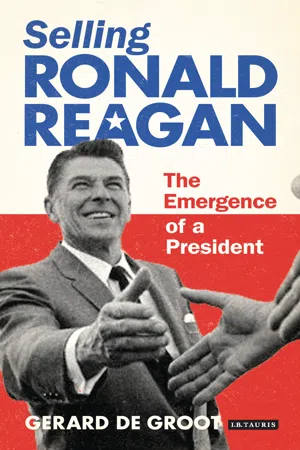
Before 1966, the idea of Reagan in politics provoked widespread scorn. To most people, he seemed a has-been actor, a right-wing extremist and a 'dunce'. Journalists therefore ridiculed his aspirations to be governor of California. No one, however, doubted his incredible ability to communicate with a crowd. In order to succeed in his campaign, Reagan had to be packaged as an outsider - an antidote to politics as usual. A highly sophisticated team of marketers and ad-men turned the scary right-winger into a harmless moderate who could attract supporters from across the political spectrum. Researchers meanwhile provided the coaching that allowed Reagan to seem well-informed - all of which led to Reagan winning the California governorship by a landslide. Gerard DeGroot here explores how, in the decade of consumerism, Reagan was marketed as a product. While there is no doubting his natural abilities as a campaigner, Reagan won in 1966 because his team of advisers understood how to sell their candidate, and he, wisely, allowed himself to be sold.
Selling Ronald Reagan tells the story of Reagan's first election, when the nature of campaigning was forever altered and a titan of modern American history emerged.
- 320 pages
- English
- ePUB (mobile friendly)
- Available on iOS & Android
eBook - ePub
About this book
Information
‘A scintillating analysis of how American politics in the 1960s and the changing nature of the state of California came together to transform a third-rate Hollywood actor into a first-rate politician. DeGroot’s sharp and witty analysis of the state of American politics in the 1960s entertains as it enlightens. A brilliant achievement.’
Marilyn B. Young, Professor of History, NYU and author of The Vietnam Wars
‘Whether Democrats or Republicans, American politicians habitually compare themselves to Ronald Reagan. Gerard DeGroot’s bold and fast-paced book explores how that past-it Hollywood actor converted himself into a silver-tongued politician and president. In telling this entertaining and important story, DeGroot explains why Ronald Reagan’s transformational career matters today, perhaps more than ever.’
Nick Witham, University College London, author of The Cultural Left and the Reagan Era: US Protest and Central American Revolution
Selling Ronald Reagan
The Emergence of a President

Published in 2015 by
I.B.Tauris & Co. Ltd
London • New York
www.ibtauris.com
Copyright © 2015 Gerard DeGroot
The right of Gerard DeGroot to be identified as the author of this work has been asserted by the author in accordance with the Copyright, Designs and Patents Act 1988.
All rights reserved. Except for brief quotations in a review, this book, or any part thereof, may not be reproduced, stored in or introduced into a retrieval system, or transmitted, in any form or by any means, electronic, mechanical, photocopying, recording or otherwise, without the prior written permission of the publisher.
References to websites were correct at the time of writing.
ISBN: 978 1 78076 828 1
eISBN: 978 0 85772 930 9
A full CIP record for this book is available from the British Library
A full CIP record is available from the Library of Congress
Library of Congress Catalog Card Number: available
Typeset by JCS Publishing Services Ltd, www.jcs-publishing.co.uk
To Charlie Roe:
a lovely man, and a believer in government
*
and to Marilyn Roe:
of course
Contents
Introduction
1 The Speech
2 Hardening of the Categories
3 ‘You Guys Are Absolutely Crazy’
4 Old Tactics, New Faces
5 Those Boys from BASICO
6 The Great Pretender
7 Drowning in Milk
8 ‘What Are You Going to Do About Berkeley?’
9 ‘Who Shot Lincoln?’
10 ‘Hey, This Guy Could Be President Someday’
Notes
Bibliography
Introduction
There once was a time when the idea of Ronald Reagan in politics provoked ridicule and scorn. (For some it still does.) The problem was not just that he was an actor, but rather that he was a bad one who, instead of giving up and implementing Plan B, hung around Hollywood for decades in the pathetic hope that his big break would come. The roles he played never suggested a capacity for leadership. He lacked the toughness of John Wayne, the cerebral charm of Gregory Peck, or the quiet solidity of William Holden. He was, quite simply, too mushy – the guy who always fell in love but never got the girl. ‘Ronnie for governor?’ the studio mogul Jack Warner quipped when rumours circulated of a Reagan candidacy. ‘No. Jimmy Stewart for governor. Ronnie for best friend.’1
As we now know, Reagan had a nasty habit of making his critics eat their words. Again, and again, and again. Yet the incredulity that his first foray into politics inspired is entirely understandable. Growing up in San Diego, I recall radio ads in which he tried to suggest that six terms as president of the Screen Actors Guild (SAG) was legitimate qualification for the new role he coveted – governor of the most populous state in the Union. I was only 11 at the time, yet I could sense that there was something wrong with that logic. The problem, however, was not just Reagan’s lack of experience; it was also that his politics seemed Mesozoic. He was a pal of the arch-conservative Barry Goldwater and, on certain issues, more extreme than his friend. Since Lyndon Johnson had trounced Goldwater in the 1964 presidential election, that seemed proof that America wanted nothing to do with the loony politics of the far right. How, then, could an extremist like Reagan dare to think he could gain election at a time when America seemed fundamentally liberal?
Reagan was right and his doubters wrong. In 1966, a far-right candidate with no political experience triumphed by nearly a million votes over the two-term incumbent, Edmund G. (Pat) Brown. That clearly qualifies as a mammoth achievement, yet how did this happen and what does it mean? Was this just another example of capricious California, or was Reagan a harbinger of a trend that would soon sweep across the United States?
‘What happens in California today often happens in America tomorrow,’ wrote the journalist Joseph Lewis not long after the Reagan landslide. ‘California is a social laboratory for the other forty-nine states.’2 Lewis was correct, even though some still deny the implications of that statement. The most successful political revolution of the 1960s was not conducted by students, nor was it left-wing. It was instead a populist revolution from the right, with Reagan in the van. Some analysts, frightened by the implications of that phenomenon, insisted that California was just being silly. They assumed that if the people supported this Hollywood lightweight something must be wrong with the people. ‘Perhaps only the capricious California electorate could stage such a political jest,’ Emmet John Hughes remarked in Newsweek. Reagan’s victory, he decided, ‘dramatizes the virtual bankruptcy, politically and intellectually, of a national party … The political point should not be more sharp. Some men learn from history. Some men run from it. And the GOP has chosen feckless flight.’3 To an extent, Hughes was right. The GOP, with Reagan in front, was running from history. What many failed to realize, however, was that voters were running in the same direction....
Table of contents
- Author bio
- Endorsements
- Title page
- Copyright page
- Dedication
- Contents
- Introduction
- 1 The Speech
- 2 Hardening of the Categories
- 3 ‘You Guys Are Absolutely Crazy’
- 4 Old Tactics, New Faces
- 5 Those Boys from BASICO
- 6 The Great Pretender
- 7 Drowning in Milk
- 8 ‘What Are You Going to Do About Berkeley?’
- 9 ‘Who Shot Lincoln?’
- 10 ‘Hey, This Guy Could Be President Someday’
- Notes
- Bibliography
Trusted by 375,005 students
Access to over 1.5 million titles for a fair monthly price.
Study more efficiently using our study tools.
Frequently asked questions
Yes, you can cancel anytime from the Subscription tab in your account settings on the Perlego website. Your subscription will stay active until the end of your current billing period. Learn how to cancel your subscription
No, books cannot be downloaded as external files, such as PDFs, for use outside of Perlego. However, you can download books within the Perlego app for offline reading on mobile or tablet. Learn how to download books offline
We are an online textbook subscription service, where you can get access to an entire online library for less than the price of a single book per month. With over 1.5 million books across 990+ topics, we’ve got you covered! Learn about our mission
Look out for the read-aloud symbol on your next book to see if you can listen to it. The read-aloud tool reads text aloud for you, highlighting the text as it is being read. You can pause it, speed it up and slow it down. Learn more about Read Aloud
Yes! You can use the Perlego app on both iOS and Android devices to read anytime, anywhere — even offline. Perfect for commutes or when you’re on the go.
Please note we cannot support devices running on iOS 13 and Android 7 or earlier. Learn more about using the app
Please note we cannot support devices running on iOS 13 and Android 7 or earlier. Learn more about using the app
Yes, you can access Selling Ronald Reagan by Gerard DeGroot in PDF and/or ePUB format, as well as other popular books in Politik & Internationale Beziehungen & Politische Biographien. We have over 1.5 million books available in our catalogue for you to explore.