- 288 pages
- English
- ePUB (mobile friendly)
- Available on iOS & Android
eBook - ePub
About this book
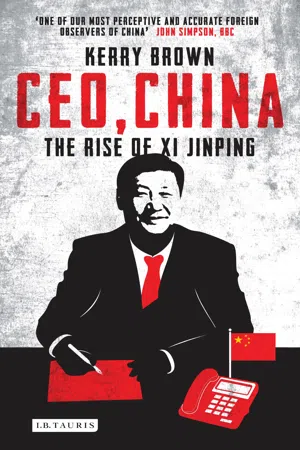
China has become the powerhouse of the world economy, its incredible boom overseen by the elite members of the secretive and all-powerful communist party. But since the election of Xi Jinping as General Secretary, life at the top in China has changed. Under the guise of a corruption crackdown, which has seen his rivals imprisoned, Xi Jinping has been quietly building one of the most powerful leaderships modern China has ever seen. In CEO China, the noted China expert Kerry Brown reveals the hidden story of the rise of the man dubbed the 'Chinese Godfather'. Brown investigates his relationship with his revolutionary father, who was expelled by Mao during the Cultural Revolution, his business dealings and allegiances in China's regional power struggles and his role in the internal battle raging between the old men of the Deng era and the new super-rich 'princelings'. Xi Jinping's China is powerful, aggressive and single-minded and this book will become a must-read for the Western world.
Information

Kerry Brown is Professor of Chinese Studies and Director of the Lau China Institute at King’s College London, and Associate Fellow specializing in Asia at Chatham House. With 20 years’ experience of life in China, he has worked in education, business and government, including a term as First Secretary at the British Embassy in Beijing. He writes regularly for international media, and has authored over ten books on contemporary China, among them The New Emperors (I.B.Tauris, 2014), Contemporary China (2012) and Struggling Giant: China in the 21st Century (with Jonathan Fenby, 2007).
‘Xi is determined to reshape China and bring it into the centre of the international stage. We all feel these profound changes, but few of us have the ability to step back, put Xi in perspective, analyse his rise, and guess where Xi will take us. Kerry Brown has it, and he delivers. This book provides an excellent account of Xi’s rise, his visions, his determination, and the future he is making for China and for the world. All who are interested in China and its global role should read it.’
Yongnian Zheng, Director of the East Asian Institute,
National University of Singapore
National University of Singapore
‘Kerry Brown is one of our most perceptive and accurate foreign observers of China’
John Simpson, BBC
‘CEO, China is a thoughtful and thought-provoking study of China’s current leader… A fascinating glimpse into the workings of the Chinese leadership.’
Frank Ching, First Bureau Chief in Beijing
for the Wall Street Journal and author of Ancestors
for the Wall Street Journal and author of Ancestors
‘A necessary read for anyone who thinks about China, which is most of us these days… Kerry Brown’s book is very timely, thorough and insightful, and gives some of the prevailing orthodoxies a bit of an overdue nudge. A lot of the commentary about Xi to date has been fairly trite; this book isn’t.’
Clinton Dines, former CEO of BHP Billiton
in China and an expert on Chinese business
in China and an expert on Chinese business
‘One of the most useful studies available of how power works in today’s China. I doubt any other writer provides as many insights into how a closed system makes decisions and allocates authority.’
Bob Carr, Director of the Australia–China Relations
Institute at UTS, former Australian Foreign Minister
and longest-serving New South Wales Premier
Institute at UTS, former Australian Foreign Minister
and longest-serving New South Wales Premier

Published in 2016 by
I.B.Tauris & Co. Ltd
London • New York
www.ibtauris.com
I.B.Tauris & Co. Ltd
London • New York
www.ibtauris.com
Copyright © 2016 Kerry Brown
The right of Kerry Brown to be identified as the author of this work has been asserted by the author in accordance with the Copyright, Designs and Patents Act 1988.
All rights reserved. Except for brief quotations in a review, this book, or any part thereof, may not be reproduced, stored in or introduced into a retrieval system, or transmitted, in any form or by any means, electronic, mechanical, photocopying, recording or otherwise, without the prior written permission of the publisher.
References to websites were correct at the time of writing.
ISBN: 978 1 78453 322 9
eISBN: 978 0 85772 961 3
ePDF: 978 0 85772 757
eISBN: 978 0 85772 961 3
ePDF: 978 0 85772 757
A full CIP record for this book is available from the British Library
A full CIP record is available from the Library of Congress
Library of Congress Catalog Card Number: available
A full CIP record is available from the Library of Congress
Library of Congress Catalog Card Number: available
Typesetting and eBooks by Tetragon, London
Printed and bound in Sweden by ScandBook AB
Printed and bound in Sweden by ScandBook AB
Dedicated to Jim O’Donoghue and Katherine Peters
Contents
- Acknowledgements
- Note on the Text
- Preface
- List of Abbreviations
- Key People
- Timeline of Xi Jinping’s Life
- Map Of China
- Introduction
- 1. The Hunt for Power in Modern China
- 2. Xi the Man
- 3. Xi, His Enemies and His Friends
- 4. The Political Programme of Xi Jinping
- 5. How Does Xi Jinping See the Outside World?
- 6. What Does Xi Want in the Next Two Decades?
- Conclusion
- Notes
- Bibliography
Master Tseng said, Every day I examine myself on these three points: in acting on behalf of others, have I always been loyal to their interests? In intercourse with my friends, have I always been true to my word? Have I failed to repeat the precepts that have been handed down to me?
Analects 1.4
Acknowledgements
I am grateful to Tomasz Hoskins and his colleagues at I.B.Tauris for their continuing support in commissioning this work, as well as to my former colleagues at the University of Sydney and Chatham House in London for all their insights, inspirations and assistance. I am also, as ever, grateful to my daughter Tanya Brown for her patience and forbearance while I wrote this in early 2015, and to Kalley Wu for her support. I am extremely grateful for the help of Emily Dunn, Simone van Nieuwenhuizen, Caroline Chong, Samuel Johnson and Haimin Huang for their work on correcting the text, and to Alexander Middleton for copy-editing it so well, Alex Billington at Tetragon for his work on the production, and Sarah Terry for her proofreading.
Note on the Text
All transliterations of Chinese into English are in Pinyin. The translations from Chinese to English in the text are my own, unless otherwise stated in the endnote references.
Preface
There is an occupational hazard for anyone who chooses to write about Chinese politics in the second decade of the twenty-first century. We may live in an age of openness and information, but the inner workings of the Chinese political system, and in particular the lives and thinking of its leaders, remain one of the few bastions of opacity. Those who choose to write about it, therefore, have to face two different kinds of criticism. From one side, there is the complaint often made from within China that anyone trying to work out its internal politics ‘doesn’t really understand’ because he or she is an outsider. These people use dark phrases like ‘you don’t really know how China works’. The implication is that the system is so fiendishly complicated and successfully protective of its secrets that only those deep within can truly understand it – and of course, they are the last to say what they know. There are also many outside China who have a vested interest in maintaining this image of ‘unknowability’. To them, years of observation and careful scrutiny of ‘name lists’ are the only legitimate pathway to understanding. Perhaps tellingly, one of the diplomats I worked with in the past combined professional interest in elite Chinese politics with collecting dead moths. He got a lot of things right, but spoke about China and the Chinese like they were taxidermy exhibits in a museum.
On the other side, there is the complaint that those who try to write with some sympathy, or attempt to understand internal Chinese politics too much on its own terms, are apologists, people who have ‘gone native’ and are guilty of producing external propaganda for an immoral system. The work of (the American) Robert Lawrence Kuhn is most representative here. His earlier biography of Jiang Zemin was one of very few based on meetings and first-hand encounters with China’s then president, and his follow-up book on the new leadership in 2011 was similarly advantaged by excellent top-level access. Kuhn’s writings, however, have been criticized for being over-respectful and fawning, presenting leaders like Xi in an uncritical light.1 This accusation of partisanship is a common taunt against those who write about Chinese politics in a far more neutral tone than Kuhn’s.
After almost a quarter of a century trying to work out what power means in China, how it is exercised and what makes Chinese elite leaders tick, something I have come to realize is that hybrid approaches work best, taking methods and insights from diverse areas and trying to link them to what one observes in China. It is a good idea too to treat Chinese political behaviour the way one would address political habits and modes of action anywhere. The United Kingdom and the United States both have peculiarities about their systems and the way people operate in them. But, broadly speaking, people strive for power and are motivated to acquire that power for very similar reasons no matter where they are. We are all part of one species, so there should be no shock about this. The important thing is to keep a sense of proportion between the unique features of specific systems and their shared attributes. Overstressing one and understressing the other are both mistaken.
Xi Jinping, who is the subject of this book, is the current leader of the People’s Republic of China (PRC). His elevation to this position happened with little transparency, and with almost every observer and pundit who watched the process initially predicting that he would have much less influence and power than he has seemingly accrued since being made general secretary of the Chinese Communist Party (CCP) in November 2012. Since that time he has adorned himself with a host of titles and leadership positions. On paper, at least, in recent decades China has never before had such a powerful person. But as I will argue throughout this book, in China, more than most other places, power is a tricky thing. That is why choosing the right framework within which to understand power and in particular the kinds of power that someone like Xi, ostensibly at the top of the political system, exercises is so important. Chinese politics exists in an historical, cultural, social and intellectual context, from where it gains much of its specificity. And as we shall see, power in modern China is circumscribed by all sorts of boundaries and manifestations that give it its unique attributes and qualities. The issue then is one of interpretation and the level of emphasis placed on each factor. Overemphasizing the organization of the CCP, and not looking at its ideological or emotional basis, means we miss something crucial about what this entity is, and how people like Xi are able to direct it. Chinese politics, like politics anywhere, is very dynamic. Seeing the visible signs of that dynamism is not difficult. The question then becomes how to devise a way to capture this dynamism and strike a balance between general and particular features. Empirical observation plays a part in that, but so does imagination. It is, as I go out of my way to make clear many times throughout this book, not a precise science. But nor is it a modern version of alchemy.
Chinese politics has often been treated as something remote and mysterious, best left to specialists. This book is part of an attempt to change that, and encourage as wide an audience as possible to think about, and engage with, the political life of China. That gives some of what follows a sometimes quite personal tone. As the great sinologist Pierre Ryckmans (whose pen name was Simon Leys) once wrote, ‘we cannot learn any foreign values if we do not accept the risk of being transformed by what we learn.’2 In that sense, China, with its re-emergence to global economic and political prominence, is already transforming us. The simple polarities that sufficed in the past – ‘they are Communists, we are democracies; they are bad, we are good!’ – have eroded to the point where the boundaries between ‘them’ and ‘us’ are almost no longer visible, a bit like the tiny vestiges of the Great Wall of China in the far west of the country, which are not easy to see even if you stand beside them, let alone if you are trying to see them from the moon.3
I hope, therefore, that this book at least captures someth...
Table of contents
- Acknowledgements
Trusted by 375,005 students
Access to over 1.5 million titles for a fair monthly price.
Study more efficiently using our study tools.
Frequently asked questions
Yes, you can cancel anytime from the Subscription tab in your account settings on the Perlego website. Your subscription will stay active until the end of your current billing period. Learn how to cancel your subscription
No, books cannot be downloaded as external files, such as PDFs, for use outside of Perlego. However, you can download books within the Perlego app for offline reading on mobile or tablet. Learn how to download books offline
Perlego offers two plans: Essential and Complete
- Essential is ideal for learners and professionals who enjoy exploring a wide range of subjects. Access the Essential Library with 800,000+ trusted titles and best-sellers across business, personal growth, and the humanities. Includes unlimited reading time and Standard Read Aloud voice.
- Complete: Perfect for advanced learners and researchers needing full, unrestricted access. Unlock 1.5M+ books across hundreds of subjects, including academic and specialized titles. The Complete Plan also includes advanced features like Premium Read Aloud and Research Assistant.
We are an online textbook subscription service, where you can get access to an entire online library for less than the price of a single book per month. With over 1.5 million books across 990+ topics, we’ve got you covered! Learn about our mission
Look out for the read-aloud symbol on your next book to see if you can listen to it. The read-aloud tool reads text aloud for you, highlighting the text as it is being read. You can pause it, speed it up and slow it down. Learn more about Read Aloud
Yes! You can use the Perlego app on both iOS and Android devices to read anytime, anywhere — even offline. Perfect for commutes or when you’re on the go.
Please note we cannot support devices running on iOS 13 and Android 7 or earlier. Learn more about using the app
Please note we cannot support devices running on iOS 13 and Android 7 or earlier. Learn more about using the app
Yes, you can access CEO, China by Kerry Brown in PDF and/or ePUB format, as well as other popular books in Storia & Biografie in ambito politico. We have over 1.5 million books available in our catalogue for you to explore.