eBook - ePub
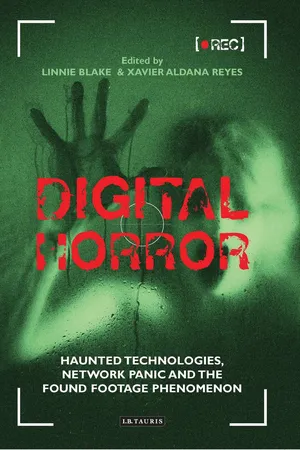
Digital Horror
Haunted Technologies, Network Panic and the Found Footage Phenomenon
- 200 pages
- English
- ePUB (mobile friendly)
- Available on iOS & Android
eBook - ePub
Digital Horror
Haunted Technologies, Network Panic and the Found Footage Phenomenon
About this book
In recent years, the ways in which digital technologies have come to shape our experience of the world has been an immensely popular subject in the horror film genre. Contemporary horror cinema reflects and exploits the anxieties of our age in its increasing use of hand-held techniques and in its motifs of surveillance, found footage (fictional films that appear 'real': comprising discovered video recordings left behind by victims/protagonists) and 'digital haunting' (when ghosts inhabit digital technologies). This book offers an exploration of the digital horror film phenomenon, across different national cultures and historic periods, examining the sub-genres of CCTV horror, technological haunting, snuff films, found footage and torture porn. Digital horror, it demonstrates, is a product of the post 9/11 neo-liberal world view - characterised by security paranoia, constant surveillance and social alienation. Digital horror screens its subjects via the transnational technologies of our age, such as the camcorder and CCTV, and records them in secret footage that may, one day, be found.
Information
Part I
Haunted Technologies and Network Panic
1
Network Anxiety: Prefiguring Digital Anxieties in the American Horror Film
The Ghost in the Machine: The Emblematic Scene
Perhaps the most emblematic shot of the recent wave of horror films concerned with the menace of digital technologies is that of the female ghost in Ringu (Hideo Nakata, 1998) emerging from the television set and stepping, in all her dripping, gruesome glory, into the living room of whoever had the bad fortune of watching TV. This is the moment when technology comes alive, when the infrastructural networks of mass communication reveal that they are possessed, haunted, eerily and uncannily animate. The shot has been imitated countless times as a sign of earnest admiration and parodied as a sign of the moment’s rapid affective, generic and, ultimately, cultural exhaustion. Its origin, The Ring, spans the cultural divide between the Japanese market, where it originated, and the American one, where its remake kicked off a cinematic cycle of digital horror films in which so-called J-Horror, and to a lesser extent films from other Asian nations, and indigenous American products seemed to merge effortlessly. And, yet, the cultural life of this emblematic shot marks a period in which cultural unease with digital technology was, quite obviously, not the provenance of any particular nation and its idiosyncratic relationship toward digital technology but a general phenomenon closely linked to highly technological cultures around the globe and, thus, to modernity itself.
The fact that the shot is hardly original detracts little from its startling power. Horror film fans might first think of the moment in David Cronenberg’s Videodrome (1983) in which Max Renn’s (James Woods) television set, under the influence of a pirate signal from Pittsburgh, PA, or that of that signal’s ability to induce vivid hallucinations, suddenly begins to breathe, its surface bulging with pulsating veins as Renn gives in to a mouth beckoning him in extreme close-up and submerges his head beneath the flexible membrane of the screen. The comparison is intriguing, though Cronenberg has technology itself come alive, and, in The Ring, it serves as a conduit for malignant forces travelling along the network’s arteries. A more apt comparison, might be the similarly hallucinatory moment that occurs in a film less well remembered – John Flynn’s Brainscan (1994) – which nonetheless marks a cycle of horror films, the last one in sequence before that crucial moment in 1998 when The Ring’s ghost emerges from the screen. A mysterious computer game named Brainscan manifests its resident spirit, a Freddy Kruegeresque figure named Trickster (T. Ryder Smith), to its hapless player, a suburban teenager named Michael (Edward Furlong). Michael suspects that playing the game has had him sleepwalk into someone’s house and commit a murder. Four years before Samara (Daveigh Chase) crawls out of that television set in Japan for the first time, Trickster plays the same trick on Michael, peeling himself out of the television screen’s bulging protuberance and stepping, with malignant glee, into Michael’s bedroom. Trickster’s arrival foreshadows that of Samara, and, yet, Brainscan the film, as well as the cycle of techno-horror films in which it is embedded, has not registered as strongly on the public mind – or, for that matter, in the historiography of the horror film genre – as one might expect. Hence, it is the goal of this chapter to trace the development of techno-horror or, more specifically, the development of the network metaphor: those conduits that come alive or through which uncanny forces travel – from its origins to that final cycle of horror films overshadowed by what was to come only a few years later.
Introduction: Technophobia, Techno-horror and Network Anxiety
To assert that recent horror films invested in the use, representation and criticism of digital technologies express a sense of unease and anxiety about just those technologies – that these films, in other words, are a prime cultural outlet of technophobic undercurrents in a culture largely comfortable with, or even enthusiastic about, technology in general – is something of a truism. Similarly, late capitalism’s invention and use of the digital has confirmed, with a vengeance, Marx’s famous observation about the curious lifelessness of human beings and animation of the inanimate under capitalism – an observation underlying countless horror films in which interchangeable characters are dispatched and, more importantly, inanimate objects come to life.1 From haunted television sets, cell phones and web sites, to blurry digital footage of supernatural events or graphic cruelty and torture circulating through the channels of social media, the techno-horror du jour happens to be digital. The digital in these films is simply the last in a long line of technologies that, ever since the Industrial Revolution, made technology an indispensable part of modernity and have caused nervousness and anxiety in equal measure, to technophilic celebration. Following technology to this current manifestation, techno-horror is performing the cultural labour of articulating, illustrating and dramatising these anxieties, and feeding the larger debate on the uses and benefits of digital technology.
Holding together the historical progression of technologies arousing unease, each one, in turn, providing the focus of anxiety during its period in the cultural spotlight before being replaced by its successor, there is a larger paradigm at work. This makes such progression readable as a narrative of progress, or a narrative of the inevitable repetition of human folly, or a narrative of the bargain that forces us to accept the horrific side-effects with the benefits of new technologies, or any number of competing or supplementary narratives. In the context of the horror film, this crucial organising metaphor is that of the network. The metaphor is applied to logistical structures like those of global agents, from the integrated production and distribution of the Walmart chain to that of actual or imagined terrorist organisations like Al-Qaeda, just as it is evoked as a description of corporate-owned digital communication within what has come to be called social media. Similar to concepts like ‘information’ or ‘energy’, the metaphor of the network is so ubiquitous, so widely and casually (or even perhaps sloppily) used as to be lacking distinct shape, essence or significance.2 Enthralled by the metaphor of the network – either as a source of utopian promises of technological transcendence, of infinite reach and connectedness, or as a dystopian menace of technological entanglement and paranoid hyper-cognition – much contemporary discourse wields the metaphor of the network like the proverbial man with a hammer to whom everything is a nail.
It is hardly surprising that a substantial cycle of the contemporary horror film focuses on the dystopian aspects of the network as it presents itself in its most recent technological manifestation, dramatising and extrapolating its inherent dangers, its power to destabilise and rewrite social protocols, and its complicated relationship to the bodies it organises. There is a long arc of historical iterations of the network metaphor that, somewhere in its early phase, includes the bodies of workers being fed into the Moloch Machine in the industrial netherworld of Fritz Lang’s Metropolis (1927) and, among its most recent images, the twisted female body extricating itself from a pixellated image to emerge from a television set into a suburban living room. The origins of this arc may go back as far as Mary Shelley’s Frankenstein (1818), a novel that transformed an older mythology of misguided creation – from the myth of Prometheus in its extended title to that of Faustian hubris – into a more historically specific articulation of technophobia at the dawn of the Industrial Revolution. But the specific roots of the network metaphor and its unique disposition toward the cinema of techno-horror can be found in the cycle of horror and science fiction films the American film industry produced and released between the late 1940s and the mid-1960s. It is with this cycle of films, their endlessly repeated and elaborated features and their historical context, with which I would like to start a discussion that will lead up, with some stops in subsequent decades along the way, to the most recent cycle of digital horror films.
Horror and Science Fiction Films in the 1950s: Cold War Networks
The oddly anachronistic ‘European’ locations in the cycle of classic Universal horror films from the 1930s and 1940s had borne little resemblance to the world of their American audience, being set in a remote space from which the abject would erupt, intrude and impinge upon the familiar world. The postwar cycle of horror films, from the late 1940s to the 1960s, brought horror closer to home. From towns with burgomasters and horse and carriage travel, horror films moved to locations within the US, the modern world of automobiles and commercial air travel, making use of the nation’s natural landscapes, its cities, movie theatres and army bases, its suburban homes, their bedrooms, the bodies in those beds and that space underneath the bed. By re-imagining global and domestic space and their relationship and interaction with each other, 1950s horror films laid the groundwork for the emergence and elaboration of the network metaphor.
Thus, in a key scene from It Came from Outer Space (Jack Arnold, 1953), an amateur astronomer (Richard Carlson) and his fiancée (Barbara Rush) come across two telephone repairmen along the open road in the south-west desert who let them listen in to a strange humming in the wires. As they ponder the inexplicable sound, there is a strong suggestion that, somewhere down the line, someone is also listening in on them. Not only is the communication network haunted, it also produces, within the vast natural landscape, an alarming moment of reciprocity and proximity. For better or worse, information is flowing in both directions at once. As observers – or eavesdroppers, in this case – we are observed; someone is listening in on us. Acting upon others by way of the network, we are being acted upon.
Vast as it may seem, the network still has its marginal zones. Washington D.C. may provide a centre; wherever danger rises, the bureaucratic, administrative and military apparatus mobilised to meet and contain it is organised in an office somewhere in the nation’s capital. At times, D.C. is also the location of the crisis; the alien visitor in Robert Wise’s The Day the Earth Stood Still (1951) does land on the White House lawn. More frequently, though, it is New York or Los Angeles that bears the burden of providing the location for fantasies of national crisis. The mutated ants in Them! (Gordon Douglas, 1954) head for the storm drains underneath Los Angeles; the radioactive dinosaur in The Beast from 20,000 Fathoms (Eugene Lourie, 1953) heads straight for New York. Clearly, marginal geographic spaces like the Arctic or the desert along America’s southern border, where these monsters originate, are still part of the larger network along which monstrous bodies travel on their way to the culture’s central nervous system.
Horizontal or vertical, the principle of reciprocity reigns supreme. Vertically speaking, as alien ships or alien seed pods come in from above, artillery fire rises up to meet them (as in Plan 9 from Outer Space (Edward Wood Jr., 1959)), missiles are fired at the intruder trying to make his escape (The Atomic Submarine (Spencer Gordon Bennet, 1959)) and fighter jets ascend toward the heavens (First Man Into Space (Robert Day, 1959)). Meanwhile, on the horizontal plane, the suburban home – annexe to, and metaphor for, the fallout shelter in its back yard or beneath its foundations – fails to prove an adequate defence against the horrific other. In The Twilight Zone, the monsters are, as an episode’s eponymous title has it, ‘due on Maple Street’ (ABC, 1960). In Invaders from Mars (William Cameron Menzies, 1953), they gain access to the suburban living room, turning good dads and loving moms into tyrannical Freudian nightmares. In I Married a Monster from Outer Space (Gene Fowler Jr., 1958), they even creep into the bedroom of that suburban home, presumably even into the marital bed and, in its final conclusion, into the bodies of blue-blooded virginal American women.
Crucial to all these movements through the network is the military. On the most superficial level, it appears diegetically as setting (the military base in First Man into Space), as character (the circle of generals in the Washington office discussing the crisis in Them!), as weapons technology (those ballistic missiles fired at the escaping alien craft in The Atomic Submarine), as the cause of crisis (atomic testing in the Arctic in The Beast from 20,000 Fathoms) and as the solution to these crises (the fighter plane dropping napalm on the giant spider in Tarantula (Jack Arnold, 1955). It is so ubiquitous that its absence from certain scenes – such as when the aliens in I Married a Monster from Outer Space are defeated by a civilian lynch mob rather than the Army or Air Force – registers on the viewer as an anomaly. Even in those few rare anomalies, the military still figures as an ideological subset of American values: courage, obedience, team spirit, self-sacrifice, discipline and patriotism. Even civilians, to the extent that they serve as vehicles for the promotion of social values within the cinematic text, adopt and embody them.3 M...
Table of contents
- About the Author
- Book Review
- Title Page
- Copyright Page
- Dedication
- Contents
- Acknowledgements
- List of Contributors
- Introduction: Horror in the Digital Age
- Part I: Haunted Technologies and Network Panic
- Part II: Digital Horror and the Postnational
- Part III: Digital Stylistics
- Bibliography
- Filmography
Trusted by 375,005 students
Access to over 1.5 million titles for a fair monthly price.
Study more efficiently using our study tools.
Frequently asked questions
Yes, you can cancel anytime from the Subscription tab in your account settings on the Perlego website. Your subscription will stay active until the end of your current billing period. Learn how to cancel your subscription
No, books cannot be downloaded as external files, such as PDFs, for use outside of Perlego. However, you can download books within the Perlego app for offline reading on mobile or tablet. Learn how to download books offline
Perlego offers two plans: Essential and Complete
- Essential is ideal for learners and professionals who enjoy exploring a wide range of subjects. Access the Essential Library with 800,000+ trusted titles and best-sellers across business, personal growth, and the humanities. Includes unlimited reading time and Standard Read Aloud voice.
- Complete: Perfect for advanced learners and researchers needing full, unrestricted access. Unlock 1.5M+ books across hundreds of subjects, including academic and specialized titles. The Complete Plan also includes advanced features like Premium Read Aloud and Research Assistant.
We are an online textbook subscription service, where you can get access to an entire online library for less than the price of a single book per month. With over 1.5 million books across 990+ topics, we’ve got you covered! Learn about our mission
Look out for the read-aloud symbol on your next book to see if you can listen to it. The read-aloud tool reads text aloud for you, highlighting the text as it is being read. You can pause it, speed it up and slow it down. Learn more about Read Aloud
Yes! You can use the Perlego app on both iOS and Android devices to read anytime, anywhere — even offline. Perfect for commutes or when you’re on the go.
Please note we cannot support devices running on iOS 13 and Android 7 or earlier. Learn more about using the app
Please note we cannot support devices running on iOS 13 and Android 7 or earlier. Learn more about using the app
Yes, you can access Digital Horror by Xavier Aldana Reyes, Linnie Blake, Xavier Aldana Reyes,Linnie Blake in PDF and/or ePUB format, as well as other popular books in Media & Performing Arts & Film & Video. We have over 1.5 million books available in our catalogue for you to explore.