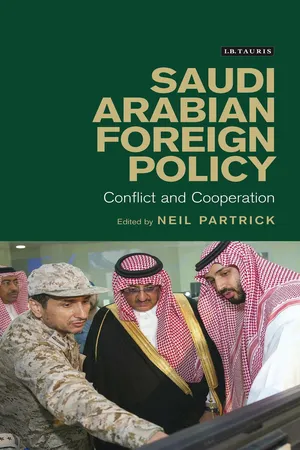
As the only oil producer with sufficient spare capacity to shape the world economy, Saudi Arabia is one of the most significant states in twenty-first century geopolitics. Despite the enormous potential for Saudi Arabia to play a more robust regional and international role, the Kingdom faces serious internal and external challenges in the form of political incapacity and competition with states such as Iran. In this examination of Saudi Arabia's foreign policy, Gulf expert Neil Partrick, and other regional analysts, address the Kingdom's relations in the Middle East and wider Islamic world, and its engagement with both established and emergent global powers. In doing so, he analyses the factors, ranging from identity politics to Iranian acquisition of nuclear weapons that determine the Kingdom's foreign policy. As Saudi Arabia prepares for a generational shift brought about by an ageing leadership, the rapidly changing balance of power in the Middle East offers both great opportunity and great danger. For students of the Middle East and international relations, understanding Saudi Arabia's foreign policy and its engagement with the region and the world is more important than ever.
'A very welcome addition to the literature on Saudi Arabia – a much needed overview of Saudi foreign policy for scholars and policy makers, while also being accessible to the wider public.' - Gabriele vom Bruck, Senior Lecturer in the Anthropology of the Middle East, SOAS, University of London.
'This volume is terrific as a reference and also a good read.' – Michele Dunne, Director and Senior Associate, Middle East Program, Carnegie Endowment for International Peace
'A timely book to help us understand the history and motivation of the major Sunni regional power. This collection of articles covers the whole gamut of Saudi's main external relationships including the role play by Islam and oil in shaping its foreign policy.' - Sir William Patey, UK Ambassador to Saudi Arabia 2007-10
- 416 pages
- English
- ePUB (mobile friendly)
- Available on iOS & Android
eBook - ePub
About this book
Information
PART I
THE INTERNAL CONTEXT
CHAPTER 1
DOMESTIC FACTORS AND FOREIGN POLICY
Context
Saudi foreign policy is articulated, applied and sometimes reviewed or even reversed, according to both domestic and external factors. This contextual chapter, the first of three, will examine the various domestic constituencies and characteristics – tribal, religious, economic and familial – that feed into the Saudi foreign policy making process.
Any political system in which leadership authority is based on acceptance by key domestic constituencies exercises autonomy in the conduct of foreign policy. However, it cannot wholly disregard popular, ‘collective’, sentiment. In Saudi Arabia, like much of the Arab world, such sentiment is often about fealties to things other than the nation: Islam, tribe and less coherently, to ‘Arabism’.
Saudi national identity is nascent but it is felt. The degree of affiliation to the Saudi nation remains conditioned by other identities and by the extent to which the ruling family, who partly define the nation, uphold the highly conservative interpretation of Islam that the state has sought to embody since its creation. State and nation are arguably not yet that distinguishable. The latter did not predate the former and the deepening of national coherence remains largely a state-led project. The challenges to the Saudi nation state are compounded when it is almost by definition indistinguishable from the family that rules it.
Acceptance, and in some cases admiration for the Saudi leadership has come through a combination of state largesse – directly or indirectly – and ideational mobilisation. However, the leadership are not beyond criticism. Ever since the founding of the Kingdom, Islam has periodically been used by some Saudi Islamists to rhetorically, or even violently, attempt to delegitimise the leadership, sometimes in combination with attacks on the inequity of wealth distribution.
The Saudi leadership navigates using the power of patronage on the one hand and the promotion of Islam on the other. However, it is very aware of the constraints of the former and of the ability of dissidents and regional opponents alike to use the latter as a critique against them.
Islamic bodies
Saudi Arabia has created several Islamic organisations with influence in the Muslim world which cement its sense of itself and perceptions of it as an international Islamic actor. This was almost bound to be the case as soon as state founder Abdulaziz bin Abdulrahman (aka ‘Ibn Saud’) took the two holiest places in Islam (haramain) in 1925 and pilgrimage revenues became the primary state earner until oil.
In the modern era, the Saudi state as organiser of the haj and umra (secondary pilgrimage) provides a self and internationally defining role. This does not make the state beyond criticism, as periodic tragedies attest. There are inevitable logistical and security problems attached to organising the haj, which attracts more than three million foreign and domestic pilgrims, and umra, with approximately six million annual participants.
Key Islamic bodies are the Organisation of the Islamic Conference (OIC) established by King Faisal in 1969, Al-Rabita (Muslim World League) founded a few years earlier as an Islamic outreach body and the Higher Council of Ulema (HCU).1 All of these will be examined in greater detail in the following chapter ‘Islam and Identity in Foreign Policy’.
In some cases the work of public bodies clashes with the state interest as articulated by Al-Saud leaders. Bodies like Al-Rabita, the HCU and charitable bodies linked to the government and to official ulema2 have been known to use their resources externally. This means that the funds of religious bodies, as well as that of the King and other arms of the Al-Saud political leadership, have been deployed abroad to influence religious and political affairs on the ground.
In Yemen for example, financial support from Saudis, both within and without the official conduct of foreign policy, is pocketed by those who identify themselves as salafi and are seen as weakening the Kingdom's enemies. However, Yemeni salafis are not simply tools of either the King or of Saudi religious bodies. Therefore, they are not an extension of Saudi foreign policy, directly or indirectly, but an external patronage network.
Saudi ‘private’ money is also provided (or encouraged) by princes for foreign causes. This provision causes considerable ambiguity between what is clearly the preserve of the state, albeit a family-run one, and what is family. It encompasses donations that support Islamic activity, whether religious, cultural or political.
Also falling under the heading of Islamic official bodies with a role in foreign policy is the Jeddah-based Islamic Development Bank (IDB), which provides developmental assistance largely in the Muslim world. This is not a Saudi bank but it was a Saudi initiative and the Saudi state is the largest shareholder and contributor.
The IDB is regarded as a reasonably efficient institution partly because it operates at several removes from the Saudi government and other shareholding Arab states. However, its autonomy has made controversial funding decisions more likely and it can fall victim to political differences. IDB assistance to Gaza after Hamas became responsible for its administration embarrassed the Saudi government.3 However, this is the kind of funding that the Saudi and other Arab/Muslim governments like to appear to have some distance from.
The most important domestic Islamic or related organisations are the HCU and the Ministry of Awqaf, Da'wa (‘calling’), Guidance and Islamic Affairs. The most important Saudi legal body is the Supreme Committee of the Judiciary (SCJ). Membership of the SCJ is largely made up of Islamic scholars who are expert in the Hanbali madhab (school) of Islamic law whose conservative Sunni interpretation is favoured by Wahhabi clerics in the Kingdom and more widely. However, salafism in Saudi Arabia, with its exclusive packaging of the sunnah (traditions) of the Prophet from which acceptable hadeeth (sayings) are gleaned, provides an almost post-madhab theology that suits the rulers. Its relatively quietistic tradition of clerics providing private nasiha (advice) has served the Saudi state well. The SCJ is headed by an HCU member while the Awqaf is always headed by a member of the Ahl Al-Sheikh family, descendants of Mohammed bin Abdul-Wahhab, the indispensable ally of the eighteenth-century Saudi entity's founder, Mohammed bin Saud.
The HCU has an executive board consisting of the 21 most senior official clerics. It is under the chairmanship of the Grand Mufti, who is almost always a member of the Ahl Al-Sheikh family. King Abdullah gave the HCU the task of reforming the application of Islamic law. King Abdullah's desire to prevent any embarrassing fatwa (Islamic judgment), or at least to provide an official one that could be presented as trumping undesirable judgements on domestic social matters, or on issues with a foreign affairs implication, effectively nationalised fatwa issuance. However, so far that has not been anything other than informal control. In the same way, a planned codification of shariah that would supposedly enable predictability in the application of legal judgements across a range of issues has not yet emerged. This would be useful for business, both domestic and foreign, but it threatens the clerical class' sometime perception of itself as a partner in power. As such there is still some official clerical resistance to the proposed reform but equally there are those judicial officials who would welcome predictability and routine rather than having to exercise responsibility.
Also relevant is the ministry of justice (MoJ), which is responsible for the building and administration of the courts. Mohammed Issa (minister from 2009 to January 2015), although not senior in either juridical or clerical matters, proved adept at ensuring that the SCJ, and the 13 member board that heads it, was largely subject to his will. The SCJ has a training and oversight role in the ostensibly independent Supreme Court. Formerly part of the SCJ, this is the highest court in the Kingdom. In February 2015, Issa was replaced as justice minister by Walid Al-Samaani. If he is a less political player, MoJ attempts to directly control the SCJ could subside. Either way, gradual legal reform is assumed to remain on the agenda under King Salman.
Non-payroll clerics
Among those clerics not employed by the state, a more critical view is sometimes expressed about both domestic and foreign matters. Although these overwhelmingly salafi clerics dress up their comments as nasiha (advice), they sometimes express them publicly which makes them, almost by definition, political. Clerics with far greater numbers of (virtual) adherents than the Grand Mufti can irritate, if not downright antagonise those in government. A critical voice from the dissenting 1990s Sahwa (Islamic Awakening) movement, Mohsen Al-Awaji, was detained for a week in July 2013 after calling for a petition in support of the deposed Muslim Brotherhood (MB) president of Egypt, Mohammed Morsi, a figure the Saudi leadership was delighted to see fall. Al-Awaji had been a largely co-operative if not co-opted voice in the 2000s. However, he remained close to clerical figures like Sheikh Salman Al-Awdah who has made comments in support of the changes in allied Arab countries and suggested the need for reform at home. Al-Awdah himself has been relatively constrained by the authorities while more radical elements from within the Wahhabi tradition have periodically been imprisoned. Shortly after Al-Awaji was arrested, the Grand Mufti spoke against seditious opinion. The ultra-conservative Sunni interpretation that has upheld the nizam siyassi (political system) as opposed to matters of aqida (religious creed) was ritually reinforced by official clerics in the early period of the uprisings. However, this was reversed when Saudi Arabia backed the forcible change of leadership in Libya and later in Syria. Abstruse arguments that these were Godless regimes (in contrast, presumably, with the Islamic standing of the former government of Hosni Mubarak in Egypt) were used to justify this stance.
Non-payroll clerics who are prepared to link a reform mood elsewhere in the Arab world with support for change at home are not influencing Saudi foreign policy. However, the more popular clerics, coming as they do from within the Sunni mainstream, sometimes raise government hackles. This became acute when some clerics including a few who are senior payroll figures4 criticised the method by which Morsi's rule was ended. That said, most dissenting Saudi Islamists are not pro-MB nor are they necessarily supporters of multi-party democracy.
The Saudi MB, such as it is, is a subterranean and diffuse trend within the Kingdom. Adherents can marshal support when given a (limited) political opportunity such as the municipal council elections of 2005, and some MB-inclined figures were a part of the Sahwa trend. It has played a historical role, mostly via foreign MB exiles, in the Saudi education sector and arguably has a ‘salafised’ presence in the court system too. In the 1960s and 1970s King Faisal allowed the Saudi Islamic charitable foundation, the World Association of Muslim Youth (WAMY), to be staffed by many MB exiles as part of his competition with Nasser's Egypt. However, the MB is not an autonomous, organised actor in the Saudi body politic and was not able to coherently exploit the Arab uprisings.
Saudi Shia: A ‘negative’ foreign policy role
Among the Shia minority (around 10 per cent of the Saudi national population) political opinion tends to galvanise around figures with religious standing, although there are other influential figures from a secular background who are not aligned with Saudi Shia clerics. The predominant political trend in Eastern Province, where the Shia tradition is ‘Twelver’ (as practised in Iran and Iraq), and where many, but certainly not all Shia reside,5 is identifiable as Islah (reform). It is led by those formerly from a radical strain of Shia Islamist opinion sympathetic to Iran but who these days pursue gradualist objectives. Their semi co-option included involvement in the late King Abdullah's National Dialogue, a state-sponsored discussion forum, and membership in a municipal council in the populous Shia-dominated Gulf city of Qateef. Other more radical Saudi Shia Islamists have come under greater pressure since the Arab uprisings. Their strident attacks feed into a government conception that Iran is not only a threat within the GCC area, principally in Bahrain, which is proximate to Eastern Province, but among the Saudi Shia too. The result is that any Saudi Shia domestic dissent makes an improved Saudi government relationship with Iran more difficult. The alienation caused to Saudi Shia by violent attacks on them by Saudi DAISH supporters in May 2015 could further complicate Saudi–Iranian relations.
Tribal underpinnings
Sunni and some Shia clerics, even some of those of a critical view, are part of a clientelist structure in Saudi Arabia. It is when they break from the unspoken bounds of that relationship that serious tensions occur. Clientelism has been part and parcel of Saudi Arabia's political life since its formation. The clerics who officiated over the preter-state nizam islami (Islamic political system) were originally genuine ‘partners in power’.6 The contemporary state's clerics and the many co-opted but non-payroll ones have since become parts of this clientelist fabric.
Ibn Saud's ability to establish the Saudi state required this partnership from the outset. It was intimately connected with the tribal co-options necessary in the pre state era to capture and maintain territory. It was tribal as much as Islamic dissent that sparked and ultimately ended the infamous Ikhwaan revolt at Sabila in 1929. Part of Saudi Arabia's founding national ‘myth’, the Ikhwaan were crushed by an Al-Saud-led tribal alliance conducted in the name of wahde (unity) under Islam. A tribal alliance, with the Al-Saud primus inter pares, has held ever since as the state has become a patron of tribes through their leaders, both within Saudi Arabian borders and without.
However, this is no longer the tribal state of lore. A Saudi's fealty today is not necessarily to the state simply be...
Table of contents
- Front Cover
- Title Page
- Copyright
- Contents
- List of Illustrations
- Preface
- Glossary
- Notes on Contributors
- Part I The Internal Context
- Part II Saudi Arabia’s Foreign Relations
- Conclusion
- Select Bibliography
Trusted by 375,005 students
Access to over 1.5 million titles for a fair monthly price.
Study more efficiently using our study tools.
Frequently asked questions
Yes, you can cancel anytime from the Subscription tab in your account settings on the Perlego website. Your subscription will stay active until the end of your current billing period. Learn how to cancel your subscription
No, books cannot be downloaded as external files, such as PDFs, for use outside of Perlego. However, you can download books within the Perlego app for offline reading on mobile or tablet. Learn how to download books offline
We are an online textbook subscription service, where you can get access to an entire online library for less than the price of a single book per month. With over 1.5 million books across 990+ topics, we’ve got you covered! Learn about our mission
Look out for the read-aloud symbol on your next book to see if you can listen to it. The read-aloud tool reads text aloud for you, highlighting the text as it is being read. You can pause it, speed it up and slow it down. Learn more about Read Aloud
Yes! You can use the Perlego app on both iOS and Android devices to read anytime, anywhere — even offline. Perfect for commutes or when you’re on the go.
Please note we cannot support devices running on iOS 13 and Android 7 or earlier. Learn more about using the app
Please note we cannot support devices running on iOS 13 and Android 7 or earlier. Learn more about using the app
Yes, you can access Saudi Arabian Foreign Policy by Neil Partrick in PDF and/or ePUB format, as well as other popular books in Ciencias sociales & Historia de Oriente Medio. We have over 1.5 million books available in our catalogue for you to explore.