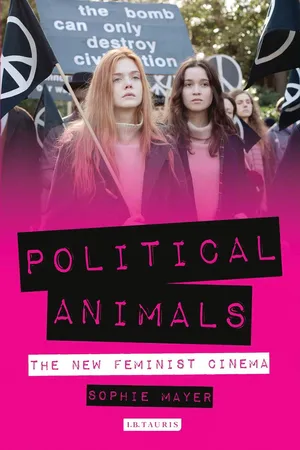
Feminist filmmakers are hitting the headlines. The last decade has witnessed: the first Best Director Academy Award won by a woman; female filmmakers reviving, or starting, careers via analogue and digital television; women filmmakers emerging from Saudi Arabia, Palestine, Pakistan, South Korea, Paraguay, Peru, Burkina Faso, Kenya and The Cree Nation; a bold emergent trans cinema; feminist porn screened at public festivals; Sweden's A-Markt for films that pass the Bechdel Test; and Pussy Riot's online videos sending shockwaves around the world. A new generation of feminist filmmakers, curators and critics is not only influencing contemporary debates on gender and sexuality, but starting to change cinema itself, calling for a film world that is intersectional, sustainable, family-friendly and far-reaching. Political Animals argues that, forty years since Laura Mulvey's seminal essay 'Visual Pleasure and Narrative Cinema' identified the urgent need for a feminist counter-cinema, this promise seems to be on the point of fulfilment.
Forty years of a transnational, trans-generational cinema has given rise to conversations between the work of now well-established filmmakers such as Abigail Child, Sally Potter and Agnes Varda, twenty-first century auteurs including Kelly Reichardt and Lucretia Martel, and emerging directors such as Sandrine Bonnaire, Shonali Bose, Zeina Daccache, and Hana Makhmalbaf. A new and diverse generation of British independent filmmakers such as Franny Armstrong, Andrea Arnold, Amma Asante, Clio Barnard, Tina Gharavi, Sally El Hoseini, Carol Morley, Samantha Morton, Penny Woolcock, and Campbell X join a worldwide dialogue between filmmakers and viewers hungry for a new and informed point of view. Lovely, vigorous and brave, the new feminist cinema is a political animal that refuses to be domesticated by the persistence of everyday sexism, striking out boldly to claim the public sphere as its own.
- 272 pages
- English
- ePUB (mobile friendly)
- Available on iOS & Android
eBook - ePub
About this book
Information
1
Ain’t about the (uh) Cha-Ching, Cha-Ching
Framing the New Feminist Cinema
Going Outside
From the set of Selma (2014), Ava DuVernay gave Manohla Dargis a powerful insight into the real struggle and practice of contemporary feminist cinema. ‘It’s not really all about money’, she said, but ‘about allowing our imaginations – and giving ourselves permission – to go outside’.1 ‘Go[ing] outside’, whether speaking from the Selma courthouse or a blog post, may be the pre-eminent trend in feminist film this century, describing its ambition, reach and outspokenness. In the introduction, Elsa and Anna, Kathleen Hanna, Shannen Koostachin and Angela Y. Davis are all pictured ‘go[ing] outside’, representing both the new global feminist politics and feminist filmmakers’ engagement therewith.
Permission may not arise from film funding, but the ways in which money is framed (as opposed to money itself) remain a key determinant of ‘access to the means of inscribing one’s vision and having it reckoned with as important in any way’, as Sarah Brouillette phrases it.2 It matters that Selma has passed the $50 million mark at the US box office, and that Women and Hollywood exists to report it, because of the incalculable potential social effects of that reportage.3 Facts and figures on gender in film have been emerging with regularity and urgency since Kathryn Bigelow became the first woman to win Best Director at the Academy Awards and then the BAFTAs in 2010, galvanizing attention to the shameful statistics on unequal participation across the industry.
Martha Lauzen’s work with the Center for the Study of Women in Television and Film, Stacy L. Smith’s work with the MDSC Initiative at the Annenberg Center and See Jane (a programme started and promoted by Geena Davis), the European Women’s Audiovisual Network and many more bodies and individuals are recording and reporting the numbers. This labour-intensive work is generally limited to the top 100 grossing films. While understandable, such a cap doesn’t account for the full range of participation of women in the industry, and continues to allow monetary value and the mainstream to define success.

Fig. 5: Ava DuVernay directing a crowd scene in Selma.
Frozen has made $1.3 billion worldwide, the eighth highest-grossing film of all time (as of August 2015), and the only film in the top 50 with a female (co) director, but those figures have had vanishingly little transformative effect.4 As Bruce Handy concludes his analysis of the dramatic success of films with female protagonists at the US box office in 2013, ‘according to math, the studios appear to be leaving money on the table, one sin they’ve rarely if ever been accused of’.5 ‘Ain’t about the (uh) cha-ching, cha-ching’, as the a cappella group sing in Pitch Perfect (Jason Moore, 2012, from a screenplay by Kay Cannon), covering Jessie J’s ‘Price Tag’. Pitch Perfect grossed nearly ten times its medium budget worldwide, its ensemble comedy cuing singalong events and a female-helmed sequel (Elizabeth Banks, 2015), the highest-grossing musical comedy ever, driven by fan culture. Both the box office and fandom are important – yet have done little to challenge the entrenched sexism and racism revealed through the leaked Sony emails in December 2014, as analysed by Lexi Alexander.6
Stacy L. Smith has demonstrated that women may be moving towards parity in US independent cinema, but not the studio system.7 Melissa Silverstein quotes her succinct observation that, ‘as U.S. studio money comes in, females are pushed out’.8 In independent and alternative cinemas, representation is more equal, often due to an intersectional commitment from funders and programmers. Danis Goulet observes that, ‘Within Indigenous cinema, women are a serious force to be reckoned with… approximately 37% of the [imagineNATIVE’s] festival submissions had come from women in [2012], and 62% of official selections were made with Indigenous women in a key creative position’.9 Systemic intersectional exclusion expresses itself through economies of scale, so that the higher budget accorded a film, the less likely it is to have a filmmaker or protagonist who is not, in Grayson Perry’s resonant term, a ‘Default Man’.10
The production narrative of Selma offers a keen reflection of systemic exclusion and its tenuous connection to balance sheets. Despite being a prestige biopic of a national hero, a favoured awards genre, the film’s greenlight depended on star David Oyelowo, who brought not only director DuVernay on board (having worked on her Sundance-winning, self-distributed feature Middle of Nowhere [2012]), but also producer Oprah Winfrey, with whom he had been cast in The Butler (Lee Daniels, 2013). As he told Gary Younge:
I had shared my dream with her of playing this role. She said, ‘I’d do anything and everything I can to help you with that’. So, not wanting to look that gift horse in the mouth, I said, ‘OK, I need you, mama’. And she came on board and that literally was the moment we were off to the races.11
Oyelowo’s story bespeaks the complexity of a contemporary media landscape that cannot be summed up in statistics, in which Winfrey’s anomalous position, as a hugely successful African American woman in US media, both does and does not counterbalance the persistence of systemic inequality. For a full picture of feminist cinema, we need to go outside the conventional narratives of film history and reportage.
Believing in Plenty
Like statistics, newsworthy ‘firsts’ such as DuVernay’s Golden Globe and Academy Award nominations, are both a telling and delimiting way of reporting on feminist film in the twenty-first century. Firsts, such as Jennifer Lee being the first female co-director of a Disney animation feature, often tokenize, obscuring rather than illuminating the coherent and continuous history of innovation and activism by female-identified filmmakers. We need to link all the ‘firsts’ together into an alternate film history. Lee’s current success might remind us that, in the 1920s, Lotte Reiniger pioneered silhouette animation, which, she noted, contained ‘feminine and masculine elements that play into each other’s hands’.12
Reiniger’s impish account is included in Antonia Lant and Ingrid Periz’s collection Red Velvet Seat: Women’s Writing on the First Fifty Years of Cinema, which brings together innovating filmmakers such as Maya Deren, Germaine Dulac and Alice Guy-Blaché with early film theorists such as the poet H.D. (Hilda Doolittle). With her ex-husband and girlfriend, H.D. founded Close-Up, Britain’s first serious film magazine, and made the experimental mixed-race bisexual romantic drama Borderline (Kenneth Macpherson, 1930). Lant and Periz’s project is part of an ongoing initiative that begins with archival detective work and critical analysis in the 1970s, such as Claire Johnston’s The Work of Dorothy Arzner: Towards a Feminist Cinema.13 This essential recovery work informed and intertwined with the feminist counter-cinema called for by Laura Mulvey in her 1975 article ‘Visual Pleasure and Narrative Cinema’, and which she practised in her own films.14
Almost two decades later, Hollywood noticed, marking 1993 as ‘Year of the Woman’ at the Academy Awards, after the success of Thelma and Louise (Ridley Scott, 1991, from a screenplay by Callie Khouri), The Piano (Jane Campion, 1993) and Orlando (Sally Potter, 1992). The subsequent blossoming of global feminist cinemas, as described in the introduction, makes it possible to respond to statistics on the mainstream by ‘rejecting models of scarcity, believing in plenty’, as poet Jill McDonough responds to VIDA’s depressing figures on women in literary publishing.15 The committed coverage of blogs such as Women and Hollywood, African Women in Cinema and Wellywood Woman (and the online camaraderie of their authors Melissa Silverstein, Beti Ellerson and Marian Evans),16 as well as journals such as the short-lived Joan’s Digest and hopefully long-lived cléo: a journal of film and feminism,17 further enables my refutation of scarcity.
At the same time, as the editors of Celluloid Ceiling: Women Film Directors Breaking Through observe, for many cisfemale and trans*, intersex and non-binary filmmakers worldwide, access is dependent on economic privilege (often linked to ethnic, class, caste, abled, cis, straight and/or educational privilege), a prior career as a performer (often connected to socially-constructed perceptions of physical beauty), and also to family networks.18 Additionally, there remains a willed ignorance and determined erasure of history.
Clio Barnard’s docudrama The Arbor (2010), like many contemporary feminist films, highlights the swiftness of this erasure, seeking out both personal and professional memories of the comet-like career of playwright Andrea Dunbar. Within our dual transitional phase of digital multi-platforming and global austerity, there are both ever more reasons for films and filmmakers to fall through the cracks, and ever-more inventive guerrilla distribution strategies to prevent further erasure. British feminist distributor Cinenova, formed following the merger of Circles and Cinema of Women, has set up a pay-what-you-can digital cinematheque at the Showroom Gallery in London, to ensure that some viewers can access rarities, from Tracey Moffatt’s documentary on Aboriginal Australian feminists, Moodejit Yorgas (Solid Women, 1990) to Bev Zalcock and Sara Chambers’ lo-fi sci-fi ‘Space Dog Assassin’ (1998).19
Feminist film scholarship has been critical in maintaining an awareness of inaccessible films, rather than seeking to institute a canon. Patricia White notes that she was wary of producing an ‘updated, cosmopolitan edition of what Andrew Sarris notoriously called the “ladies auxiliary” to his pantheon of great directors [which] could be considered fundamentally at odds with feminist work on authorship’.20 Authorship, like box office success, is a...
Table of contents
- Cover
- Title
- Copyright
- Contents
- List of Figures
- Acknowledgements
- Introduction: Girls to the Front
- 1. Ain’t about the (uh) Cha-Ching, Cha-Ching: Framing the New Feminist Cinema
- 2. Not in Kansas: Animal Selves and Becoming-Girls
- 3. Water Rites: Ecocinema’s New Earth Mothers
- 4. Home Front: Women at War, Women against War
- 5. I Have No Country: British Cinema as a Runaway Girl
- 6. All Dressed Up: Costume Drama Loosens its Corset
- 7. Mirror, Mirror: Fairy Tales of the Feminist Fantastic
- 8. Girl ‘Hood: A Body, a Room and a World of One’s Own
- 9. Haunted Houses: Reclaiming ‘Women’s Cinema’
- 10. Come Together: Love, Justice and a New Sexual Politics
- Conclusion: An Open Letter
- Notes
- Further Reading
Trusted by 375,005 students
Access to over 1.5 million titles for a fair monthly price.
Study more efficiently using our study tools.
Frequently asked questions
Yes, you can cancel anytime from the Subscription tab in your account settings on the Perlego website. Your subscription will stay active until the end of your current billing period. Learn how to cancel your subscription
No, books cannot be downloaded as external files, such as PDFs, for use outside of Perlego. However, you can download books within the Perlego app for offline reading on mobile or tablet. Learn how to download books offline
Perlego offers two plans: Essential and Complete
- Essential is ideal for learners and professionals who enjoy exploring a wide range of subjects. Access the Essential Library with 800,000+ trusted titles and best-sellers across business, personal growth, and the humanities. Includes unlimited reading time and Standard Read Aloud voice.
- Complete: Perfect for advanced learners and researchers needing full, unrestricted access. Unlock 1.5M+ books across hundreds of subjects, including academic and specialized titles. The Complete Plan also includes advanced features like Premium Read Aloud and Research Assistant.
We are an online textbook subscription service, where you can get access to an entire online library for less than the price of a single book per month. With over 1.5 million books across 990+ topics, we’ve got you covered! Learn about our mission
Look out for the read-aloud symbol on your next book to see if you can listen to it. The read-aloud tool reads text aloud for you, highlighting the text as it is being read. You can pause it, speed it up and slow it down. Learn more about Read Aloud
Yes! You can use the Perlego app on both iOS and Android devices to read anytime, anywhere — even offline. Perfect for commutes or when you’re on the go.
Please note we cannot support devices running on iOS 13 and Android 7 or earlier. Learn more about using the app
Please note we cannot support devices running on iOS 13 and Android 7 or earlier. Learn more about using the app
Yes, you can access Political Animals by So Mayer in PDF and/or ePUB format, as well as other popular books in Social Sciences & Film & Video. We have over 1.5 million books available in our catalogue for you to explore.