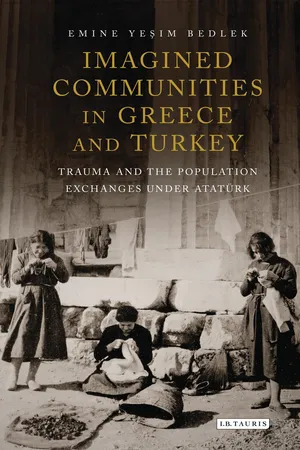
eBook - ePub
Imagined Communities in Greece and Turkey
Trauma and the Population Exchanges under Ataturk
- 224 pages
- English
- ePUB (mobile friendly)
- Available on iOS & Android
eBook - ePub
Imagined Communities in Greece and Turkey
Trauma and the Population Exchanges under Ataturk
About this book
In 1923 the Turkish government, under its new leader Kemal Ataturk, signed a renegotiated Balkan Wars treaty with the major powers of the day and Greece. This treaty provided for the forced exchange of 1.3 million Christians from Anatolia to Greece, in return for 30,000 Greek Muslims. The mass migration that ensued was a humanitarian catastrophe - of the 1.3 million Christians relocated it is estimated only 150,000 were successfully integrated into the Greek state. Furthermore, because the treaty was ethnicity-blind, tens of thousands of Muslim Greeks (ethnically and linguistically) were forced into Turkey against their will. Both the Greek and Turkish leadership saw this exchange as crucial to the state-strengthening projects both powers were engaged in after the First World War. Here, Emine Bedlek approaches this enormous shift in national thinking through literary texts - addressing the themes of loss, identity, memory and trauma which both populations experienced. The result is a new understanding of the tensions between religious and ethnic identity in modern Turkey.
Trusted by 375,005 students
Access to over 1.5 million titles for a fair monthly price.
Study more efficiently using our study tools.
Information
CHAPTER 1
THE MILLET SYSTEM: AN OTTOMAN LEGACY IN LAUSANNE
The Millet-i Rum
The millet system was established by Sultan Mehmet II as he conquered Constantinople in 1453 and gathered different ethnic and religious groups under his reign. The millet system, which established religion as an ethnic identification, lasted until it was eliminated in 1839 with the Tanzimat Charter. The Westernisation of the Empire continued with the Islahat Charter of 1856. With the pressure and influence of the West, the Tanzimat and Islahat Charters reorganised Ottoman society, abandoning traditional society for a more modern and Western direction.1 Thereafter, non-Muslims were practically regarded as citizens of the Empire. However, Alexis Alexandris states that the Ecumenical Patriarch Iōakeim III resigned his post as a reaction to the new system that affected the privileges of Millet-i Rum in the early 1880s. His protest and resignation ‘forced Sultan Abdülhamid II to issue a proclamation restoring the traditional rights and privileges of the Greek millet’.2 Thus, the millet system continued to function until the signing of the Treaty of Lausanne in 1923. This was obviously a contradiction for the negotiators of the Lausanne Convention because both Greece and Turkey, two modern nation states, were trying to bury all legacies of the Ottoman Empire during their foundation. However, they could not manage to divide the peoples of the Aegean without consulting the millet system because that was how they had been ruled for centuries. The ethnic and religious ambiguity of Ottoman society was so complex that it was not easy for the new nation states to eliminate this Ottoman institution at once. In order to understand how this Ottoman legacy operated or functioned at Lausanne, one should know the millet system and the role of religious affiliation in Ottoman society as well as in the lives of the Orthodox Christians within the Empire who were subject to the population exchanges.
Before discussing the millet system, it is crucial to clarify the terminology for Asia Minor and Anatolia, Greek and Rum, refugee and exchangee. Both of these terms, ‘Anatolia’ and ‘Asia Minor’, were coined by Greeks. ‘The word “anatoli” means “east” in Greek, more literally “the land of sunrise”’.3 Asia Minor, the heartland of the Ottoman Empire, is the standard terminology in Greece today. However Turkish people are not familiar with the word; they prefer to use ‘Anatolia’, the term adopted by the Ottomans after their conquest. The names of the cities and villages will be referred to both by their Greek and Turkish names throughout my book. Ottomans classified Orthodox Christians of Asia Minor as Millet-i Rum. As Bernard Lewis explains, ‘The word used by the Turks, and more generally by Muslims in the Middle East, to designate the Greeks is Rum. But Rum doesn't mean Greeks; Rum means Romans, and the use of the name, first by the Greeks themselves and then by their new Muslim masters, echoes their last memory of political sovereignty and greatness.’4 The Qur'an has a chapter titled ‘Rum’ in which the peoples of the Roman Empire were called Rum (30:1–2).5 Ottoman Sultans regarded themselves as the heirs of the Eastern Roman Empire and called their realm ‘Rumeli’ stemming from the land of the Romans. Rum, then, means the inhabitants of Rumeli. Therefore, Orthodox Christians of Asia Minor were called Rum. Millet-i Rum referred to Orthodox Christian subjects of the Empire. The Greeks of modern Greece are called Yunan or Yunanlı in Turkey. The Orthodox Christians of Asia Minor must be distinguished from the citizens of modern Greece because they are different socially, politically, culturally and linguistically.
For the purposes of this book, ‘Asia Minor’ is the preferred term rather than Anatolia since it is more common in Greek and Western historiography. For the words to define the Millet-i Rum of the Ottoman Empire, Asia Minor Greeks, Rum and the Ottoman Greeks are the common words used in both Turkish and Western historiography. With the rise of nationalism, the Greek Kingdom claimed that all Orthodox Christians of Asia Minor were ethnically Greek. Turkey also claimed that all Muslims of the Balkans and Greece were ethnically Turk. However, the correct words should be Orthodox Christians of Anatolia/Asia Minor, the Millet-i Rum or just the Rum because these are what really define the Orthodox Christians of Asia Minor who were different from the Greeks of modern Greece. Furthermore, the ethnic diversity of the Ottoman Empire makes it impossible to define people without referring to their religious affiliations. For the Turkish exchangees who migrated from Greece to Turkey, the correct word should be the ‘Muslims of Greece’ for the same reasons. In this book, I will mostly use ‘Orthodox Christians of Asia Minor’. However, ‘Asia Minor Greeks’, ‘Ottoman Greeks’, Rum and the Millet-i Rum will also be used to show how Orthodox Christians were identified and named in history.
The terminology for the exchanged peoples of Turkey and Greece used after the Lausanne Convention is also important to identify and address the Orthodox Christians of Asia Minor and the Muslims of Greece. Orthodox Christians of Asia Minor are called ‘refugees’ in Greece although they were given citizenship by the Lausanne Convention. Normally, the term ‘refugee’ is not appropriate to refer to the Christians of Asia Minor because a refugee does not have a citizenship in the host country. However, the Christians of Asia Minor call themselves ‘refugee’ to be distinguished from the local Greeks.6 In Turkey, mübadil, meaning exchangee, is a common word that refers to the exchanged peoples of Lausanne; whereas ‘refugee’ is not used at all. While Muslims of Crete refer to themselves as ‘exchangees’, the Muslims of Greece prefer muhacir, meaning immigrant.7 Tolga Köker informs us of ‘muhacirs being the immigrants of Atatürk's presidency (1923–1938) and göçmens those of İnönü's (1938–1950)’.8 This implies that immigrants from the Balkans and Crete are classified according to the time of their arrival to Turkey. Each immigrant group tried to identify themselves in the host country.
The millet system has always been a subject of debate among historians and scholars since, unlike in the Western colonial tradition, the Ottoman Empire did not for the most part colonise and assimilate its subjects by force. Kemal Karpat says that ‘Linguistic, ethnic and religious assimilation occurred on a local basis, rather than on a global one, and was largely voluntary, based on the relative influence of a majority group.’9 It was not by force as in the case of Western imperialism because the Ottoman Sultans created a harmonious multicultural society within which subjects of the Empire were autonomous. Ethnicity and religion were closely connected, and the subjects of the Empire were identified through their faith, rather than by race or ethnicity. Karpat also claims that the millet system, which was a religion-based identification of the Ottoman subjects, gave birth to nationalities within the Ottoman Empire.10 National identification stemmed from the millet system, which ‘enabled them to retain their separate identities and religious organizations’.11
The millet system was based on Islamic (Sharia) law. According to the Sharia, as Seyyed Hossein Nasr states, human rights are consequences of human obligations and ‘Islam holds this conception not only for its own followers but also for the followers of all other religions who, therefore, as religious minorities, are given rights under their own religious codes.’12 This was how the Ottoman subjects were ruled. Furthermore, the Qur'an has several verses that forbid racism and compulsory conversion of people to Islam: ‘O mankind! We created you from a single (pair) of a male and a female, and made you into nations and tribes, that ye may know each other (Not that ye may despise each other)’ (49:13), ‘Let there be no compulsion in religion’ (2:256), ‘If it had been the Lord's Will, they would all have believed – All who are on earth! Wilt thou then compel mankind, against their will, to believe!’ (10:99).13 The Qur'an teaches Muslims to be ideal believers who should be tolerant and respectful towards the followers of other religions. Islam opposes racism, aspiring instead to universal egalitarianism rather than privileging one particular group.
The word millet, derived from ‘mille’ in Arabic, did not have the meaning of ‘nation’ it has now.14 The millet system was based on Islamic law and it was a division of monotheistic religions into various sects. Thus, each religious group was recognised through its faith, not ethnicity, because ethnicity was determined by religion. Alexis Alexandris says:
This was mainly the outcome of a remarkable system of government, the millet system, adopted by the Ottoman state machinery. Faced with the administration of a large cosmopolitan empire, the Islamic Ottoman ruling class granted a substantial degree of self-government to the non-Muslim religious minorities. Perhaps the most striking feature of the millet structure was its formation on strictly religious, rather than racial or linguistic, affiliations.15
The Ottoman Empire was a pluralistic society within which various ethnic and religious groups lived, worked and worshipped together. The largest group was the Muslim Turks, and the second largest group was the Orthodox Christians, the remnant population of the defeated Byzantine Empire who were more privileged compared to other millets. The Orthodox Christians remained as the privileged millet of the Empire with the support of the privileged Orthodox Church, and the Greek language continued flourishing without any obstacle. Greek was partly the official language of the Empire in which some declarations were written. Moreover, educated Orthodox Christians had administrative positions.16 The Ottomans successfully synthesised ‘the legal traditions of Islam, their own knowledge of the Byzantines, and the distinctive customs of the Turkish peoples’17 as they ruled the multi-ethnic Empire. Non-Muslims were the dhimmi (protected) subjects of the Empire, and they were literarily protected by the Ottoman state against any kind of violence or oppression.18
Halil İnalcık evaluates the millet system from an economic point of view as he thinks that the Ottoman Empire was not interested in creating a common culture, religion or language: for them, sovereignty over the people was more important.19 With the conquest of Istanbul in 1453, Sultan Mehmet II revived the Greek Orthodox Patriarchate in Phanar (Fener in Turkish), and it became the Church of all the Orthodox Christians in the Empire. Each religious group had their churches, and they were free to participate in the rituals required by their faith. İnalcık says that ‘It is an undeniable fact that in these vast empires the central government had to operate, for practical reasons, through such already established organizations, religious or professional, in which communal identity was essential’.20 Therefore, the relations between the Ottoman administration and the millets were mutual. As Bruce Clark states in Twice A Stranger, ‘as long as they remained loyal to their sovereign and his local representatives, and respected the privileges of the Muslims, the minorities were more or less free to go about their business as merchants, craftsmen or peasants’.21 Non-Muslim subjects were free in their commercial affairs unless they threatened the peaceful atmosphere of the society guaranteed by the Sultan. Mutual respect was meant to put everything in order in the Ottoman Empire. ‘For while the Ottoman sultans assumed the responsibility of protecting the life and property of their subject races, the heads of the millets, in return ensured the fidelity and obedience of their “flocks” to the Sublime Porte’,22 notes Clark.
According to Kemal Karpat, the millet system not only arranged the religious lives of Ottoman subjects, but also their social, political, cultural and economic lives.23 Orthodox Christians not only preserved their religion and culture, but also established international trade between the West and the East with the rich resources of the Ottoman land and through the help of the Greek Diaspora. The Greeks were highly urbanised and populated the biggest cities of the Empire such as Constantinople, Smyrna and Thessaloniki.24 Ottoman Greeks were also well educated because ‘The large Greek diaspora, first in Italy and the Balkans, then in Russia, Egypt, central and western Europe, and, finally, in the Americas, also provided this community a flow of ideas, funds, and various other kinds of support that helped their kin in the empire.’25 The schools of the minorities in the Empire were better than the schools of the Muslims. Furthermore, the Ottoman Greeks were also interested in studying abroad, a practice that also improved their language skills.26
Elena Frangakis-Syrett asserts that ‘The Greeks, whether as Ottoman citizens, European-protected subjects, or Hellenes, predominated in all sectors of trade – from large-scale international trade to medium-scale intraregional trade and from small-scale local trade in the interior to wholesale and retail trade in the stalls of the city's bazaars.’27 Although the Ottoman Greeks were well educated and they had opportunities to establish international trade, there was another reason behind their wealth. Since the Christian subjects of the Empire were exempt from military service, the burden of military service and long years of fighting in the battlefields was borne by Muslims. During their absence, the Christian subjects of the Empire purchased the farmlands of the Muslims because the women and children, whose husbands and fathers ...
Table of contents
- Front Cover
- Title Page
- Copyright
- Contents
- Acknowledgements
- Introduction
- 1. The Millet System: An Ottoman Legacy in Lausanne
- 2. Memories of Exile: Witnessing the Catastrophe
- 3. Nationalism in Asia Minor: Resolution of a Conflict
- 4. Imperial Identities of Mikrasiátes
- Conclusion
- Notes
- Bibliography
Frequently asked questions
Yes, you can cancel anytime from the Subscription tab in your account settings on the Perlego website. Your subscription will stay active until the end of your current billing period. Learn how to cancel your subscription
No, books cannot be downloaded as external files, such as PDFs, for use outside of Perlego. However, you can download books within the Perlego app for offline reading on mobile or tablet. Learn how to download books offline
Perlego offers two plans: Essential and Complete
- Essential is ideal for learners and professionals who enjoy exploring a wide range of subjects. Access the Essential Library with 800,000+ trusted titles and best-sellers across business, personal growth, and the humanities. Includes unlimited reading time and Standard Read Aloud voice.
- Complete: Perfect for advanced learners and researchers needing full, unrestricted access. Unlock 1.5M+ books across hundreds of subjects, including academic and specialized titles. The Complete Plan also includes advanced features like Premium Read Aloud and Research Assistant.
We are an online textbook subscription service, where you can get access to an entire online library for less than the price of a single book per month. With over 1.5 million books across 990+ topics, we’ve got you covered! Learn about our mission
Look out for the read-aloud symbol on your next book to see if you can listen to it. The read-aloud tool reads text aloud for you, highlighting the text as it is being read. You can pause it, speed it up and slow it down. Learn more about Read Aloud
Yes! You can use the Perlego app on both iOS and Android devices to read anytime, anywhere — even offline. Perfect for commutes or when you’re on the go.
Please note we cannot support devices running on iOS 13 and Android 7 or earlier. Learn more about using the app
Please note we cannot support devices running on iOS 13 and Android 7 or earlier. Learn more about using the app
Yes, you can access Imagined Communities in Greece and Turkey by Emine Yesim Bedlek in PDF and/or ePUB format, as well as other popular books in Politics & International Relations & Middle Eastern History. We have over 1.5 million books available in our catalogue for you to explore.