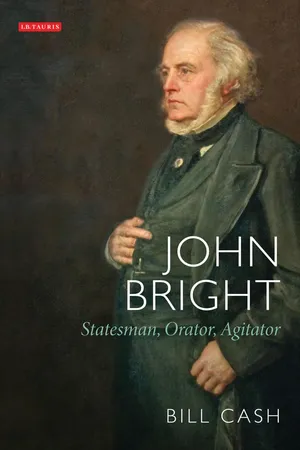
John Bright was one of the greatest British statesmen of the nineteenth century. In a series of Punch cartoons in 1878, Bright featured alongside Disraeli and Gladstone as among the most influential politicians of the age. However, his profound contribution to British politics and society has been virtually forgotten in the modern world.
Bright played a critical role in many of the most important political movements of the Victorian era, from the repeal of the Corn Laws to Home Rule. In his great campaign leading up to the Reform Act 1867, he fought for parliamentary reform on behalf of the working class and for the abolition of newspaper taxes. Internationally renowned as an orator, he was a dedicated opponent of slavery and champion of the North in the American Civil War. His testimonial for Abraham Lincoln's re-election was found in the President's pocket on his assassination. He was vigorously opposed to the Crimean War and campaigned against the oppression of the Irish tenantry and colonial subjects throughout the Empire. Fiercely independent, he eventually split from the Liberal Party over Home Rule, becoming a Liberal Unionist.
In this new biography, the first for over 30 years, Bill Cash provides an incisive and engaging portrait of a man who influenced the politics of his generation more than virtually any other, with important implications for the present day.
- 360 pages
- English
- ePUB (mobile friendly)
- Available on iOS & Android
eBook - ePub
About this book
Information
CHAPTER 1
The Unquiet Quaker: Battling Against the Corn Laws
I have nothing to gain by being the tool of any party.
(John Bright to the electors of Durham, 1843)
Bright the Man
‘My life is in my speeches.’1 This statement by John Bright in his later years, tinged as it was with exasperation at the stream of requests from would-be biographers, is only partly true. It may be that his speeches demonstrated his power of oratory, which by all contemporary accounts was remarkable, but they do not entirely convey the hidden and driven force which compelled Bright to deliver them. Nor do they show how Bright was a thoroughly rounded man, as well as being a political statesman.
Bright’s ideas, which could not really be called a philosophy, were derived from practical experience – part social, part religious and part political. They intertwined in a strong conviction that he was right, a conviction that fascinated and repelled people in equal measure. He was also deeply honest and despised flattery, often speaking so plainly as to cause upset. As his sister, Priscilla, wrote to his clearly rattled sister-in-law in the 1840s,
Thou must not mind all the fault John finds with thee, as he makes no scruple to say the very worst he can to our faces. But in justness to his character, I must say he says very little if anything against his friends, or enemies either, behind their backs; unless it be touching the aristocracy and the clergy.2
He certainly pulled no punches in the political arena, as Lord George Bentinck acknowledged when he said of Bright: ‘If he hadn’t been a Quaker, he would have been a prize fighter.’3
Bright’s moral strength was also evident in his appearance. He wore plain Quaker dress, standing out from his more fashion-conscious colleagues at Westminster in his sombre black coat and cravat, but it was his bearing that was most imposing. As one American journalist, George W. Smalley who met John Bright in 1866, described him:
His hair even then was gray [sic], though abundant, the complexion florid, and the rather irregular but powerful features gave you at first sight an impression of singular force and firmness of character. So did the whole man. The broad shoulders, the bulk of the figure, the solid massiveness of his masterful individuality, the immovable grasp of his feet upon the firm earth, his uprightness of bearing, the body knit to the head as closely as capital to column – all together made the least careful observer feel that here was one in whose armour the flaws were few.4
Yet, despite these impressive, and occasionally unnerving, traits, Bright was a man of great sympathy and friendship. He adored, and was adored by, his family, and found great joy and comfort in children, most notably his own eight children and, later, his grandchildren. Twice widowed, Bright particularly enjoyed the company of women, and his diaries are peppered with compliments about the intelligent and attractive women he encountered. The editor of his diaries, R. A. J. Walling, records, for example, that on his travels in 1835, Bright ‘studied female beauty on shore when it was available (and complained to his diary when it was not)’.5 On one occasion he even described the wife of the MP for Glasgow, Mrs Dennistoun, as ‘Magnificent! Perhaps the finest woman as animal I ever saw.’6
His powerful sense of humour was well recognized by those who met him. When it came to politics, however, no one underestimated his powerful and uncompromising sense of independence. Nevertheless, he invariably maintained courteous relations with his political opponents, reserving withering contempt only for those whom he loathed, such as Palmerston. It was his enemies who portrayed him as earnest and moralistic – as picked up by the historian, Llewellyn Woodward, when he described Bright displaying at times a ‘repellent religiosity’;7 others might call it courage of his moral convictions.
Religious belief was indeed central to Bright’s being, but it was not overbearing. He stated clearly in the House of Commons on one occasion that ‘This House is not the place for religious questions.’8 Even at home, where a pompous moralist might be expected to overwhelm family life with sermons and strictures, Bright was restrained. As his son, Philip, recalled, ‘I never heard my father mention religious questions in our home, although he was a deeply religious man, as his speeches abundantly prove.’9 Instead, the family shared a simple and enjoyable daily affirmation of their faith:
My father when at Rochdale invariably read the Bible to our household before breakfast, and so greatly did we delight in his reading that we were always down in time to hear him. He had a remarkable gift for reading and reciting poetry, and often made use of it for our benefit.10
Bright’s tastes included not only Milton and Tennyson but equally, and unexpectedly, the erotic Byron, and he had even visited the graves of Shelley and Keats.11 He returned frequently to the Meditations of Marcus Aurelius.
Bright was immensely well read and a true man of culture, with a natural appreciation of fine art. He shared with Disraeli the common experience of visiting the Near East as a young man, but there is little doubt that there the comparison ended. Whereas Disraeli’s visit with his friend James Clay could be described dissolute, Bright preferred culture, architecture and art. Indeed, when he travelled to Italy in 1857, he spent much of his time in art galleries, including the Vatican Museum, churches and ancient sites, and was fascinated by del Sarto, Michelangelo and Murillo, among many others.12
His company was much sought after at the best tables in London and around Westminster, where, despite the Quakers’ temperance convictions, he would enjoy alcohol and fine cigars. He was also known to be an enthusiastic player of both cricket and billiards. He took particular pleasure in meeting poets and authors, including Longfellow and Dickens. But, while he was happy to play this role, his real need was for true friendship based on shared conviction and principles. This was to bring him both happiness and misery. When buttressed by friends allied to the same cause, most notably Richard Cobden, Bright’s physical and mental capabilities could withstand any storm – as he proved during the days of the Anti-Corn Law League and the American Civil War. Disraeli himself acknowledged Bright’s strength when he said in 1855,
I have always thought Gladstone, Bright and myself the three most energetic men in the House. Bright is sometimes blunt, but his eloquence is most powerful. He has not the subtleness of Cobden, but he has far more energy and his talents are more practically applied.13
Yet when Bright was forced to stand alone because of his opinions, as during the Crimean War, he suffered the effects of the tempest and his energy and health were depleted to the point of breakdown. During such moments of personal crisis he would retreat to Scotland, often for extended periods, to fish and rid himself of self-doubt. Thus refreshed, he would return to the fray and to live by the principles he set out in a speech to the working men of Rochdale in 1847:
There is only one way that is safe for any man, or any number of men, by which they can maintain their present position if it be a good one, or raise themselves above it if it be a bad one – that is, by the practice of the virtues of industry, frugality, temperance, and honesty.14
From his diaries, however, it is clear that Bright was unimpressed by his own achievements. Above all, he was a humble man. At times, his devoted family life inevitably had to give way to his formidable political timetables and commitments, but, as his personal correspondence clearly illustrates, he never lost sight of his personal affairs or his commitment to the welfare of those who worked in the family mill. It is highly significant that throughout his life, even when he was one of the most revered and famous statesmen in Britain, he maintained his position in the Society of Friends’ meeting houses he attended, in particular at Rochdale, where he served as a doorkeeper.
When it came to the many calls on him for likenesses and biographies, therefore, Bright was understandably unenthusiastic. ‘Obscurity better than this notoriety,’ he grumbled while correcting some proofs.15 On one occasion, following a visit from Humphry Ward, who was writing a biography of him for Cassell, he recorded,
The proposition is not pleasant to me, for it involves trouble and lays me open to a charge or suspicion of vanity. I am against biographies and portraits and statues. They are troublesome and are soon forgotten, and of no influence in the future. I have been and am a victim of the habit of my time to commemorate the ordinary labours of ordinary lives.16
Nevertheless, albeit with great reluctance, he co-operated with his biographers and sat for a number of artists and sculptors, including the great Pre-Raphaelite, John Millais. Regarding one commission, he noted, ‘I do not care for statues, and I have no wish to appear in marble in the Manchester Town Hall ... There have been only a few men worthy of statues, and to the memory of those so worthy, statues are not needed.’17 In 1883, he even deprecated the making of the Birmingham statue by Albert Bruce Joy, though he recognized that ‘The model seems very good.’18 By January 1884, he was exasperated: ‘I wish I had finished with photographers, artists, sculptors and interviewers and newspaper people. They have given me not a little trouble – and will not leave me “obscure”.’19
As his colleague, Joseph Chamberlain, recalled after Bright’s death, Bright had once told him ‘that whenever he entered a strange house, if there were a dog or a cat in it, it always came to him directly and made friends with him’. Chamberlain concluded, ‘I know – I am certain – that theirs was the only popularity that Mr. Bright ever courted.’20
Early Years
John Bright was born into a Quaker family in Rochdale, Lancashire, on 16 November 1811. His father, Jacob, was a bookkeeper in the cotton industry who, when Bright was 12, established his own cotton-spinning firm. The eldest surviving child of 11, Bright had been born prematurely and was a delicate boy. His constitution dictated his schooling at a series of Friends’ schools in various northern towns, culminating in 18 months at a boarding school in the idyllic Hodder Valley at Newton-in-Bowland. There, he grew strong as he joined his fellow pupils in hill-walking and bathing in the River Hodder, indulged his love of English literature and discovered a passion for the contemplative pursuit of fishing.
The Society of Friends had instilled in him the respect for humanity and unbreakable belief in people which would underpin his later career. His schooling, however, was patchy, as he himself later admitted: ‘some Latin and a little French, with the common branches then taught in such schools as I had been placed in. Reading, writing, arithmetic, grammar and geography – no mathematics and no science.’21 On leaving school at 15 to work at the family’s Greenbank mill, he sought to fill these gaps in knowledge by reading in the early mornings before his working day began. He set up a small study above the counting house and there devoured books on all manner of subjects, from statistics to history.
Further lessons were learnt while working at the family’s mill. Unlike the mills in larger towns such as Manchester, Greenbank, despite being the second-largest employer in Rochdale, did not suffer from a damaging gulf between rich and distant owners and struggling workers. While John Bright would later state that the purpose of his business activities was primarily ‘to procure for myself and family a comfortable income’,22 the Bright family were by instinct benevolent employers. As G. M. Trevelyan describes it, they oversaw a ‘half-democratic, half-patriarchal society’.23 Jacob Bright lived with his family in a modest house next to the mill and knew all his workers by name. His own private funds were directed towards educating their children, many of whom were also employed at the mill, and he gave the workers’ families both financial assistance and moral support during difficult times. As John Bright was to say in 1836, he
envied neither the head nor the heart of that man who could live amongst the factory operatives of Lancashire without perceiving the injurious effects of the long hours and close confinement to which they were subjected and without feeling an ardent desire to assist in improving their condition.24
Starting in the warehouse, Bright became friendly with his fellow workers and learnt from them the radicalism that was sweeping the northern towns in the first quarter of the nineteenth century. His new friends taught Bright the realities of life in such an unequal society, and spoke of their desire for political enfranchisement. Some of them had witnessed the massacre at Peterloo in August 1819 at first hand. As Bright later wrote,
I was, as I now am, a member of the Society of Friends. I know something of their history and of the persecutions they had endured, and of their principles of equality and justice. I knew that I came of the stock of the martyrs, that one of my ancestors ... had been in prison for several years because he preferred to worship in the humble meeting-house of his own sect rather than in the church of the law-favoured sect by whom he and his friends were barbarously persecuted.25
In the summer of 1830, Bright’s mother, Martha, died aged 41. She had been at the centre of the spirited and intellectually stimulating atmosphere of the Bright home, and the family were grief-stricken at her passing. As Bright recalled, it was ‘a loss which never could be repaired. From it sprung many troubles and disappointments, which disturbed us in after years.’ Bright and his surviving five brothers and four sisters, who had been raised to be independent in both mind and spirit, now sought a new focus for their intellectual and emotional energies. As Quakers, the obvious and most socially acceptable choices were religion and business but, as Trevelyan points out, ‘the Brights of Greenbank were a law unto themselves’.26 They chose politics, and radical politics at that, an arena frowned upon by the Quaker theologians, who spoke eloquently of the dangers of becoming entangled in the worldly diversions of public life. National politics was not for the Society of Friends.
Bright had his first taste of radical politics in action in December 1830, during the Preston by-election. His fellow warehouseman, Nicholas Nuttall, whom he described as ‘a great politician of the radical type’27 was a keen follower of Henry ‘Orator’ Hunt, one of the speakers at the meeting in August 1819 at St Peter’s Field, Manchester, which led to the massacre. Hunt had put himself up against the latest in a line of untouchable and unchallenged Tories, the Stanleys, in Preston, and enthusiastically Nuttall kept Bright informed of the progress of the election. It lasted two weeks until ‘The son of the great peer was defeated, and Hunt became member for Preston to the great joy of Nicholas and to my entire satisfaction.’ As Bright said, ‘Through him I became something of a politician.’28
In his room above the counting house, Bright had added the new ...
Table of contents
- Cover
- Author biography
- Title page
- Dedication page
- Copyright page
- Contents
- List of Illustrations
- Acknowledgements
- Preface
- Introduction
- 1 The Unquiet Quaker: Battling Against the Corn Laws
- 2 The Corn Laws in Parliament: Harrying Peel
- 3 Parliamentary Reform: Manchester and Birmingham
- 4 The New Democracy: Converting Disraeli
- 5 Lincoln and Bright: Fighting against Slavery and for America
- 6 A Just Foreign Policy for India and the Empire
- 7 Foreign Policy and War
- 8 Oppression in Ireland and British Sovereignty
- 9 Home Rule, Party Splits and the End
- Notes
- Bibliography
Trusted by 375,005 students
Access to over 1.5 million titles for a fair monthly price.
Study more efficiently using our study tools.
Frequently asked questions
Yes, you can cancel anytime from the Subscription tab in your account settings on the Perlego website. Your subscription will stay active until the end of your current billing period. Learn how to cancel your subscription
No, books cannot be downloaded as external files, such as PDFs, for use outside of Perlego. However, you can download books within the Perlego app for offline reading on mobile or tablet. Learn how to download books offline
Perlego offers two plans: Essential and Complete
- Essential is ideal for learners and professionals who enjoy exploring a wide range of subjects. Access the Essential Library with 800,000+ trusted titles and best-sellers across business, personal growth, and the humanities. Includes unlimited reading time and Standard Read Aloud voice.
- Complete: Perfect for advanced learners and researchers needing full, unrestricted access. Unlock 1.5M+ books across hundreds of subjects, including academic and specialized titles. The Complete Plan also includes advanced features like Premium Read Aloud and Research Assistant.
We are an online textbook subscription service, where you can get access to an entire online library for less than the price of a single book per month. With over 1.5 million books across 990+ topics, we’ve got you covered! Learn about our mission
Look out for the read-aloud symbol on your next book to see if you can listen to it. The read-aloud tool reads text aloud for you, highlighting the text as it is being read. You can pause it, speed it up and slow it down. Learn more about Read Aloud
Yes! You can use the Perlego app on both iOS and Android devices to read anytime, anywhere — even offline. Perfect for commutes or when you’re on the go.
Please note we cannot support devices running on iOS 13 and Android 7 or earlier. Learn more about using the app
Please note we cannot support devices running on iOS 13 and Android 7 or earlier. Learn more about using the app
Yes, you can access John Bright by Bill Cash in PDF and/or ePUB format, as well as other popular books in Politics & International Relations & Political Biographies. We have over 1.5 million books available in our catalogue for you to explore.