- 1,040 pages
- English
- ePUB (mobile friendly)
- Available on iOS & Android
eBook - ePub
About this book
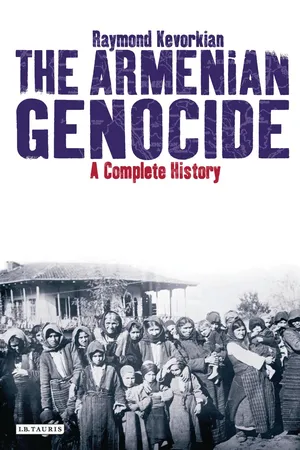
The Armenian Genocide was one of the greatest atrocities of the twentieth century, an episode in which up to 1.5 million Armenians lost their lives. In this major new history, the renowned historian Raymond Kevorkian provides an authoritative account of the origins, events and consequences of the years 1915 and 1916. He considers the role that the Armenian Genocide played in the construction of the Turkish nation state and Turkish identity, as well as exploring the ideologies of power, rule and state violence. Crucially, he examines the consequences of the violence against the Armenians, the implications of deportations and attempts to bring those who committed the atrocities to justice. Kevorkian offers a detailed and meticulous record, providing an authoritative analysis of the events and their impact upon the Armenian community itself, as well as the development of the Turkish state. This important book will serve as an indispensable resource to historians of the period, as well as those wishing to understand the history of genocidal violence more generally.
Trusted by 375,005 students
Access to over 1.5 million titles for a fair monthly price.
Study more efficiently using our study tools.
Information
Table of contents
- Cover
- About the Author
- Title page
- Copyright page
- Contents
- Introduction
- Part I Young Turks and Armenians Intertwined in the Opposition (1895–1908)
- 1 Abdülhamid and the Ottoman Opposition
- 2 The December 1907 Second Congress of the Anti-Hamidian Opposition: Final “Preparations for a Revolution”
- Part II Young Turks and Armenians Facing the Test of Power (1908–12)
- 1 Istanbul in the First Days of the Revolution: “Our Common Religion is Freedom”
- 2 Young Turks and Armenians Facing the Test of “The 31 March Incident” and the Massacres in Cilicia
- 3 The Ottoman Government’s and the Armenian Authorities’ Political Responses to the Massacres in Cilicia
- 4 The CUP’s First Deviations: The 1909, 1910, and 1911 Congresses
- 5 Armenian Revolutionaries and Young Turks: The Anatolian Provinces and Istanbul, 1910–12
- Part III Young Turks and Armenians Face to Face (December 1912–March 1915)
- 1 Transformations in the Committee of Union and Progress after the First Balkan War, 1913
- 2 The Armenian Organizations’ Handling of the Reform Question
- 3 The Establishment of the Ittihadist Dictatorship and the Plan to “Homogenize” Anatolia
- 4 Destruction as Self-Construction: Ideology in Command
- 5 Turkey’s Entry into the War
- 6 The Teşkilât-ı Mahsusa on the Caucasian Front and the First Military Operations
- 7 The First Acts of Violence
- 8 Putting the Plan into Practice, and the “Temporary Deportation Law”
- Part IV In the Vortex of the War: The First Phase of the Genocide
- 1 The Armenian Population of the Empire on the Eve of the War: The Demographic Issue
- 2 The Ottoman Armenians’ Socio-Economic Situation on the Eve of the War
- 2.1 The Eradication of the Armenian Population in the Provinces of the Ottoman Empire: Reasons for a Regional Approach
- 3 Deportations and Massacres in the Vilayet of Erzerum
- 4 Resistance and Massacres in the Vilayet of Van
- 5 Deportations and Massacres in the Vilayet of Bitlis
- 6 Deportations and Massacres in the Vilayet of Dyarbekir
- 7 Deportations and Massacres in the Vilayet of Harput/Mamuret ul-Aziz
- 8 Deportations and Massacres in the Vilayet of Sıvas
- 9 Deportations and Massacres in the Vilayet of Trebizond
- 10 Deportations and Massacres in the Vilayet of Angora
- 11 Deportations and Massacres in the Vilayet of Kastamonu
- 12 Constantinople in the Period of the Deportations and Massacres
- 13 Deportations in the Vilayet of Edirne and the Mutesarifat of Biğa/Dardanelles
- 14 Deportations in the Mutesarifat of Ismit
- 15 Deportations and Massacres in the Vilayet of Bursa and the Mutesarifat of Kütahya
- 16 Deportations and Massacres in the Vilayet of Aydın
- 17 Deportations and Massacres in the Vilayet of Konya
- 18 The Deportees on the Istanbul-Ismit-Eskişehir-Konya-Bozanti Route and Along the Trajectory of the Bagdadbahn
- 19 Deportations from Zeitun and Dörtyol: Repression or Genocidal Program?
- 20 Deportations in the Mutesarifat of Marash
- 21 Deportations in the Vilayet of Adana
- 22 Deportations in the Sancaks of Ayntab and Antakya
- 23 Deportations in the Mutesarifat of Urfa
- Part V The Second Phase of the Genocide Fall 1915–December 1916
- 1 The Aleppo Sub-Directorate for Deportees: An Agency in the Service of the Party-State’s Liquidation Policy
- 2 Displaced Populations and the Main Deportation Routes
- 3 Aleppo, the Center of the Genocidal System and of Relief Operations for the Deportees
- 4 The Camps in Suruc, Arabpunar, and Ras ul-Ayn and the Zones of Relegation in the Vilayet of Mosul
- 5 The Concentration Camps along “The Euphrates Line”
- 6 The Deportees on the Hama-Homs-Damascus-Dera’a-Jerusalem-Amman-Maan Line
- 7 The Peculiar Case of Ahmed Cemal: The Ittihad’s Independent Spirit or an Agent of the Genocide?
- 8 The Armenian Deportees on the Bagdadbahn Construction Sites in the Taurus and Amanus Mountains
- 9 The Second Phase of the Genocide: The Dissolution of the Armenian Patriarchate and the Decision to Liquidate the Last Deportees
- Part VI The Last Days of the Ottoman Empire: The Executioners and Their Judges Face-to-Face
- 1 Grand Vizier Talât Pasha’s New Turkey; or, Reanimating Pan-Turkism
- 2 The Refounding of the Young Turk Party Shortly Before and Shortly After the Armistice
- 3 The Debates in the Ottoman Parliament in the Wake of the Mudros Armistice
- 4 The Mazhar Governmental Commission of Inquiry and the Creation of Courts Martial
- 5 The Armenian Survivors in their Places of “Relegation” in the Last Days of the War
- 6 The Great Powers and the Question of “Crimes Against Humanity”
- 7 The First Trial of the Young Turk Criminals Before the Istanbul Court-Martial
- 8 The Truncated Trial of the Main Young Turk Leaders
- 9 The Trial of the Responsible Secretaries and the Vicissitudes of the Subsidiary Trials in the Provinces
- 10 Mustafa Kemal: From the Young Turk Connection to the Construction of the Nation-State
- Conclusion
- Notes
Frequently asked questions
Yes, you can cancel anytime from the Subscription tab in your account settings on the Perlego website. Your subscription will stay active until the end of your current billing period. Learn how to cancel your subscription
No, books cannot be downloaded as external files, such as PDFs, for use outside of Perlego. However, you can download books within the Perlego app for offline reading on mobile or tablet. Learn how to download books offline
Perlego offers two plans: Essential and Complete
- Essential is ideal for learners and professionals who enjoy exploring a wide range of subjects. Access the Essential Library with 800,000+ trusted titles and best-sellers across business, personal growth, and the humanities. Includes unlimited reading time and Standard Read Aloud voice.
- Complete: Perfect for advanced learners and researchers needing full, unrestricted access. Unlock 1.5M+ books across hundreds of subjects, including academic and specialized titles. The Complete Plan also includes advanced features like Premium Read Aloud and Research Assistant.
We are an online textbook subscription service, where you can get access to an entire online library for less than the price of a single book per month. With over 1.5 million books across 990+ topics, we’ve got you covered! Learn about our mission
Look out for the read-aloud symbol on your next book to see if you can listen to it. The read-aloud tool reads text aloud for you, highlighting the text as it is being read. You can pause it, speed it up and slow it down. Learn more about Read Aloud
Yes! You can use the Perlego app on both iOS and Android devices to read anytime, anywhere — even offline. Perfect for commutes or when you’re on the go.
Please note we cannot support devices running on iOS 13 and Android 7 or earlier. Learn more about using the app
Please note we cannot support devices running on iOS 13 and Android 7 or earlier. Learn more about using the app
Yes, you can access The Armenian Genocide by Raymond Kévorkian in PDF and/or ePUB format, as well as other popular books in History & 20th Century History. We have over 1.5 million books available in our catalogue for you to explore.