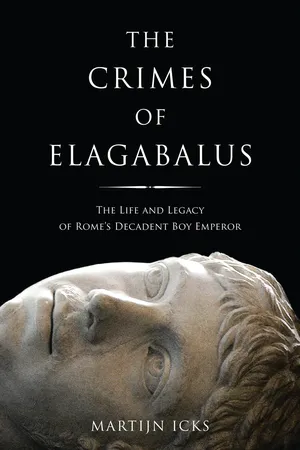
Elagabalus was one of the most notorious of Rome's 'bad emperors': a sexually-depraved and eccentric hedonist who in his short and riotous reign made unprecedented changes to Roman state religion and defied all taboos.
An oriental boy-priest from Syria - aged just fourteen when he was elevated to power in 218 CE - he placed the sun god El-Gabal at the head of the established Roman pantheon, was married at least five times, engaged in orgiastic rituals, took male and female lovers, wore feminine dress and was alleged to have prostituted himself in taverns and even inside the imperial palace. His behaviour drew criticism and condemnation from the Senate and the people alike. In 222 CE, just four years after he came to power, his short reign ended abrumptly and violently when he was assassinated by the Praetorian Guard at the age of eighteen and his body dumped unceremoniously in the river Tiber.
Although not as widely known as Caligula or Nero, Elagabalus's reputation for luxury, licentiousness and insanity is just as extreme, if not more so. The ancient authors who described his reign portrayed him as one of Rome's notorious 'bad emperors' and he has since become an object of fascination for historians and a source of inspiration for artists and writers. This immensely readable book examines the life of one of the Roman Empire's most colourful figures, and charts the many guises of his legacy: from evil tyrant to firebrand rebel, from mystical androgyne to modern gay teenager, from decadent sensualist to ancient pop star.
- 288 pages
- English
- ePUB (mobile friendly)
- Available on iOS & Android
eBook - ePub
About this book
Information
1
THE BOY ON THE THRONE
In his four years as emperor [...] Heliogabolus did lots of interesting things. Not nice things; but nonetheless interesting.
Neil Gaiman, Being an Account of the Life and Death of the Emperor Heliogabolus (1991–92)
When Elagabalus gained the throne in 218CE, he was the youngest sole-ruling emperor the empire had ever seen. Being only 14 years of age and without any political or military experience, he seems an unlikely candidate for the imperial purple. How did a 14-year-old boy, living in the Syrian town of Emesa, become the ruler of the Roman world? How much power did he actually have during the four years in which he held the principate? It is difficult to answer these questions accurately, because they require a detailed insight into the political and military dynamics of the time – a reality which was probably much more complex than the ancient writers would have us believe.
Analysing ‘what happened’ under Elagabalus becomes even more difficult when we take the religious reforms of this period into account. Given their controversial and unprecedented nature, they not only complicate the issue of power balance within the imperial administration, but provoke the question of what exactly Elagabalus and his supporters were trying to achieve – and to what extent the religious innovations contributed to the downfall of the infamous ‘priest-emperor’. This chapter will give a chronological survey of the period 218–22, addressing all of these questions.
GAINING THE THRONE
On 8 April 217, the emperor Caracalla met with a sudden and violent end. The 29-year-old ruler – son of Septimius Severus, who had founded the Severan dynasty – had spent the last years of his reign in the East, waging war on the Parthians, and was on his way from Edessa to Carrhae when he was attacked by one of his own men. The blow he received was not immediately fatal, but the onrushing guards grasped the opportunity to kill the emperor themselves. According to both Dio and Herodian, the murder had been plotted by Macrinus, one of Caracalla’s praetorian prefects (commanders of the imperial guard). Whether this is true or not, Macrinus was certainly the person who gained most from the emperor’s untimely death, since the soldiers proclaimed him Caracalla’s successor. The senate could do little but accept the choice of the army, despite the fact that Macrinus was only of equestrian rank and therefore in principle not a qualified candidate for the imperial purple.
However, Rome would never lay eyes on this new emperor. There were matters in the East which had to be dealt with first, most of all the war with the Parthians. Unwilling to continue Caracalla’s campaign, Macrinus bought a truce with the enemy, an act which did not make a good impression on the soldiers. Moreover, he decided to reduce the army’s pay and to withhold the privileges that new recruits had been granted by Caracalla, denying them prizes and exemption from military duties. This further reduced his popularity with the soldiers. As Herodian remarks, ‘it was obviously inevitable that Macrinus would lose the empire, and his life too, whenever chance provided a small, trivial excuse for the soldiers to have their way.’1
After the death of Caracalla, it had seemed the days of the Severan dynasty were over. The emperor had left no legitimate children and had murdered his brother and co-ruler Geta several years earlier. Caracalla’s mother Julia Domna had committed suicide – perhaps at the instigation of Macrinus, who may have perceived her as a threat. Her elder sister Julia Maesa, who had been living with her, had returned to her home town Emesa. It is quite likely that she was forced to go there by the new emperor, as Herodian claims. After all, Maesa was a very rich and probably quite influential woman. Now, she and her family would be the axis of a military revolt against the unpopular Macrinus.
Julia Maesa had two grandsons by two daughters, the 14-year-old Varius Avitus and the nine-year-old Alexianus, who were both dedicated to the service of the local sun god Elagabal. The elder boy, Elagabalus, served as Elagabal’s high priest. In this role, he attracted the attention of the soldiers of Legio III Gallica, a large garrison stationed not far from Emesa. Herodian describes:
As Bassianus [Elagabalus] performed his priestly duties, dancing at the altars to the music of flutes and pipes and all kinds of instruments in the barbarian fashion, everyone, especially the soldiers, viewed him with fairly close interest because they knew he was a member of the imperial family (apart from the fact that his beautiful appearance attracted everyone’s attention).2
According to Herodian, Julia Maesa told the soldiers that Caracalla had slept with both her daughters and that Elagabalus was actually Caracalla’s bastard son. A rumour spread that the old lady was willing to distribute her immense wealth to the soldiers if they restored her family to power. Maesa and her family were invited to come to the camp at night, where Elagabalus was immediately acknowledged as emperor and clad in imperial purple.
Cassius Dio gives a rather different account of the events, making no mention of Elagabalus’s priesthood of Elagabal and naming a certain Gannys as the main instigator of the revolt. This person, who is not mentioned in any other source, plays an important part in Dio’s account of Elagabalus’s rise to power. According to Dio, Gannys was a youth who ‘had not as yet fully reached manhood’.3 He had been raised by Julia Maesa and was the lover of Elagabalus’s mother Julia Soaemias. Since Soaemias’s husband was no longer alive, Gannys acted as the boy’s protector and foster father. He allegedly dressed Elagabalus up in clothes which had been worn by Caracalla as a child, pretending that his young protegé was the murdered emperor’s son, and smuggled him to the army camp at night without telling either Maesa or Soaemias. On the morning of 16 May 218, he persuaded the soldiers to revolt.
It is hard to believe that Julia Maesa, who had so much to gain if her grandson were to become emperor, was completely uninvolved in hatching the plot. On the other hand, it seems equally improbable that she acted completely on her own, as Herodian apparently suggests. Dio mentions that Gannys was supported by a few freedmen (former slaves) and soldiers, but also by some (unspecified) equestrians and senators of Emesa. This indicates that the initiative for the rebellion was taken not only by Maesa and her family, but also by part of the ruling elite of the Syrian town. Despite Dio’s assurance to the contrary, we might wonder if any Roman senators or equestrians were in on the plan as well. Although it is impossible to establish how many conspirators were in on the coup, the involvement of powerful figures from Rome is certainly not beyond reasonable imagination.
Another detail is also of interest. Different though Dio’s and Herodian’s accounts may be, they both make mention of the story that Elagabalus was Caracalla’s bastard son. Although almost certainly not true, this story would be of prime importance for Elagabalus’s legitimation, as is apparent from the imperial name he took: Marcus Aurelius Antoninus, which had also been the official name of his ‘father’, Caracalla. The emperor even made his invented ancestry explicit by styling himself ‘son of the divine Antoninus, grandson of the divine Severus’.4 The implicit ideals of imperial succession were regarded in this way: the new Antoninus was not a usurper, but could claim the throne by rights of his blood. At the same time, the name held the promise of a continuation of Caracalla’s military policy, which must have appealed greatly to the army.
Emperor Macrinus was staying in Antioch when word reached him of the rebellion at Emesa. According to Herodian, he did not take the threat too seriously, and sent his prefect Julianus to deal with it, but Dio records that Julianus was already in the vicinity of Emesa and acted on his own initiative. The prefect killed a daughter and son-in-law of Marcianus, the husband of Elagabalus’s aunt Julia Mammaea. The passage does not mention Marcianus’s own death, but it is highly likely that he was also killed sometime during the power struggle, since he is no longer mentioned in any source afterwards.
Julianus proceeded to lay siege to the camp in which Elagabalus, his family and the revolting legion were gathered. However, the besieged rebels made tempting promises to the attacking soldiers: namely, that they would receive the posts and possessions of their officers if they killed them; that Elagabalus would give back possessions and civil status to deserters; that he would pardon those who had been exiled; and (emphasised by Herodian) that riches would be distributed to those who joined the other side. As a result, the soldiers revolted and killed their officers.
According to Herodian, Julianus was beheaded on the spot, and his head sent to Macrinus in Antioch. The emperor then decided to pick up the sword himself. Dio gives a more elaborate version of the events. He records that Julianus managed to escape initially. Macrinus, on learning that his prefect had been beaten, hastened to Legio II Parthica, the Roman legion which was stationed at Apamea. There, he granted his ten-year-old son Diadumenianus, who up until that point had only held the honorary title of Caesar, the title of Augustus, making him his official co-ruler. This may be regarded as a last attempt at dynastic legitimation, especially since Diadumenianus bore the name Antoninus. However, Dio regards the act as no more than an excuse to load gifts and promises upon the troops and the people of Apamea. Whatever Macrinus’s reasons, he failed to win the favour of Legio II Parthica. A soldier handed him a sack which turned out to contain the head of the prefect Julianus, who had apparently been captured after his initial escape.
The emperor, realising that his cause was lost with this legion, returned to Antioch and tried to gather an army there. Given the distance he had to travel, it is unlikely that he reached the Syrian capital before 27 May. Since the decisive battle took place on 8 June, Macrinus had less than two weeks to gather his forces. The nearest legion, IV Scythica, was stationed at Zeugma, more than 120 miles from Antioch; Legio XVI Flavia was even further away, at Samosata. Dio records that Elagabalus also sent messengers to these legions to win them for his cause, so we do not even know for certain that they fought entirely on Macrinus’s side. However, the messengers sent by the usurper to Basilianus, prefect of Egypt and since the death of Julianus also praetorian prefect, and Marius Secundus, governor of Syria Phoenice, were put to death by these men.
Meanwhile, more and more troops were joining the ranks of Elagabalus. The whole of Legio II Parthica went over to the youthful pretender. As Hans-Georg Pflaum has argued, the commander of this legion was probably P. Valerius Comazon, who would play an important role during Elagabalus’s reign.5 With the support of a second legion, Elagabalus’s chances of winning the throne increased significantly. According to Dio, the rebel troops marched on Antioch quickly, undoubtedly to give Macrinus as little time as possible to prepare himself. On 8 June, barely more than three weeks after Elagabalus had first been proclaimed emperor, the decisive battle took place at a small village near Antioch. Allegedly, it was Gannys who led Elagabalus’s troops, despite his youth and the fact that he did not have any military experience. Macrinus seemed to be winning at first, but the tide turned when Maesa and Soaemias started encouraging the fleeing men and Elagabalus himself stormed forward on a horse with unsheathed sword. This terrified Macrinus, and he fled the battlefield, leaving victory to the young priest.
Although Elagabalus’s uncharacteristically heroic role in the battle leaves room for doubt, Dio’s account seems more likely than that of Herodian, who records that Macrinus took the initiative in the conflict and marched towards Emesa to defeat his rival. Elagabalus met the emperor at the border of Syria Phoenice and Syria Coele. Battle ensued, but when Macrinus saw many of his soldiers defecting to the other side, he fled the field. His remaining followers surrendered and joined the army of Elagabalus. In view of the lack of loyal troops Macrinus had at his disposal, it is hard to believe that he would have chosen to challenge the pretender so quickly, although he may have decided that this threat should be eliminated as soon as possible.
Whichever account comes closest to the truth, both Dio and Herodian agree that Macrinus met with a sorry end. The defeated emperor was arrested and killed when he tried to travel to Rome incognito. His son Diadumenianus, who had been Augustus for just a few weeks, met a similar fate.
Elagabalus entered Antioch as the new ruler, promising the soldiers 2000 sesterces apiece if they refrained from sacking the city. According to Dio, the victorious boy sent a message to the senate and the people of Rome, styling himself ‘emperor and Caesar, the son of Antoninus, the grandson of Severus, Pius, Felix, Augustus, proconsul, and holder of the tribunician power’ before these titles had been officially granted to him.6 Once again, the senate was confronted with a de facto emperor whom it had no choice but to recognise. The ‘dies imperii’, the anniversary of Elagabalus’s ascent to the throne, may have been 14 July, since that was the day on which the boy became a member of two important Roman priestly colleges, the arval brothers and the ‘sodales Antoniniani’.7 Just a few weeks earlier, the senate had declared war on him and his family at the instigation of Macrinus. Now the tables were turned and Macrinus was declared an enemy of the state. Elagabalus took over his predecessor’s consulate for the remainder of the year, allowing the other consul, Oclatinius Adventus, to keep his post.
Yet even with the official approval of the senate, the position of the new emperor was by no means secure. Cassius Dio describes how several pretenders made their own bid for the purple now that Macrinus was out of the way. Ironically, one of them was Verus, the commander of Legio III Gallica, the legion which had first proclaimed Elagabalus emperor. Strict measures were taken against the pretenders: Verus was executed and the legion temporarily disbanded.8 Gellius Maximus, the commander of Legio IV Scythica, met with the same fate when he too rebelled. According to Dio, many others tried to seize power, including a worker in wool and a private citizen. It is highly likely that these stories tell us less about the reality than about Dio’s opinion that if Elagabalus could become emperor, anybody could. Even so, the many imperial coins with legends like ‘FIDES EXERCITVS’ or ‘CONCORDIA MILIT(VM)’ suggest that the loyalty and unity of the army were certainly not taken for granted by the members of the recently restored dynasty and their supporters.9
The new Severan ruler and his family spent about a year in the East to consolidate their power, first in Antioch and later in Nicomedia, where they were forced to spend the winter. According to Herodian, Elagabalus immediately dressed in luxurious garb and began to practice the rites of his cult. His grandmother and advisers were left to deal with affairs. Dio records that Gannys was probably frequently employed as the emperor’s associate in government. However, he allegedly soon lost imperial favour:
To be sure, Gannys was living rather luxuriously and was fond of accepting bribes, but for all that he did no one any harm and bestowed many benefits upon many people. Most of all, he showed great zeal for the emperor and was thoroughly satisfactory to Maesa and Soaemias, to the former because he had been reared by her, and to the latter because he was virtually her husband. But it was not at all because of this that the emperor put him out of the way, inasmuch as he had wished to give him a marriage contract and appoint him Caesar; it was rather because he was forced by Gannys to live temperately and prudently. And he himself was the first to give Gannys a mortal blow with his own hand, since no one of the soldiers had the hardihood to take the lead in murdering him.10
The story sounds too much like a topos, a literary commonplace, meant to make Elagabalus look bad, to be credible – especially when we consider the comment on Gannys’s own lifestyle. If we take Dio’s word for it, Gannys himself made no effort to live up to the high moral standards he set for his pupil. We can only speculate about alternative explanations for the man’s death, but perhaps his favoured position with the emperor made others, like Maesa and Comazon, decide that he was becoming too influential and had to be removed. Even if that was the case, however, it is anyone’s guess who was responsible for his death.
Gannys was by no means the only person who perished. During the first year of Elagabalus’s reign, many men who had supported Macrinus or were deemed untrustworthy for other reasons were executed. The list includes Fabius Agrippinus, governor of Syria Coele; Pica Caerianus, governor of Arabia; Aelius Triccianus, governor of Pannonia Inferior; and M. Munatius Sulla Cerialis, former governor of Cappadocia. The proconsul of Cyprus, L. Claudius Attalus, was allegedly killed because he had once sent Elagabalus’s ally Comazon to the galleys as punishment for some unspecified crime. Julius Basilianus, prefect of Egypt and one of Macrinus’s praetorian p...
Table of contents
- Cover
- Author biography
- Epigraph page
- Title page
- Copyright page
- Contents
- List of Illustrations
- Acknowledgements
- Introduction
- 1 The boy on the throne
- 2 The child priest from Emesa
- 3 The invincible priest-emperor
- 4 The rejected ruler
- 5 The evil tyrant
- 6 The decadent emperor
- 7 The modern prince
- Epilogue
- The Nachleben of Elagabalus in art and literature: an overview
- Severan family tree
- Notes
- Select bibliography
Trusted by 375,005 students
Access to over 1.5 million titles for a fair monthly price.
Study more efficiently using our study tools.
Frequently asked questions
Yes, you can cancel anytime from the Subscription tab in your account settings on the Perlego website. Your subscription will stay active until the end of your current billing period. Learn how to cancel your subscription
No, books cannot be downloaded as external files, such as PDFs, for use outside of Perlego. However, you can download books within the Perlego app for offline reading on mobile or tablet. Learn how to download books offline
We are an online textbook subscription service, where you can get access to an entire online library for less than the price of a single book per month. With over 1.5 million books across 990+ topics, we’ve got you covered! Learn about our mission
Look out for the read-aloud symbol on your next book to see if you can listen to it. The read-aloud tool reads text aloud for you, highlighting the text as it is being read. You can pause it, speed it up and slow it down. Learn more about Read Aloud
Yes! You can use the Perlego app on both iOS and Android devices to read anytime, anywhere — even offline. Perfect for commutes or when you’re on the go.
Please note we cannot support devices running on iOS 13 and Android 7 or earlier. Learn more about using the app
Please note we cannot support devices running on iOS 13 and Android 7 or earlier. Learn more about using the app
Yes, you can access The Crimes of Elagabalus by Martijn Icks in PDF and/or ePUB format, as well as other popular books in History & Historical Biographies. We have over 1.5 million books available in our catalogue for you to explore.