- 272 pages
- English
- ePUB (mobile friendly)
- Available on iOS & Android
eBook - ePub
About this book
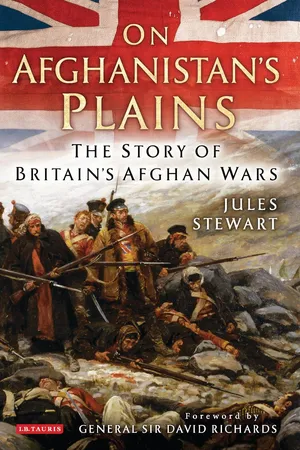
Britain's military involvement in Afghanistan is a contentious subject, yet it is often forgotten that the current conflict is in fact the fourth in a string of such wars dating back as far as the early nineteenth century. Aiming to protect the British territories in India from the expanding Russian empire, the British fought a series of conflicts on Afghan territory between 1838 and 1919. The Anglo-Afghan wars of the 19th and early 20th centuries were ill-conceived and led to some of the worst military disasters ever sustained by British forces in this part of the world, with poor strategy in the First Afghan War resulting in the annihilation of 16,000 soldiers and civilians in a single week. In his new book, Jules Stewart explores the potential danger of replaying Britain's military catastrophes and considers what can be learnt from revisiting the story of these earlier Afghan wars.
Information
CHAPTER 1
Cradle of Political Insanity
The Honourable Mountstuart Elphinstone rode through the gates of Peshawar on a dazzling spring morning in 1809, at the head of a column of 450 infantry and cavalry with drums and trumpets playing, behind which trailed a mile-long multitude of Indian servants, 600 roaring baggage camels and a dozen elephants.
The city’s Pashtun inhabitants poured out by the thousands from their market stalls and mud-walled houses, and even the fabled Storytellers’ Bazaar was left deserted, as the tribesmen fought to catch a glimpse, many for the first time, of the fair-skinned sahibs in their fine blue cavalry uniforms glittering with gold buttons and braid. The banks on each side of the road were covered with people and many climbed trees to watch the procession. The mass of people swelled as Elphinstone and his entourage reached the city centre but, as he noted, this caused no inconvenience: ‘The King’s Horse that had come out to meet us charged the crowd vigorously, and used their whips without the least compunction.’1 One of the Afghan troopers in particular attracted Elphinstone’s attention. He was a ferocious-looking soldier known as Rusool the Mad, an officer in the King’s Guard who had acquired, and perhaps it is best not to inquire by what means, an English helmet and cavalry uniform. He carried a long spear, bellowing with a loud and deep voice as he charged the tightly-packed throng at speed. ‘He not only dispersed the mob’, Elphinstone recalls, ‘but rode at people sitting on terraces with the greatest fury.’2
Such was the tumultuous finale to a four-month trek that had begun in Delhi, where Elphinstone was handed his marching orders by Lord Minto, the Francophobe governor general of British India, to proceed westward to explore the uncharted land of Afghanistan. Elphinstone, who had just turned 30, was a colonial administrator of superb intellect in the tradition of the soldier-scholars who engendered so much interest at home in India’s cultural as well as its pecuniary treasures. He was a fluent Persian speaker and became a noted authority on Indian literature and philosophy. Elphinstone was posted to Benares, a key centre of British intelligence gathering, where he was to put to good use his talents for picking up useful gossip, from the bustling bazaars to princely gatherings. His achievements were not confined to scholarly pursuits. After his arrival in Calcutta, he was appointed to the Duke of Wellington’s staff and distinguished himself at the Battle of Assaye, which definitively crushed the Maratha threat to British dominion in India. He was certainly a more colourful character than his fellow Scotsman Gilbert Elliot, the future Lord Minto. Despite remaining a lifelong bachelor, Elphinstone declared himself fond of ‘philandering’ with Calcutta society ladies and Indian dancing girls.
Minto, on the other hand, was an able administrator and a well-intentioned, though less engaging personality who laboured under an exaggerated fear of Napoleon’s hostile designs on India. He had been educated at the Pension Militaire in Fontainebleau, an experience that did little to endear him to his host country. Minto was a vigorous opponent of the French Revolution who spent much of his early diplomatic career in Italy and later in Austria, galvanizing local forces to oppose Napoleon’s armies. At the time of Elphinstone’s mission, Britain had been at war with France for five years. The imperial struggle for mastery in Europe had another six years to run before Napoleon’s final defeat at Waterloo, the battle in which another Elphinstone, Mountstuart’s first cousin William, was to see active service. He was later to go on to become one of the chief culprits behind Britain’s worst military catastrophe in Afghanistan.
In 1808, the Government of India had received word via agents in Tehran that the French were intending to carry their war with Britain into Asia. There were reports of Napoleon conniving with Russia’s Tsar Paul I to launch a joint invasion of India, though it was never clear how the spoils were to be divided up, namely if the invading armies were to defeat Britain, whether India was to be a French or a Russian Raj. These fears were founded on reasonably accurate intelligence, for in 1801 the two imperial rulers agreed an alliance to bring their scheme to fruition. The plan was for the Russians to sweep down across the Hindu Kush and Afghanistan, while the French would march their army through Persia to link up with the tsar’s forces on the Indus. The plan collapsed quite suddenly with the tsar’s assassination later that year, but Napoleon continued to dream of Eastern conquest. The signing of the Treaty of Tilsit in 1807, which ended hostilities between the two imperial powers, brought France and Russia together in an alliance that rendered the rest of Continental Europe almost powerless. When mapping out the strategy for his Egyptian expedition, Napoleon had in fact planned to subsequently join forces with Indian princes to attack the British. But when Bonaparte was forced to beat a retreat from the Middle East, putting a French army across the Indus had ceased to be a viable undertaking, even before the Elphinstone mission set off for Afghanistan.
Elphinstone’s task was to negotiate a treaty with the Emir Shah Shuja ul Mulk and secure undertakings to resist an advance across his territory by any foreign power. The Afghan monarch was deemed to be an arrogant ruler who was strongly opposed to receiving a British mission. For this reason the Government thought it appropriate to send a deputation in a style of great magnificence, in order to duly impress the king with British might. Shuja’s Sikh friends, never ones to shirk from an opportunity to stir up trouble for the British, had warned the emir he would be coerced into giving up territory to British India. But being a vain and covetous man, Shuja eventually relented and sent word that Elphinstone would be permitted to proceed to Peshawar, though keeping him at arm’s length from the Afghan heartland. Shuja had heard tales of Britain’s fabulous wealth and he anticipated receiving handsome gifts from his European visitors.
His European visitors, meanwhile, were toiling with great hardship across the Thar Desert. The column often marched by night to avoid the consuming heat of day, drums beating to alert stragglers who got separated from the main body. Men deserted in droves, such was their terror of the waterless expanses and the ever-present danger of cut-throat bandits who swooped down on the defenceless camp followers. As they neared the Indus, Afghan horsemen from the wild border hills beyond began to make their appearance. These warriors were equally mystified by the approaching horde, taking them for Hindus or Mughals. ‘They believed we carried great guns . . . and that we had certain small boxes, so contrived as to explode and kill half a dozen men each, without hurting us’, wrote Elphinstone. ‘Some thought we could raise the dead.’3 Once ferried across the Indus, Elphinstone found himself in tribal territory proper, amongst the Pashtuns of today’s North-West Frontier Province of Pakistan. The mission had been forced to trace a southerly route instead of following a direct line westward. The shorter journey would have taken the mission through Sikh territory, which was under the iron-fisted rule of the diminutive one-eyed Maharajah Ranjit Singh. Though an uneasy truce prevailed between the British Government and the King of the Punjab, Minto was eager to avoid provoking the Sikhs, who had a two-to-one superiority in artillery.
Shuja prepared a royal residence to receive his European guests. He sent provisions for 2,000 men, most of which was discarded and left to rot, and only with great difficulty was Elphinstone able to persuade the emir to restrain his cordiality. In his first audience with Shuja in Peshawar’s Bala Hissar fortress, Elphinstone lavished presents of great splendour on the king. Shuja was duly impressed, even for one who wore on his arm the fabled Koh-i-Noor diamond, one of history’s most romantic gems, which eventually became part of the British Crown Jewels. Back in Calcutta, Minto was less impressed by the mission’s lavish expenditure, which to his mind far exceeded the necessity of the occasion. The emir was especially delighted with a pair of magnificent custom-made pistols and he was also pleased to receive an organ, though we have no record of how it was put to use. On returning to his residence after the first meeting with Shuja, Elphinstone was delivered a royal request for yet another gift, a pair of silk stockings like the ones worn by the British visitors.
Minto’s misgivings were well founded when measured against the results achieved by the mission. Elphinstone brought back a wealth of scholarly information on Afghan geography, tribal customs and culture. But on the diplomatic front, it took three months for him to negotiate ‘a somewhat useless treaty, by the terms of which no Frenchman or other European was to be allowed to enter Afghanistan’.4 Before the year was out, Shuja had been ousted from the throne of Kabul by his elder brother Mahmud. The former emir wandered alone as a fugitive across Afghanistan. He was seized by Ata Mohammed Khan, the son of his former vizier, or chief minister, who subjected the fallen monarch to humiliating indignities. Shuja was confined in a fortress in Attock, a lancet was threateningly held over his eyes, he was nearly drowned in the Indus with his arms bound, and when released from his tortures, he travelled to the Punjab to take refuge with Ranjit Singh in Lahore. The wily Sikh turned out to be less of a loyal ally than Shuja had envisaged. The emir was made a virtual prisoner. He was dispossessed of the Koh-i-Noor diamond and only succeeded in making an ignominious escape by creeping through the city sewer in disguise. Shuja’s final mortification was to seek asylum in Ludhiana from the same British Government that he had entertained in such splendour in Peshawar.
Thirty years were to pass before Britain dispatched another expedition to Afghanistan. On this occasion, the British embassy was sent not to negotiate but to impose its will by force of arms. The intervening three decades of expansion were characterized by ‘a sequence of tactical decisions made in response to local and sometimes unexpected crises’.5 It was George Douglas Campbell, the Duke of Argyll, who recognized in the heyday of Britain’s imperial expansion that ‘The pure Instinct of Dominion, unadulterated by another other feeling more rational than itself, is one of the very strongest of human passions.’6 For Argyll, that instinct has always been strongest with those who fielded the strongest armies, and through them it has been the most powerful of impulses in the history of human progress, never more manifest than in the British conquest of India.
The years 1810 to 1818 saw bits of territory in India and the Far East systematically gobbled up by a colonial power determined to seize the initiative from its French, Portuguese and Dutch rivals. The British captured Goa, taking advantage of the French occupation of Portugal. Nor did France escape the British Empire’s voracious clutches. Réunion and Mauritius were taken, and then Minto turned his attention to the Dutch possessions in the East Indies. Amboyna and the Moluccas fell, followed by Java, in an expedition in which Minto himself took part. In this period, the East India Company’s army concluded the last of three wars with the Maratha Confederacy.7 In 1818, Minto’s successor, the Marquess of Hastings (not to be confused with Warren Hastings, who served as governor general from 1774 to 1785), scored a victory over the Marathas at the decisive Battle of Konegaon, which left the British with dominion over most of what was to become the Indian Empire south of the Sutlej River. There remained the question of the Sikh kingdom of the Punjab and the tribal lands to the north-west, to be dealt with at a later date.
With the final pacification of the Maratha Confederacy, the Government’s attention was drawn to events taking place beyond India’s frontiers. If France was no longer seen as a threat to British hegemony in India, the shadow of Russian expansionism loomed large in the strategic thinking of Calcutta and Whitehall.
The fear of a Russian attack against India created a political fault line that threw the two great imperial powers into conflict for supremacy in Central Asia. The ‘Great Game’ was a phrase coined by Captain Arthur Conolly, a British intelligence officer who in 1842 fell foul of the deranged Emir of Bokhara and, along with his fellow officer Lieutenant Colonel Charles Stoddart, was publicly beheaded in that city on charges of spying.
The Great Game was a nineteenth-century forerunner of the Cold War, a battle involving secret agents and diplomats, in which not a shot was fired between British and Russian forces. This confrontation was played out roughly between the settlement of the Russo-Persian War of 1813 and the Anglo-Russian Convention of 1907, which left Persia carved up into spheres of Russian and British influence. This treaty officially marked the end of the Great Game, though Russia kept the diplomatic heat turned up until Britain’s departure from India in 1947. Russia always coveted India and its warm-water outlet to the Arabian Sea. Around the time the 1907 accord was being negotiated, by which both powers were expected to retreat from their century-long war footing, the influential Russian Army general and Orientalist Andrei Evgenevich Snesarev wrote:
England must not dictate our path to us. Rather, we should direct her fate. Above all, remember that . . . beyond the snow-capped mountain range of the eastern Hindu Kush lies India, the foundation of British power, and perhaps the political key to the whole world.8
It is no coincidence that Persia takes centre stage from start to finish in the Great Game drama. Napoleon believed he could conquer India with an army of 50,000 men marching through Persia. This fantasy aside, the spectre of Persia serving as an invasion route into India was taken seriously enough for the government to negotiate a treaty with the shah, bringing Persia into a defensive alliance by which it would oppose any European force crossing its territory towards India. The treaty was given definitive form five years later. The final agreement provided for a frontier settlement to be negotiated with British assistance. Likewise, the shah agreed to do his best to prevent Central Asian (a euphemism for ‘Russian’) neighbours from attacking India from Persia.
Persia and India of course do not share a border. The real cause for alarm was of Persia as a gateway into British India’s buffer state: Afghanistan. The Royal Navy was in undisputed control of the sea lanes, and the great Himalayan and Hindu Kush ranges rose as a natural barrier to any army foolish enough to attempt a crossing. Therefore the only viable attack could come from the west, across the unprotected passes that straddle the present Pakistan-Afghan frontier.
Despite his misplaced anxiety over the French peril, Minto, the first of six Scots who were to rule India, was ‘a discerning politician and diplomat and an energetic administrator’9 who set a sound and useful example to his successors in office. Unfortunately, Minto’s nephew Lord Auckland landed at Bombay in 1835, destined as governor general to chart a downward course from his prior successes as President of the East India Company’s Board of Trade and First Lord of the Admiralty. Another candidate, Lord Heytesbury, a nobleman of proven diplomatic skill, had been chosen before by Robert Peel’s Conservative Government and had actually taken the oath of office. ‘Lord Palmerston’s opposition to Heytesbury seems to have grown out of the fact that he had been Ambassador to Russia, and was known to be an admirer of Tsar Nicholas.’10
Auckland arrived at a time of prevailing tranquillity in India. He was a confirmed bachelor who left his social engagements in the hands of his two adoring sisters. The letters of one of them, Emily Eden, offer a unique insight into the lively frivolity of British India’s courtly society. Here’s a charming sample:
There is a Colonel E. Come into camp today . . . He is about the largest man I ever saw, and always brings his own chair with him, because he cannot fit into any other. [. . .] To finish off Colonel E., I must mention that the officer who commands his escort is called Snook, and that his godfathers, to make it worse, called him Violet. He is a little man, about five feet high, and is supposed to have called out to three people for calling him Snooks instead of Snook.11
Auckland was too eager to emulate his uncle’s hard-line policies on the foreign threat to India. His bogeyman was Russia and in this endeavour there was no shortage of supporters in India as well as at home. Auckland fell victim to an acute case of Russophobia and this brought on ‘a crisis which probably need not have occurred, and which he did not show any great talent in dealing with. He was one of the least distinguished of those who have held his place.’12 Variously described as ‘a notorious and useless jobber’ and ‘a man without shining qualities’, Auckland imagined invasion by an enemy in retreat and betrayal by a monarch whose hand was extended in friendship.
Almost inevitably, behind such a mediocre administrator of empire there stood a figure of Machiavellian political astuteness, combined with the ambition of a Wall Street banker. This was the Indian-born William Hay Macnaghten, political secretary to the governor general. Of Auckland’s three closest advisers – Henry Torrens, John Colvin and Macnaghten – the latter was the most fanatical Russophobe and he could also be assured of the governor general’s ear on matters of imperial security.
Macnaghten was unquestionably the most refined specimen that his clan had produced for decades. One is hard-pressed to envisage a blood relationship between the Sanskrit- and Arabic-speaking bespectacled scholar, and his forbear John Macnaghten, who had survived a botched execution for murder, only to clamber back up the gibbet demanding the job be done ‘properly’. Macnaghten’s linguistic ability was such that he was reputed to speak Persian with greater fluency than his native English. Indeed, his last mortal words, a plea for mercy from his assassin, were spoken in that language.
Auckland and his sisters luxuriated in the social gaieties and bracing mountain air of Simla, the summer hill station of the Raj which one contemporary historian described as ‘That pleasant hill sanatorium . . . where our Governors General, surrounded by irresponsible advisers, settle the destinies of empires, and which has been the cradle of more political insanity than any place within the limits of Hindustan.’13 Auckland was shortly to validate the accuracy of this statement. While the governor general and his entourage delighted in tea parties, balls and lawn tennis, some 500 miles to the west events were unfolding that were to eventually bring about Auckland’s downfall in disgrace.
Lord Palmerston was one of the first in Government to react to the gathering war clouds over Herat, Afghanistan’s most westerly city, which in 1835 was coming under the threat of Persian attac...
Table of contents
- Cover
- Author biography
- Title page
- Copyright page
- Dedication page
- Contents
- List of illustrations
- Epigraph page
- Foreword by General Sir David Richards
- Acknowledgements
- Introduction
- 1 Cradle of Political Insanity
- 2 Victoria’s First War
- 3 The Present Happy Moment
- 4 Vengeance is Mine, Sayeth Lord Ellenborough
- 5 The Pure Instinct of Dominion
- 6 Chronic Suspicion and Undignified Alarm
- 7 Nothing but Misfortune and Disaster
- 8 Once More unto the Breach
- Notes
- Bibliography
Trusted by 375,005 students
Access to over 1.5 million titles for a fair monthly price.
Study more efficiently using our study tools.
Frequently asked questions
Yes, you can cancel anytime from the Subscription tab in your account settings on the Perlego website. Your subscription will stay active until the end of your current billing period. Learn how to cancel your subscription
No, books cannot be downloaded as external files, such as PDFs, for use outside of Perlego. However, you can download books within the Perlego app for offline reading on mobile or tablet. Learn how to download books offline
Perlego offers two plans: Essential and Complete
- Essential is ideal for learners and professionals who enjoy exploring a wide range of subjects. Access the Essential Library with 800,000+ trusted titles and best-sellers across business, personal growth, and the humanities. Includes unlimited reading time and Standard Read Aloud voice.
- Complete: Perfect for advanced learners and researchers needing full, unrestricted access. Unlock 1.5M+ books across hundreds of subjects, including academic and specialized titles. The Complete Plan also includes advanced features like Premium Read Aloud and Research Assistant.
We are an online textbook subscription service, where you can get access to an entire online library for less than the price of a single book per month. With over 1.5 million books across 990+ topics, we’ve got you covered! Learn about our mission
Look out for the read-aloud symbol on your next book to see if you can listen to it. The read-aloud tool reads text aloud for you, highlighting the text as it is being read. You can pause it, speed it up and slow it down. Learn more about Read Aloud
Yes! You can use the Perlego app on both iOS and Android devices to read anytime, anywhere — even offline. Perfect for commutes or when you’re on the go.
Please note we cannot support devices running on iOS 13 and Android 7 or earlier. Learn more about using the app
Please note we cannot support devices running on iOS 13 and Android 7 or earlier. Learn more about using the app
Yes, you can access On Afghanistan's Plains by Jules Stewart in PDF and/or ePUB format, as well as other popular books in History & Middle Eastern History. We have over 1.5 million books available in our catalogue for you to explore.