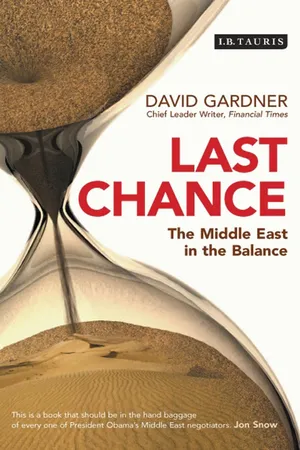
As Barack Obama seeks to chart a new course in American foreign policy, one of the English language media's most respected authorities on the Arab world, David Gardner, addresses the controversial but urgent question: why is the Middle East so dysfunctional? And what can be done about it? Clear-sighted, never flinching from unpalatable truths, Gardner draws on his acute grasp of history and decades of experience covering the region to look at why conflict, despotism and sectarianism continue to flourish in the Arab world whilst as they decline everywhere else. The 'Middle East exception' is, he argues, a product of the West's own making. By supporting tyrants, fuelling the Israeli-Palestinian conflict and demonizing democratically elected Islamist parties, the West in general but specifically America has incubated a region inherently resistant to economic and political reform, and suppurating with resentment. As the Obama administration plans its Middle East policy, Gardner argues for nothing less than a total reappraisal of what realpolitik means. The traditional shibboleths: support Israel, mollify the Saudis, suppress Islamism, simply will not do in the 21st century, he argues.
Both an introduction to the modern Middle East and an impassioned polemic, "Last Chance" is essential reading for anyone concerned with the future of the region.
- 272 pages
- English
- ePUB (mobile friendly)
- Available on iOS & Android
eBook - ePub
About this book
Information
I
The Arab Political Jungle
Few people in the world find The Lion King politically controversial, but those who do are likely to be functionaries of the Arab world’s hydra-headed intelligence services.
Producers at the Lebanese film company that dubbed the Walt Disney jungle opera into Arabic can tell you why. For a start, the dubbers were banned from using two words at the heart of the story: namely ‘lion’ and ‘king’.
In the eyes of the censors of the Mukhabarat, as the intelligence services are generically known, any use of the normal words for lion and king – assad and malik – would amount to the crime of lèse-majesté. Assad, of course, is the name of the present and former president of Syria, Bashar al-Assad and his late father, Hafez al-Assad. Alongside this republican dynasty, moreover, there are real kings who could be affronted in Saudi Arabia, Jordan and Morocco.
To confer their names or titles on an animal would guarantee a ban on the film, the production company said, describing how it manages to navigate this politico-semantic minefield.
King Fahd, for instance, the late Saudi monarch, would present a double challenge because his name means ‘panther’. That word is therefore also banned, one acceptable alternative being daba’a – which according to some dictionaries can mean hyena (‘The Pink Hyena’?).
‘We are forced to change all these names or find some sort of synonym’, said one of the dubbing producers – such as ‘ruler of the forest’ for ‘Lion King’.
As a prominent Arab journalist observed at the time: ‘words frighten these people almost as much as ideas’. The Disney bestiary appears full of terrors for the lords of the Arab political jungle.
If the local fortunes of the Lion King or the Pink Panther were simply a matter of social mores, this would be a colourful but trivial matter. The intoxicating power and poetry of the Arabic language, furthermore, would inevitably command police attention in a region swept barren of ideas by the autocrats who are its political hallmark.
For the world at large, however, there is nothing trivial about this absolutist political culture in the aftermath of the 11 September 2001 attacks on New York and Washington, and a proliferation of jihadi outrages thereafter. The way most Arab countries are governed – in particular Saudi Arabia and Egypt, Washington’s two closest Arab allies, where most of the 9/11 suicide hijackers and their ostensible leader came from – has ceased to be of primarily local or regional concern and become a burning domestic and foreign policy issue across the world.
Put simply, the breathtaking audacity and cruel realpolitik of the 9/11 assault made it no longer possible for the USA, the West and their Arab despot clients to ignore a dictatorial political set-up that incubated blind rage against them. Osama bin Laden had smashed a near century-long status quo in the region.
Western indulgence of and support for a panoply of Sunni Arab strongmen, in charge of often artificial states bolted together from the debris of the Ottoman empire, had become as great an affront to Arab and Muslim sensibilities as western bias towards Israel in the endless battle over how to share Palestine. Policies pursuing stability, cheap oil and the ostensible security of Israel had ended up by incubating Islamist terror.
An ossified political order, invariably incapable of lifting its economies out of stagnation or offering a decent livelihood to the majority of its citizens, had spawned the threat of globalized Islamist hyper-terrorism inspired by bin Laden and al-Qaeda. Resentful of tyranny and humiliated by backwardness, the very young population of the Arab world (where up to two thirds of citizens are under 25) had watched as democratic change embraced Latin America, eastern Europe, and large swathes of Asia and Africa, but passed them by, creating an ‘Arab Exception’ connived in by the West.
The point that the USA and some of its allies were, at last, beginning to grasp was this: that the habitual tyranny of many Arab regimes was an essential alloy in the alchemy of Islamist terror; and that western indulgence of Arab despotism was an equally important element in that witches’ brew.
Condoleezza Rice, US secretary of state in the second term of President George W. Bush, spelt out the new US position in a speech in Cairo in June 2005. For 60 years, she said, the USA had pursued stability at the expense of democracy in the Middle East and had ended up with neither. America, she averred, had learnt its lesson. From now on it would align with those who saw freedom as the indispensable platform for stability, prosperity and security, and against the tyranny that bred despair, rage and terror.
Nearly two years earlier in Washington, in a November 2003 speech to the National Endowment for Democracy, President Bush had castigated the ‘cultural condescension’ that suggested Arabs and Muslims were unsuited to democracy. He would commit America to a ‘generational’ struggle for the democratization of the Middle East, just as preceding generations had fought the Cold War.
These are cogent, declaratory speeches. They communicate conviction that despotism has been tried and has failed. But what has been lacking, so far, is action that really demonstrates that the USA – bogged down in an Iraq it believed would be the lever to transforming the ‘wider’ Middle East – is prepared to take the risks the inevitably messy process of democratization will involve. Instead, Washington and its allies, frightened by the forces they have unleashed by their misconceived and bungled intervention in Iraq, are retreating into a shallow new ‘realism’, falling back fatally on the old political order that has brought the Arab world and the West to this pass.
Those who affected to remake the Arab world in America’s image, moreover, seemed to bring to the enterprise everything except actual knowledge of the countries they targeted for redemption.
Some, exemplified by Ms Rice, brought a Cold Warrior mindset to the job, reading over the transformation of east and central Europe into a wholly different environment in which the West has been backing, as it were, the local variant of Stalinism. Others, typified by the neo-conservative cabal that provided the main philosophical justification for the war in Iraq, appeared to take a ten-pin bowling alley approach to geo-politics in the region: hit the front pin (in this instance, Iraq) hard enough, and the rest would simply be skittled over. No one with experience of the region was invited into the circle of decision makers. As Paul Bremer, the second US administrator of the occupation authorities in Iraq, would sneer to a veteran Central Intelligence Agency man in Baghdad at the time: ‘all you people know about is history – we are making history, we are making the future’.1
There are three overarching features that define these Arab regimes. First, every Arab country is, to a greater or lesser degree, an autocracy – whether republican or royalist, an absolute or quasi-constitutional monarchy/emirate, whether it has elections or not, or whether it is secular or avowedly religious. There are partial but no complete exceptions to that rule. Infinite variety of form cannot disguise the uniformity of the underlying substance of Arab governance.
Yes, there have been faltering steps towards democracy in the monarchies of the Gulf (Bahrain, Qatar, Kuwait and Oman, for example) and Morocco. Lebanon, with its ‘Cedar Revolution’ and sectarian political quota system in ferment, is a big but still only partial exception, trapped in its own parochialism and the sectarian gridlock that has gripped the region after Iraq. Egypt and even Saudi Arabia have made recent genuflections to democratic ritual. And, over nearly two decades, there have been flawed and controlled electoral exercises in Jordan and Yemen, or Algeria and Tunisia.
Yet Freedom House, the New York-based monitor of political and civic freedoms, said in its Freedom in the World report of December 2001 that the Islamic and Arab nations had diverged with the rest of the world on democracy. In one of the more cogent early reactions to 9/11, it identified the nature of ‘the Arab Exception’.
‘Since the early 1970s, when the third major wave of democratization began, the Islamic world, and, in particular, its Arab core, have seen little evidence of improvements in political openness, respect for human rights and transparency’, the survey said, ranking Iraq, Libya, Saudi Arabia, Sudan and Syria among the ten least free countries in the world.
In those three decades, which saw the end of the Cold War and dictatorships tumbling from Bucharest to Buenos Aires, the Arab world remained marooned in tyranny. In the post-Communist era, moreover, there is no other part of the world – not even China – that is examined by the West with such little regard for the political and human rights of its citizens.
The second defining feature of the modern Arab regime is that autocrats are kept in power by the key institution of the military, including, as the single most important political component, the intelligence services – the ubiquitous Mukhabarat.
So overarching is the military as an institution that in countries as apparently distinct as Saudi Arabia and Saddam Hussein’s Iraq there were two armies – a regular army and a praetorian guard (National Guard in Saudi Arabia, Republican Guard in Iraq) for the ruling family. In both these cases that guard was based on tribal networks. And in equally distinct set-ups, such as Jordan and Syria, tribal and clan loyalties underpin state power. But the point is that all that tribal interstitial tissue is worthless unless attached to the hard bone and articulated joints of security establishment and military power.
All Arab countries, moreover, have a plethora of these security services, some of them purely to spy on each other. Syria gets by with six, a relatively lean model, while the Palestinians under Yassir Arafat, even without a state, had a dozen security and intelligence bodies. Arab leaders may make the just rejoinder that the USA, say, has 16 intelligence services. But it is not their primary purpose to keep any individual leader or clan in power.
The third defining feature, and arguably the root of it all, is that most Arab rulers have a problem of legitimacy. That problem has grown over the past three decades, especially in the wake of the disaster of Arab defeat by Israel in the Six Day War of 1967. Such lack of legitimacy has severe consequences in the Arab world, where rulers never change by the ballot but either die with their boots on, or by the bullet.
This book will start by examining this crisis of legitimacy, whose initial beneficiaries appeared to be the feudal monarchies of the Gulf. But the longer-term winners are more likely to be the Islamic revivalists who stepped into this vacuum, picking up the fallen banners of pan-Arab nationalism and portraying their amorphous ideology as a liberation theology.
The Islamists have been the main beneficiaries of stagnation, failure and tyranny indulged by the West. Fortunately, they come in many varieties. This book will argue that one of the main policy challenges facing the USA and Europe will be to separate out irreconcilable jihadis of bin Ladenist conviction from the Islamist movements that are implanted and organized in their societies and wish to play the democratic game, to play in the global marketplace of ideas. There is no conceivable way forward unless the latter are engaged – albeit on clear democratic terms. They cannot be shut out. That is a fantasy.
The fostering of freedom, and, of course, the adoption of a more even-handed policy in Israel–Palestine designed to secure justice for the Palestinians as well as security for the Israelis, will be the key to which way mainstream Muslims tilt – towards the bin Ladens and their jihad against the West or towards representative politics, the rule of law and the development of civil society. For the starting point of any re-examination of policy must be the now irrefutable evidence piled up in poll after poll about how low America’s reputation has sunk in the Islamic and Arab world, among notional friends and ostensible foes alike.
In the years since 9/11, the Bush administration and its cheerleaders successfully sold the idea that its jihadi perpetrators ‘hate us for our freedoms’ and loathe us for our values: for what we are and think, rather than anything that we do. Pause for a moment and recall all those post-9/11 magazine covers and potboilers purporting to answer the question: ‘Why do they hate us?’ There is something so nearly right in the sheer wrongness of the lethal condescension of most of the answers. Properly formulated, the answer would say: ‘they hate us because we have freedoms, but we have found it politically and commercially convenient to back tyrants who deny them their freedom’. In what is ultimately a war of ideas within the Islamic world, there is no idea more damaging than to suggest Muslims and Arabs have no interest in freedom – that they do not bleed just the same as everyone else. Unless we break free from it, radical Islamism will win that war of ideas.
The self-serving fallacies of the ‘they hate us for our freedoms’ industry were exposed in a host of different books from, for example, the former Central Intelligence Agency official in charge of pursuing bin Laden, Michael Scheuer (the initially anonymously-written Imperial Hubris), to the Palestinian–American historian Rashid Khalidi (Resurrecting Empire). They and others argued persuasively that it is the policies of the USA and its allies that have ignited Arab and Muslim antagonism.
In September 2004 a comprehensive validation of this analysis emerged from an unusual quarter: the Defense Science Board (DSB), a federal committee of academics and strategists that gives independent advice to the US defence secretary. The DSB found that ‘America’s power to persuade is in a state of crisis’ – not least, it suggested between the lines, because of the Bush administration’s unappealing mix of high-handedness, incompetence and attraction to the use of force. Credibility matters, the report said, and ‘simply, there is none – the US today is without a working channel of communication to the world of Muslims and Islam’. The polls examined by the DSB are salutary: single digit support for the USA and its policies (for example, a 98 and 94 per cent ‘unfavourable’ rating in Egypt and Saudi Arabia). Support for the USA in subsequent polls, by the Zogby International group and Pew Global Attitudes Project, among others, was almost undetectable.
The DSB found, nonetheless, that majorities or pluralities do support values such as freedom and democracy, embrace western science and education, and like western products and American movies. ‘In other words, they do not hate us for our values, but because of our policies’, the DSB said, before noting that the surveys showed that hatred of the policies was so corrosive it had begun to tarnish the attraction of the values – a warning if ever there was one that there may not be too much time left to change course. So what is to be done?
In Iraq, state and society have broken apart under a US-led occupation that continued to use disproportionate firepower against an elusive, for a long time barely identified, enemy, causing high civilian casualties. Unable to control an insurgency then being prosecuted by a minority of the minority Sunni, the occupiers committed a seamless catalogue of errors and misjudgements. Their bluster and bungling, and serial own-goals, seemed to be creating strategic disaster, a Balkans-in-the-sands. Arab public opinion watched in anguish as ethnosectarian civil war engulfed Iraq, creating the menacing possibility of a wider sectarian conflict between Sunni and Shia that could suck in Iraq’s neighbours, with Shia Iran on one side and Sunni Arab rulers terrified by the empowerment of Iraq’s Shia majority on the other.
Meanwhile, US (and British) support for Israel appeared to solidify even while the Israelis continued to strengthen their grip on the immeasurably weaker Palestinians and the occupied West Bank, the summer of 2005 Israeli withdrawal from Gaza notwithstanding. In both these arenas, obsessively observed by Muslims around the world through the relatively new medium of Arab satellite television channels, the events of April 2004 may prove to have been a turning point.
During that fateful month, Arabs and Muslims from Fez to Rawalpindi watched in perplexed horror as US troops destroyed the town of Fallujah, west of Baghdad in the Euphrates valley, and as Israeli forces pulverized Rafah, the Palestinian town in the south of the Gaza Strip. Despite highly restricted media access in both cases, they were sometimes able to watch both infernos simultaneously on split screens, connected up by a plethora of Arab satellite television stations. This was a degree of integration their world had probably not known since the golden days of the Muslim commonwealths so celebrated by today’s Islamic revivalists, except that it recalled darker days. It was not uncommon to hear remarks in the vein of: ‘this is like watching the Crusades, live on television’.
In the middle of this, on 14 April 2004, President Bush provided Ariel Sharon, Israel’s prime minister and the champion of Israeli settlers in the Palestinian territories, with a letter recognizing that Israel would keep virtually all the big West Bank blocs of settlements. Tony Blair, Britain’s prime minister, seemed to endorse this new, one-sided and illegal policy, which trampled on several UN Security Council resolutions as well as the Fourth Geneva Convention. To Arabs it looked like a second edition of the 1917 Balfour Declaration through which Britain first identified Palestine as a national home for the Jews.
Then, on top of all that, came the incalculably damaging scandal of prisoner abuse at Abu Ghraib. That threw into high relief worse abuses – amounting to torture – going on at the US facility for suspected jihadis in Guantanamo Bay, Cuba and the Bagram airbase in Afghanistan, as well as a host of other undeclared facilities for the ghost prisoners of the so-called Global War on Terror, across Central Asia, the Middle East and eastern Europe.2
Soon enough, it also became clear that the public justifications the USA used for the Iraq war – Saddam Hussein’s alleged possession of weapons of mass destruction and a purported link between Baghdad and al-Qaeda – were not true. Indeed, not one of nearly 30 US assertions about Iraq to the UN Security Council by Colin Powell, then secretary of state, in February 2003, was ever substantiated. To most Arabs, US policy looked less the ‘forward strategy for freedom in the Middle East’ proclaimed by President Bush and more like an American drive to secure forward bases in the region that traditionally provided the West with cheap oil.
The administration’s vaunted Greater Middle East Initiative, in this light, looked long on rhetoric and short on action – suspiciously like France and Britain’s duplicitous behaviour during their post-First World War carve-up of the Middle East. It did not help that this partnership programme set up its small secretariat in Tunisia, arguably the most efficient police state in the region, whose president, Zine al-Abidine Ben Ali, had just managed to perform yet again the miracle of electoral near-unanimity to prolong his rule.
As a leading Arab editor in Beirut observed around that time, while the year 1989 saw the fall of the Berlin Wall and a new democratic wave burst over east and central Europe, that was also the year of the Taif Accord aimed at ending the 1975–90 Lebanese civil war – used ever after by Syria as the excuse for its creeping Anschluss in Lebanon. ‘It seems that in our part of the world’, he said, ‘West Berlin was taken over by East Berlin’.
It seemed for a while that was at last beginning to change, and in often unpredictable ways. In the course of 2005, in particular, there were tentative grounds for believing that democracy was establishing a toehold in the region – at least at first.
We observed above the paradox that the person most responsible for undermining the status quo in the region was Osama bin Laden. It was his actions that made it impossible to ignore how western collusion with tyrants, who appeared set against both f...
Table of contents
- Cover
- Author biography
- Title page
- Copyright page
- Dedication page
- Contents
- Acknowledgements
- Preface to the Paperback Edition
- Preface to the Hardback Edition
- Chapter I: The Arab Political Jungle
- Chapter II: The Despot in his Labyrinth
- Chapter III: The Janus of Islamic Revivalism
- Chapter IV: The Time of the Shia
- Chapter V: Arabia Infelix
- Chapter VI: Getting Away with Murder?
- Chapter VII: A Naked, Poor and Mangled Peace
- Chapter VIII: Pax Arabica: the Middle East and the West
- Notes
Trusted by 375,005 students
Access to over 1.5 million titles for a fair monthly price.
Study more efficiently using our study tools.
Frequently asked questions
Yes, you can cancel anytime from the Subscription tab in your account settings on the Perlego website. Your subscription will stay active until the end of your current billing period. Learn how to cancel your subscription
No, books cannot be downloaded as external files, such as PDFs, for use outside of Perlego. However, you can download books within the Perlego app for offline reading on mobile or tablet. Learn how to download books offline
Perlego offers two plans: Essential and Complete
- Essential is ideal for learners and professionals who enjoy exploring a wide range of subjects. Access the Essential Library with 800,000+ trusted titles and best-sellers across business, personal growth, and the humanities. Includes unlimited reading time and Standard Read Aloud voice.
- Complete: Perfect for advanced learners and researchers needing full, unrestricted access. Unlock 1.5M+ books across hundreds of subjects, including academic and specialized titles. The Complete Plan also includes advanced features like Premium Read Aloud and Research Assistant.
We are an online textbook subscription service, where you can get access to an entire online library for less than the price of a single book per month. With over 1.5 million books across 990+ topics, we’ve got you covered! Learn about our mission
Look out for the read-aloud symbol on your next book to see if you can listen to it. The read-aloud tool reads text aloud for you, highlighting the text as it is being read. You can pause it, speed it up and slow it down. Learn more about Read Aloud
Yes! You can use the Perlego app on both iOS and Android devices to read anytime, anywhere — even offline. Perfect for commutes or when you’re on the go.
Please note we cannot support devices running on iOS 13 and Android 7 or earlier. Learn more about using the app
Please note we cannot support devices running on iOS 13 and Android 7 or earlier. Learn more about using the app
Yes, you can access Last Chance by David Gardner in PDF and/or ePUB format, as well as other popular books in History & Middle Eastern History. We have over 1.5 million books available in our catalogue for you to explore.