Clint Eastwood is one of the world's most popular action stars, who has matured into a fine American producer-director. Entertaining, illuminating and packed with information, up to and including "The Changeling", this is the first book to cover his full life in the movies, from his beginnings in 1950s B-movies and in TV's "Rawhide" to "Gran Torino" showing how as both actor and filmmaker Eastwood aims for the heart of the drama, whatever the story. Howard Hughes follows Eastwood's craft through over 50 movies. He looks at his launch into superstardom in Sergio Leone's 1960s spaghetti westerns. Back in America, he built on his success as western hero with such films as "High Plains Drifter" and "The Outlaw Josey Wales", winning an Oscar for "Unforgiven" in 1992. He blasted his way through the seventies and eighties as Inspector Harry Francis Callahan, the last hope for law enforcement in San Francisco. He also monkeyed around in two phenomenally popular films with Clyde the orang-utan, which brought tough-guy Eastwood to a whole new audience and made him the biggest box office star of his generation.
"Aim for the Heart" also looks at Eastwood's more unusual roles, including "The Beguiled", "The Bridges of Madison County" and "Million Dollar Baby". Since 1970, he has enjoyed parallel success as director-producer of his own Malpaso Productions, with "Bird", "Mystic River" and "Letters from Iwo Jima", demonstrating formidable directing credentials. "Aim for the Heart" covers all Eastwood's movies of many genres in detail, and Eastwood's story is illustrated with film stills, glimpses behind the scenes, and rare poster advertising material. "Aim for the Heart" also includes the most comprehensive credits filmography has ever compiled on Eastwood's work, as star and director.

- 272 pages
- English
- ePUB (mobile friendly)
- Available on iOS & Android
eBook - ePub
About this book
Information
PART ONE
THE WESTERNS
In the early sixties, western films were still locked in a range war for audiences with TV westerns – and losing. What cinema needed was an out-of-towner, a hired gun, a specialist who could turn the tide and entice audiences from their comfy sofas back into theatres, where seats cost money. Their unlikely saviour was an Italian director named Sergio Leone.
Hollywood had counterattacked TV in the late fifties with a series of hugely popular, adult-themed big-screen westerns – including The Man from Laramie (1955), The Searchers (1956), The Big Country (1958) and Rio Bravo (1959) – but they were few and far between. By the early sixties some interesting genre one-offs had driven the western into new and interesting territory. Paramount among these was a remake of Akira Kurosawa’s Japanese action drama Seven Samurai (1955) as The Magnificent Seven (1960), which was a massive hit in Italy where the heroes’ mercenary adventures struck a chord.
A Fistful of Dollars (1964)
When Sergio Leone cast Clint Eastwood in a trio of westerns, A Fistful of Dollars followed by For a Few Dollars More (1965) and The Good, the Bad and the Ugly (1966), it gave the genre a much needed fuel-injection of style, wit, violence and grit. The ‘Dollars’ trilogy made Eastwood a stratospheric celebrity climber, from TV star to global success story, and his character ‘The Man with No Name’ who ‘sold lead in exchange for gold’ is still probably the most recognisable gunslinger in cinema. Eastwood’s hero killed with passion, but no compassion, and was a slender moral cut above the villains he dispatched. ‘No Name’ was a loner (like perennial western stalwarts Gary Cooper, Alan Ladd and James Stewart) and had no relationships with women and decidedly untrustworthy ones with men. He was just on the side of ‘law and order’, but only for his own ends – his rewards were a fistful of dollars, a cartload of valuable ‘Wanted’ corpses or a coffin brimming with stolen gold coins. In an era when image was everything, the trappings of ‘The Man with No Name’ – the Mexican poncho, the cheroot cigar, the two-days’ growth of stubble – were as recognisable and marketable as The Beatles’ black suits and mop tops, Barbarella’s skimpy space outfits, raffiné Holly Golightly’s Givanchy, Tiffany diamonds and cigarette holder, and James Bond’s tux and tie.
There have been many different versions of how Eastwood came to be cast in A Fistful of Dollars. The most accepted one is that in the autumn of 1963 a script called ‘Il Magnifico Straniero’ (‘The Magnificent Stranger’) arrived at the William Morris Agency, Eastwood’s representatives. Eastwood was hardly the first choice for the lead role of ‘Joe the Stranger’ – the list of actors who had already been contacted included Henry Fonda, James Coburn, Charles Bronson, Henry Silva, Rory Calhoun and Richard Harrison. The project was to be financed by Italian, West German and Spanish investors and directed by Leone, then known only for ‘sword and sandal’ flicks. The film’s entire budget was only $200,000 and none of the actors approached would accept the $15,000 offered. Eastwood recognised the verbose, thick manuscript, which resembled a telephone directory and ‘wasn’t even typed up in regular script form’, as a rewrite of Yojimbo, a successful 1961 Japanese samurai film directed by Kurosawa, which he’d seen on its American release as Yojimbo – The Bodyguard. Eastwood loved Kurosawa’s action comedy, masterfully shot in black and white Tohoscope, and though not especially keen on the dialogue rewritten in Leone’s adaptation, he accepted the offer and flew to Rome in April 1964, for the $15,000 all-in salary – even though he and Paul Brinegar were making that kind of money in a single engagement as entertainers on the rodeo publicity tours for Rawhide.
Interviewed in 1971 for Photoplay, Eastwood recalled, ‘In Rawhide I did get awfully tired of playing the conventional white hat. The hero who kisses old ladies and dogs and was kind to everybody. I decided it was time to be an anti-hero’. Leone had screened ‘Incident of the Black Sheep’ from Rawhide, some sources claim with an eye on casting Eric Fleming, but this seems unlikely as Fleming hardly figures in the story. Leone cast Eastwood, though the hero envisioned by Leone was a far cry from Rowdy Yates. Leone’s co-scriptwriter Duccio Tessari had wanted to call the protagonist Ringo. The original script called him ‘Texas Joe’, while the published script (issued in Italy in 1979) calls him Joe, lo Straniero (‘Joe the Stranger’), but all UK/US publicity marketed him as ‘The Man with No Name’.
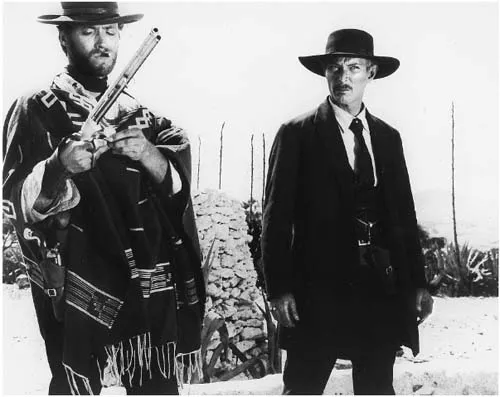
1.1 Spaghetti Westerns: Bounty hunters ‘The Man With No Name’ and Colonel Douglas Mortimer in For a Few Dollars More (1965); Clint Eastwood and Lee Van Cleef on location in Los Albaricoques, Almeria. Image courtesy Kevin Wilkinson Collection.
Joe arrives by mule in the Mexican border town of San Miguel, where he discovers from cantina owner Silvanito (Pepe Calvo) that the district is controlled by two rival gangs of bandits and smugglers: the Rojos, who deal bootleg liquor, and the Baxters, big gun merchants. The gangs employ hired gunmen and pay in dollars; in Leone’s original script, both factions were Mexican (the Rojos and the Morales). ‘If you don’t mind doing a little killing, you will have no trouble finding someone eager to pay you’, Silvanito advises. The stranger sees an opportunity to make a few dollars and exploits the gangs’ rivalry, hiring himself as a gunhand to the Rojos. The Rojos’ leader, Ramon (Gian Maria Volonte), leads a raid on a Mexican army convoy, stealing their shipment of gold, and tries to make peace with the Baxters. But Joe stirs up trouble, taking payment from both factions. Soon the feud is as fervid as ever, with the gangs shooting it out in a cemetery. Joe helps Marisol (Marianne Koch), a woman who has been blackmailed into living with Ramon as his mistress, to escape, but the subterfuge is discovered and the Rojos capture Joe and beat him up. He escapes and the Rojos search the town, massacring the Baxters, burning them out and shooting them down. Whisked out of town by coffin-maker Piripero (Josef Egger), Joe recovers in a disused mine. When Silvanito is caught bringing supplies to Joe and is tortured, the stranger returns to San Miguel for the last time, killing the Rojos in a duel before unhitching the coffin-maker’s mule and riding back into the sierras.
When Eastwood arrived in Rome, he brought his Rawhide props (boots, gunbelt, spurs and Cobra-handled Colt), plus a hat, some black drainpipe jeans and a battered sheepskin waistcoat. Leone and costume designer Carlo Simi draped him in a rather unusual addition – a fringed Spanish poncho, essentially a square piece of fabric with a slit for the head, decorated with a series of concentric patterns, including a rope motif, criss-cross lines and geometric Grecian designs. This poncho appears green in some washed-out prints of the film and almost black in Italian prints, but it’s actually brown. In the original script, Eastwood’s character, a Confederate sergeant called Ray, steals it from a Mexican peon swimming in the Rio Grande. In Fistful’s duel scenes, the stranger flicks this poncho over his shoulder to quicken his draw. Eastwood also grew a stubbly beard for the role, possibly inspired by Toshiro Mifune, who played Sanjuro Kuwabatake, the unshaven lead in Yojimbo. One key mannerism Eastwood stole from Mifune was his thoughtful chin rubbing. Joe smokes cheroots throughout, even though Eastwood was in reality a non-smoker and the cigar is rarely lit. It is as Joe that he perfected the Clint squint, reputedly caused by the strong Spanish sunlight. The stranger’s costume, props and mean demeanour fashioned Eastwood’s screen image, which he honed into what became known by critics and fans as spaghetti westerns, Euro-westerns, macaroni westerns, pizza westerns or Western All’Italiana (‘Westerns, Italian-style’). After years of being told that he looked ‘wrong’ for starring roles, that he was too tall, too ungainly, that he didn’t look like the popular stars of the day, or that he squinted too much, he found that in this new style western he was the look.
Leone shot Fistful in Italy and Spain. The budget didn’t allow much room for luxury and Eastwood even brought along his own stunt double – Bill Thompkins from Rawhide. It is Thompkins as Joe who gallops through the desert in the night-time riding sequences; he also plays the Baxter gunman in the green shirt during the hostage exchange. San Miguel was filmed in ‘Golden City’, a western set at Hojo De Manzanares (north of Madrid) and the adobe village of Los Albaricoques in Almeria, southern Spain. The interiors of Rojo’s residence and its whitewashed walled courtyard were Casa Da Campo, a Madrid museum. The small adobe house where Marisol is imprisoned, currently a hotel called Cortijo El Sotillo, is near San Jose in Almeria, while the Rio Bravo gold ambush was filmed on the River Alberche at Aldea Del Fresno. Filming commenced on Rome interiors in April at Cinecitta studios, moved to Hojo De Manzanares and its environs (for the graveyard shootout and the town scenes) and then wrapped in the Almerian desert.
A notable aspect of Fistful is the severe bloody beating Joe the Stranger suffers at the hands of the Rojos in their wine cellar, probably the worst onscreen pummelling Eastwood has taken in his entire career. As Eastwood remembered, ‘In the ‘Dollars’ films, stoic was the word. It was comedy and yet it was played dead straight. The violence tag was hung too tightly around my neck. The fact that they were made by an Italian in Europe had some people going in as edgy as I was when I made them. I personally don’t think of them as violent, only perhaps as black humour’. In Fistful, Joe is so badly injured (one eye is almost closed) and immobilised that the coffin maker has to sneak him out of town in a casket. This rough treatment reappeared in many of Eastwood’s later films and his heroes have had to recover quickly to defeat the villain: a symbolic ‘resurrection’.
Fistful contains two quintessential action moments in Eastwood’s transformation from clean-cut TV western hero to screen idol. In the first, he guns down four Baxter gunmen hanging around the San Miguel corral, for $100 in Rojo blood money. Having already spooked Joe’s mule as a warning, the quartet tells him to leave town. The gang find their threats amusing, but the stranger doesn’t: ‘My mule don’t like people laughing, gets the crazy idea you’re laughing at him’. His mood suddenly changes, from amiable cowboy kidding around to lethal killer demanding an apology. Joe flicks his poncho over his shoulder and the tension mounts, until in a flash, guns blaze and four Baxters bite the dust. Having ordered three coffins before the confrontation, Joe corrects his order: ‘My mistake ... four coffins’. The Saturday Review scathingly noted that ‘Eastwood ... makes full use of his one expression’, but the actor’s underplayed performance and his delivery marked Eastwood as a new type of action movie star, one for whom understatement and stoicism were trademarks.
In the film’s finale, Joe faces Ramon and four of his men in the plaza of San Miguel, near a water tower. The stranger announces his return with two dynamite explosions, which wreath the street in dust, unnerving his opponents: it’s a powerful image, with the stranger striding out of the dust cloud. Earlier Ramon has quoted a Mexican proverb to the stranger, claiming that a Colt .45 is inferior to a Winchester rifle. We already know from Ramon’s demonstrations of marksmanship that he always aims for the heart. ‘Shoot to kill, you better hit the heart’, goads the stranger, ‘The heart Ramon, aim for the heart, or you’ll never stop me’. Ramon fires at Joe repeatedly, hitting him, but each time the stranger gets back to his feet, seemingly supernatural. Eventually, when he’s within pistol range, Joe reveals that he’s been wearing a sheet of iron strapped to his chest, an armour hidden under his poncho, and there are seven bullet dents in the area of his heart. Real-life professional killer and lawman Jim Miller, known variously as ‘Killin’ Jim’ and ‘The Deacon’, wore a breastplate during his gunfights. One of the most deadly, not to say indestructible shootists, Killin’ Jim survived 14 gun battles.
Fistful’s memorable score was composed by Ennio Morricone, a school friend of Leone’s. The main theme (or ‘titoli’) deployed acoustic guitar, bells and whip-cracks backing the melody, voiced by a whistler and an electric guitar (both performed by Alessandro Alessandroni), while I Cantori Moderni (‘The Modern Singers’) supplied harmonies. This accompanied the pop-art title sequence, deploying rotoscope, an animation process that converts action from the film into garish, comic-strip violence. The titles begin with hypnotic smoke rings, which reveal the galloping hero and ricocheting gunshots herald Eastwood’s name onscreen. Elsewhere Morricone used the ominous piano and harmonica of ‘Almost Dead’ (for the stranger’s arrival in town), the cacophonous percussion and trumpet of ‘The Chase’, the eerie build-up to ‘Without Pity’ (for the Baxter massacre), and the Mexican trumpet ‘Deguello’, a funereal Mariachi backed by strings and chorus. Entitled ‘A Fistful of Dollars’ on soundtrack albums, this was released by RCA as a 45rpm single under the title ‘The Man with No Name’. This music and that of Eastwood’s later spaghetti westerns were inexorably linked to the actor throughout his career. They became Eastwood’s ‘theme tunes’ and his later films occasionally deployed Morricone-style musical cues as knowing references to his career as ‘The Man with No Name’.
Fistful was released in Italy as Per Un Pugno di Dollari (‘For a Fistful of Dollars’) in September 1964, to great word-of-mouth success, eventually becoming the biggest-grossing Italian film of all time up to that point. Italian posters for its premiere trumpeted ‘The most recent and sensational western film with the new American idol’. For international release, United Artists dubbed the film A Fistful of Dollars (shortened in the animated title sequence to simply Fistful of Dollars) and prepared a high-profile publicity campaign ahead of the opening in the US in January 1967. Key art featured Eastwood in his poncho, with the taglines ‘He’s going to trigger a whole new style in adventure’, ‘In his own way he is perhaps the most dangerous man who ever lived!’ and ‘The first motion picture of its kind. It won’t be the last!’ Fistful was rated ‘M’ in the US and ‘X’ in the UK, even after it was trimmed for violence; subsequent DVD releases, rated ‘15’, are uncut. In the US, Fistful took $4.25 million in 1967 and eventually grossed $14.5 million. Many Italian and Spanish westerns of the sixties and early seventies capitalised on the success of Leone’s film, with derivative titles and poncho-clad heroes, including ‘Vance Lewis’/Luigi Vanzi’s For a Dollar in the Teeth (1966 – aka A Stranger in Town), starring Tony Anthony as the stranger and Frank Wolff (Leone’s original choice for Ramon Rojo) as bandit leader Aguila (‘The Eagle’). Eastwood made better films and he also made much more money, but A Fistful of Dollars facilitated his leap from TV fame to international superstardom. When, in December 1980, the Museum of Modern Art paid tribute to Eastwood with a one-day retrospective of his films, the works chosen were Escape from Alcatraz, Play Misty for Me, Bronco Billy and A Fistful of Dollars.
For a Few Dollars More (1965)
Fistful certainly wasn’t the last motion picture of its kind and Eastwood was soon back in Italy and Spain filming a sequel, literally For a Few Dollars More – his salary this time was $50,000. As ‘the anti-hero to end all anti-heroes’ (as Films and Filming christened him), Eastwood was again a gunfighter, now a bounty hunter named Manco. The story was based on an original outline by Leone and his brother-in-law Fulvio Morsella, with a screenplay by Leone, Luciano Vincenzoni and an uncredited Sergio Donati.
Manco and Colonel Douglas Mortimer (Lee Van Cleef) are two deadly bounty killers, ridding the American southwest of renegade outlaws and cashing in their rewards. When the territory’s most notorious criminal El Indio (Gian Maria Volonte) escapes from prison, the pair teams up to scoop the $10,000 reward offered ‘Dead or Alive’. Indio and his cadre of bandidos target the three-ton safe in El Paso, a supposedly impregnable fortress containing almost a million dollars. Working to Mortimer’s stratagem, ‘one from the outside, one from the inside’, Manco infiltrates Indio’s gang and tries to sabotage their plan, but Indio is smarter and the gang flees with the loot. The robbers lie low in ...
Table of contents
- Cover
- Title page
- Copyright page
- Dedication page
- Contents
- List of Figures
- Preface: Aim for the Art
- Acknowledgements
- Universal Casting: The Early Films
- Ridin’ Easy: Rawhide
- Part One: The Westerns
- 1. A Fistful of Dollars (1964)
- Part Two: The Cops
- 1. Coogan’s Bluff (1968)
- Part Three: The Lovers
- 1. The Witches (1967)
- Part Four: The Comedies
- 1. Every Which Way But Loose (1978)
- Part Five: The Dramas
- 1. Honkytonk Man (1982)
- Part Six: The Thrillers
- 1. Thunderbolt and Lightfoot (1974)
- Part Seven: The War Movies
- 1. Where Eagles Dare (1968)
- Epilogue
- Eastwood Filmography
- Bibliography and Sources
Trusted by 375,005 students
Access to over 1.5 million titles for a fair monthly price.
Study more efficiently using our study tools.
Frequently asked questions
Yes, you can cancel anytime from the Subscription tab in your account settings on the Perlego website. Your subscription will stay active until the end of your current billing period. Learn how to cancel your subscription
No, books cannot be downloaded as external files, such as PDFs, for use outside of Perlego. However, you can download books within the Perlego app for offline reading on mobile or tablet. Learn how to download books offline
Perlego offers two plans: Essential and Complete
- Essential is ideal for learners and professionals who enjoy exploring a wide range of subjects. Access the Essential Library with 800,000+ trusted titles and best-sellers across business, personal growth, and the humanities. Includes unlimited reading time and Standard Read Aloud voice.
- Complete: Perfect for advanced learners and researchers needing full, unrestricted access. Unlock 1.5M+ books across hundreds of subjects, including academic and specialized titles. The Complete Plan also includes advanced features like Premium Read Aloud and Research Assistant.
We are an online textbook subscription service, where you can get access to an entire online library for less than the price of a single book per month. With over 1.5 million books across 990+ topics, we’ve got you covered! Learn about our mission
Look out for the read-aloud symbol on your next book to see if you can listen to it. The read-aloud tool reads text aloud for you, highlighting the text as it is being read. You can pause it, speed it up and slow it down. Learn more about Read Aloud
Yes! You can use the Perlego app on both iOS and Android devices to read anytime, anywhere — even offline. Perfect for commutes or when you’re on the go.
Please note we cannot support devices running on iOS 13 and Android 7 or earlier. Learn more about using the app
Please note we cannot support devices running on iOS 13 and Android 7 or earlier. Learn more about using the app
Yes, you can access Aim for the Heart by Howard Hughes in PDF and/or ePUB format, as well as other popular books in Mezzi di comunicazione e arti performative & Regia e produzione cinematografica. We have over 1.5 million books available in our catalogue for you to explore.