The television industry has metamorphosised from a national and largely-monopolized sector to a commercial and global enterprise. This has profoundly altered the way 'historical truth' and shared memory are constructed and conveyed. Here Ashuri provides a groundbreaking study of the changes through the vantage point of an illuminating mode of television production, international co-productions. By taking an example based on current events in the Middle East - a television documentary on the Arab Israeli conflict co-produced by three television networks (BBC, PBS, MBC) - her study enriches contemporary media research, providing an unprecedented, behind-the-scenes look at the entire production process of a co-produced television history.She shows that making the documentary on the Arab-Israeli struggle turned into a war: a war over competing memories, interpretation, editing, and finally narration. Ashuri's analysis of transnational documentary collaborations reveals inherent tensions between economic constraints and cultural forces, between the local and global, and between 'shared' and 'cosmopolitan' memory.
Enriching political economy studies of media by exploring the cultural negotiations at the heart of television production process, and highlighting the economic processes that underlie the contested constructions of national histories, "The Arab-Israeli Conflict in the Media" will be essential reading for those interested in media and television studies, as well as globalization and cultural identity.
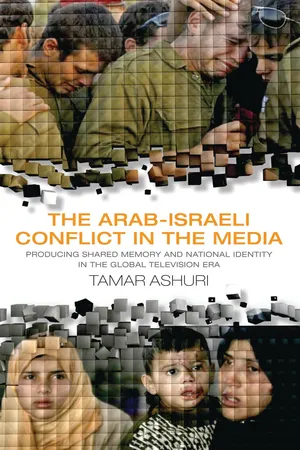
eBook - ePub
The Arab-Israeli Conflict in the Media
Producing Shared Memory and National Identity in the Global Television Era
- 272 pages
- English
- ePUB (mobile friendly)
- Available on iOS & Android
eBook - ePub
The Arab-Israeli Conflict in the Media
Producing Shared Memory and National Identity in the Global Television Era
About this book
Information
Chapter One
THE TELEVISION DOCUMENTARY AND THE REPRESENTATION OF NATIONAL IDENTITY AND SHARED MEMORY
We would like to hear about what you did and what you witnessed.... In our programmes, ‘telling it as a story’ matters as much as the information itself. Our aim is to take viewers inside meetings at which critical decisions were taken so they can hear the arguments as they happened. In this way, dry concepts come alive for the viewers. Our method is to choose a few key events and go into them in depth. We would like to hear your own memories of the following events in which you were involved1
— Norma Percy, Series Producer, Brian Lapping Associates,
London, UK
I begin with Norma Percy, who is neither cultural historian nor economist, media theorist nor television critic, but a television producer. The role of the television producer is vital to my study on the economic and cultural interactions between the creators and disseminators of television documentaries in general and my examination of the production process of the documentary The Fifty Years War: Israel and the Arabs in particular. In her above-noted instructions to potential subjects/interviewees for the film, Percy makes it very clear that for the film to tell history ‘as a story’ and ‘matter’ to her audience, the ‘witnesses’ will have to recount their ‘memories’. In effect, Percy’s thoughts foreground the central issues of the forthcoming chapter: the role of ‘television history’ in shaping, maintaining and reflecting national identity; in providing an ‘historical map’ that will be readable and amenable to a community that is proud of its traditions and identity; and its makers insistence on providing experiences that fall under the category of ‘shared memory’.
‘To possess a culture’, Tzevetan Todorov wrote in his essay ‘The Coexistence of Cultures’, ‘means having at our disposal a prearrangement of the world, a miniature model, a map of sorts, which permits us to orient ourselves within it’ (1997:3). From their very beginning, television documentaries have provided Todorov’s ‘miniature model’, as they help shape, preserve and reflect national identity by linking a national audience to a national experience and ‘shared memory’ (e.g. Smith 2000:52; Edgerton 2001).
Television is a cultural practice as well as a cultural institution. It is a vehicle through which cultural forms are manifested and a repository of a nation’s culture takes form. More specifically, ‘television histories’—the unique mode of representation that stands at the centre of this book—serve as essential constructs through which recognizable symbolic forms, narratives and languages, namely cultural representations that embody the achievements of a national identity, are inculcated into the public consciousness.
In light of the above, the creators of television histories should be counted amongst the influential agents that fill the role of interpreting the nation’s past in a coherent and significant fashion by placing historical events into meaningful narrative frameworks. These frameworks are predicated on shared symbolic systems (values, myths and memories), which are reaffirmed by virtue of their representation. In this fashion, the representations serve as the scaffolding for a shared (or contested) political, cultural and social discourse, namely the edifice of national identity.
My attempt to situate television histories within the purview of the demands of national cultures—that is, to grasp the critical link between television, memory and nation—necessitates a review of the range of critical studies dealing with concepts of nation/nationhood and the general nexus between nation/culture and shared memory. To contend with these issues, diverse disciplines (e.g. Sociology, Economics, Cultural Studies and Media Studies) have embraced a coherent set of key terms (some old, some new), such as nationalism, cosmopolitanism, globalization and post-nationality, over the past two decades.
I begin this theoretical survey at the beginning, with a look at the more acclaimed definitions of nation.
Defining ‘Nation’
Anthony D. Smith, in his book National Identity, defined the nation as ‘a named human population sharing an historic territory, common myths and historical memories, a mass public culture, a common economy and common legal rights and duties for all members’ (1991:14). To this may be added the essentially irrational psychological bond that binds fellow nationals together, which was underscored by Walker Connor (1978; 1993). Connor believed that this form of national identity offers its members ‘a sense of belonging’, or what the anthropologist Clifford Geertz referred to as ‘a fellow feeling’ (Geertz 1963). In a similar vein, Jessica Evans (1999) touched upon the symbolic dimension of national identity in her introduction to Representing the Nation: A Reader:
In recent years, ‘The Nation’ has come to be seen not merely as the object of political, geographical or economic analysis, but as one of cultural analysis. People are not merely legal citizens of a nation; in an important sense a nation is also a symbolic community which creates powerful—and often pathological allegiances to a cultural ideal....This cultural ideal expressed is the motivation to unify, to create a congruence between membership in a political nation-state and identification with a national culture, a way of life (1999:1, Evans’s italics).
Since the early 1980s, the conceptualisation of the nation as a socially constructed category of meanings has become accepted practice. Along with the general ‘cultural turn’ in social history, ethnicity and nationalism, scholars have begun to deconstruct nationalism and national identity by studying the shared symbols, values, discourses and memories that enabled large groups of people to develop a sense of belonging to a national community (e.g., Anderson 1983; 1991; Hobsbawm & Ranger 1983; Billig 1995). Against this backdrop, the questions that undergird the present discourse are as follows: How has national identity gained precedence over all other claims to social identity and loyalty? ‘In what way does a national identity maintain temporal continuity, exerting its fierce gravitation pull from generation to generation’ (Bell 2003:67)?
These questions tie into the wider debate over the origins of nationalism and have elicited a broad array of responses (e.g. Anderson, 1983; Gellner 1983; Smith 2001). Notwithstanding the differences that inform the various approaches to theorizing nationalism, Bell noted that all the modes ‘rely on the centrality of nationalist story telling, on the evocative narration of the links between the past, present and future’ (2003:66, Bell’s italics). Bell provided a utile taxonomy that divides the different theories of nation and nationalism into five categories2: primordialists, perennialists, modernists, historical ethno-symbolists and the post-modernists. All of these schools of thought attempt to understand the temporal continuity of national identity (Bell 2003:66).
• The primordialists see the nation as rooted in bonds of kinship and genetic similarities. As far as they are concerned, one’s allegiance to the nation is as much a function of blood or nature as history. That said, the strength of these biological ties is rooted in the age-old custom of story telling. It is these stories that provide the impetus for a national revival and mobilize the emotions of the masses (Geertz 1963; Connor 1993).
• Perennialists contend that nations have been a constant on the landscape of human history since ancient Egypt. Nations continuously emerge and dissolve, only to reappear in later periods and different venues (discussed in Smith 1999:5). According to perennialists, the survival of the national structure is predicated on the ability of nationalists to generate a form of communal identity that clearly differentiates the collective from other groups. It is this need for distinguishment that makes the nexus between representation and identity so crucial (e.g. Hastings 1997).
• The modernists, as their name suggests, consider the ‘nation’ to be a product of modernity, which is exemplified by the bureaucratic state, the industrial economy of capitalism and secular social norms (e.g. Anderson 1983; Gellner 1983; Hobsbawm 1990). Scholars who subscribe to this approach concentrate on the industrial revolution, the spread of capitalism and the role of economic and political elites in the construction (and invention) of social bonds—to include distinct historical narratives—that instil a sense of national unity. Representation of stories from the past constitutes a principal source of evidence for this line of reasoning (e.g. Hobsbawm & Ranger 1983; Anderson 1991).
• According to the historical ethno-symbolism approach, nationalism derives its power from myths, memories, traditions and symbols of ethnic heritage, along with the rediscovery and reinterpretation of popular living pasts on the part of modern nationalist intelligentsias (Smith 1999). Here too, representation is crucial, for without the construction of a particular interpretation of the past, this type of argument would be untenable.
• The post-modernists do not offer a distinct explanatory framework. Instead, they propose a set of concepts that derive from a constructivist mode of theorizing. The post-modernists (e.g. Bhabha 1990) accentuate the ways in which particular narratives are shaped and disseminated and thus perceive nations as cultural artefacts. Given their focus on the discursive construction of national communities, they are interested in the media through which these sorts of narratives are communicated and imagined communities are formed and dismantled.
Despite their different interpretations of the genesis and nature of the nation, all five perspectives deem story-telling and representation to be decisive factors, as the construction of nation-specific narratives of the past is central to each theory. In summarizing his review of the five perspectives, Duncan S.A. Bell unequivocally points to ‘representational practices’ as the core element that is common to all five approaches:
Representational practices are thus inherently bound up in the process of national identity formation: to mould a national identity—a sense of unity with others belonging to the same nation—it is necessary to have an understanding of oneself as located in a temporally extended narrative, and in order to be able to locate one as such, nationalist discourse must be able to represent the unfolding of time in such a way that the nation assumes a privileged and valorized role (2003:69).
In their effort to explain how nations produce and reproduce the crucial link between past, present and future, scholars repeatedly turn to assorted variations of the concept of collective memory, namely a memory that is found and shared in some form by many, if not most, of the members of any given national community (Bell 2003:69). It is through these memories, so the argument goes, that the nation is forged and maintained. As Smith put it, ‘Memory, almost by definition, is integral to cultural identity, and the cultivation of shared memory is essential to the survival and destiny of such collective identity’ (1999:10). Therefore, ‘nationalists must rediscover and appropriate shared memories’ (Smith 1996:383).
Theorizing the Nexus between Nation and Memory
In his essay ‘What is a Nation?’ ([1882] 1996:52), Ernest Renan, the French religion historian, defined the nation as ‘a soul, a spiritual principle’, whereupon he immediately linked this definition to ‘memories’:
Two things, which, in truth, are really just one, make up this soul, this spiritual principle. One is in the past, the other is in the present. One is the possession in common of a rich legacy of memories; the other is current consent, the desire to live together, the willingness to continue to maintain the values of the heritage that one has received in an undivided form (1996:52, my italics).
The nation, Renan argued, is bound together not by the past itself—what actually happened—but by stories of that past—what is remembered; the ‘rich legacy of memories’ that members of a national community tell one another in the present. Notably, Renan added that the national community also agrees to forget, for the story of the past is crafted by holding on to some events, while letting go of others. What the nation ‘remembers’ and what it ‘forgets’ determine its character.
This definition of the nation places ‘national memory’ at the heart of national identity. The stories of a nation’s past are kept alive in the minds of individuals and narrated in written texts; they are performed on stage, represented on screen and encoded into monuments. In principle, every member of the community can refer to and draw upon these stories. ‘The willingness to continue to maintain the values of the heritage that one has received in an undivided form’, according to Renan, is the basis of their national identity (1996:52).
Renan’s pioneering conception of the ‘nation’ as a community of shared memory and shared forgetting was expanded upon in more recent works, such as Pierre Nora’s Between Memory and History: Les Lieux de Mémoire (1989). Nora contended that the institution of memory began to decline in the nineteenth century on account of the accelerated pace of everyday life wrought by industrial and social modernization. As old traditions and affiliations lost their hold on the people, the bond with their past was reconstructed through ‘second-order’ simulations. Elites produced ‘sites of memory’ in language, monuments and archives, all of which contained one common referent: the nation. In other words, efforts were made to guarantee the nation’s future by means of appealing reinventions of its traditions.
Focusing on the construction of ‘collective memory’ in France, Nora (1996) inventoried the sites of French national memory that were erected over the centuries, while similar studies were conducted on other national heritages (e.g. Gillis 1994; Samuel 1994 [UK]; Zerubavel 1995 [Israel]; Zamponi [Italy] 1998). This body of work has served as a springboard for nationalism and ethnicity critics that study the interplay between memory and national identity. In his prolific oeuvre, Anthony D. Smith (1986; 1991; 1995; 1996; 1999) placed great store on the role that memory plays in the forging and maintenance of national identity, noting that the ‘relationship of memories to collective cultural identity and the cultivation of shared memories is essential to the survival and destiny of such collective identities’ (1999:10). ‘[O]ne might almost say: no memory, no identity; no identity, no nation’ (Smith 1986:383). In his book Nationalism and Modernism: A Critical Survey of Recent Theories of Nations and Nationalism, Smith bolstered his claim by pointing to the historiography of specific nations. For example, in his analysis of Poland’s rejuvenation, Smith showed that that the Polish nation is not merely a fabrication, but ‘linked in many ways with the earlier Polish state, not least through the shared codes, rituals, memories, myths, values and symbols which bound Poles together during the long nineteenth century of their unfreedom’ (1998:131, my italics).
In Smith’s estimation, then, the amalgam of memory and nation is grounded on the crucial interplay between manifold, highly-resilient cultural elements that are shared by most of the members in a given national community. Smith and other scholars primarily attributed the wherewithal of nations to produce and re-produce themselves over time to ‘shared memory’ (e.g. Anderson 1991; Hall 1992b). Karl W. Deutsch, for example, argued that the ultimate exercise of national power relies upon a ‘relatively coherent and stable structure of memories, habits and values’ (1966:75 my italics). Put differently, the adherents of ‘shared memory’—whether of real events or ancient myths—locate the collective inside a shared history. Memory acts as a powerful force of cohesion, uniting disparate individuals under the political (and cultural) ‘roof’ of the nation. It is memory, Bell wrote, that ‘demarcates the boundary between Them and Us, delineating the national self from the foreign, alien Other. Such binding memories can be passed from generation to generation, transmigrating across multiple historical contexts. They can (allegedly) be invented, acquired, and established, although more often than not they assume a life-force of their own, escaping the clutches of any individual group and becoming embedded in the very fabric, material and psychological, of the nation’ (2003:70).
In recent years, these observations on the relationship between memory and national identity have been applied to the study of the profound role that different media play in the articulation and construction of the nation’s past (Silverstone 1999; Reading 2003). These studies point to the mass media (pictures, newspapers, etc.) as the principal mnemonic sites and most influential mnemonic agents for the construction and preservation of nationalism (e.g. Mosse 1990; Sturken 1997; Olick 1998).
Therefore, in order to comprehend the nature of the tri-lateral interplay between national identity, shared memory and the media, it is incumbent upon scholars to first clarify the meaning of ‘shared memory’.
Theorizing ‘Shared Memory’
The scholarly interest in ‘shared memory’ can be traced at least as far back as Emile Durkheim (1915) and his notion of the ‘conscience collective’. However, most collective memory theorists consider their point of departure to be the ground-breaking work of the sociologist Maurice Halbwachs, a student of Durkheim. Following in Halbwachs’ footsteps, they define collective memories as shared representations of the past. Halbwachs’ principal hypothesis was that human memory could only function within a collective context: ‘Memory needs continuous feeding from collective sources and is sustained by social and moral props. Just like God needs us, so memory needs others’ (1992:34).
Throughout...
Table of contents
- Cover
- Author biography
- Title page
- Copyright page
- Dedication page
- Contents
- Acknowledgements
- Introduction
- 1. The Television Documentary and the Representation of National Identity and Shared Memory
- 2. Television, Nationalism and Globalization
- 3. Co-Producing Television Programmes
- 4. The Cultural Economy of the ‘Televised History’: The Fifty Years War—the Production Process
- 5. Editing Nation and Culture: the Three Final Cuts
- 6. TV ‘Tension’: Globalization vs. Nationalism and Shared vs. Cosmopolitan Memory in Co-Produced Television Documentaries
- Conclusion
- Notes
- Bibliography
Trusted by 375,005 students
Access to over 1.5 million titles for a fair monthly price.
Study more efficiently using our study tools.
Frequently asked questions
Yes, you can cancel anytime from the Subscription tab in your account settings on the Perlego website. Your subscription will stay active until the end of your current billing period. Learn how to cancel your subscription
No, books cannot be downloaded as external files, such as PDFs, for use outside of Perlego. However, you can download books within the Perlego app for offline reading on mobile or tablet. Learn how to download books offline
Perlego offers two plans: Essential and Complete
- Essential is ideal for learners and professionals who enjoy exploring a wide range of subjects. Access the Essential Library with 800,000+ trusted titles and best-sellers across business, personal growth, and the humanities. Includes unlimited reading time and Standard Read Aloud voice.
- Complete: Perfect for advanced learners and researchers needing full, unrestricted access. Unlock 1.5M+ books across hundreds of subjects, including academic and specialized titles. The Complete Plan also includes advanced features like Premium Read Aloud and Research Assistant.
We are an online textbook subscription service, where you can get access to an entire online library for less than the price of a single book per month. With over 1.5 million books across 990+ topics, we’ve got you covered! Learn about our mission
Look out for the read-aloud symbol on your next book to see if you can listen to it. The read-aloud tool reads text aloud for you, highlighting the text as it is being read. You can pause it, speed it up and slow it down. Learn more about Read Aloud
Yes! You can use the Perlego app on both iOS and Android devices to read anytime, anywhere — even offline. Perfect for commutes or when you’re on the go.
Please note we cannot support devices running on iOS 13 and Android 7 or earlier. Learn more about using the app
Please note we cannot support devices running on iOS 13 and Android 7 or earlier. Learn more about using the app
Yes, you can access The Arab-Israeli Conflict in the Media by Tamar Ashuri in PDF and/or ePUB format, as well as other popular books in Social Sciences & International Relations. We have over 1.5 million books available in our catalogue for you to explore.