The conclusion of World War I and the subsequent breakup of the Ottoman Empire led to the
independence of a number of Arab nations and resulted in a Western scramble for roles of
control and influence over them. It was not until after World War I that Syria and the United States had a formal diplomatic relationship - prior to then the only Americans who had developed a relationship with the nation were missionaries, particularly those involved with the Syrian Protestant College, established in 1866. The collapse of the Ottoman Empire, however, single-handedly brought Syria into the sphere of influence of the Western world, and as Sami Moubayed here illustrates, particularly that of the United States.
The relationship between the two nations was by no means uncomplicated, and there were a number of challenges from the years following World War I to the early years of the Cold War. Though relations were warm between the United States and Syria while Emir Faisal was ensconced in Damascus, Washington saw little point in pursuing an American-Arab alliance,
and Faisal's reputation suffered greatly as a result of his relationship with Wilson, particularly with respect to his stance on the creation of a Jewish state in Palestine. Relations cooled between the two nations during the presidencies of both Warren Harding and Calvin Coolidge, neither of whom saw any value in being involved in Middle East affairs.
However, with the discovery of large oil reserves in the Middle East, as well as Syria's siding with the Allies and declaring war on Nazi Germany, interest in the American-Syrian relationship was greatly revived. As quickly as the relationship warmed though, it also cooled: in the aftermath of World War II, the United States was linked to involvement in a series of coups and counter-coups that destabilized Syria from 1949 until the Syrian-Egyptian union of
1958. Furthermore, Washington's initially benevolent attitude towards the right to self-determination gradually evolved into one of manipulation, espionage and covert activity during the Cold War when the US considered Syria as a Soviet proxy in the Middle East.
The forty years between 1919 and 1959 saw the creation and unravelling of America's relationship with Syria. In this book, Moubayed brilliantly explores the events of these years and, using original research and previously unpublished material, sheds light on an often overlooked subject. Syria and the USA is an essential read for scholars of the Middle East, US diplomatic history and twentieth-century international relations.
eBook - ePub
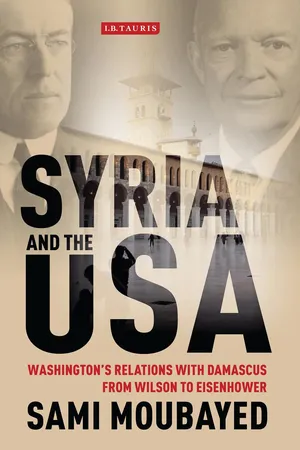
Syria and the USA
Washington's Relations with Damascus from Wilson to Eisenhower
- 240 pages
- English
- ePUB (mobile friendly)
- Available on iOS & Android
eBook - ePub
About this book
Information
1
WILSONIAN PRINCIPLES AND SHATTERED DREAMS
The Paris Peace Conference opened on 18 January 1919, when international leaders assembled in France to discuss the future of the world. The Ottoman Empire, which had ruled Syria since 1516, had just collapsed. Sharif Hussein, leader of the Arab Revolt against the Ottomans in 1916–1918, was invited to attend, but declined – he was too busy laying claim to the vast deserts of Arabia, which he wanted to bring under the Hashemite Crown. Instead, he sent his 36-year-old son, Sharif Faisal, who, in October 1918, had been proclaimed the first Arab ruler of Syria after 400 years of Ottoman rule.
Young and passionate, yet politically inexperienced, the short and handsome bearded Bedouin headed for Europe, not knowing what to expect from the Occidental world. US President Woodrow Wilson, registered to attend the Paris Conference, had expressed a revised American interest in Europe, and a newborn interest in the Middle East. Before 1919, the word ‘Arab’ had never been mentioned in public by a US president – and certainly not the word ‘Syria’.1 Apart from second generation Arabs who lived and worked in the USA as Arab–Americans, no American leader had ever met an Arab residing in the Arab world. To the Arabs, the USA was far away – completely detached from the Middle East, its plight, past and future. Apart from Christian missionaries who had come to the region during the nineteenth century, no senior US officials had visited the Arab territories of the Ottoman Empire. The only Americans the Arabs had ever met were nurses, doctors, educators, archeologists and biblical scholars. Wilson – although an educator by training – was the first US president to come into face-to-face contact with an Arab.2
Sharif Hussein’s son Faisal had triumphantly marched into Damascus on 3 October 1918, aided by the mighty British Army. He had received a hero’s welcome, unprecedented since the days of the Umayyad Dynasty. Everywhere he went, flags of the Arab Revolt were perched on balconies, along with photographs of the young Prince and his legendary father, Sharif Hussein Ibn Ali. Faisal knew the Syrians relatively well, having frequently visited Damascus in the early years of the Great War and befriended its prominent Ata Pasha al-Bakri and his son, Nasib. Most Syrians welcomed the Arabian Emir as a breath of fresh air, coming after the ruthless era of Jamal Pasha, the Ottoman Governor of Syria during the Great War. Faisal was young and mirrored the ambitions of young Syrians of his age, who had been dragged to the war front in large numbers to fight for an Ottoman cause that did not concern them, on the part of Germany. He was a Hashemite, scion of a family that descended directly from the Prophet Mohammad, and had plenty of war medals for his military role in the Arabian Revolt. A passionate, bold and decorated war hero, he seemed the perfect ruler for the people hungry for Arab leadership. A few local politicians, however, complained that Faisal was an ‘imported’ ruler with a social, cultural and political background that was very different from that of most Syrians. Many took great pride in their urban past and saw Faisal as an uncivilized Bedouin, unfit to rule those who had been raised in the grace of great cities like Damascus and Aleppo.3 From day one, Faisal tried to prove to the handful of his opponents in Damascus that they were wrong about him. He promised to usher in reforms and stability, becoming ‘a modern day Mu’awiya!’4
Faisal spoke with a Bedouin accent that was strange to many urban dwellers – certainly the residents of his new capital, Damascus. Still inexperienced in politics, he had begged his father not to go to Paris and to send his elder brother Abdullah instead.5 He needed to spend quality time with the Syrians, he argued, so they would familiarize themselves with their new monarch, while he would learn of their culture, norms and living habits. Blending in did not seem too difficult, for the Syrians showed eagerness to please their new leader. When he declared, for example, that he preferred European bowler hats to the traditional Ottoman fez, hundreds of young people discarded the fez and began to dress to the liking of their new Prince.6 Faisal had never travelled beyond Arab territory and, although fluent in French, felt that he was not ready to face seasoned world leaders like France’s Georges Clemenceau and Great Britain’s Lloyd George. It was safer to stay behind in his comfort zone in Damascus and for Abdullah to go instead, given the latter’s strong interaction with British officials during the Great War. Hussein, a stern man, curtly refused his son’s suggestion, claiming that he needed Abdullah – perhaps the ablest of all his children – by his side for further conquests in Arabia. Hussein’s only instructions were verbal; Faisal was to press for an answer from the Great Powers regarding the future of Arab territories liberated from the Ottoman Empire. The British, in their famous correspondence with Sharif Hussein, had promised him a kingdom in the Arab world to be ruled along with his sons Ali, Abdullah and Faisal. Now that the Great War was over, Hussein wanted the British to fulfil their wartime promise. According to Sir Alec Kirkbride, a future British advisor to Abdullah, ‘He (Hussein) and his sons agreed that Ali, the eldest, should succeed their father as King of the Hijaz; that Abdullah, the second, should be King of Iraq and that Faisal, a third, should become King of Syria.’7
While Faisal had spent the pre-war years dabbling in Ottoman politics with Arab nationalists in Damascus, Abdullah had been instructed to open channels with Great Britain, which attached great importance to the Arab world, due to its presence in Egypt. In February 1914, Abdullah had gone to Cairo, at his father’s request, and met with Lord Herbert Kitchener, the British Consul-General in Egypt. Abdullah inquired on the British response should Sharif Hussein – who had recently been appointed Prince of Mecca by the Ottoman Sultan – raise a revolt against the Ottoman Empire. Kitchener initially gave him a cold shoulder, given that war had not yet erupted in Europe and there was no sense in provoking conflict with the Ottomans. When war did break out in August 1914, many European statesmen felt that it would be swift and ‘over by Christmas’. In November 1914, however, the Ottoman Empire went to war against Great Britain and France, completely changing the attitude in London. Kitchener’s successor, Lord Henry McMahon, famously orchestrated the British–Arab alliance through a series of correspondence carrying his name, and that of Sharif Hussein, in 1915. Hussein made it a condition that in exchange for opening an internal front against the Ottomans, he wanted Palestine, Lebanon, Iraq and Syria to fall under his control. McMahon controversially approved Sharif Hussein’s request.
On 11 November 1918, Hussein sent a note to the British that Faisal would attend the Paris Conference in his capacity as the new ruler of Syria. There are no documents available to prove whether Hussein knew beforehand that President Wilson was going to be in Paris, but even if he did it is doubtful that he would have really cared. Hussein came from an older generation of Arab politicians who worried more about what statesmen coming from Paris and London were thinking; Washington was on nobody’s radar in 1919. The telegram confirming Faisal’s attendance did not reach the British until 19 November.8 When Faisal arrived at the port of Marseilles on board the British ship, Gloucester, nobody in the French government knew what to do with the Arab royal. The young Prince immediately panicked. Lord Derby, the British Ambassador to Paris, swiftly contacted the Foreign Office, asking them to grant him an official reception, and on-the-spot entry permission. The French snapped that they did not recognize Faisal’s government in Damascus and could not welcome him as head of state, representing the newly created and yet not internationally recognized Kingdom of Syria. He would be treated as a royal guest, they said, and a friend of Great Britain. He would be allowed to speak at the Paris Conference, which was due to open in six weeks, but would have no say over the decisions made.9 The British used their considerable influence with the French to take him on a tour of France, while he waited for the conference to begin. Delegates of the Foreign Ministry even escorted him on a night out on the Champs Élysées, then to a Parisian night club where he was given full entertainment with half-naked dancing girls, in complete disregard to his conservative Muslim background. Faisal grumbled to one of his hosts, ‘I did not come here for entertainment or fun! I came here to serve my nation!’10 He was granted an audience with the president of Sorbonne University, and received a delegation of French artists, one of whom expressed enchantment with the Emir, who they claimed ‘bore a striking resemblance to Jesus Christ’.11 Faisal then made a dashing visit to London, where after staying at the Carlton Hotel, he was given an immediate, if ceremonial, audience with King George V and Foreign Minister Arthur Balfour. The meeting was so brief that Faisal was not even given a chance to properly discuss the fate of Jews and Arabs in Palestine, given that the Foreign Minister’s signature graced a famous declaration that granted the Jews a national home in Palestine. Recalling the meeting years later, Balfour noted that during his brief encounter with Faisal, the Emir made no mention of Iraq or Palestine and was only concerned with his throne in Syria.12
Faisal in Paris
The thing that worried Faisal most while in Paris was the realization that Europe was determined to fulfil the Sykes–Picot Agreement, which carved up the Middle East between French and British mandates, and the Balfour Declaration, granting the Jews a national home in Palestine. The Sykes–Picot Agreement, which was officially named the Asia Minor Agreement, had been signed in February 1916, granting mandates to France and Great Britain on the same territories that had been promised to Sharif Hussein and his three sons. Then came the Balfour Declaration in November 1917, stressing that Great Britain favoured ‘the establishment in Palestine of a National Home for the Jewish people’. In Paris, Faisal quickly saw that these two wartime promises would surely hamper his family’s ambitions of ruling all Arab territory just liberated from the Ottoman Empire and be likely to bring his political career to an abrupt end. Hussein and Faisal had first heard of the Sykes–Picot Agreement shortly after it was signed, before the full text was first revealed in Izvestiaand Pravda, two Russian newspapers, on 23 November 1917. The Manchester Guardianreprinted the text on 26 November 1917, which in turn found its way into the Arab press. The text became public only three weeks after the Balfour Declaration was issued, sending shockwaves throughout the Arab world. Miraculously, the Arabs were persuaded to allay their worries, through British pledges that the Hussein–McMahon correspondence would be honoured, regardless of the Sykes–Picot Agreement. Hussein, aged and apparently naïve, accepted everything the British told him.13
With these fears and complications in mind, and a challenge to defeat his opponents in Syria at any cost, Faisal attended sessions of the Paris Conference on 1 January 1919. Initially he stayed at the Continental Hotel, overlooking Tuileries Gardens, just down the block from the American delegation that was registered to attend the Paris Conference.14 He then switched to a small private hotel, a former mansion to King Louis XVI, on the well-heeled Avenue du Bois, transforming it into his headquarters, complete with an Arab tent, strong Arabic coffee, and full Bedouin uniform, for the remainder of his stay in Paris.15 Faisal’s first surprise was that he was not welcomed as a head of state by the French government, but rather as an envoy for his father, the King of Hijaz, meaning that as far as the Great Powers were concerned, the sovereignty of Syria, and authority of its new Emir, were both in doubt. He took along a trusted aid, Nuri al-Said, who was to become the future Prime Minister of Iraq, and Jamil Mardam Bey, a recent graduate of Paris who was to become the future Prime Minister of Syria, as his private translators. Other members of the Syrian delegation included the Lebanese statesman Rustom Haydar from Baalbek, and the Palestinian nationalist Awni Abdul Hadi. Faisal relied on Haydar, Mardam Bey and Said to convey his messages in French and English to the world leaders assembled in Paris.
On 1 January 1919, Faisal presented a memorandum to the conference, calling for self-government in Syria. On 6 February he addressed the Council of Ten, making similar demands for self-rule.16 The French thundered back that the young prince had no authority to speak on behalf of the people of Syria. Faisal immediately contacted his younger brother Zayd, who was acting as Regent back in Damascus, asking him to gather the signatures of city notables saying that Faisal Ibn al-Hussein was in Paris with a mandate to speak on behalf of the Syrians. The signatures were gathered by Zayd and Faisal’s Prime Minister Rida Pasha al-Rikabi, and included the Greek Orthodox Patriarch of Antioch and All the East, the Catholic Patriarch, and the Chief Rabi of Syria.17 Among those to sign the document was Hashem al-Atasi, a senior administrator from the Ottoman Era who was now running for the to-be-created Syrian parliament as a deputy for Homs (and was to become a future three-time president of Syria). Days later, one of Faisal’s American friends, Howard Bliss of the Syrian Protestant College, whispered in the Emir’s ear that he should give a copy of the declaration to Woodrow Wilson, pointing to the direction of the tall and frail President of the USA.
Although he needed no introduction, Bliss told Faisal that Wilson was the first US president to ever leave his country while in office, and the first to attend an international convention. His country had joined the war in April 1917 and was theoretically fighting on the same side as the Arabs although there had been no Arab–American contact during the war. Wilson’s presence in Paris was testimony to the rising role of the USA in world affairs, Bliss added, stressing that if Faisal wanted to be heard in France, he had to knock on the door of the US President. Wilson had first attracted Arab attention in a speech delivered at the US Congress on 8 January 1918. In that speech, he assured Americans that the Great War was being fought for a moral cause and for peace in Europe. Wilson spoke about the four ‘great ends for which the people of the world are fighting’. One of them, he added, required that ‘the settlement of every question, whether of territory or sovereignty, of economic arrangement, or of political relationship, [should be determined] upon the basis of the free acceptance of that settlement by the people immediately concerned, and not upon the basis of material interest or advantage of any other nation or people which may desire a different settlement for the sake of its own exterior influence or mastery’. The speech, which was translated into Arabic and republished in Arab dailies, came ten months before the armistice. Wilson mentioned his infamous Fourteen Points, which captivated Faisal and ordinary Arabs. A full translation and study of the points was made by Abdul Rahman Shahbandar, Faisal’s political consultant, who was to become his Minister of Foreign Affairs in 1920. Shahbandar, who spoke flawless English and like Bliss, always had the Prince’s, ear, had greatly admired Wilson since 1912.
To Shahabandar, Bliss and Faisal, Wilson’s Points Five and Twelve were of particular interest. They read:18
Point Five: A free, open-minded, and absolutely impartial adjustment of all colonial claims, based upon a strict observance of the principle that in determining all such questions of sovereignty the interests of the populations concerned must have equal weight with the equitable claims of the government whose title is to be determined.
Point Twelve: The Turkish portion of the present Ottoman Empire should be assured a secure sovereignty, but the other nationalities which are now under Turkish rule should be assured an undoubted security of life and an absolutely unmolested opportunity of autonomous development.19
The Bliss legacy
Thanks to the Fourteen Points, Faisal developed an immediate admiration for Wilson long before meeting him, and by many accounts the two men bonded well in Paris. The US President, then aged 63, was old enough to be Faisal’s father, and the young Emir treated him with the respect of an obedient son. Of all the photographs of Faisal from 1916 until his death in 1933, only one is found of him smiling graciously, and it was taken by Edith Wilson, the US First Lady. After his first encounter with Faisal, Wilson remarked, ‘Listening to the emir, I think that I hear the voice of liberty, a strange – and I fear stray – voice coming from Asia.’20
The sympathy that Wilson developed immediately for Faisal was a result of two influences; the Emir’s charm, and Faisal’s extensive conversations with American academics, who accompanied Wilson to Paris as part of his official think tank. The US team included William Westermann, a professor at Columbia University who was an expert on the Crusades, George Louis Beer, another professor at Columbia, international historian James Shotwell, and Isiah Bowman, a cartographer and president of the American Geographical Society.21 During his first encounter with these men, Faisal boasted of his family history, being a direct descendent of the Prophet Mohammad, and of the sacrifices his family had made during the Arab Revolt against the Ottomans. Faisal enchanted...
Table of contents
- Cover
- Author biography
- Title page
- Copyright page
- Contents
- List of Illustrations
- Acknowledgements
- Foreword by Abdulsalam Haykal
- Preface
- 1 Wilsonian Principles and Shattered Dreams
- 2 Crane in Damascus Again
- 3 The Rocky 1920s
- 4 The Road to Washington Runs Through Berlin
- 5 Free at Last
- 6 The Syrian Mussolini
- 7 The Rise of Colonel Shishakli
- 8 Ike Comes to Damascus
- 9 Turning Back the Clock
- 10 Ropes of Sand
- 11 Tipping the Balance at Suez
- 12 The Stone Affair
- 13 The United Arab Republic
- Notes
- Bibliography
Trusted by 375,005 students
Access to over 1.5 million titles for a fair monthly price.
Study more efficiently using our study tools.
Frequently asked questions
Yes, you can cancel anytime from the Subscription tab in your account settings on the Perlego website. Your subscription will stay active until the end of your current billing period. Learn how to cancel your subscription
No, books cannot be downloaded as external files, such as PDFs, for use outside of Perlego. However, you can download books within the Perlego app for offline reading on mobile or tablet. Learn how to download books offline
Perlego offers two plans: Essential and Complete
- Essential is ideal for learners and professionals who enjoy exploring a wide range of subjects. Access the Essential Library with 800,000+ trusted titles and best-sellers across business, personal growth, and the humanities. Includes unlimited reading time and Standard Read Aloud voice.
- Complete: Perfect for advanced learners and researchers needing full, unrestricted access. Unlock 1.5M+ books across hundreds of subjects, including academic and specialized titles. The Complete Plan also includes advanced features like Premium Read Aloud and Research Assistant.
We are an online textbook subscription service, where you can get access to an entire online library for less than the price of a single book per month. With over 1.5 million books across 990+ topics, we’ve got you covered! Learn about our mission
Look out for the read-aloud symbol on your next book to see if you can listen to it. The read-aloud tool reads text aloud for you, highlighting the text as it is being read. You can pause it, speed it up and slow it down. Learn more about Read Aloud
Yes! You can use the Perlego app on both iOS and Android devices to read anytime, anywhere — even offline. Perfect for commutes or when you’re on the go.
Please note we cannot support devices running on iOS 13 and Android 7 or earlier. Learn more about using the app
Please note we cannot support devices running on iOS 13 and Android 7 or earlier. Learn more about using the app
Yes, you can access Syria and the USA by Sami Moubayed in PDF and/or ePUB format, as well as other popular books in Politics & International Relations & Middle Eastern History. We have over 1.5 million books available in our catalogue for you to explore.