eBook - ePub
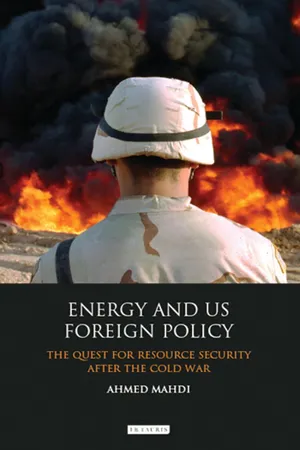
Energy and US Foreign Policy
The Quest for Resource Security After the Cold War
- 256 pages
- English
- ePUB (mobile friendly)
- Available on iOS & Android
eBook - ePub
About this book
The quest for oil can be seen as a defining principle of global US foreign policy, an imperative which has shaped and redefined the practice of American diplomacy, especially in the wake of 9/11, which raised questions about the stability of global oil resources. In "Energy and US Foreign Policy", Ahmed Mahdi relates the military expansion of the world's biggest superpower to its quest to gain guaranteed and secure access to the world's most important commodity. Examining the foreign policy of George Bush Sr., Bill Clinton and George W. Bush, culminating in the unprecedented military campaigns of the latter, Mahdi demonstrates how and why oil has played a central role in US relations with the wider world. By dissecting the failures of the US to secure its own economic and energy interests, and by demonstrating the devastating impact this has had on the rest of the world, especially in the Middle East, Mahdi offers vital analysis for researchers and students of International Relations, Diplomacy, Security and Energy Studies.
Information
CHAPTER 1
FOREIGN ENERGY RESOURCES IN THE POST-COLD WAR DECADE
The Democracy Conundrum, Regional Diversification, and an Ad Hoc Policy on Energy Resources
I put it this way. They got a president of the United States that came out of the oil and gas industry, that knows it and knows it well.
George H. W. Bush, on the eve of his inauguration as President.1
Prosperity at home depends on stability in key regions with which we trade or from which we import critical commodities, such as oil and natural gas.
William J. Clinton, December 1999.2
During his State of the Union speech in February 1989, President George H.W. Bush expressed optimism that ‘we meet at a time of extraordinary hope . . . And it’s a time of great change in the world’.3 Despite this optimism, however, there were authors who thought that the new world was rife with instability. Charles Krauthammer challenged the conventional wisdom which said that the threat of war would decrease after the fall of the Soviet Union,4 arguing that Saddam Hussein’s invasion of Kuwait and plans to develop weapons of mass destruction using his oil wealth were proof that the threat of war was not declining, and that weapons of mass destruction were increasingly a global threat. Moreover, said Krauthammer, Iraq was not the only state seeking weapons of mass destruction; so were Syria, North Korea, Libya and Iran. He argued that the post-cold war era could be called the era of weapons of mass destruction.5 Michael Cox agreed that the end of the cold war made the world more complicated, due to the great shifts in the balance of global power, politically as well as economically, which made it more difficult for policy makers to come up with solutions to global problems.6 Bush himself would say during his State of the Union speech in January 1992: ‘As we seek to build a new world order in the aftermath of the Cold War . . . the enemy we face is . . . instability itself.’7 Moreover, William J. Clinton added during his presidential campaign that the factors which could make the new era a time of peace were the same factors which could make it a time of uncertainty and increased danger.8
On the other hand, the end of the cold war, despite ushering in a more complex world, also ushered in the Age of Globalization, where doors were open for the free movement of US capital, trade, principles and culture. The two American administrations which presided during the post-cold war decade (the George H.W. Bush and William J. Clinton administrations) were similar in that they both pursued a policy of global economic openness. Thus, an American policy of global economic openness replaced the policy of Containment (although, as seen in the writings of William Appleman Williams, Bush and Clinton did not invent openness; they just revived a strategy that predated the cold war by several decades).9
Even though George H.W. Bush failed to come up with a foreign policy ‘vision’ and failed to uphold the New World Order, he did adhere to the patterns identified by William Appleman Williams. Similarly, Clinton’s doctrine of Engagement and Enlargement followed Bush’s footsteps on emphasizing global openness and free trade and investment as prerequisites for prosperity at home, as Bush pushed for NAFTA and APEC, and Clinton continued on this path, again building on Williams’ views. Openness was also a matter of national security, as Larry Summers, Clinton’s Treasury Secretary, argued that trade promoted peace among nations, that the American market was saturated, and that the American economy could not grow without the international market.10
This shows that both Bush and Clinton followed on with a global Open Door imperialism, based on corporatism, or the political economy of the large corporation, or a corporate globalization policy. In both administrations, the US military had a great role in supporting the American policy of openness in regions critical to the strategy of openness, such as the Persian Gulf and Asia-Pacific; as Secretary of Defence William Cohen pointed out, ‘economists and soldiers share the same interest in stability’.11
While Bush and Clinton tried to come up with global doctrines – Bush’s New World Order and Clinton’s Engagement and Enlargement – which promoted American global leadership, a policy of democratization and promotion of market openness, both doctrines failed to promote democracy in the Middle East, due to the Democracy Conundrum, which is the fear that attempts at democratization or political reform would threaten the stability of the pro-American, oil-producing Gulf regimes.12 Another name for this phenomenon is the ‘Arab despotic exception’, where America opposes democracy in the Middle East due to fears over oil supplies, and the fear that anti-American parties might win elections.13 Thus, Bush and Clinton’s strategy of openness did not apply to the Middle East, where Washington’s aim was to maintain the status quo because it feared that attempts to change the region would threaten the flow of oil.14 Also, both had a policy of regional diversification of energy resources away from the Middle East. For example, NAFTA, which gave much attention to North American energy cooperation,15 started in the Bush era, US energy companies started doing business in the Caspian region in 1991,16 and Clinton followed through with this diversification policy.
Also, both initially supported an anti-democratic regime which was vital for America’s oil supplies, which later turned out to be anti-American, as Bush initially supported Saddam Hussein in order to promote the interests of American oil corporations, before the invasion of Kuwait, and urged Iran to stop its anti-American and anti-Iraq behaviour in the region. Similarly, Clinton supported the Taliban, in order to promote the TAP gas pipeline which American corporations were building in the region,17 before the 1998 bombings in Kenya and Tanzania. They both maintained oil sanctions on other rogue states. Thus, both administrations had an ad hoc policy on foreign energy resources. They also both followed what David Painter called the ‘public–private partnership’ in the field of energy, where the US Government promotes and protects the aims of the oil industry, in order to secure America’s national and energy security.
With the end of the cold war, and as George H.W. Bush succeeded Ronald Reagan as President of the United States, Yergin argued that ‘the confrontations of the future would surely become global competitions for money and markets’18:
The competition among nations in the years ahead, some predicted, would no longer be ideological but instead primarily economic . . . If that would be the case, oil as a fuel would certainly remain a vital commodity in the economies of both the industrialized and the developing nations of the world. As a bargaining chip among the producers and consumers of oil, it would also remain of paramount importance in the politics of world power.19
Similarly, Michael Mandelbaum wrote that ‘as security issues lose some of their previous significance, economic questions will assume a new international importance . . . Promoting capitalism, then, is a plausible goal for American foreign policy in the post-Cold War world.’20
A leading author who agreed that conflicts after the cold war were mainly over resources, especially oil, was Michael Klare. He wrote in Resource Wars (2002) that resources were always critical to US foreign policy, but during the cold war their emphasis in US foreign policy diminished as attention to Europe and Asia increased. After the end of the cold war, the issue of resources reassumed their central role in US military planning.21 Among the US objectives after the cold war, ‘none has so profoundly influenced American military policy as the determination to ensure US access to overseas supplies of vital resources’, especially Persian Gulf oil, on which US dependence is growing, and the US presence in the region is dictated by its need to control its oil supplies.22
Due to the importance of energy, a major concern for the George H.W. Bush administration when it took office in 1989 was Persian Gulf security through cooperation with Iraq. Before the Iraqi invasion of Kuwait, the Bush administration remained committed to a policy of engagement with Iraq, as it thought that continued engagement would lead to the moderation of Iraqi behaviour.23 As the Iraqis emerged with the upper hand from the Iraq–Iran war, US policy makers saw Baghdad as a potential ally against Iran. Furthermore, in a show of corporatism, a secret policy review of Iraq was performed shortly after Bush took office, promoting US business interests, saying that Iraq’s ‘vast oil reserves {promised} a lucrative market for US goods’, and adding that US oil imports from Iraq skyrocketed after Iraq began offering American oil companies ‘large incentives’.24 This led to National Security Directive 26, ‘US Policy Toward the Persian Gulf’, dated 2 October 1989. The first paragraph of the directive emphasized the importance of Persian Gulf oil:
Access to Persian Gulf oil and the security of key friendly states in the area are vital to US national security. The United States remains committed to defend its vital interests in the region, if necessary and appropriate through the use of US military force, against the Soviet Union or any other regional power with interests inimical to our own.25
The directive also encouraged normal relations with Saddam Hussein and Iraq, linking Baghdad to the wider issues of the Middle East, such as Arab–Israeli peace, Lebanon, Iran, WMDs and human rights:
Normal relations between the United States and Iraq would serve our longer-term interests and promote stability in both the Gulf and the Middle East. The United States Government should propose economic and political incentives for Iraq to moderate its behaviour and to increase our influence with Iraq. At the same time, the Iraqi leadership must understand that any illegal use of chemical and/or biological weapons will lead to economic and political sanctions . . . Human rights considerations should continue to be an important element in our policy toward Iraq. In addition, Iraq should be urged to cease its meddling in external affairs, such as in Lebanon, and be encouraged to play a constructive role in negotiating a settlement with Iran and cooperate in the Middle East peace process.26
On Iran, NSD 26 recognized the opportunities presented by the death of Ayatollah Khomeini in June 1989, and held out the possibility of normalized relations with Iran if the latter stopped its anti-American behaviour and signed a peace treaty with Iraq:
The United States should continue to be prepared for a normal relationship with Iran on the basis of strict reciprocity. A process of normalization must begin with Iranian action to cease its support for international terrorism and help obtain the release of all American hostages, which will not be a matter for bargaining or blackmail. Other criteria Iran must meet before full normalization of US–Iranian relations include halting its subversive activities and improving relations with its neighbours, making a good faith effort toward a peace treaty with Iraq, and improving its human rights practices.27
However, the document was vague on what US policy would be if Tehran did not change its behaviour. Also, Washington failed to obtain Baghdad’s cooperation on the Arab–Israeli peace process, as Iraqi foreign minister Tariq Aziz refused James Baker’s offer of an aid package of $1.2 billion in return for Iraq’s assistance in Arab–Israeli negotiations.28
Nevertheless, despite the lack of progress on these issues, American business interests in Iraq, especially in the field of energy and reconstruction, were encouraged:
We should pursue, and seek to facilitate, opportunities for US firms to participate in the reconstruction of the Iraqi economy, particularly in the energy area, where they do not conflict with our non-proliferation and other significant objectives.29
Oil was a significant factor in the Bush administration’s relationship with Baghdad. From only 80,000 barrels a day in 1987, US imports of Iraqi oil jumped to 675,000 barrels in 1990, and the figures kept rising rapidly from month to month. By July 1990, it had leapt to 1.1 mbpd – more than a quarter of Iraq’s total oil exports.30 Bush, an old oilman himself (having founded Zapata Offshore Drilling in the 1950s, with James Baker as his lawyer),31 understood the needs and importance of oil considerations, and Baker admitted in his memoirs, The Politics of Diplomacy, that policy toward Iraq was ‘not immune from domestic economic considerations’.32 (‘When you look at NSD 26, you find out that it was th...
Table of contents
- Cover
- Author biography
- Title page
- Copyright page
- Dedication page
- Contents
- Acknowledgements
- Introduction
- 1 Foreign Energy Resources in the Post-Cold War Decade: The Democracy Conundrum, Regional Diversification, and an Ad Hoc Policy on Energy Resources
- 2 The Unilateral Oilman: Energy Procurement in George W. Bush’s Foreign Policy (January–September 2001)
- 3 Anti-Terrorism Melds with Energy Procurement: How the 11 September Attacks Affected the Quest for Foreign Oil
- 4 ‘A Big Shot’ and ‘A Lot of Money’: Operation Iraqi Freedom and US Foreign Energy Policy
- Conclusion: Overstretch, the Decline of Energy Security and the Fall of the American Empire
- Notes
- Bibliography
Trusted by 375,005 students
Access to over 1.5 million titles for a fair monthly price.
Study more efficiently using our study tools.
Frequently asked questions
Yes, you can cancel anytime from the Subscription tab in your account settings on the Perlego website. Your subscription will stay active until the end of your current billing period. Learn how to cancel your subscription
No, books cannot be downloaded as external files, such as PDFs, for use outside of Perlego. However, you can download books within the Perlego app for offline reading on mobile or tablet. Learn how to download books offline
Perlego offers two plans: Essential and Complete
- Essential is ideal for learners and professionals who enjoy exploring a wide range of subjects. Access the Essential Library with 800,000+ trusted titles and best-sellers across business, personal growth, and the humanities. Includes unlimited reading time and Standard Read Aloud voice.
- Complete: Perfect for advanced learners and researchers needing full, unrestricted access. Unlock 1.5M+ books across hundreds of subjects, including academic and specialized titles. The Complete Plan also includes advanced features like Premium Read Aloud and Research Assistant.
We are an online textbook subscription service, where you can get access to an entire online library for less than the price of a single book per month. With over 1.5 million books across 990+ topics, we’ve got you covered! Learn about our mission
Look out for the read-aloud symbol on your next book to see if you can listen to it. The read-aloud tool reads text aloud for you, highlighting the text as it is being read. You can pause it, speed it up and slow it down. Learn more about Read Aloud
Yes! You can use the Perlego app on both iOS and Android devices to read anytime, anywhere — even offline. Perfect for commutes or when you’re on the go.
Please note we cannot support devices running on iOS 13 and Android 7 or earlier. Learn more about using the app
Please note we cannot support devices running on iOS 13 and Android 7 or earlier. Learn more about using the app
Yes, you can access Energy and US Foreign Policy by Ahmed Mahdi in PDF and/or ePUB format, as well as other popular books in Politics & International Relations & Middle Eastern History. We have over 1.5 million books available in our catalogue for you to explore.